Miyazaki Madness, Ecology & God's Environmental Rescue Plan
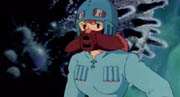
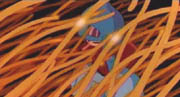
Japanese animation in the 1980s consisted of transformer robots and space fortresses, laser-blasting and high-technology. When the movie Nausicaä came out during that period, Miyazaki was established as a one-man sub-genre. He did not idolise the gleaming metal and glass surfaces of the "mecha" school. Instead, Miyazaki created a post-apocalyptic world of fluttering insects, swarming herds, stampeding Ohmu, hard discarded shells, soft moss, clouds of sand, lush forests, tangled fungi, bristles, drifting spores and spurting fluids; of natural phenomena. A self-organising system which had evolved to clean up the pollution of past human follies but which humans were presently trying to destroy, fearful of things they could not understand.
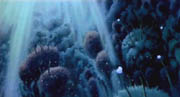 Nausicaä, on the other hand, communicated with the Ohmu, understood the behaviour of the insects and purpose of the advancing forest in cleansing the earth from the technological filth of mankind.
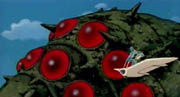
The marvellous thing about Miyazaki's anime is the many threads in each story and commonalities across films:
Said Miyazaki,"I think it better to think of environmental problems in view of "courtesy" proposed by Ryotaro Shiba (1923-1996), a novelist who has written about many distinguished figures in the history of Japan. We need courtesy toward water, mountains, and air in addition to living things. We should not ask courtesy from these things, but we ourselves should give courtesy toward them instead. I do believe the existence of the period when the "power" of forests was much stronger than our power. There is something missing within our attitude toward nature."
Not bad for a card-carrying atheist and one-time communist.

Perhaps an important pre-requisite of communicating with animals and other creatures is to be able to see them first. In "My Neighbour Totoro", there are creatures that only children can see: the makkuro kurosuke or susu-atari (fluffy soot bunnies) who in habit vacant houses and fly away sadly when houses become occupied
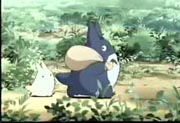
a small sometimes translucent white creature called Chibi Totoro and a larger blue version called Chu Totoro who have a fetish for acorns and a habit of losing them through a rip in their bag
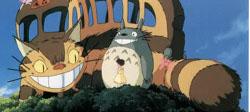
Totoro, a giant shambling forest spirit that looks like a cross between a huge bunny rabbit and a racoon and lives in a camphor tree
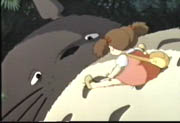
and a cat bus: comfy seats and quick transportation.
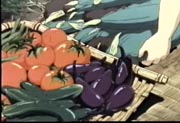
In this movie, the lush fertile countryside is portrayed as a panacea for ill-health, with its fresh air and clean bountiful harvests.
Totoro is given a poker face. Its cheshire cat, Colgate smile is incomprehensible and rigid, no reflection of its thoughts or emotions. Miyazaki decided that Totoro's expression ought not reveal what it is thinking. He wanted to portray someone or something whose existence per se (even without actual interaction with it) has strong meaning or warm feelings for us. "Courtesy", not quite communication.
Miyazaki hoped that instead of staying indoors and watching Totoro every day (once a year is enough! he said), this movie would induce children to enjoy nature, run in available forests and pick up acorns.
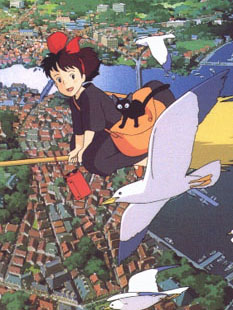
Another young female protagonist who could communicate with animals was Kiki in "Kiki's Delivery Service". As a young witch, she and her black cat were raised together from infancy and so can communicate with each other. Their close bond and intimate relationship comes to a halt when Kiki grows up and becomes independent. She can no longer understand what her cat is saying, hearing only "meow"s.
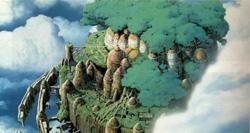
Another type of relationship between mankind and nature is hinted at in "Laputa: Castle in the Sky". Laputa was a highly-advanced civilisation which built and lived on a floating island in the sky. Its reality is later dismissed as mere fantasy, but 2 children eventually find their way to it. When they arrive, it is deserted. It is explained at the end of the show that this technologically-dependent civilisation lived apart from the earth for far too long and so perished.
In "Spirited Away", another young female protagonist is tasked as an employee of a bathhouse to attend to a large disgusting slimeball of something that looks like sewage comes to the bathhouse as a guest.
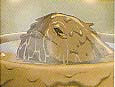
It carries such a stench, squelching through the corridors, that it clears the bathhouse. Yubaba believes at first it must be a stink spirit and assigns new employee Chihiro to help it bathe. It turns out that what had been mistaken for a stink spirit is actually a water spirit altered beyond recognition by human pollution. It was entangled with an incredible array of garbage and discarded metal objects and lost its identity because the real river was filled in for a housing development.
But Miyazaki isn't simplistically against modernisation and technology nor advocating a return to nature without qualification. He has said,"It is not simply a matter of whether technology is good or bad. It is more complicated. In my view, technology is the fate of people in a modern society...I'm not against technology. But you must know how to use it. If I knew how to use it, then I would say, "Why not?" But for me it doesn't seem so easy to manipulate and operate it."
"One of my biggest frustrations is that because I deal with issues of ecology in my films, people automatically want to dismiss me as an 'ecology filmmaker'. But making a film involves testing all of your own values, as well as reflecting the world around you -- and in the world today, I don't believe you can escape addressing these themes. In one way, a film is for escape, but it can't only have that function."
What values should Christians have in relation to nature, ecology, the environment and animals?
********
Miyazaki Madness (Nausicaä of the Valley of the Wind)
Earth in crisis: is this the biggest moral issue we face?
Images from Nausicaa.net and Studio Ghibli.
- the human inability to communicate and have relationship with animals and insects; and
- their inability to understand the environment and so its subsequent degradation, abuse and depletion
Said Miyazaki,"I think it better to think of environmental problems in view of "courtesy" proposed by Ryotaro Shiba (1923-1996), a novelist who has written about many distinguished figures in the history of Japan. We need courtesy toward water, mountains, and air in addition to living things. We should not ask courtesy from these things, but we ourselves should give courtesy toward them instead. I do believe the existence of the period when the "power" of forests was much stronger than our power. There is something missing within our attitude toward nature."
Not bad for a card-carrying atheist and one-time communist.
Miyazaki hoped that instead of staying indoors and watching Totoro every day (once a year is enough! he said), this movie would induce children to enjoy nature, run in available forests and pick up acorns.
In "Spirited Away", another young female protagonist is tasked as an employee of a bathhouse to attend to a large disgusting slimeball of something that looks like sewage comes to the bathhouse as a guest.
It carries such a stench, squelching through the corridors, that it clears the bathhouse. Yubaba believes at first it must be a stink spirit and assigns new employee Chihiro to help it bathe. It turns out that what had been mistaken for a stink spirit is actually a water spirit altered beyond recognition by human pollution. It was entangled with an incredible array of garbage and discarded metal objects and lost its identity because the real river was filled in for a housing development.
But Miyazaki isn't simplistically against modernisation and technology nor advocating a return to nature without qualification. He has said,"It is not simply a matter of whether technology is good or bad. It is more complicated. In my view, technology is the fate of people in a modern society...I'm not against technology. But you must know how to use it. If I knew how to use it, then I would say, "Why not?" But for me it doesn't seem so easy to manipulate and operate it."
"One of my biggest frustrations is that because I deal with issues of ecology in my films, people automatically want to dismiss me as an 'ecology filmmaker'. But making a film involves testing all of your own values, as well as reflecting the world around you -- and in the world today, I don't believe you can escape addressing these themes. In one way, a film is for escape, but it can't only have that function."
What values should Christians have in relation to nature, ecology, the environment and animals?
- Should we place no value at all on nature and eschew all material and physical things as evils of the world?
- Or should we place so much value on nature that we tie ourselves to trees to prevent deforestation, murder animal-killers and destroy companies who test their products on animals?
********
Earth in crisis: is this the biggest moral issue we face?
Images from Nausicaa.net and Studio Ghibli.
Labels: Films, Hayao Miyazaki, Travels: Japan