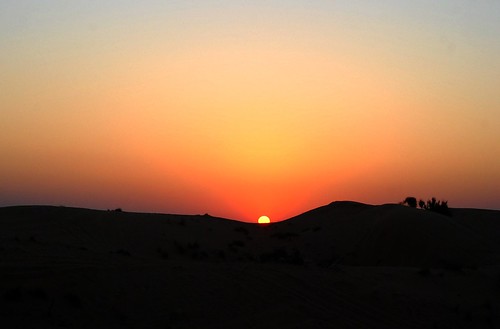
Disneyland in Doha and the Realness of Reality
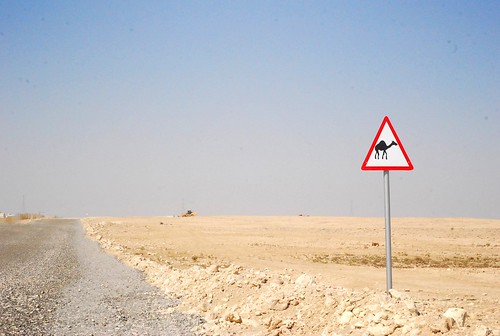
Shortly before keeling over from the halitosis of a dromedary who happened to yawn 100km away.[1]
Reading confident articles by commentators on the Middle East, who make their khubz by writing confident articles professing insights into the mind of Johnny Dishdash. How much is fact? How much is generalisation? How much is conjecture? How much is stereotype? And how much do the locals buy these generalisations, conjectures and stereotypes of outsiders, internalise them and make them, infact, fact?

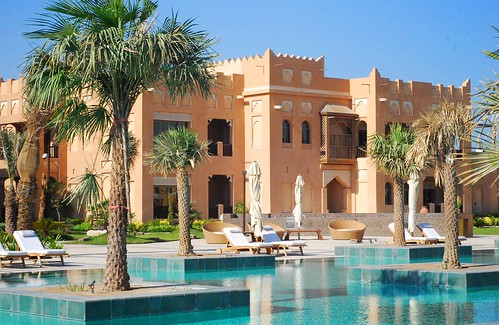
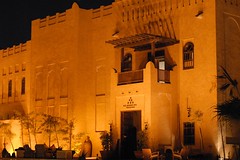
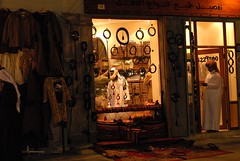
It's as if the copywriter was taking the mickey (mouse).Just as Qatar's pearl divers sought the hidden treasures of the Gulf, the village guides you through a maze of shady souk alleyways to discover precious Arabian tales...
Beyond the giant iron-studded wooden doors and sun-baked, roughly hewn walls lie cool winter courtyards, refreshing waters, ornate arches and candlelit glowing recesses. Underneath wooden ceilings from Zanzibar, the gympsum motifs, colourful mosaics and the stars above, lies a secret walled garden of magic.
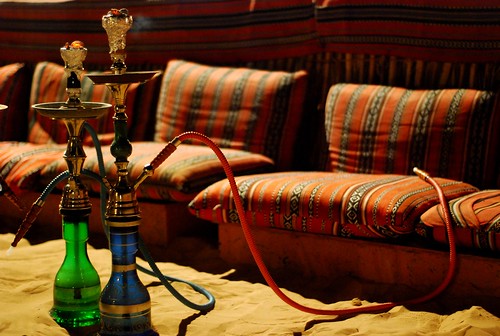
Surrounding this courtyard oasis are cushioned majlis areas, wood-trestle verandas, wood-barred windows and canvas-shaded flat roofs all reflecting a generations-old home life that was designed to provide cooling refuge from the harsh Qatari sun.
As Sharq Village & Spa, each room enjoys the legacy of Qatar's Gulf trade. Omani chests, Iranian lanterns and Indian furniture surround a trader's wooden four-poster bed. Beaten copper, inlaid brass, pebbled glass, worn sandstone and carpeting kilms inform a deeply private Qatari sanctuary.








[1] Blokarting in the desert was cancelled because of the lack of wind and the thick fog pressing down on Doha, which, incidentally, smelled like 1,000 camels indulging in a mass yawn.

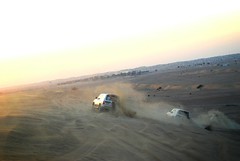
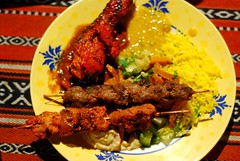
Off for an overnight camp out in the desert. So just a jot-down of swirling half-baked ideas:
It is common to assume that we can live in reality, that we pass our days aware of the state of things as they actually exist. But just how real is that which we assume is reality?
We're fairly confident that the going-ons in Disneyland aren't real. But to a child, Disneyland is a city in which illusion is reality, the archetype of the simulated city. To a child, Disneyland is a place in which the hopes and dreams of an ideal world, where there is peace and unity amongst all peoples, laughter, fun and joy, are realised. We know that the Mickey and Minnie Mouse are merely sweaty teenagers in Mickey and Minnie Mouse suits so we'd diss any one (adult or child) who believes otherwise. But Jean Baudrillard admonishes those who laugh at Disneyland. Disneyland is presented as imaginary, he says, to reassure you that your reality is infact, real.
So how real is the world we think we live in?
Virtual reality, obviously computer-simulated environments, like flight or combat simulations or Second Life represents one not-very-convincing level of reality.
On a slightly more subtle level is simulated reality: the externally-simulated reality experienced by Truman Burbank of a constructed soap opera set, or the solipsistically-simulated reality perceived by some humans in The Wachowski Brothers' The Matrix that is, in actuality, a simulated programme created by intelligent machines in order to pacify and subdue the human population. But authentic reality is easily established by being unplugged from The Matrix or escaping from The Truman Show set through the door marked "Exit"; the assumption of an objective reality.
What Baudrillard finds far more sexy is the idea that there is no such thing as objective reality. Once upon a time, children, simulation was simulation and reality was reality. But now, borrowing from Jorges Luis Borges' metaphor which itself was borrowed from Lewis Carroll, instead of representing the territory, the map has itself become the territory; the reflection in the mirror is now the real. It used to be that the map, the mirror, the representation, the imitation feigned the real but left the real intact. Now, the simulacra precedes the real so that it is now what is real: hyperreality. And in hyperreality, there is an implosion of medium and the real into a hyperreal nebula where Cartesian certainties are outlawed and truth is indecipherable.
Past the unwashed granny bloomers, it is lovely to be reminded to examine our assumed realities. The ever-entertaining, ever-critical Slavoj Žižek asks good questions of ideologies that adduce ultimately inconsistent reasons to support the same goal of political unity, of the role of Hollywood blockbusters in elevating 9/11 to a mythical spectacle and of our lives in an insulated artificial universe. Mary Midgley writes fiercely against the myth of the objectivity and omniscience of science, of the theory of evolution as a religion, of our uncritical acceptance of the flawed research and reductivist thinking that passes of as science as the arbiter of all things.
While it is entirely possible, as time-passing thought experiments, to imagine that we are pure simulations living in a simulated world, and that the people who are simulating us are themselves simulations with recursive simulations within simulation ad infinitum, the fact is that we live our lives as if some things are objective truths. We may not believe the spiel about the sort of diets that are best for us, but we see the need to take in some food and water on a regular basis. We may not be able to express any meaning in life nor profess to any theory about the afterlife, but we still treasure our lives and feed and breathe to keep ourselves alive.
It is not surprising that documentary evidence, though able to demonstrate to a high probability the historicity of Jesus and his ministry, cannot prove without a doubt the facts recorded in the Bible. Because, simply, historical facts cannot be proved like scientific facts. And it is not surprising that scientific research, though able to discover greater and greater intricacies in our universe, cannot ascribe their marvellous design to an intelligent being, much less God. Because if there is a God, a omnipotent, omniscient being, he would be far beyond our own imagination or understanding. Unless of course, he decided to reveal himself to us:
It is common to assume that we can live in reality, that we pass our days aware of the state of things as they actually exist. But just how real is that which we assume is reality?
We're fairly confident that the going-ons in Disneyland aren't real. But to a child, Disneyland is a city in which illusion is reality, the archetype of the simulated city. To a child, Disneyland is a place in which the hopes and dreams of an ideal world, where there is peace and unity amongst all peoples, laughter, fun and joy, are realised. We know that the Mickey and Minnie Mouse are merely sweaty teenagers in Mickey and Minnie Mouse suits so we'd diss any one (adult or child) who believes otherwise. But Jean Baudrillard admonishes those who laugh at Disneyland. Disneyland is presented as imaginary, he says, to reassure you that your reality is infact, real.
So how real is the world we think we live in?
Virtual reality, obviously computer-simulated environments, like flight or combat simulations or Second Life represents one not-very-convincing level of reality.
On a slightly more subtle level is simulated reality: the externally-simulated reality experienced by Truman Burbank of a constructed soap opera set, or the solipsistically-simulated reality perceived by some humans in The Wachowski Brothers' The Matrix that is, in actuality, a simulated programme created by intelligent machines in order to pacify and subdue the human population. But authentic reality is easily established by being unplugged from The Matrix or escaping from The Truman Show set through the door marked "Exit"; the assumption of an objective reality.
What Baudrillard finds far more sexy is the idea that there is no such thing as objective reality. Once upon a time, children, simulation was simulation and reality was reality. But now, borrowing from Jorges Luis Borges' metaphor which itself was borrowed from Lewis Carroll, instead of representing the territory, the map has itself become the territory; the reflection in the mirror is now the real. It used to be that the map, the mirror, the representation, the imitation feigned the real but left the real intact. Now, the simulacra precedes the real so that it is now what is real: hyperreality. And in hyperreality, there is an implosion of medium and the real into a hyperreal nebula where Cartesian certainties are outlawed and truth is indecipherable.
There is no more hope for meaning. And without a doubt this is a good thing: meaning is mortal...This is where the seduction begins.Which is all very sexy. Except for the bit about how Mr. Baudrillard appears to be conveying his ideas to us.
Past the unwashed granny bloomers, it is lovely to be reminded to examine our assumed realities. The ever-entertaining, ever-critical Slavoj Žižek asks good questions of ideologies that adduce ultimately inconsistent reasons to support the same goal of political unity, of the role of Hollywood blockbusters in elevating 9/11 to a mythical spectacle and of our lives in an insulated artificial universe. Mary Midgley writes fiercely against the myth of the objectivity and omniscience of science, of the theory of evolution as a religion, of our uncritical acceptance of the flawed research and reductivist thinking that passes of as science as the arbiter of all things.
While it is entirely possible, as time-passing thought experiments, to imagine that we are pure simulations living in a simulated world, and that the people who are simulating us are themselves simulations with recursive simulations within simulation ad infinitum, the fact is that we live our lives as if some things are objective truths. We may not believe the spiel about the sort of diets that are best for us, but we see the need to take in some food and water on a regular basis. We may not be able to express any meaning in life nor profess to any theory about the afterlife, but we still treasure our lives and feed and breathe to keep ourselves alive.
It is not surprising that documentary evidence, though able to demonstrate to a high probability the historicity of Jesus and his ministry, cannot prove without a doubt the facts recorded in the Bible. Because, simply, historical facts cannot be proved like scientific facts. And it is not surprising that scientific research, though able to discover greater and greater intricacies in our universe, cannot ascribe their marvellous design to an intelligent being, much less God. Because if there is a God, a omnipotent, omniscient being, he would be far beyond our own imagination or understanding. Unless of course, he decided to reveal himself to us:
No one has ever seen God; the only God, who is at the Father’s side, he has made him known. (John 1:18)
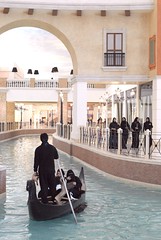
Villaggio, Doha. A mall simulating similarly-styled mall in Las Vegas simulating Venice.
Labels: Art/Architecture/Design, Slavoj Žižek, Travels, Travels: Middle East