Wednesday, July 13, 2011

Jewel Coffee and the Gem of Micah
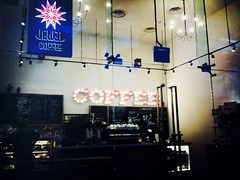
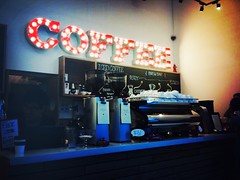
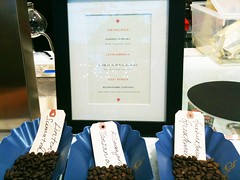
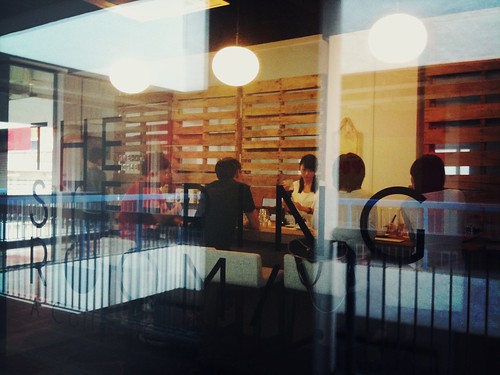
Jewel Coffee, One Shenton Way Coffee in Lights, Jewel Coffee, One Shenton Way
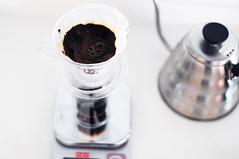
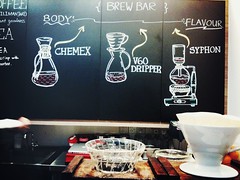
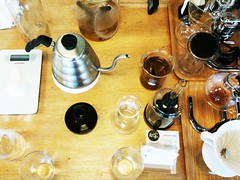
Brew Bar Menu, Jewel Coffee, One Shenton Way Brew Bar, Jewel Coffee, One Shenton Way
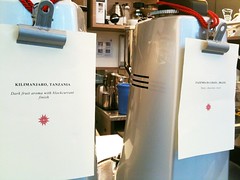
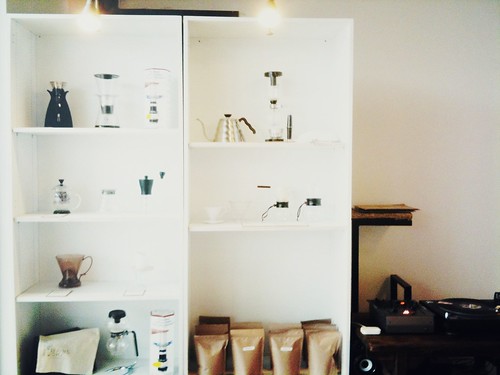
Single Origin Beans, Jewel Coffee, One Shenton Way La Marzocco Strada Manual, Jewel Coffee, One Shenton Way
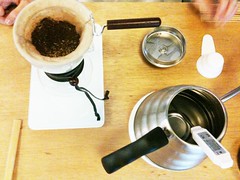
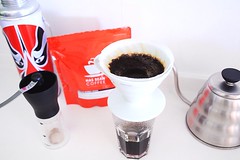
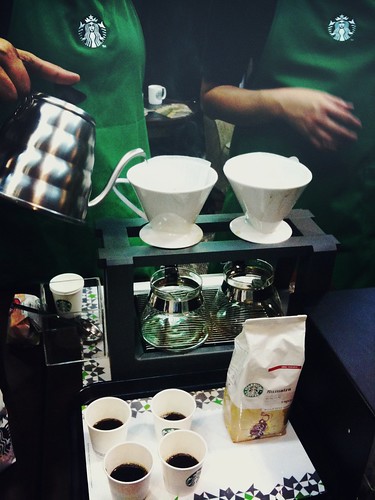
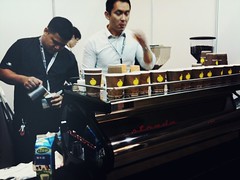
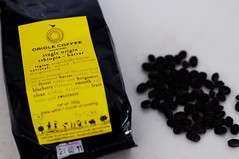
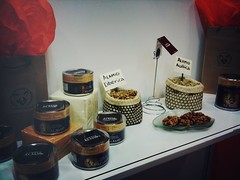
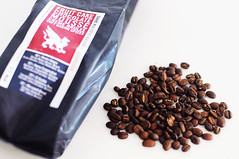
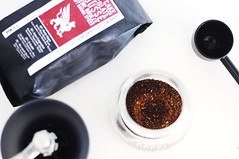
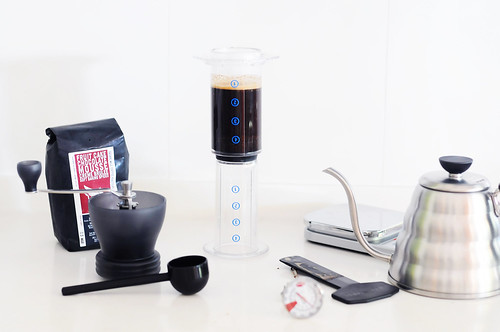
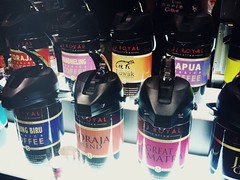
Jewel Coffee at One Shenton Way - another artisan coffee joint but one stuffed with coffee toys for its single origin beans. At the brew bar - Hario V60, Hario Siphon, Chemex; for the espresso crowd - a manual La Marzocco Strada...and an Uber Boiler. Win.

And we're having another go at Micah:

Q: What genre of literature is this?
series of visions?/prophecies with loads of literary devices

Q: How then should we read/interpret Micah?

Q: When did Micah prophesy?
1:1 - in the days of Jotham, Ahaz, Hezekiah - kings of Judah

He was a contemporary of Hosea (Hosea 1:1) and Isaiah (Isaiah 1:1), roughly in 8th century B.C. The reigns of Judean kings: Jotham (about 750–735 B.C.), Ahaz (about 735–715 B.C.) and Hezekiah (about 715–687 B.C.).

Q: To whom did Micah prophesy?
Possibly spoke God's warnings to both Israel (aka Samaria, the northern kingdom) until they went into exile in Assyria, and to Judah (aka Jerusalem, the southern kingdom). Yet, also to the whole world (1:2)

[Q: What is the point of prophesy?]

Q: What was Micah/God's warning?
Impending destruction/judgment from God due to their sin and transgression (1:2-7,12-16).

Q: What is notable about coming destruction/judgment?
The destruction/judgment will fit their crime:
  • they were proud and coveted the fields of others, oppressed them and left them destitute, therefore they too will be oppressed and ruined and they shall have neither land nor people left after God is done with them (2:1-5)
  • their leaders and rulers are themselves the purveyors of injustice and terror and falsehood and greed when the judges should be the ones discerning what is unjust and the rulers be the ones doing what is right. Since they ignored the good of the people, therefore God will no longer answer them so they will no longer be able to discern or understand (3:1-12)
Similar to the "giving over" of Romans?

Q: Micah 6-7 presents the imagery of a court case. What is the charge?
Covenant violation. God reminds them of covenantal obligations and of his own faithfulness to his promises, and in contrast, their flagrant breaches.

Their breaches are not the lack of sacrifices but their disobedience - not doing justice, nor loving kindness nor walking humbly before their God (6:8). They had already been given prior notice of these requirements. Instead they indulged in injustice, violence and deceit.

Q: What was the judgment and punishment?
Guilty. Since they did not honour the giver of the covenant, they would not be able to enjoy the good land that God had given them - neither the fruit of the land, nor the relationships with each other (6:13-7:6).

Q: Why weren't the people given due warning of impending disaster through usual channels?
Preachers were false (1:6)
People wanted falsehood (1:11)

Q: What emotion does God demonstrate as he warns the people through Micah?
1:8-9

Q: What does this tell you about God?

Q: In line with such a marvellous character, what further promises does God give?
Reversal and fulfilment (4-5, 7:8-20). God will do a deep clean (5:10-15). New land, new people, new king.

Q: In contrast with current situation, what would future hold?
God's laws would be learnt, there would be justice and peace.

Q: How would promising promised future happen?
Shepherd ruler will gather, protect, forgive

Q: How does God sign off so the people would know that God was trustworthy?
Reminder that he had been concerned for the Israelites since the time of Moses and that did what he said he would at the Exodus.

In Jeremiah 26:18, the elders of the land observe the influence of Micah's words on Hezekiah (cf Micah 3:12). Yet we know that this didn't last long and Judah was carted off by the Babylonians.

Q: Has promised future occurred?

Q: Now how?


Labels: ,

Monday, May 16, 2011

I Shall Wear the Bottom of My Trousers Rolled

A cup of Papua New Guinea Sigri Peaberry, The Steeping Room
The Steeping Room
Fun times at The Steeping Room, a pop-up shop with a lifespan of only 3 months, from the same folk who brought us Papa Palheta and Loysel's Toy. Reminiscent of Square Mile Coffee Roasters' Penny University. Fantastic initiative and, to use politico-speak, where the ground is heading. (Or is the ground being led there?)
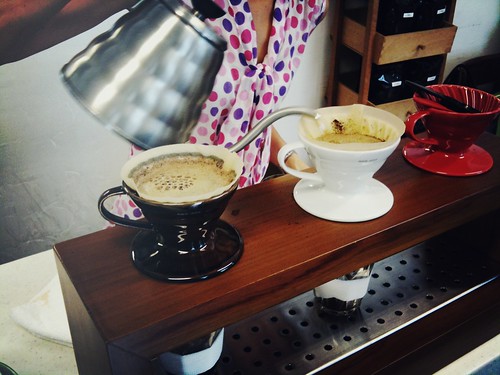

Like much art and theory, the methodology isn't new - the nonchalant Kenyan AA in a syphon has hung around The Coffee Connoiseur for some time and the Hario Buono Kettle, V60 drip filters and Skerton and Slim Mill grinders have been offered by Japanese department stores for ages.
But this is now gathering enough support (and coolness?) to be termed "a movement", with attendant evangelistic guerilla shop set up on the second floor of the 261 Waterloo Street HDB block, two floors down from farm.sg and a stone's throw from Food For Thought, with wooden pallets as wall decor and Pyrex Iwaki beakers as beverage vessels.

Shelves of Exhibits/Wares, The Steeping Room
Despite oozing such coolness that even ah-peks think I'm far less hip than them (plus the uncle from the "Famous Waterloo Street" chicken rice downstairs was so pained by my lousy Mandarin, he felt it necessary to hold up the queue to correct it), I've managed to acquire almost half the equipment on display during the continuing quest for the most decent cup of homebrew (early and late March, April*).

The Steeping Room Menu, The Steeping Room
The current menu for May was interesting enough: Papua New Guinea Sigri Peaberry served in the Hario V60 or Hario Woodneck cloth drip, Ibero El Salvador Pacamara in the Aerobie Aeropress, Ethiopia Yirgacheffe in the Hario Syphon and for The Steeping Series, the PNG Sigri Peaberry and Ethiopian Yirgacheffe paired with dark and milk Royce nama chocolates. Lovely. No espresso-based drinks or milk additives here - just coffee in its glory.

Leon Foo explaining coffee, The Steeping Room The Steeping Room
Still, the highlight of the visit was to be able to lean over and have a grand old yabber with the baristas about failed home experiments, 13g-14g for the Aerobie Aeropress) vs 23g (! aiyoh!), "circular pour with agitation", Geishas, etc without so much as a puzzled blink from across the counter.

The Bench at The Steeping Room Papua New Guinea Sigri Peaberry, Hario Woodneck, The Steeping Room
It seemed to me, as we were debating the historicity of Jesus' resurrection at Christianity Explored today, that there are great similarities between coffeegeekery and Christian evangelism - you've discovered something great and it's so marvellous that you want to share the good news with everyone! Yet, being obsessed about coffee makes one an interesting person but being passionate about the God who made this wonderful world makes you a scary fundamentalist; gabbing on about beans and showing people that "coffee can be sweet, floral, fruity and nutty" is very exciting but talking about Jesus who died in our place for the sins we committed and showing people the goodness of God's laws just results in complaints that we are infringing on the rights of others.

Yet exploring the coffee bean is so much much less important than exploring the meaning to life, the reason we have been put on earth, who made the entire universe, who rules it, and where we will go when we die.


*
Hasbean's Malawi Mzimba Geisha coffee in the Hario V60-02 for Election Day
My most recent experiments involving Has Bean's Malawi Mzimba Geisha 2011 + Hario V60 have been fantastic for the princely sum of £4.30. It's not that geisha from Hacienda La Esmerelda in Panama, but the fallout radius was still at least 10m from the epicenter of the mid-afternoon brew in the office pantry. Much less swooning with Has Bean's Malawi Viphya Geisha 2011 though.

Here's Stephen Leighton's write-up:
Grown in the Viphya North Hills on the grassland plateau overlooking Lake Malawi, this micro lot is of the Geisha varietal. Geisha is an ancient and very rare coffee variety that has gained a lot of favour of late. The agronomic yield of Geisha is extremely low, which is why it is so difficult to find commercial plantations of this variety. One of the reasons for its new found popularity is an auction lot that fetched a huge premium. In fact it was the most expensive coffee ever, which in some areas led to a huge rush to rip out perfectly good plant stock and replace it with a varietal that tends only to work at a higher altitude and in perfect growing conditions.

The good news about the Mzimba Geisha Micro Lot is that it has been growing in this location for a very long time at an altitude of 1600m above sea level upwards, and it's great tasting. This coffee is so similar to the Mssese I have tried to find out more about why it is so close and if it's a co op name change.

In the cup expect the super creamy mouth-feel and clarity that you would expect from a great washed African coffee. This is then backed up by a delicious tropical fruit that zaps your mouth with pineapple, apricot and all sorts of summer fruits. Great mouth-feel.

Labels:

Monday, April 04, 2011

The Hario V60 Trials and Stewardship of Time

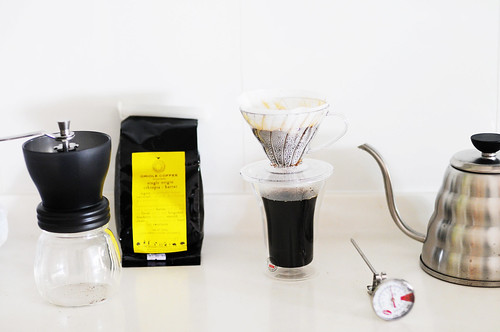
Oriole Coffee Roasters' Ethiopian Harrar + Hario V60 + Hario Buono drip kettle
Assume only one brewing device: the single-cup Hario V60 - 01.
Assume a similar grind: dialing in at 3 notches from zero on the Hario Skerton.
Assume also a dose of 23g of the same beans (but no two beans are the same!).
Assume even a water temperature of 93 degrees celcius.

There are still too many factors to vary in search of the perfect cup:

Brew Ratio
The market norm is said to be 60g coffee for 1l water. But everyone has their sure-hit ratio. Plus this is probably dependent also on actual grind size of beans, type and roast profile of beans, maybe even composition of water, etc etc
- Stumptown Coffee: 23g with 11oz water for 8oz coffee
- Counter Culture: 1.6 - 2g per 1oz water
- Brown Coffee Co: 18g; 11 fl oz of water at 204F to yield 10 fl oz (via bitterpress)
- Taylor St Baristas: 23g with 320ml water
- Trevor Hyman (Bean Vagrant): 29g with 500g water

Boiling the water
To boil water in the Hario Buono drip kettle or not?
Filter water or tap?

Pre-wetting
To pre-wet or not? Theoretical grounds (haha) for pre-wetting include allowing the carbon dioxide trapped within the beans during roasting to be released, ensuring even extraction of the grounds

Circular pour vs center pour
Raised (though not high and dry) most famously in Scott Rao's "Everything But Espressp". See Matthew P Williams' post for a re-think.

You know that this is an all-important topic when Hitler gets emo about it.

To allow all the water to drip through or to stop near the end? If so, when to stop the flow?

Oriole Coffee Roasters' Ethiopian Harrar + Hario V60
Bean: Ethiopian Harrar, Oriole Coffee Roasters
Time from roast: 5 days
Grind: 2+ notches from zero on the Hario Skerton
Brew Ratio: 23g to 11 fluid oz
Water Temperature: 93 degrees celcius
Pre-wetting: yes (but didn't record how much water was used or whether allowed bloom to subside)
Pour: circular
Drip-through: yes, all the way to the last drop
Taste: floral but sour on finish when cold

Oriole Coffee Roasters' Ethiopian Harrar + Hario V60 Oriole Coffee Roasters' Ethiopian Harrar
Bean: Ethiopian Harrar, Oriole Coffee Roasters
Time from roast: 6 days
Grind: 3+ notches from zero on the Hario Skerton
Brew Ratio: 23g to 8 fluid oz
Water Temperature: 93 degrees celcius
Pre-wetting: yes (but didn't record how much water was used or whether allowed bloom to subside)
Pour: circular
Drip-through: no
Taste: floral, lovely even when cold but somewhat bitter when added to milk!

mojotogo
But such record-keeping is hardly accurate. What about the percentage of extraction and total dissolved solids via extractmojo or mojotogo + refractometer? Will these numbers necessarily give a good cup?

Drink Your Words coffee journal
And since the smelevision and tastovision has yet to be invented, words are the only means of recording taste, perhaps via coffee journals like 33 Coffees or drinkyourwords.

Still, exciting stuff!

The attempt at keeping records of these little variables and examining how small things affect the end product, has made me curious about my stewardship of time. So i've had a go at listing the goings-on of the past week.

On one hand, it is useful to keep close accounts of resources gifted to one by God (still alive = gift of time) so as to be considered about the spending of such resources, and additionally in my case, to ensure i stop double-booking the same time slots.

However, there is the danger that is somewhat similar to the danger of census-taking (especially wrt the Old Testament), and also the danger of doing this all for the sake of ticking off the to-do list and being smug and self-congratulatory about all this activity (or v.v.).

So, just a once-off snapshot for future reference (to satisfy own idle curiosity in future about how 2011 went by in a flash):

Seafood Paella, My Spanish Place
Sunday
journey to church: stoned
morning: Sunday School on Genesis, breakfast, service
afternoon: lunch, 121 on John, wandered around Little India + salty fruit juice
evening: old friend's birthday dinner
journey home: slept

German sausage and rosti, Marche Peanut ice-kachang, Tiong Bahru Food Centre
Monday
journey to work: slept
lunch: met ex-colleague to talk about surreal experience in Japan and meaninglessness of old life
dinner: 121 on Ezra and Nehemiah
journey home: slept

Tuesday
journey to work: caught up on emails
lunch: colleague and her "lousy life"
dinner: "One-to-one" training with Sophie Peace (Sophie de Witt) and 3 others
journey home: discussed training for bible study leaders and how to encourage pastor
night: messed around with HTML for youth camp blog

Flat White, Highlander Coffee Flat White, Nutella Cupcake, Black Coffee at TripleOne Somerset
Wednesday
journey to work: caught up on SMSes, Mark Ashton's "Christian Youth Work"
lunch: Mark Ashton's "Christian Youth Work"
dinner: discussed local politics and how best to help work in Malaysian church
journey home: tried to sort out bible study group for SAHM
night: played around with Khan Academy stuff to see if pedagogy will be useful for teaching the Word, read Tim Hawkins' "Disciples Who Will Last"

Thursday
journey to work: read Judges 6-8
lunch: prepared bible study on Judges, laughed through Dale Ralph Davis' commentary on Judges 6 - 8
("Sunday School Hero" Gideon was a character right out of Monty Python - especially Sir Robin the Chicken-hearted, except funnier! But like the whittling down of the army to 300, this shows it is God who saves rather than the hunk.)
dinner: Tim Hawkins' "Disciples Who Will Last", bible study on Judges
journey home: slept
night: prepared Sunday School material

Friday
journey to work: prepared material for meeting young adult
lunch: met young adult + friend to discuss priorities in Christian life
(Chuffed that they laid out their Bibles on the table in the expectation that we would be relying on God's word for answers, not on me!)
evening: worked late while listening to Sonicflood and Charlie Skrine on Judges 6 "Fearful Deliverer" at St. Helen's Bishopsgate
journey home: worked on getting three-stars for all levels on Angry Birds Rio

Vietnamese Valrhona chocolate tart
Saturday
morning: baked tarts for meet-up
late morning and lunch: met-up with SAHM
journey to the East: re-read Exodus and Andrew Sach and Richard Alldritt's "Dig Even Deeper"
Man possessed by Monkey God, Joo Chiat Road Joo Chiat Road
afternoon: witnessed a man allegedly possessed by the spirit of the monkey god blessing the opening of a new shop, watched what we thought was a silat dance that later appeared to be a possession/exorcism thing? along Joo Chiat Road, pho at Long Phuong + discussion on spirits + study on Exodus (Fascinating details about the tabernacle - what references to the Garden of Eden!)
evening: a refreshing pint and chat with the bartend at The Cider Pit (by East of Avalon Wines) - a yummy Westons Vintage Organic Still Cider on draught (but it's flat, bitter and like chou dou fu, said the disbelieving bartender), groceries at Parkway Parade
journey home: slept
night: cooked dinner for family, prepared Sunday School material

Hong Kong Cafe + John 3
Sunday
journey to church: prepared 121 on John 3
morning: Sunday School on Genesis (we had a good laugh at Laban's household gods which had been sat on by Rachel), breakfast, Christianity Explored course
lunch: de-briefing on women's ministry event, planning for next event
afternoon: 121 on John 3 + good long chat about sin in the Christian life
dinner: with family
night: spent quality time with B. Taylor and J.S. Bach + Violin Concerto to give vent to pent-up music, wrote this post

Obviously more concerted effort needs to be made to make full use of time - need to carve out time for exercise before turning completely into a lard-ball and for keeping up with current affairs and to some extent, pop culture so my references aren't too obsolete to be of much use in explanations, but being aware of how time is spent is useful step in hopefully the right direction...

Labels:

Sunday, March 27, 2011

An Ethiopian, a Palm Civet Cat and a Judge Walk into a Brew Bar...

It is a funny feeling to come upon one's preferences quite suddenly, as if simultaneously running into an old friend around a street corner and identifying him for the first time.

At first cupping, the Ethiopian Djimmah stood head and shoulders above a rather earthy Sumatran Madheling and dependable Brazilian Santos although the Japanese neighbour preferred the Sumatran.

Then at Tea & Coffee World Cup Singapore 2011 (Singapore's Suntec Convention Centre), while others had photos taken with towering shiny Probat roasters and coffee industry stars, I stood gobsmacked at this sight:
Starbucks, Tribute Blend + Hario Buono Drip Kettle + Melitta Filter Holder, Tea & Coffee World Cup Singapore 2011
It shouldn't have come as too much of a surprise since Howard Schultz's re-education (or good marketing story) and the company's monopoly on Clover machines has already been widely reported. The Starbucks booth, fooling no one with their new nameless logos, was serving a mix of "aged Sumatran" and "sun-dried Ethiopian" in their 40th Anniversary Tribute Blend - note ubiquitous (and very useful until someone manufactures something better) Hario Buono drip kettle, Melitta single-serve drip filter holders on a rack (the Marina Square branch was selling the filter holders for S$8.90). Somewhat fragrant, safe and clean, just not terribly attention-retaining.

La Marzocco Strada, Oriole Coffee Roasters, Tea & Coffee World Cup Singapore 2011 Flat White with Ethiopian Sidamo espresso base, Tea & Coffee World Cup Singapore 2011
What left a very long and pleasant after-taste that compelled me to look for more of the same the next day, was the Ethiopian Sidamo offered by Oriole Coffee Roasters just across from the Starbucks booth.They'd put the beans in their spanking new La Marzocco Strada (Singapore's first say some), despite crowd-opinion about putting Ethiopians only in filters and siphons, and what a good call - in an espresso, the florals and citrus were squeezed into a nice round body. The obvious sweetness of the coffee juice was different from the sweetness of steamed milk, so when paired with dairy, the drink teetered on the edge of too-much-of-two-good-things. Still, a lovely cup. There are no plans to serve the Sidamo on the machine at the Oriole Cafe & Bar for now...if only we had the taste/olfactory equivalent of a snapshot of this one-off.

(We realised later that Romeo Alfen might have been practising for the finals of the Singapore National Barista Championships 2011. The next day, he based his routine on that very same single origin, 80% roasted to half-city on the Diedrich and the rest roasted full-city, rested for 10 days.)(Ryan Kieran Tan of Papa Palheta eventually swept the top prize for both the Greenfields Latte Art Challenge as well as the Singapore National Barista Championships.)

Ethiopia Harrar, Oriole Coffee Roasters Ethiopia Harrar from Oriole Coffee Roasters + Hario V60 drip + Hario Buono drip kettle
Ethiopia Harrar from Oriole Coffee Roasters + Hario Skerton grinder + Hario V60 drip + Hario Buono drip kettle
Since there weren't any packs of the Sidamo to be had from Oriole Coffee Roasters, settled for an Ethiopian Harrar instead from the Yirgacheffe (and?) Harrar region. It was a mixed heirloom varietal, dry-processed. Oriole's tasting notes enthused about floral notes and bergamot, blueberry flavours, smooth and clean acidity, balance of fruit notes and sweetness. Ethiopia heirloom varietals from the wild forests are said to resemble the typicas from Yemen which were brought to Indonesia and later Latin America. Stumptown Coffee Roasters say that heirlooms produce some of the most coveted flavours in the world that, ranging from floral (jasmine in particular), to sweetly citric (distinct lemon), to chocolate, to Assam tea, and to wild berries. This bag from Oriole had a lovely floral aftertaste 5 days from roasting - coffee breath begone! and was exceptionally good with buttery Danish biscuits.

Brew method: Hario V60
Grind size: between 2-3 notches from zero on the Hario Skerton
Dose weight: 13g
Brew water temperature: 93 degrees celcius
Brew water weight: 161g
Time from roast: 5 days

Papa Palheta Specialty Coffee, Hooper Road Papa Palheta Specialty Coffee, Hooper Road
Papa Palheta Specialty Coffee, Hooper Road
The Ethiopian Yirgacheffe from Papa Palheta, wet processed, city to full-city roast, S$15.00 for 250g. Papa P's tasting notes described cane sugar sweetness with honey and floral flavours.

Brew method: Hario V60 drip filter pourover
Dose weight: 13g
Brew water weight: whatever it takes to fill the glass
Brew water temperature: 93 degrees celcius

Yirgacheffe is grown around the town of Yirgacheffe in the middle of Sidamo at around 1800-2000 meter altitude (on average). Yirgacheffe is wet processed and generally known for giving a clean cup with powerful floral and fruit notes. Some have described a good cup as "beginning with sublime aromas of sweet sugary honey and hints of cedar and raisin, it is then followed by a well balanced floral acidity in the cup. The flavours are very up front and straight away there is berry, citrus and soft cocoa with a subtle underlining of Mediterranean herbs. These flavours are on the bright side but they bring a well toned smoothness and medium body to the pallet, and as the cup cools the aromatic herbs come to the forefront."

Ethiopia is known more generally for its famines and internal strife (and attendant distasteful jokes) than the quality of its coffee. But the internets point to Ethiopia as the birthplace of coffee, the Motherland of the Arabica Bean, the Motherlode of Black Gold. It is the currently the seventh largest producer in the world, with tens of thousands of farms gardens in the regions of Harar, Sidamo, Yirgacheffe, Limmu and Djimmah. Several hundred thousands of heirloom varietals also grow indigenously and abundantly in the wild forests of the country. ("Wild forests" may not mean wild forests, really.)

Sadly, little can be known about this treasure trove of beans because of the centralisation of all coffee exports through the Ethiopia Commodity Exchange (ECX) in 2008. Lots are thrown together and thus anonymised upon arrival at the ECX so accurate information of the precise traceability of coffees is impossible to be had. The pooled beans would also obviously be rather hit-and-miss, the only identifier being the region and not a specific farm or altitude or varietal. Cupping then is very important to separate the wheat from the chaff. Cup quality from bags labelled, for example, "Yirgacheffe", might vary wildly.

Last year however, the ECX set up the Ethiopian Direct Specialty Trade (DST) auction which allowed smaller lots to be auctioned off, erm, directly. Read Tim (Counter Culture)'s report here, Stephen Vick's report here, Max Nicholas-Fulmer's account here. Doesn't seem too different from Willem Boot's ECAFE Foundation from 2005, except that the government gets a cut - in 1998, all coffee had to be sold through a handful of government-sanctioned exporters. Later, at the end of decades of communist rule and civil strife, unions were organised by farmers and these by-passed the government system.

Several American specialty coffee have managed to go to source for cupping and a look-around:
Counter Culture
Sweet Maria
Daniel Humphries
Stumptown Coffee Roasters
David Pohl for Equator Coffees & Teas
Get me on the Ethiopian Cupping Caravan already.

God in a Cup
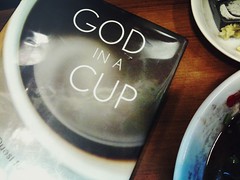
But they could not bring the beans out with them. Ethiopian coffee is hard work not only because of the roadblock that is the ECX, but getting coffee physically out of the country is in itself an issue. Michaele Weismann's God In A Cup from 2008 reports of several roasters asking Menno Simons of Trabocca BV, a sourcer of organic coffees in Africa, for their beans. The late shipments were not his fault - coffee export defaulting continued to be an issue in 2010. And there was the bizarre disappearance of 9 million kilogrammes of coffee on route for export.

Because we live at a time when it's not even politically-correct to speak of the white man's burden, though any discussion concerning a developing country's exports necessarily requires ethical-soothers for importers in developed countries - the campaigns behind headings like "How can Ethiopia's coffee farmers get more from your £2 latte?" appeal to such tender social consciences. But the issue with this, as with all other foreign intervention, is whether such programmes really work. In Weismann's book, Peter Giuliano explained that when the coffee unions got coffees certified as organic and Fair Trade, big money started pouring in. But corruption and mismanagement was not far behind and farmers were not paid for their crop despite co-operatives being paid. Fair trade has also been accused of forcing farmers into co-operatives, requiring them to borrow money to pay certification fees, and basically failing to understand cultural or country-specific realities. Hopefully, this will not be on the scale of the boo-boos of the Green Revolution which led to deforestation in Africa. The good thing about Fair Trade though is that they provide a safety net on falling prices.

With Ethiopia, there is also the usual suspicion of the activity of large multinationals, specifically, Starbucks opposing Ethiopia's attempt to trademark geographical indicators Sidamo and Harar. I'd like some further questions to be asked - why trademark rather than certificate of origin? Who exactly will be the trademark owner - Meles Zenawi? Does this mean that if farmers from Sidamo or Harar sell their crop directly to specialty coffee roasters, they cannot imprint the regional appellation without paying the trademark owner?

Perhaps direct trade, a la Intelligentsia, might be the way forward?

JJ Royal Indonesian Coffee, Tea & Coffee World Cup Singapore 2011 Coffee Alamid, Tea & Coffee World Cup Singapore 2011
In the eyes of the, erm, tongue, the civet cat poo coffees have now been knocked down to second place by the Ethiopians. But I still sought them out. Previously, I'd gotten my fix of cà phê Chồn during regular visits to Ho Chi Minh City (where there were rumours that hydrogen chloride was used instead of the digestive tract of relatives of the mongoose). At Tea & Coffee World Cup Singapore 2011, JJ Royal offered brewed kopi luwak from flasks - a good way to showcase its unique flavour and didn't leave room for error for the in-house barista. Bote Central's coffee alamid booth from Philippines pulled a rather harsh espresso on my turn so although the aroma of the bean was in present, the cup itself wasn't terribly pleasant which was a pity.

All contemporary coffee conversations appear to revolve around the variables that make up a good cup (there are also conversations about post-postmodernism, critical theory and the objectivity of a quality brew). Other than the bean itself - its varietal, the region and altitude at which it was grown, the influence of the weather and soil on its growth etc, there's also how the bean is processed - the washing and drying and milling and storage,

Probat, Tea & Coffee World Cup  Singapore 2011
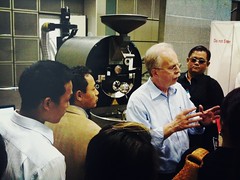
Probat roasting workshop, because everyone's a micro-roaster
then the roasting - from light, cinnamon to full city to continental to, oops, charcoal,

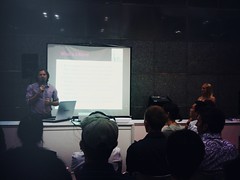
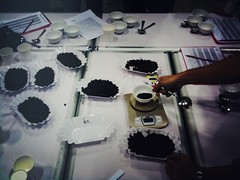
Cupping and Blending Workshop, Wolff Coffee Roasters, Tea & Coffee World Cup Singapore 2011 Cupping and Blending Workshop by Peter and Penny Wolff, Tea & Coffee World Cup Singapore 2011
Peter and Penny Wolff from Wolff Coffee Roasters conducting the blending workshop
then, if not serving single estate or single origin, there's the blending of the beans. (The green beans can also blended before roasting.)

Winter Espresso 2010/2011, Square Mile Coffee Roasters Hario Skerton 2-turns-from-zero Grind, Winter Espresso 2010/2011, Square Mile Coffee Roasters
Hario Skerton Grinder + Aeropress + Winter Espresso 2010/2011, Square Mile Coffee Roasters + Hario Buono Drip Kettle
Square Mile Coffee Roasters' Winter Espresso + Hario Skerton grinder + Hario Buono drip kettle + Aeropress
It was really interesting to taste how the Ethiopian Yirgacheffe (albeit an identifiable from the Hama Cooperative in Kocherie) hung out with the Monte Alegre from Sul de Minas Gerais in Brazil, the El Guabo from San Ignacio, Cajamarca, Peru and random micromill blend from Tarrazu, Costa Rica in Square Mile Coffee Roasters' Winter Espresso blend.

Highlander Coffee Mypressi Twist + Highlander Coffee Supremo Blend
Highlander Coffee's Supremo blend on the machine at 49 Kampong Bahru Road vs on the mypressi TWIST at home
Served single origin or in a blend, the coffee must then be extracted by different methods (drip, siphon, Aeropress, espresso machine etc). The grind of the bean, the water temperature, the water to coffee ratio, extraction yield, total dissolved solids, pressure profiling (for espresso) etc all contribute to the characteristics of the drink.

MoJotoGo - Coffee Lite
So of course there is an iPhone app for this - MoJotoGo - even the Coffee Lite version has been useful.

Latte, Soho7 Cafe & Bistro, 36 Armenian Street
Soho 7 Cafe & Bistro, 36 Armenian Street, along Loke Yew Street
Then, there is the skill of the barista, especially where coupling with dairy is involved. The same National Heritage blend, not more than three days old, also accompanied by the Best Ever Burger at SoHo7 Cafe & Bistro,
Best Ever Burger, Soho7 Cafe & Bistro, 36 Armenian Street
was delicious in a latte made by Swee Sim, a vast difference from the previous "flat white" by a different person.

Great progress has been made in articulating what can be known about coffee, yet there there is still so much more to understand which National Geographic et al cannot hope to plumb the depths of (and it is merely one in millions of plants in the world). This is nothing compared to the wonder of God working in the Book of Judges, but without fair trade or direct trade considerations. Afterall, one would expect the God who made the coffea family, to do even more amazing things with his people.

The details of his various rescues of the people of Israel are far more fascinating than the refractometer readings of a good cup of the mythical Hacienda La Esmeralda Special. So far, we've had Ehud the leftie with a two-edged dagger in the hideously fat Eglon's roof chamber, Shamgar with an ox-goad, and Jael the non-Israelite woman with a tent-peg in her own tent (read Judges 3 - 5 - absolutely riverting).

People have tried to apply these accounts by saying that lack of gifting in some area should not dissuade one from serving in that area. This seems a nonsense since (1) elsewhere we are told that God gives us all unique ways of serving the body (so an eye should not wish to be a thumb when it is obviously an instrument of sight), and (2) this is really about the glory going to no one but God - whereas hunky heroes and the latest in iron chariot technology would induce little more than neighbour envy and self-improvement workshops, salvation via such random judges can mean that only God is at work. This looked forward to the day a son of a carpenter (though not fathered by him) would wrought a rescue to end all rescues with no other weapon but his own perfect obedience and his life blood.

Will we trust and obey him? Or will we, like the stubborn Israelites call God's judgement upon ourselves?

Winter Espresso 2010/2011, Square Mile Coffee Roasters and its friends
(Another surprising discovery: whereas the previous assumption was that I was immune to the effects of caffeine, it appears now that coffee has a soporific effect. After ten espressos/espresso-based drinks, the struggle to keep awake is almost overwhelming. Apparently, this is common amongst ADD/ADHD folk and caffeine has in fact been recommended by everyoneisanexpertontheinternet as an alternative to Ritalin. So much for the efficacy of that morning cup.

Angry Birds Seasons - St. Patrick's Day Angry Birds Seasons - St. Patrick's Day
Angry Birds - Ham 'Em High Angry Birds - Ham 'Em High
Angry Birds Rio Angry Birds Rio
Angry Birds - Seasons: St Patrick's Day, Ham 'Em High, Rio (love the programming of the monkeys)
Video/computer/iPhone games are supposed to have the same effect. Haha...wheeeeeeeeeee!)

Labels: