Sunday, December 20, 2009

Churlish Christmas Cookies and Celebrating Christmas

Christmas Cookie Depiction of The Fall (Genesis 3)
Christmas cookie baking with Karl Richter is always a FAIL

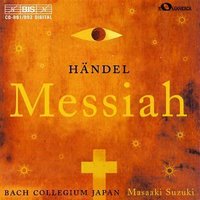
The time came for the Christmas cookies to be baked, and they were baked to Karl Richter's Handel's Messiah, because there was no Masaaki Suzuki in the music stash.

But the burnt and leprosy-ridden butter snowflakes and head-losing gingerbread people were depictions of the real reason for celebrating Christmas.

rediscover christmas
Jordan (from Jordan), who is wintering hereabouts following an unfortunate accident, says: discover Christ, rediscover Christmas.

Even discounting the gift-giving red-and-white Santa/St. Nicholas popularised by Cocoa-Cola, the real spirit of Christmas isn't ultimately about cultivating a mindset of peace and goodwill to all, love for one's fellowmen and generous hospitality featuring family-togetherness, good friends, roasts and spuds, mixed fruit desserts, mulled wine with cinnamon stick stirrers, consumed in the midst of a heavy cloud of citrus studded with cloves; it is celebrating the birth of the man who did not come to bring peace on earth but a sword, who divided families (Matthew 10:34-36), who demanded absolutely everything (including their very lives) from his followers (Matthew 10:37-39), who condemned those who did not acknowledge him as Messiah and Christ.

Which is why Handel's Messiah isn't all Hallelujah chorus without context - the rejoicing in that popular Christmas chorus is actually in reaction to God's final and terrible judgement on those who do not worship his Son as Lord and Saviour*.

Handel's Messiah was originally written for Easter but surely any Easter song is interchangeable for a Christmas one because any celebration of Jesus' birth must encompass his antagonistic claims that all of history has been awaiting his birth, his exclusivist insistence that salvation from the fallen-ness of this world and its ultimate destruction comes solely through him, his shameful crucifixion, his lonely death and his triumphant resurrection.

Christians can celebrate Christmas because they alone can sing Part Three of Handel's Messiah:
I know that my Redeemer liveth, and that he shall stand at the latter day upon the earth. And though worms destroy this body, yet in my flesh shall I see God. (Job 19 : 25-26)
For now is Christ risen from the dead, the first fruits of them that sleep. (I Corinthians 15 : 20)

Since by man came death, by man came also the resurrection of the dead. For as in Adam all die, even so in Christ shall all be made alive. (I Corinthians 15 : 21-22)

Behold, I tell you a mystery; we shall not all sleep, but we shall all be changed in a moment, in the twinkling of an eye, at the last trumpet. (I Corinthians 15 : 51-52)

The trumpet shall sound, and the dead shall be raised incorruptible, and we shall be changed. For this corruptible must put on incorruption and this mortal must put on immortality. (I Corinthians 15 : 52-53)

Then shall be brought to pass the saying that is written: Death is swallowed up in victory. (I Corinthians 15 : 54)

O death, where is thy sting? O grave, where is thy victory The sting of death is sin, and the strength of sin is the law. (I Corinthians 15 : 55-56)

But thanks be to God, who giveth us the victory through our Lord Jesus Christ. (I Corinthians 15 : 57)

If God be for us, who can be against us? (Romans 8 : 31)

Who shall lay anything to the charge of God's elect? It is God that justifieth, who is he that condemneth? It is Christ that died, yea rather, that is risen again, who is at the right hand of God, who makes intercession for us. (Romans 8 : 33-34)

Worthy is the Lamb that was slain, and hath redeemed us to God by His blood, to receive power, and riches, and wisdom, and strength, and honour, and glory, and blessing. Blessing and honour, glory and power, be unto Him that sitteth upon the throne, and unto the Lamb, for ever and ever. Amen. (Revelation 5 : 12-13)
They can rejoice because they have been redeemed by the blood of Jesus and need no longer stumble under the burden of the condemnation of their sin; they can die without fear because Jesus' resurrection is proof that they too will be raised on the Last Day, not to face God's wrath and then everlasting death but to everlasting life, to live in perfect relationship with God forever in a world where things more important than gingerbread people have been made whole again.

* Messiah - Libretto
MAJORA CANAMUS (Virgil, Eclogue IV)
And without controversy, great is the Mystery of Godliness: God was manifested in the Flesh, justified by the Spirit, seen of Angels, preached among the Gentiles, believed on in the World, received up in Glory (I Timothy 3 : 16)
In whom are hid all the Treasures of Wisdom and Knowledge (Colossians II : 3)

PART ONE : The prophesy and realization of God's plan to redeem mankind by the coming of the Messiah

Sinfony (Overture)

Accompagnato (Tenor or Soprano)
Comfort ye, comfort ye my people, saith your God. Speak ye comfortably to Jerusalem, and cry unto her, that her warfare is accomplish'd, that her Iniquity is pardoned. The voice of him that crieth in the wilderness; prepare ye the way of the Lord; make straight in the desert a highway for our God. (Isaiah 40 : 1-3)

Air (Tenor or Soprano)
Ev'ry valley shall be exalted, and ev'ry mountain and hill made low; the crooked straight, and the rough places plain. (Isaiah 40 : 4)
Chorus
And the glory of the Lord shall be revealed, and all flesh shall see together; for the mouth of the Lord hath spoken it. (Isaiah 40 : 5)

Accompagnato (Bass)
Thus saith the Lord, the Lord of Hosts; Yet once a little while and I will shake the heav'ns and the earth, the sea and the dry land: And I will shake all nations; and the desire of all nations shall come. (Haggai 2 : 6-7)
The Lord, whom ye seek, shall suddenly come to His temple, even the messenger of the Covenant, whom ye delight in: behold, He shall come, saith the Lord of Hosts.
(Malachi 3 : 1)

Air (Alto)
But who may abide the day of His coming, and who shall stand when He appeareth? For He is like a refiner's fire. (Malachi 3 : 2)
Chorus
And He shall purify the sons of Levi, that they may offer unto the Lord an offering in righteousness.
(Malachi 3 : 3)

Recitative (Alto)
Behold, a virgin shall conceive and bear a Son, and shall call his name Emmanuel, GOD WITH US. (Isaiah 7 : 14; Matthew 1 : 23)

Air (Alto) & Chorus
O thou that tellest good tidings to Zion, get thee up into the high mountain. O thou that tellest good tidings to Jerusalem, lift up thy voice with strength; lift it up, be not afraid; say unto the cities of Judah, behold your God! O thou that tellest good tidings to Zion, Arise, shine, for thy Light is come, and the glory of the Lord is risen upon thee. (Isaiah 40 : 9; Isaiah 60 : 1)

Accompagnato (Bass)
For behold, darkness shall cover the earth, and gross darkness the people; but the Lord shall arise upon thee, and His glory shall be seen upon thee. And the Gentiles shall come to thy light, and kings to the brightness of thy rising. (Isaiah 60 : 2-3)

Air (Bass)
The people that walked in darkness have seen a great light; and they that dwell in the land of the shadow of death, upon them hath the light shined. (Isaiah 9 : 2)
Chorus
For unto us a Child is born, unto us a Son is given, and the government shall be upon His shoulder; and His name shall be called Wonderful, Counsellor, the Mighty God, the Everlasting Father, the Prince of Peace. (Isaiah 9 : 6)

Pifa (Sinfonia pastorale)

Recitative (Soprano)
There were shepherds abiding in the field, keeping watch over their flocks by night. (Luke 2 : 8)

Accompagnato (Soprano)
And lo, the angel of the Lord came upon them, and the glory of the Lord shone round about them, and they were sore afraid. (Luke 2 : 9)

Recitative (Soprano)
And the angel said unto them: Fear not, for behold, I bring you good tidings of great joy, which shall be to all people. For unto you is born this day in the city of David a Saviour, which is Christ the Lord. (Luke 2 : 10-11)

Accompagnato (Soprano)
And suddenly there was with the angel, a multitude of the heavenly host, praising God, and saying: (Luke 2 : l3)
Chorus
Glory to God in the highest, and peace on earth, good will towards men. (Luke 2 : 14)

Air (Soprano or Tenor)
Rejoice greatly, O daughter of Zion; shout, O daughter of Jerusalem! Behold, thy King cometh unto thee; He is the righteous Saviour, and He shall speak peace unto the heathen.(Zecharaiah 9 : 9-10)

Recitative (Soprano)
Then shall the eyes of the blind be opened, and the ears of the deaf unstopped. Then shall the lame man leap as an hart, and the tongue of the dumb shall sing.
(Isaiah 35 : 5-6)

Aria (Soprano)
He shall feed His flock like a shepherd; and He shall gather the lambs with His arm, and carry them in His bosom, and gently lead those that are with young. (Isaiah 40 : 11)
Come unto Him, all ye that labour, come unto Him that are heavy laden, an He will give you rest. Take His yoke upon you, and learn of Him, for He is meek and lowly of heart, and ye shall find rest unto your souls. (Matthew 11 : 28-29)
Chorus
His yoke is easy, and his burden is light. (Matthew 11 : 30)

PART TWO : The accomplishment of redemption by the sacrifice of Jesus, mankind's rejection of God's offer, and mankind's utter defeat when trying to oppose the power of the Almighty
Chorus
Behold the Lamb of God, that taketh away the sin of the world. (John 1 : 29)

Air (Alto)
He was despised and rejected of men, a man of sorrows and acquainted with grief. (Isaiah 53 : 3)
He gave His back to the smiters, and His cheeks to them that plucked off the hair: He hid not His face from shame and spitting. (Isaiah 50 : 6)
Chorus
Surely He hath borne our griefs, and carried our sorrows! He was wounded for our transgressions, He was bruised for our iniquities; the chastisement of our peace was upon Him. (Isaiah 53 : 4-5)
Chorus
And with His stripes we are healed. (Isaiah 53 : 5)
Chorus
All we, like sheep, have gone astray; we have turned every one to his own way, and the Lord hath laid on Him the iniquity of us all. (Isaiah 53 : 6)

Accompagnato (Tenor or Soprano)
All they that see Him laugh Him to scorn; they shoot out their lips, and shake their heads, saying: (Psalms 22 : 7)
Chorus
He trusted in God that He would deliver Him; let Him deliver Him, if He delight in Him. (Psalms 22 : 8)

Accompagnato (Tenor or Soprano)
Thy rebuke hath broken His heart: He is full of heaviness. He looked for some to have pity on Him, but there was no man, neither found He any to comfort Him. (Psalms 69 : 20)

Arioso (Tenor or Soprano)
Behold, and see if there be any sorrow like unto His sorrow. (Lamentations 1 : 12)

Accompagnato (Tenor or Soprano)
He was cut off out of the land of the living: for the transgressions of Thy people was He stricken. (Isaiah 53 : 8)

Air (Tenor or Soprano)
But Thou didst not leave His soul in hell; nor didst Thou suffer Thy Holy One to see corruption. (Psalms 16 : 10)
Chorus
Lift up your heads, O ye gates; and be ye lift up, ye everlasting doors; and the King of Glory shall come in. Who is this King of Glory? The Lord strong and mighty, the Lord mighty in battle. Lift up your heads, O ye gates; and be ye lift up, ye everlasting doors; and the King of Glory shall come in. Who is this King of Glory? The Lord of Hosts, He is the King of Glory. (Psalms 24 : 7-10)

Recitative (Tenor or Soprano)
Unto which of the angels said He at any time: Thou art My Son, this day have I begotten Thee? (Hebrews 1 : 5)
Chorus
Let all the angels of God worship Him. (Hebrews 1 : 6)

Air (Alto)
Thou art gone up on high; Thou hast led captivity captive, and received gifts for men; yea, even from Thine enemies, that the Lord God might dwell among them. (Psalms 68 : 18)
Chorus
The Lord gave the word; great was the company of the preachers. (Psalms 68 : 11)

Air (Soprano)
How beautiful are the feet of them: that preach the gospel of peace, and bring glad tidings of good things. (Romans 10 : 15)
Chorus
Their sound is gone out into all lands, and their words unto the ends of the world. (Romans 10 : 18 / Psalms 19 : 4)

Air (Bass)
Why do the nations so furiously rage together, and why do the people imagine a vain thing? The kings of the earth rise up, and the rulers take counsel together against the Lord, and against His Anointed. (Psalms 2 : 1-2)
Chorus
Let us break their bonds asunder, and cast away their yokes from us. (Psalms 2 : 3)

Recitative (Tenor)
He that dwelleth in heaven shall laugh them to scorn; the Lord shall have them in derision. (Psalms 2 : 4)

Air (Tenor)
Thou shalt break them with a rod of iron; thou shalt dash them in pieces like a potter's vessel. (Psalms 2 : 9)
Chorus
Hallelujah! for the Lord God Omnipotent reigneth. (Revelation 19 : 6)
The kingdom of this world is become the kingdom of our Lord, and of His Christ; and He shall reign for ever and ever. (Revelation 11 : 15)
King of Kings, and Lord of Lords. (Revelation 19 : 16)
Hallelujah!

PART THREE : A Hymn of Thanksgiving for the final overthrow of Death
Air (Soprano)
I know that my Redeemer liveth, and that he shall stand at the latter day upon the earth. And though worms destroy this body, yet in my flesh shall I see God. (Job 19 : 25-26)
For now is Christ risen from the dead, the first fruits of them that sleep. (I Corinthians 15 : 20)
Chorus
Since by man came death, by man came also the resurrection of the dead. For as in Adam all die, even so in Christ shall all be made alive. (I Corinthians 15 : 21-22)

Accompagnato (Bass)
Behold, I tell you a mystery; we shall not all sleep, but we shall all be changed in a moment, in the twinkling of an eye, at the last trumpet. (I Corinthians 15 : 51-52)

Air (Bass)
The trumpet shall sound, and the dead shall be raised incorruptible, and we shall be changed. For this corruptible must put on incorruption and this mortal must put on immortality. (I Corinthians 15 : 52-53)

Recitative (Alto)
Then shall be brought to pass the saying that is written: Death is swallowed up in victory. (I Corinthians 15 : 54)

Duet (Alto/Tenor)
O death, where is thy sting? O grave, where is thy victory The sting of death is sin, and the strength of sin is the law. (I Corinthians 15 : 55-56)
Chorus
But thanks be to God, who giveth us the victory through our Lord Jesus Christ. (I Corinthians 15 : 57)

Air (Soprano)
If God be for us, who can be against us? (Romans 8 : 31)
Who shall lay anything to the charge of God's elect? It is God that justifieth, who is he that condemneth? It is Christ that died, yea rather, that is risen again, who is at the right hand of God, who makes intercession for us. (Romans 8 : 33-34)
Chorus
Worthy is the Lamb that was slain, and hath redeemed us to God by His blood, to receive power, and riches, and wisdom, and strength, and honour, and glory, and blessing. Blessing and honour, glory and power, be unto Him that sitteth upon the throne, and unto the Lamb, for ever and ever. Amen. (Revelation 5 : 12-13)

from here

Labels: , ,

Sunday, March 01, 2009

Fashion Forward? Fitness First? and Haggai and the Construction Industry

Due to the many Sloth-venly discussions of late, did not junk but actually went to have a play-around with the looklet.com beta site when the invitation code came in the mail. It's like Polyvore but with live model paper dolls thrown-in for dress-ups.

Looklet.com Beta
In a backalley somewhere, a model was aghast to discover herself the locus of a fashion disaster

There is probably a reason why Tom Gunn will not have the benefit of my unique fashion design sense any time soon...

Fitness too is all the rage these recessionary times, corporate rats finally having the time to work off the flab or get that gout treated. In the mail as well this past week was Lance Armstrong's livestrong.com, also in beta, where you can be inspired to find balance in your life, track the calories in your daily food intake and find out how many calories "standing quietly in church" would cost, and make teeth whiteners at home (eh, Micky Jackson?). The idolatry of control over one's life.

But why add to the abundance amongst Christians of the "vain spending of time, idleness, unprofitableness, envy, pride, worldliness, selfishness" (John Owen)?

The returns on the fashion and fitness industries look dim anyway. Haggai has convinced me that now is a good time as any to get into construction.

Mark O'Donoghue, A Sound Investment Strategy (Haggai 1)
Mark O'Donoghue, Crunch Time (Haggai 2:1-9)
Mark O'Donoghue, Investing For The Future (Haggai 2:10-23)

Deo gloria!, we say, to God be the glory! And nightly perhaps we extol, our Father in heaven, honoured be your name! But are God's glory and honour really our chief aim in life?

One can tell one's chief aim in life by one's investments. We all invest. Our investments are that in which we pour our time, ambitions, energies, dreams, money. What do we think will really make us happy? What do we day-dream about in that lull period during the day? What are we living for week after week, month after month? Is our investment in God's glory and honour? Are we giving all that we have to God's glory? And are we being to be singleminded about it? It's far too easy for personal fulfilment and comfort to replace the pleasure of God. Like the remnant of the people of God in Haggai's day who busied themselves each with his own panelled houses (Haggai 1:4) while God's house lay in ruins (Haggai 1:9), so we wrap ourselves in layers of material comfort, the hedonism of relaxation and happy feelings, and reject tough tasks and unpopular stances and exhausting relationships needed to build God's house. When man turns to religion, he wants tickling relaxation - to be soothed, supported, invigorated - hot tub religion. Do we who profess to be God's people have God-centred priorities or has something else just crowded in recently into our horizons? Are we prepared to go anywhere, do anything, give up everything for glory of God?

Sixth month, twenty-fourth day
So back to the construction business. The remnant were to rebuild God's temple, the physical one, with sticks and stones and bricks and bones.

After Christ, we now understand that the temple isn't a place to come in out of the sun and of the rain. The temple is no longer made of stones but of people, with Jesus as the living cornerstone (1 Peter 2:4-5). We are now to build a people amongst whom God will dwell for eternity. Do we want God to be glorified above our personal comfort and everything else? Will we give up financial security and personal safety to put ourselves forward as missionaries? Or will we claim a lack of gifting to thus escape our task?

Seventh month, twenty-first day
About a month after construction commenced, the temple was starting to take shape and it looked...like a ramshackle job, an amateur DIY job (Haggai 2:3). The oldies would have wept for the glorious temple of the past. And perhaps their nostalgia for the past might have sapped energies for working in present. Look at the pile of junk they had been working on. How could this temple ever be like the house in its former glory? Not by their own strength alone for God tells them to be strong and work because the LORD was with them (Haggai 2:4).

It is easy to pine for those halcyon days, which time has inevitably tinted with a shade of ancient rose. Oh, remember how clear and courageous this or that Christian hero was back then, how on fire for God the young people were; ah the thousands of people who wanted to hear the visiting evangelist, wanting to ask questions etc. And oh, look at the current trend, looks like returns on investment in God's kingdom will go down in the future - see all the infighting in church even amongst the leaders, hear how boring the preachers are, look at how lacklustre the men and how manipulative the women and how superficial and corrupt the young people, did you know that attendance at the evangelistic event was at an all time low and the speaker just had a one-to-one chat with the sole attendee? etc.

It is hard work and nerve-wrecking to tell people about Jesus. We just want to keep our head down when people diss stupid dour Christians with their coke-bottled eyewear and beetroot wholemeal sandwiches and smelly doctrines. Be strong for the present and work, Jesus says, for I myself will build my church. For from Christ the whole body, joined and held together by every supporting ligament, grows and builds itself up in love, as each part does its work (Ephesians 4:16). God does not tell us to just pull up our socks, keep calm and carry on, but to be strong and work for he is with us. A comforting assurance when having to stand firm in a hostile classroom or workplace.

So let's keep on reading the Bible with the non-christian whom we met at an evangelistic service, or serving in a small group bible study, or ministering to the sick and grumpy etc. All this looks like thankless work but there is no better project to give ourselves to. Let us be certain about the future, a glorious breath-taking future that will outstrip anything we've seen thus far: a universal people, glorious temple, lasting peace. What a rock solid investment.

Yet also, Haggai 2:3 might be a warning against being easily satisfied with this tatty temple. Stop patting ourselves on the back at this edifice stuck together with duct-tape and get back to work. We are meant to be relying on God but also meant to have a dose of realism too - things are not as they are meant to be. There is a place for godly dissatisfaction with the present.

Ninth month, twenty-fourth day
Three months after project commencement and... the people were still in God's bad books! But aren't things supposed to get better after we turn back to him, the people might have muttered. Ok, so we admit that God was right to punish us before we bothered to build the temple (Haggai 1:6) but now that we've started construction, why is there so little wine (Haggai 2:16) and grain and fruit (Haggai 2:19)? And why has the little that we have and toiled so hard for been struck by blight and mildew and hail (Haggai 2:17)?

Don't presume on God's gracious blessing, says Haggai. God isn't a vending machine into which you put in a bit of sweat and get back a good harvest. Religious association alone is not sufficient. It's easy enough to be corrupted by what is unclean but impossible to be corrupted and evil by that which is clean and holy (Haggai 2:11-14). An unclean people inevitably offer up unclean sacrifices, so all their sweat blood and toil in construction came to nothing really because a holy God can only accept holy sacrifices.

Yet, suddenly, God promises to bless them who did not deserve to be blessed. Just like that. What grace. What mercy. No one would understand just how he could do this, until Jesus the Son died on the cross for all the sins the world had committed and would commit.

So we are left to pine for God's glorious future. On that day when God shakes the heavens and the earth, when he destroys the strength of the kingdoms of nations and overthrows the horses and their riders (Haggai 2:21-22), only the investments made for God's glory will stand. The crash to end all crashes.


Thus saith the Lord, the Lord of hosts: Yet once a little while and I will shake the heavens and the earth, the sea and the dry land.
And I will shake all nations; and the desire of all nations shall come.
(Haggai 2:6-7)

The Lord, whom ye seek, shall suddenly come to His temple, even the messenger of the Covenant, whom you delight in; behold, He shall come, saith the Lord of hosts.
(Malachi 3:1)

Labels: , ,

Wednesday, May 14, 2008

Chek Jawa, the 37.96km Ride Along the Coastal Park Connector and 2 Samuel 14 - 18

We've been spending quite a bit of time in the East (of Singapore) lately.

Tree Not Making It
A fortnight ago, with Joseph Lai as our trusty guide, a bunch of city bumpkins went to gawk at Chek Jawa, very much like Leninas and Bernards at the Savage Reservation. And like the Savage Reservation of Aldous Huxley's Brave New World, the very fact of nature reserves, the identification of the natural as distinct and necessitating protection, suggests a certain degree of perversion and unnatural-ness in the "normal" world.

And as if to prove the existence of Jean Baudrillard's hyperreality, the nature walk proceeded almost Photo Hunt style. Here're some highlights:
Monitor Lizard and Heron
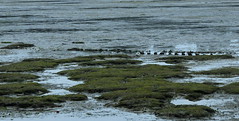
Heron and monitor lizard. "Fight! Fight!" we chanted but they were unco-operative. The monitor lizard, having just visited relatives on Pulau Ubin, ignored the heron completely and plunged into the sea for a nice swim back to mainland.

Fiddler Crabs Fighting
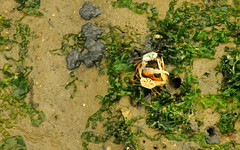
Two fiddler crabs. "Fight! Fight!" cried the previously-disappointed bloodthirsty crowd and they did.

Wild Boar or MSK in Wild Boar Outfit
Black speck = wild boar. Well, from what anyone could tell, might also have been MSK in wild boar outfit.

Ribs of Illegal Immigrants' Boat
Not actually wildlife: the ribs of the boat that illegal Vietnamese immigrants burnt when they arrived on Pulau Ubin.

Fine Sand in Mangrove
Fine sand as byproduct of mangrove swamp. Not imported from a small island somewhere in Indonesian waters.

Spot The Mudskipper
Spot the mudskipper. One second after this photo was taken, said mudskipper was scared away by ten excited girls shrieking,"AAAAAAH! MUDSKEEPPER!!!"

Male Sunbird
Male sunbird(?). Joe said that its red plummage, which puts the theory of evolution in some doubt, wasn't to attract the dull grey brown female.

Unglam Photo of Joe 1Unglam Photo of Joe 2
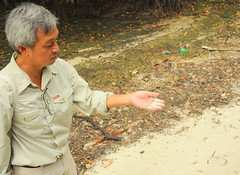
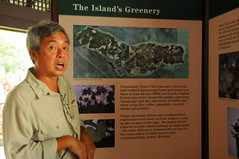
Unglam photos of Joe. Poor Joe. He was thoroughly knowledgeable, completely friendly and very patient with the blank looks as he enthused over a rare [something] growing on a rock (which someone then promptly stepped on). And he was the only one dressed appropriately in light-coloured shirt and pants.

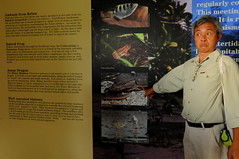
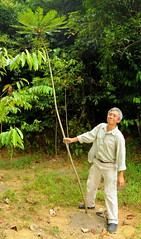
Slightly More Glam Photo of Joe Explaining Benefits of Tongkat Ali Plant
Alright, alright. Here's one of Joe more glamly explaining the bountiful benefits of the tongkat ali plant. Still much to see and much to learn about the inhabitants of the six different habitats in Chek Jawa.

Under Flight Path
This past weekend saw the mounting of a discounted Giant road bike from Kit Runners (beside Burger King) and a ride through the entire length of East Coast Park, down the Eastern Coastal Park Connector past Changi Airport and Changi Beach Park to Changi Village for drinks and nosh and then back again. Changi Village had been an arbitrary destination. I'd merely wanted space to think and according to Jeff Yen's GPS, got a very sweet 37.96km of it (except for the straight speedster strip parallel to the airport runway where someone hailed me and we rode together and chatted for a few klick).

The last bicycle rented in East Coast Park had been a rusty old BMX more than a decade ago. As I sped along on it, a toddler with a deathwish trundled into my path. Hemmed in from both sides by an assortment of pedestrians and cyclists, I squeezed the wrong brake lever too hard and flew through the air in a trajectory that arc-ed above the toddler's tricycle and ended on a grass patch some distance away. Much less blood was spilled than the time I presumed to skate in a wet bathroom atop of two wet sponges. In any case, the offending toddler broke out, I think, into spontaneous applause. Terribly well-mannered the youth of those times.

No Speeding!
McDonald's, East Coast Park to Changi Village in an hour while keeping within speed limit - PASS

Casurina Trees
Lovely casurina-lined sections sweet with the fragrance of the trees - PASS. Attempting to take photos with camera phone while riding - FAIL.

Sunset Over Changi Airport
Watching the sun set from across the road from the Changi Airport runway - PASS.

Bugs in teeth from singing while riding - FAIL. Protein from bugs in teeth - PASS.

[Photos censored]
Major Bike Chaff - FAIL! Harness-issues aside, cycling is sweeter than horse-riding because bicycles don't stop every now and then for a nibble on wayside flowers. Bicycles also less likely to wander off sniggering when your head gets caught in a tree, unlike Absalom's mule (2 Samuel 18:9).

Absalom's unglam death was what concluded last week's edition (2 Samuel 14 - 18) of our continuing gambol through the Second Book of Samuel.

Absalom was one of the hunkiest men of the Old Testament. "Now in all Israel there was no one so much to be praised for his handsome appearance as Absalom. From the sole of his foot to the crown of his head there was no blemish in him." - the Bible's words (2 Samuel 18:26), not the pre-teen gushings of an infatuated kid. He had three sons and a beautiful daughter (2 Samuel 18:27). And Absalom was no dumb jock. He was an intelligent strategist (the burning of Joab's barley field and his wheedling himself back into his father's good books (2 Samuel 14:32), his seditious ministry of discontent at the city gates (2 Samuel 15:1-6), his acquisition of the services of Ahithophel the Gilonite who was David's advisor and whose counsel was like the word of God and was greatly esteemed by David (2 Samuel 15:12; 16:23), his well-planned and well-executed rebellion (2 Samuel 15:7-11)) and had such personal charisma and persuasiveness that he won vast numbers of friends and influenced his father's people to have him instead as king. Dale Carnegie wouldn't even have made it to the White House. And what ambition and drive Absalom had: he was deadset on leaving a legacy (2 Samuel 18:18) and had very early on, already imagined a crown on his fair head (2 Samuel 15:1 cf 1 Kings 1:5). But brains and looks and a purpose-driven life full of steely determination must not and cannot stand in the way of their Creator's explicit design and plan.

(Re-)reading Christopher Ash's Out of the Storm on the Book of Job in tandem with our gander through 2 Samuel, it seemed that one of the yummiest things about Old Testament narrative is how it shows-and-tells us of the complexity of God's world in which we live, one not run simplistically on mere cause and effect or robotic predestination.

In 2 Samuel 14 - 18, we see both the outworking of the prophesied punishment of David's sin with Bathsheba and murder of Uriah and also the rightful end to rebels against God's anointed king. Absalom's rebellion and public copulation with David's ten concubines were foretold by Nathan as God's judgement on David (2 Samuel 12:11-12). And Absalom's death, which followed that of David's other sons (the out-of-wedlock baby (2 Samuel 12:15b-23) and Amnon (2 Samuel 13:1-33)), fulfilled God's word that the sword would not depart from David's house but was also at the same time just punishment for rebelling against God's chosen ruler. Sort of like the amazing mathematical equations undergirding beautiful baroque counterpoint pieces, but more-ish.

2 Samuel 18 ends with David weeping for his enemy and his son. Christopher Ash has a nice little article on how the tension between the demands of justice and the longings of love is finally reconciled in the New Testament in the person of David's greater son, Jesus. See The Death of Absalom - Drama and Theology.

The focus of Old Testament narrative tends to not to be on those men of old but on God
. Therefore, our interpretation of such passages should be theocentric rather than anthropocentric. I suspect that instead of reading ourselves into specific characters in the narrative, eg. as the embattled incumbent king David or the dashing naughty Absalom, we should rather be concerned to see that human history consists of a course of events shaped by Yahweh, who continually directs and delivers, and so steadily presses these events towards their fulfillment in history. We should then be concerned about our place in the working out of God's promises and about whom we follow and to whom we are loyal.

Regardless of how rosy things might look for the opposition in the temporal here-and-now then, it is pretty clear how everything will end. God has shown that his word is steadfast (in this case, that David is his chosen servant and king over his people) and that he is more than in control of human history to ensure that his promises do not prove false in the future (eg. the LORD defeating the good counsel of Ahithophel in 2 Samuel 17:14). We may be affronted by God's doings as Shimei was by David's ascending the throne after Saul (2 Samuel 16:5-8), but the only correct interpretation of events is God's since, after all, he was in control of the past and he alone knows the future of his world.


But who may abide the day of His coming from Handel's Messiah, sung by Yoshikazu Mera. Not my favourite countertenor but love Masaaki Suzuki's interpretation.
But who may abide the day of His coming, and who shall stand when He
appeareth? For He is like a refiner's fire. (Malachi 3:2)
_________________________________________

Labels: , ,

Tuesday, December 13, 2005

The Cure and Handel's "Messiah"

When you are bopping and bouncing along to The Cure on the way home, about boys not crying and love cats, you will, when you get home, pick up the orange and black fluffball curling around you to welcome you, hold her to your face, nose to moist quivering nose, look into her eyes, let her whiskers tickle you, and sing with love,
You're so wonderfully wonderfully wonderfully
Wonderfully pretty!
(or in her case: one flea, one flea, one flea, one flea spitty)
then dance around belting out just like heaven while someone else intros drums with wooden spoons and Milo tins and another plays air guitar with the chopping board, until she turns away from these humans in disgust and scans the vicinity for food.

Then you will remix Christmas carols with dragostea din tei, do the nu mă nu mă to each other, periodically say "Heelloo" to the mixing bowls and whip up colourful little chocolatey Christmas treats.

Then after the kitchen, the house, your clothes, your fingers, your hair smell of the aforementioned Christmas goodies, and you are tired and happy, you will put the kettle on, potter to a cushy chair with a cuppa and a plate of cookies and settle down for the annual listen to Handel's "Messiah".

There are too many versions of the Oratorio floating around (Handel always edited it to suit the needs of the moment) to decide which I like best. My dream team for "Messiah" is somewhat conventional: the interpretation of Masaaki Suzuki, the emotionally mature mezzo of Janet Baker or Anne Sofie von Otter, the deep dire baritone of Dietrich Fischer-Dieskau and beautifully strong countertenor of a younger Michael Chance.

Of course, "Messiah" isn't really an oratorio for just Christmas.

The story about Handel's "Messiah" is this: unlike the pious Lutheran JS Bach, history tells us that Georg Friedrich Händel was hardly a religious man. His life's goal was popularity, riches and the bright lights of the urban capitals of the civilised world. Unfortunately, both fame and fortunate eluded the man and Handel was at a low point in his life; his opera company had failed, he had suffered a mild stroke, was denounced as an infidel by the church authorities and was almost bankrupt.

Along came the staunchly protestant Charles Jennens who, to challenge the claims of the deists, had written a libretto about the life of a man called Jesus: from prophecies of his birth, to his miraculous virgin birth, to his horrendous death, to his victorious resurrection and as a consequence, the hope of humans for the future. Would Handel set the words to music for some cold hard cash and a safe place away from the debtor's prison? Oo'er. Don't mind if I do said Handel and scribbled off the score in less than a month.

So it's actually good for any time of the year, and Christmas is a good time as any.

Charles Jennens' own explanation for the flow of his libretto is apparently this:
I
(i) The prophecy of Salvation;
(ii) the prophecy of the coming of Messiah and the question, despite (i), of what this may portend for the World;
(iii) the prophecy of the Virgin Birth;
(iv) the appearance of the Angels to the Shepherds;
(v) Christ's redemptive miracles on earth.

II
(i) The redemptive sacrifice, the scourging and the agony on the cross;
(ii) His sacrificial death, His passage through Hell and Resurrection;
(iii) His Ascension;
(iv) God discloses his identity in Heaven;
(v) Whitsun, the gift of tongues, the beginning of evangelism;
(vi) the world and its rulers reject the Gospel;
(vii) God's triumph.

III
(i) The promise of bodily resurrection and redemption from Adam's fall;
(ii) the Day of Judgement and general Resurrection;
(iii) the victory over death and sin;
(iv) the glorification of the Messianic victim.
Fit the structure to the libretto. Lovely.

Then fit the libretto to verses in the Bible (the libretto is made up purely of verses from Scripture). Check out how Jennens arranges them together to form beautiful threads of shorthand biblical theology. Groovy.

Which is why I love Handel's "Messiah" so much. Not for the dream team (even if they could get together), not so much for the truly wonderful music (which sends people humming every time they get to those passages in Bible studies) but for the power of words themselves. Powerful because of their truth.

Is Christianity just a fictional metanarrative? Is it merely a story made up by humans to feel better about themselves? Is it just one of the many ways to interpret the world and the live life? Is it just a useful lie to believe in, just to have the strength to live and die peacefully?

Look at the Bible. Look at the tens of authors from mind-blowingly different cultures, languages and nations. Look at the one coherent story told by all of them over hundreds and hundreds and hundreds of years. Look at the predictions and prophecies made about Jesus thousands of years before he was born. Look how he fulfilled every single one of them in a way that could never have been imagined or collusively arranged.

If all arrows point to the Bible story being true, then other claims to truth and other interpretations of reality cannot be true. Then humanity is under a death penalty. And submission to God and trust in Jesus' death is the only way to gain pardon from it.

It's pretty darned scary and amazing at the same time.

********


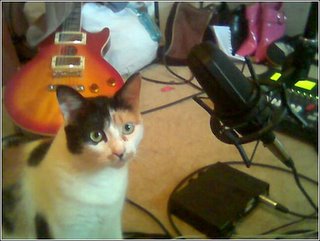
Not my rockstar cat

Labels: , ,