Wednesday, May 28, 2008

The Myanmar-Sichuan Double Disasters, "Ironman" and "Watchmen", and 2 Samuel 21 - 24

Coastes, Sentosa
We were at the beach in Singapore. Lapping calmly on the sand, the stench of the Irrawaddy waters, which once held mother and child decomposing wrapped around a tree, rendered impotent by distance and good fortune. I have been irritable and grumpy these few weeks. It has been difficult to be patient with the frivolities of lesson plans and the niceties of home decor and attention-seeking self-centredness when friends who'd only just managed to enter Myanmar sent word about Cyclone Nargis survivors sheltering under thin plastic, with fresh prawns as their only means of sustenance. There had so far been little in the way of news: only that there were just too many dead to count; only of the helpless frustration of foreign aid rotting on Bangkok airstrips; only the rehashing of personal anecdotes that survivors still heard the pitiful cries of ghosts at night; only the taking of surreptitious photographs that, even in their graphic R-18 way, sanitised the suffering (sometimes high resolution isn't a good thing). And then also, the observation that the prawns had been unusually plump.

So Ironman seemed an exercise in CG juvenilia. If only high-tech missiles and one bad guy with un-democratic visions of grandeur was all that stood in the way of world peace. If only a hot-rod red powersuit (not the Maggie Thatcher kind) could......ok, but arguably Tony Stark didn't intend to stop universal suffering, only suffering caused by his rather profitable products. And what else is the draw of Hollywood other than the neat glossy solutions endemic to its simulated reality? Samuel L Jackson as the patch-eyed Nick Fury of S.H.I.E.L.D. in little easter egg after the credits points the way to a United Nations-type Avengers Initiative sequel. Gloriously Hollywood too, that, considering the emasculated model in current reality.

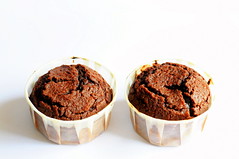
A Lazy Afternoon: Alan Moore's "Watchmen", A Cupcake, Some Cold Milk
Unlike Ironman, Alan Moore's Watchmen is possibly classified as an adult comic because it presents superheroes as mere human beings wearing homemade costumes, their boxers outside their tights, their capes getting caught in revolving doors (where were you, Edna Mode?), fighting baddies but ultimately, fighting their own rottenness and the pain from the rottenness of others. World peace and utopia-ship? The self-styled smartest man in the world, Adrian Veidt/Ozymandias, attempts to end all wars by the horrific deaths of millions in New York. Even though founded on the blood of millions, the closing panels of the graphic novel suggest that the success of his solution is doubtful. Far too real for the kiddies.

In Bombs from the album All New Arrivals, Faithless sings:
We think we're heroes, we think we're kings
We plan all kinds of fabulous things
Oh look how great we have become

So much heaven, so much hell
So much love, so much pain
So much more than I thought this world could ever contain
So much war, so much soul
Moments lost, moments go
So much more than I thought this world can ever hold
We're just children, we're just dust
We are small and we are lost
And we're nothing, nothing at all

One bomb, the whole block gone
Can't find me children and dust covers the sun
Everywhere is noise, panic and confusion
But to some, another fun day in Babylon
I'm gonna bury my wife and dig up my gun
My life is done so now I got to kill someone
Since we are incompetent at achieving the world peace so eagerly alluded to by Miss Universe contestants not bogged down with the dilemma of saving either their mothers or their boyfriends, perhaps it is easier to think of getting someone to pay for the our pain, to pass on our suffering. Tim Costello, the CEO of World Vision Australia who'd gone to Myanmar to see how he could help, went home and wept in grief at the hard-heartedness of the junta. The international media continues to spew its outrage that the powers-that-be could reject the aid so badly needed by the people. I don't think many would consider it a violation of human rights if a chap in a hot-rod red suit fried certain uniformed men in an Ark Reactor training accident. Ironically, this must be somewhat like how God views us sinners, so terribly in need of aid and not only refusing it but preventing others from getting hold of it too.

Then over the weekend, toddler-sitting, I accidentally taught the said toddler a (fortuitously mild) exclamation. He took to it like a duck to water.
Ants are spotted on the flowers: "Oh dear!"
His baby brother hits a bowl of porridge out of his mother's hand: "Oh dear!"
He is informed that he has run indoors with his shoes on: "Oh dear!"

After a few hours, he decided that a change of repetoire was in order. In his little kiddy voice, with the slight lisp of extreme youth that has seen little, if any, of the pain that this world can contain, he said:"Rejoice in the Lord always!" (and here he lifted his little arms heavenward) "Again I say,'Rejoice in the Lord always!'"

A timely word of inadvertent encouragement from Philippians:
Rejoice in the Lord always; again I will say, Rejoice. Let your reasonableness be known to everyone. The Lord is at hand; do not be anxious about anything, but in everything by prayer and supplication with thanksgiving let your requests be made known to God. And the peace of God, which surpasses all understanding, will guard your hearts and your minds in Christ Jesus. (Philippians 4:4-7)
To urge anyone to rejoice in such circumstances seems sick. But we do not rejoice at the terrible suffering or the communal grief. We rejoice that there is a God who is in control of everything. Quis custodiet ipsos custodes? (Who will watch the watchmen?) We do not worry because this God who is in control of everything is also all-seeing and is just and righteous. He cares for the weak and the vulnerable and the oppressed, and will deal with the bullies and the murderers rightly.

In the sandwich/sub that is 2 Samuel 21 -24, chapters 21 and 24 are the toasted sesame seed buns. Both the 3-year famine in 2 Samuel 21 and the 3-day pestilence in 2 Samuel 24, we are told, are a result of Israel's sin. (That is not to say all disasters are a direct cause-and-effect result of sin. But these are because God tells us so through the writer of 2 Samuel.) Saul was a fabulously bad king and he led Israel to sin against the Gibeonites which caused the famine in Chapter 21. David who succeeded Saul was described as a man after God's own heart. Yet, even this great king who united the tribes and built a great kingdom for God's people fared negligibly better - his census of Israel brought about the pestilence in chapter 24 (see also 1 Chronicles 21:1-28).

We who wish for perpetrators to be justly punished are faced with the awful truth and moral dilemma that we are negligibly better. But not all is bleak because just as God provided a way out from the judgement on Israel's sin through sacrifices, so he too provides us a way out from his judgement on our sins through the sacrifice of his Son on our behalf.

The roast beef and sauteed onions that are Chapters 22 and 23 flavour the entire 2 Samuel 21-24 sub. Unsurprisingly, God is at the centre of everything. David acknowledges the LORD's direct intervention in his life - he has trained him and empowered him and made David righteous and acceptable to God himself. But we know that David, though the greatest king of Israel still = FAIL. So God promises another king, one who rules justly over men, ruling in fear of God (2 Samuel 23:3). David Jackman (download his talk from St. Helen's Media here) gives a good run-down on how Jesus, great King David's greater king, fulfilled all the aspects of a perfect king so that when he died on the cross for our sins, he was the perfectly unblemished sacrifice.

There is encouragement in these universal truths. There is also encouragement in the fact that real people, flesh and blood, humans like us, lived through these things. They thought these thoughts, made these decisions, schemed against others, saw loved ones die, felt joy and happiness and sorrow and anguish. This happened in the life of a guy called David, who was part of God's plan. And the Gospels record what happened in the life of another real guy called Jesus, who was also part of God's plan for the salvation of all humanity.
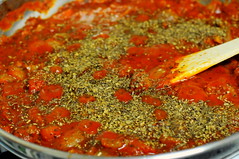
Spicy Italian Sausage Pasta Sauce
So then, things started to look up. Attribute the chink of light in the horizon to the umami of a potently garlicky and tomato-ey spicy italian sausage sauce for that tasty bioavailable lycopene hit,
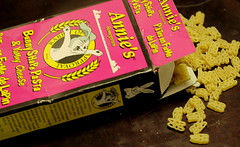
Annie's Bunny Shaped Durum Wheat Pasta

married with Annie's little bunny-shaped durum wheat pasta bits, or the joyous arrival of a squidgy bundle of new life called Marisa, or the impending weddings of friends, or the news that foreign aid workers and aid are now trickling into Myanmar.

But good as all this may be, I suspect the real reason for the ability to really rejoice (as opposed to rejoicing = "Everyone in God's house, JUMP AROUND! JUMP AROUND!") is itself proportional to the ability to lean harder on God, to trust him more deeply because we understand his ways more clearly. And we rejoice also because we do not have a king who reigns patronisingly and smugly, all privileged and comfy in his ivory tower but a king who as our mediator, our high priest, who is able to sympathise with our weaknesses, because he was himself in every respect tempted to rebel against God as we are, but yet did not sin.

Therefore, let us then with confidence draw near to the throne of grace, that we may receive mercy and find grace to help in time of need. (Hebrews 4:15-16)

_________________________________________

Labels: ,

Friday, May 16, 2008

Dead Dogs, Dead Cows and Dead Men in 2 Samuel 19 - 20

Minature Schnauzers Dashing Out From Kitchen

Am grateful for the dogs in my life, none of whom I need to feed, bathe, walk or groom; my sole responsibilities vis-à-vis the cuddly canines being to play with them, kiss them unhygienically on their wet noses and use them as furry footrests during bible study.

Almost every week, we are greeted at the door by an ecstatic golden retriever, chew toy already in mouth, anticipating several hours of play time. And some weekends, there are three minature schnauzers completely mad for a stuffed (and well-chewed) puffer fish.

(Would have said that I was grateful for the babies in my life as well but, frankly, they are quite useless as footrests. Plus I don't kiss them.)

It was a source of great amusement to see that the prevailing turn of phrase in the Second Book of Samuel was "dead dog". "What is your servant, that you should show regard for a dead dog such as I?" asked Mephibosheth humbly of King David (2 Samuel 9:8). "Why should this dead dog curse my lord the king? Let me go over and take off his head." says Abishai of the disgruntled Shimei (2 Samuel 16:9). Being a dog and being dead was quite the pits, it seems.
Golden Retriever Not Camera-trained
In uni in the English countryside, the choice insult was "stupid cow". Biblical cows, it appears, were not stupid. The worst they got was thin and ugly (Genesis 41), unless of course they came from Bashan (Amos 4:1).

In any case, am also greatly fond of cows, this time especially of dead ones. During the sporadic days of rainy respite from the heat, we've been able to take side trips from wimpy fruit-centric meals to chow down on some dead cow.
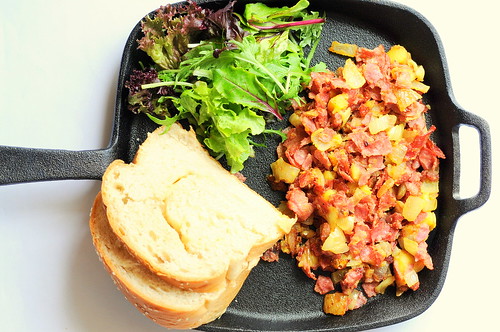
Corned Beef Hash Breakfast
Corned beef hash based on a recipe from Aun at Chubby Hubby. Had my corned beef sliced instead of chopped into chunks to increase the surface area available for crust-formation.

But corned beef hash didn't quite fulfil dead cow desires, so on we went.

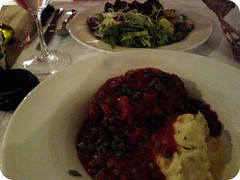
Ristorante Pietrasanta, Wessex Estate
squint to view dishes
At Ristorante Pietrasanta, sitting outside the renovated ex-Judo Federation headquarters in Wessex Village lined with herbs in plant boxes and hanging lamps, we had eyes only for one sort of meat. The table next door said this place'd been recommended by the chef at Valentino's and expected good things. The snails were well-pan-fried and appeared fully-infused with rich garlicky stewed tomato sauce. The osso buco, veal shank slow-cooked for four hours in un-traditional tomato-based stew, was tender and tasty though lacking in marrow. The tenderloin was fresh and tender but overwhelmed by crushed black pepper. Service staff ranged from efficient and knowledgeable (the English waitress) to grumpy and ignorant (the mainland Chinese waitress).

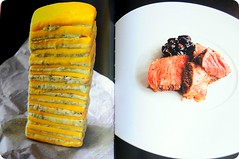
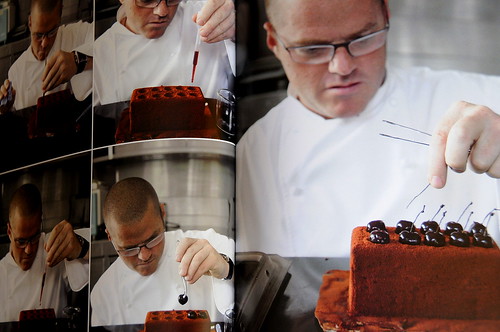
Steak Pictorial from Heston Blumenthal's "In Search of Perfection"
More dead cow beckoned. Heston "Fat Duck" Blumenthal in In Search of Perfection had suggested the use of blue-cheese-infused butter in cooking steak to approximate something of the spectacularly nutty, cheesy character of aged beef. Here's his 18-hour recipe for the perfect steak.

Some weeks ago, we were at Brewerkz Indoor Stadium and I was chuffed to find a blue cheese burger on the menu. Everyone to whom I'd spoken about blue-cheese-infused butter had gagged but the person who had more than half the shared burger said it was delish. There was hope, after all, for the combination in polite company. (Though, given that we'd have been equally happy sitting around with beers watching football as going for the MayDay concert if someone had forgotten the tickets, not sure how polite the company really was.)

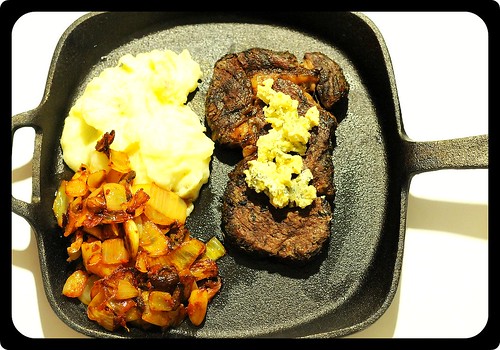
Steak Experiment
Some days later, I attempted a ribeye topped with Roaring Forties Blue Cheese just after it'd been taken off the fire. The cheese, being less mouldering-wet-sock-like than other blue cheeses did spectacularly well with the meat. However, if the definition of a good steak is one that is chargrilled on the outside but juicy and richly tender on the inside, this one didn't make it. The meat, though still pink on the inside was nevertheless still slightly tough.

A browse through Shirley Corriher's Cookwise and Peter Barham's The Science of Cooking yielded a smorgasbord of things that could have affected the tenderness and flavour of the final product. I probably scored top marks in them all. This is probably only interesting to me and to the cow. Oh wait, the cow just died of boredom:
Several books opined that in describing a piece of meat as tender, we mean, inter alia, that there is liquid between the fibres and that the proteins in the meat hold on to moisture. A piece of meat is tough when it is difficult to cut through and chew.

Part of the Dead Cow
In general, meat is tough if it is a much-used muscle and tender if it is a little-used muscle. Therefore muscles like the legs, hips, shoulders and neck are tough and the muscles in the center of the back of the animal (rib and loin) are tender. Tougher muscles that are used a lot may contain more myoglobin and may be deeper red in colour but are also very flavourful.

I'd used a ribeye which had been on sale at at discount at the butcher's. It contained streaks of fat (marbling) which would have melted in the cooking, flavouring and tenderising the meat by creating liquid between the fibres.

Rigor
But there's only so much that the cut of the beef influences tenderness. The moisture-holding ability of the proteins is influenced by acidity. Changes in acidity of the meat before, during and after rigor may influence meat tenderness, so even muscles that should be tender can be made tough if they are not allowed to go through rigor and relax again under proper conditions.

Rigor takes place after death because all animal muscles have their own storage supply of glycogen or carbohydrates, which they burn for energy. This process creates lactic acid as a waste product. When circulation stops, blood no longer flows through the muscles, and this lactic acid is not removed. In addition to the protein myosin, muscles contain actin, which normally slides past the myosin during muscle movement. When lactic acide builds up in the muscles, the actin and myocin that normally slide past each other react chemically to form acto-myosin. This causes muscles to contract tightly and become "stiff as a board".

Eventually, though, the muscles relax again. The temperature and the species are the two main determinants of how long it takes muscles to go into rigor and how long they stay in that state. Rigor takes about a day to pass in beef, but only about 6 hours in pork and chicken. Fish can take a few hours to a few days depending on the species.

Going through rigor improves meat in several ways. First it greatly improves the texture; meat that does not go through rigor has a gummy texture. Second, the increase in acidity slows spoilage of meat and also enhances the water-holding ability of the meat proteins. Meat that has been allowed to go through rigor properly is juicier than meat that has not.

One thing that will prevent proper rigor is the animal's being under stress or working very hard just before slaughter. When that does happen, the animal's muscles will have used up their supply of glycogen or carbohydrates and lactic acid will not have formed. The resulting meat will therefore be less acidic, darker in colour and more easily spoiled.

Meat is usually hung at moderate temperatures (16°C) for 16 to 20 hours postmortem to enhance its tenderness and ensure its proceeding into rigor. The hanging is done to stretch out the muscles before the rigor sets in. if the muscles are allowed to contract as the rigor starts, the bonding of the actin and myosin is stronger and the meat is tougher. The temperature is kept moderate because rapid chilling of meat before it goes into rigor will toughen it.

So a dark, poor-textured piece of meat or one that should be tender but is very tough may have been processed poorly.

Aging
Meat also benefits greatly from aging after rigor – in both texture and falvour. Aged meat has a buttery texture and a more intense meaty flavour. Meat should be held at 1-2.2°C to control bacterial growth. An optimal aging period for beef is 11 days. Aging can be hastened by holding meat at a warmer temperature 21°C for 2 days under high humidity (85-90 percent) to prevent moisture loss and with ultraviolet light to control bacteria. The meat found in most markets is fast aged and gets a little additional aging during shipping and in the store.

Meat can be aged wet (sealed in cryovac) or dry (exposed to air). Nearly all meat today is wet aged. Because of the moisture and weight loss of costly meat, dry-aged prime beef is extremely expensive. Even if you are willing to pay the price, it is difficult to find – obtainable only from a handful of specialty suppliers. You can age meat in your refrigerator at home. Place the unwrapped meat on a rack over a dish that is lined with a paper towel and leave uncovered 2 to 7 days in your refrigerator which is between 2.2 -4.4°C. It will turn dark, and the surface will dry out. When you are ready to cook, cut away the dried surface area.

Tenderising
The physical methods of tenderising consist of cutting or tearing long meat fibers across the grain. They can be ground or sliced and carved. Muscle fibers can be as long as a foot. When meat is sliced with the grain (that is, parallel to those fibers) you have a long, tough, uninterrupted fiber that may be unchewable. The same piece of meat thinly sliced across the grain has only a tiny length of fibre (the thickness of a slice) and is easy to chew. Even tough cuts of meat can seem tender when thinly sliced across the grain.

Chemical tenderisers such as enzymes papain and chymopapin from papayas and ficin from figs attack muscle proteins and there is a fungal enzyme, Rhozyme P-11, that attacks meat. The fresh ginger rhizome contains a single enzyme that attacks both muscle and collagen. Bromelain from pinapple is more active toward collagen than muscle. Even honeydew contains enzymes that attack meat proteins. These tenderizers work only when in direct contact with the meat, so unless they are injected into the meat, only the surface can be tenderised.

Acid-based marindes both tenderise and add flavour. The acid causes the denaturation or unwinding of long proteins. Anything acidic can be used as marinade – wine, fruit juice, buttermilk, milk, yoghurt. Oils that contain emulsifiers (mono- and di- glycerides) penetrated deeper and faster, thus making better marinades. Extra-virgin olive oil contains monoglycerides which will penetrate deeper nad faster than pure oilive, canola, corn or soyabean oil.

Heating/Cooking
When muscle fibres are heated above about 40°C, the proteins start to denature, that is they change their shape irreversibly. In muscle proteins, this change of shape involves the proteins coiling up. This coiling process inevitably causes some contraction of the muscle. As the muscles contract in cooking, so pieces of meat contract along the direction of the muscle fibres and the meat becomes harder. The longer you cook, the progressively tougher it gets.

Animal fats are solid in uncooked meats but melt during cooking and will often run out into the cooking pain. These fats provide a good deal of the flavour of meats – flavour comes from small molecules and in uncooked meats the only small molecules are the fats. The fats also act as a sort of lubricant so that if there is some fat close to a toughened muscle fibre it can act to make it appear less tough when we eat. For fats to act in this way, it is necessary that they are intimately mixed into the meat (marbled through the meat) and not well separated from the muscles as is often the case.

The remaining component of meat is water. Most of the meat (about 60%) is water making it the largest single component of meat. When meat is cut some water flows out and the meat becomes a little wet. However, most of the water in a piece remains locked-in ("bound water"); the water molecules are actually trapped by some of the proteins in the meat. When the proteins are denatured by heating some of this "bound water" can escape. You can see this when you fry meat after a short cooking time, some liquid will start to flow out of the meat and as it boils in the hot fat and "spit" at you.

Meats with low content of connective tissue should be cooked (grilled, fried, roasted) for short time whereas meats with a lot of connective tissue should be cooked (stewed) for a longer time. Muscle proteins start to denature at 40°C and coagulate into hard knotty lumps above 50°C. But connective tissue, collagen only denatures at 60°C.

This explains why Heston Blumenthal's perfect steak recipe calls for the fore-rib to bask gloriously in the oven at 50°C for a grand total of 18 hours.

Maillard Reactions
It is common kitchen lore that searing the meat "seals in the juices". Harold McGee, in On Food And Cooking, disproves this fiction and shows instead that more moisture is lost at higher temperatures (duh). What searing, cooking the surface of the food at very high temperatures, does though is to create flavour and give texture to the meat.

Maillard reaction is the term for a series of complex reactions between the amino acids in the proteins and the sugars in carbohydrates. In the first stage of the reactions, the proteins and carbohydrates are degraded into smaller sugars and amino acids. Next, the sugar rings open and the resulting aldehydes and acids react with amino acides to produce a wide range of chemicals. These new molecules then react amongst themselves to produce the main flavour compounds. One particularly important molecule, bis-2-methyl-3-furyl-disulphide, that is generated has been associated with meaty odours. If it is missing, the meaty smell is absent.

If you are cooking several steaks, you will find that the steak you cook last will brown most quickly. This may be because the Maillard reactions are autocatalytic. Once some of the reaction products (brown bits) have accumulated in the reaction vessel (frying pan), the reactions will go faster.
There was a different sort of butchering going on in 2 Samuel 19 - 20. David, in reclaiming his kingdom, made Amasa commander-in-chief of his army in place of Joab (2 Samuel 19:13). Amasa had only recently been Absalom's own commander-in-chief (2 Samuel 17:25) leading the fight against David. Now that Absalom had been defeated, David might have meant this as a reconciliatory gesture towards Judah who'd supported Absalom in his rebellion against David?

But whatever his motivations, David's first task to Amasa was to have him rally the men of Judah to David within three days to fight against the newest rebel, Sheba and the rest of the ten tribes of Israel (2 Samuel 20:4). But Amasa dallied and Sheba was getting near fortified cities. There was no time to be lost so David instructed Joab's brother Abishai (note, and still not Joab himself) to pursue Sheba. Assumedly, Joab was part of the contingent. He comes upon the tardy Amasa at a great stone landmark in Gideon and, well, the Bible tells it best:
Now Joab was wearing a soldier's garment, and over it was a belt with a sword in its sheath fastened on his thigh, and as he went forward it fell out. And Joab said to Amasa, "Is it well with you, my brother?" And Joab took Amasa by the beard with his right hand to kiss him. But Amasa did not observe the sword that was in Joab's hand. So Joab struck him with it in the stomach and spilled his entrails to the ground without striking a second blow, and he died. (2 Samuel 20:8b - 10b)
Amasa's wallowing in his own blood caused a jam on the highway because people were stopping for a gawk so someone took him and threw him over the hedge. Joab then concluded successful negotiations with a wise woman in Abel of Beth-maacah where Sheba was hiding and soon returned to David with Sheba's head.

2 Samuel 20 ends with Joab in command of all the army of Israel again.

There is much to understand from these two chapters - the reactions of Shimei, Mephibosheth and Barzillai to the returning king and David's demonstration of the restoration of his reign and kingship, and the folly of opposing God's plan and God's king, for example. But am intrigued by Joab.

The narrator of 2 Samuel makes no comment on Joab's actions. But David on his deathbed did. In 1 Kings 2, David instructed his successor, Solomon:
...you also know what Joab the son of Zeruiah did to me, how he dealt with the two commanders of the armies of Israel, Abner the son of Ner, and Amasa the son of Jether, whom he killed, avenging in time of peace for blood that had been shed in war, and putting the blood of war on the belt around his waist and on the sandals on his feet. Act therefore according to your wisdom, but do not let his gray head go down to Sheol in peace. (1 Kings 2:5-6)
It is interesting that despite common speculation to the contrary, David did not seem to have doubted Joab's loyalty to him. He did not fault Joab even for disobeying his explicit instructions and killing his son Absalom. Instead, his beef with Joab was that Joab had sinned; that he committed murder, that is, "avenging in time of peace for blood that had been shed in war", killing Abner (commander of Saul's army) for killing his brother Asahel (2 Samuel 2) and Amasa assumedly for fighting against David under Absalom.

Even more interesting is that David considered these murders a personal affront even though he was not himself harmed in any way. Having Abner and Amasa out of the way might in fact have made his reign as king more straightforward and secure. Most commentators suggest that David felt so strongly about these events because they threatened to destabilise his rule. People might think David an untrustworthy hypocrite for appearing to extend the olive branch to former enemies publicly but getting his commander-in-chief to off them privately.

Wonder if it would be too much of a stretch to say that if all sin is ultimately a sin against God, then it was also a sin against David, as God's representative ruler over his people. And so, to sin in the name of doing David's good/God's work/God's will was an affront to both David and God.

Also, I suppose in a similar way, to claim that sinning is alright in light of the greater good of ministry, eg. telling little white lies to get someone with proper theology elected to a position of greater influence or touting membership benefits to would-be converts never promised by God, is pretty perverted logic. Sinning in the name of doing God's work suggests that we don't trust God's word nor are we able to understand his view of the world. Sin is sin not because it just breaks a couple of arbitrary laws that can be held in abeyance once in a while when it is convenient to do so but that it goes against immutable laws that explain how God designed the universe to work and describe things that are of value to the unchanging Creator.

Minature Schnauzer Sitting Comfy on Human Sofa
Gratuitous picture of minature schnauzer and schnauzer sofa

Pietrasanta The Italian Restaurant
5B Portsdown Road #01-03 Wessex Estate
E-mail: pietrasanta@singnet.com.sg
Tel: 6479 9521

_________________________________________

Labels: , ,

Wednesday, May 14, 2008

Chek Jawa, the 37.96km Ride Along the Coastal Park Connector and 2 Samuel 14 - 18

We've been spending quite a bit of time in the East (of Singapore) lately.

Tree Not Making It
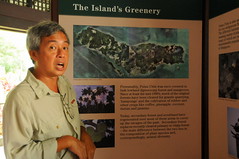
A fortnight ago, with Joseph Lai as our trusty guide, a bunch of city bumpkins went to gawk at Chek Jawa, very much like Leninas and Bernards at the Savage Reservation. And like the Savage Reservation of Aldous Huxley's Brave New World, the very fact of nature reserves, the identification of the natural as distinct and necessitating protection, suggests a certain degree of perversion and unnatural-ness in the "normal" world.

And as if to prove the existence of Jean Baudrillard's hyperreality, the nature walk proceeded almost Photo Hunt style. Here're some highlights:
Monitor Lizard and Heron
Heron and monitor lizard. "Fight! Fight!" we chanted but they were unco-operative. The monitor lizard, having just visited relatives on Pulau Ubin, ignored the heron completely and plunged into the sea for a nice swim back to mainland.

Fiddler Crabs Fighting
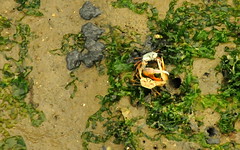
Two fiddler crabs. "Fight! Fight!" cried the previously-disappointed bloodthirsty crowd and they did.

Wild Boar or MSK in Wild Boar Outfit
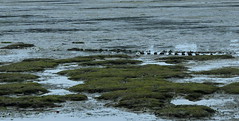
Black speck = wild boar. Well, from what anyone could tell, might also have been MSK in wild boar outfit.

Ribs of Illegal Immigrants' Boat
Not actually wildlife: the ribs of the boat that illegal Vietnamese immigrants burnt when they arrived on Pulau Ubin.

Fine Sand in Mangrove
Fine sand as byproduct of mangrove swamp. Not imported from a small island somewhere in Indonesian waters.

Spot The Mudskipper
Spot the mudskipper. One second after this photo was taken, said mudskipper was scared away by ten excited girls shrieking,"AAAAAAH! MUDSKEEPPER!!!"

Male Sunbird
Male sunbird(?). Joe said that its red plummage, which puts the theory of evolution in some doubt, wasn't to attract the dull grey brown female.

Unglam Photo of Joe 1Unglam Photo of Joe 2
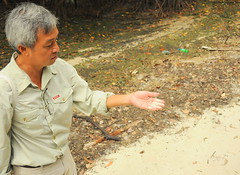
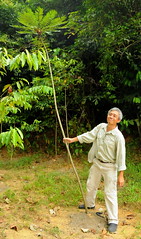
Unglam photos of Joe. Poor Joe. He was thoroughly knowledgeable, completely friendly and very patient with the blank looks as he enthused over a rare [something] growing on a rock (which someone then promptly stepped on). And he was the only one dressed appropriately in light-coloured shirt and pants.

Slightly More Glam Photo of Joe Explaining Benefits of Tongkat Ali Plant
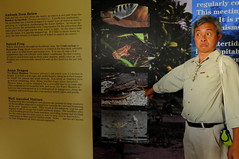
Alright, alright. Here's one of Joe more glamly explaining the bountiful benefits of the tongkat ali plant. Still much to see and much to learn about the inhabitants of the six different habitats in Chek Jawa.

Under Flight Path
This past weekend saw the mounting of a discounted Giant road bike from Kit Runners (beside Burger King) and a ride through the entire length of East Coast Park, down the Eastern Coastal Park Connector past Changi Airport and Changi Beach Park to Changi Village for drinks and nosh and then back again. Changi Village had been an arbitrary destination. I'd merely wanted space to think and according to Jeff Yen's GPS, got a very sweet 37.96km of it (except for the straight speedster strip parallel to the airport runway where someone hailed me and we rode together and chatted for a few klick).

The last bicycle rented in East Coast Park had been a rusty old BMX more than a decade ago. As I sped along on it, a toddler with a deathwish trundled into my path. Hemmed in from both sides by an assortment of pedestrians and cyclists, I squeezed the wrong brake lever too hard and flew through the air in a trajectory that arc-ed above the toddler's tricycle and ended on a grass patch some distance away. Much less blood was spilled than the time I presumed to skate in a wet bathroom atop of two wet sponges. In any case, the offending toddler broke out, I think, into spontaneous applause. Terribly well-mannered the youth of those times.

No Speeding!
McDonald's, East Coast Park to Changi Village in an hour while keeping within speed limit - PASS

Casurina Trees
Lovely casurina-lined sections sweet with the fragrance of the trees - PASS. Attempting to take photos with camera phone while riding - FAIL.

Sunset Over Changi Airport
Watching the sun set from across the road from the Changi Airport runway - PASS.

Bugs in teeth from singing while riding - FAIL. Protein from bugs in teeth - PASS.

[Photos censored]
Major Bike Chaff - FAIL! Harness-issues aside, cycling is sweeter than horse-riding because bicycles don't stop every now and then for a nibble on wayside flowers. Bicycles also less likely to wander off sniggering when your head gets caught in a tree, unlike Absalom's mule (2 Samuel 18:9).

Absalom's unglam death was what concluded last week's edition (2 Samuel 14 - 18) of our continuing gambol through the Second Book of Samuel.

Absalom was one of the hunkiest men of the Old Testament. "Now in all Israel there was no one so much to be praised for his handsome appearance as Absalom. From the sole of his foot to the crown of his head there was no blemish in him." - the Bible's words (2 Samuel 18:26), not the pre-teen gushings of an infatuated kid. He had three sons and a beautiful daughter (2 Samuel 18:27). And Absalom was no dumb jock. He was an intelligent strategist (the burning of Joab's barley field and his wheedling himself back into his father's good books (2 Samuel 14:32), his seditious ministry of discontent at the city gates (2 Samuel 15:1-6), his acquisition of the services of Ahithophel the Gilonite who was David's advisor and whose counsel was like the word of God and was greatly esteemed by David (2 Samuel 15:12; 16:23), his well-planned and well-executed rebellion (2 Samuel 15:7-11)) and had such personal charisma and persuasiveness that he won vast numbers of friends and influenced his father's people to have him instead as king. Dale Carnegie wouldn't even have made it to the White House. And what ambition and drive Absalom had: he was deadset on leaving a legacy (2 Samuel 18:18) and had very early on, already imagined a crown on his fair head (2 Samuel 15:1 cf 1 Kings 1:5). But brains and looks and a purpose-driven life full of steely determination must not and cannot stand in the way of their Creator's explicit design and plan.

(Re-)reading Christopher Ash's Out of the Storm on the Book of Job in tandem with our gander through 2 Samuel, it seemed that one of the yummiest things about Old Testament narrative is how it shows-and-tells us of the complexity of God's world in which we live, one not run simplistically on mere cause and effect or robotic predestination.

In 2 Samuel 14 - 18, we see both the outworking of the prophesied punishment of David's sin with Bathsheba and murder of Uriah and also the rightful end to rebels against God's anointed king. Absalom's rebellion and public copulation with David's ten concubines were foretold by Nathan as God's judgement on David (2 Samuel 12:11-12). And Absalom's death, which followed that of David's other sons (the out-of-wedlock baby (2 Samuel 12:15b-23) and Amnon (2 Samuel 13:1-33)), fulfilled God's word that the sword would not depart from David's house but was also at the same time just punishment for rebelling against God's chosen ruler. Sort of like the amazing mathematical equations undergirding beautiful baroque counterpoint pieces, but more-ish.

2 Samuel 18 ends with David weeping for his enemy and his son. Christopher Ash has a nice little article on how the tension between the demands of justice and the longings of love is finally reconciled in the New Testament in the person of David's greater son, Jesus. See The Death of Absalom - Drama and Theology.

The focus of Old Testament narrative tends to not to be on those men of old but on God
. Therefore, our interpretation of such passages should be theocentric rather than anthropocentric. I suspect that instead of reading ourselves into specific characters in the narrative, eg. as the embattled incumbent king David or the dashing naughty Absalom, we should rather be concerned to see that human history consists of a course of events shaped by Yahweh, who continually directs and delivers, and so steadily presses these events towards their fulfillment in history. We should then be concerned about our place in the working out of God's promises and about whom we follow and to whom we are loyal.

Regardless of how rosy things might look for the opposition in the temporal here-and-now then, it is pretty clear how everything will end. God has shown that his word is steadfast (in this case, that David is his chosen servant and king over his people) and that he is more than in control of human history to ensure that his promises do not prove false in the future (eg. the LORD defeating the good counsel of Ahithophel in 2 Samuel 17:14). We may be affronted by God's doings as Shimei was by David's ascending the throne after Saul (2 Samuel 16:5-8), but the only correct interpretation of events is God's since, after all, he was in control of the past and he alone knows the future of his world.


But who may abide the day of His coming from Handel's Messiah, sung by Yoshikazu Mera. Not my favourite countertenor but love Masaaki Suzuki's interpretation.
But who may abide the day of His coming, and who shall stand when He
appeareth? For He is like a refiner's fire. (Malachi 3:2)
_________________________________________

Labels: , ,

Thursday, May 01, 2008

Inevitabilities, Boat Asia, Strawberries, 五月天 (wuyuetian, MayDay)'s 回到地球表面 (Down To Earth) Concert and 2 Samuel 12

A crazy week filled with inevitabilities.

Boat Asia 2008 at Marina@Keppel Bay, Keppel Island, Singapore
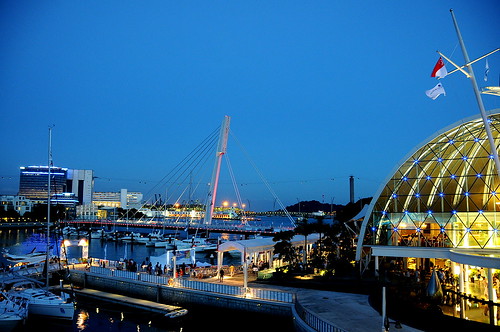
It was inevitable that the gloriously hot weekend was just the thing for Boat Asia 2008 at Marina@Keppel Bay on Keppel Island. There were jetskis and sailboats for sale, and floating platoons to put together like real life Lego, and yachts to clamber onto for joyrides and also houseboats to dream of living and navigating the world in.

Marina@Keppel Bay, Keppel Island, Singapore
Out of the heat, in the air-conditioned confines of TCC, we sat and chatted till the lights came on and some of the boat crew sounded their foghorns, untied big bunches of balloons and let the wind carry them up into the darkness.

Le Fraisier
It was also inevitable that the heat made it impossible to eat much, so fruits were the order of the day. Because strawberries were cheap in the fresh produce section, there was an attempt at Le Fraisier, but really, that was far too precious.

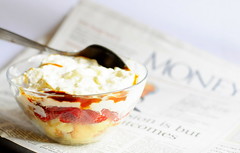
TGIF Breakfast Faux-Trifle
Much better was just heaping them in a bowl with leftover vanilla sponge and natural Greek yoghurt and drizzling some manuka honey over the lot.

Fresh Strawberries and Greek Yoghurt
And even better just kosong: strawberries and yoghurt and nothing else.

(When some friends rolled into town from half-way across the world though, we managed (for their sake, of course) a bit of chilli crab and cereal crayfish (the receipt said "clay fish"). After, durians were hunted down.)

Ashin and Monster
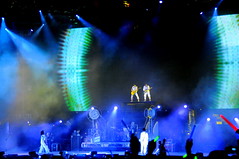
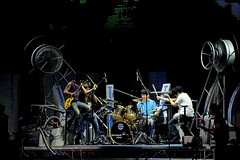
Again, it was inevitable that we would not have had been able to enjoy completely 五月天 (wuyuetian, MayDay)'s 回到地球表面 (Down To Earth) (新加坡第一站 hor) Concert at the Singapore Indoor Stadium, however novel the concept of Chinese pop music concert-going, however free the tickets, however better the sound system than the one at Singapore Expo Max Pavilion,

DSC_6205.JPG
however innovative the stage,

Monster
however wonderful the guitar antics of Monster (here with pink bear standing by),

Guanyou/Ming
however crazy the drumming of Guanyou/Ming (here with unwelcome helpers),

DSC_6271.JPG
however communist and equal-opportunity the UFO-like skybridge,

Raptuous Audience
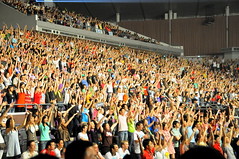
however raptuously the crowd greeted the proximity of band members,

DSC_6297.JPG
drummer Guanyou/Ming and bassist Masa
however cheeky the banter that put paid the innocence of candles on birthday cakes,

"O""V"
however "high" the audience and however companionable the neighbours. A function, no doubt, of the fact that no amount of earnest emotion set to catchy music can guarantee the future and the understanding that all good things are but a pale low-quality imitation of the great party-to-come (see Revelation).

Setlist/Song list (mostly thanks to the fans at mdmd.net forum):
Ashin hamming it up for the camera
lead singer Ashin hamming it up for the camera
五月天 回到地球表面
The stage was covered with a ceiling-to-floor white sheet. 4 "armed" men rappelled down from the ceiling wearing gas masks. Continuation of video from their last concert 離開地球表面.
1. 抓狂 - MV, Singapore concert
2. 香水 - MV
3. 叫我第一名
4. 為愛而生 - MV, Singapore concert
5. 一千個世紀 - MV, Singapore concert
6. 雌雄同體 - MV, Singapore concert
7. 愛情萬歲 - MV, Singapore concert
8. 離開地球表面 - MV
9. 生命有一種絕對 - MV
10. 孫悟空 (每個人各唱一小段) - MV, Singapore concert
11. 小太陽 (「回到地球表面」演唱會主題曲) - MV, Singapore concert
12. 九號球+離家出走 - MV, Singapore concert
13. 闖 - MV, Singapore concert
14. 生活 + 疯狂世界 - MV, MV, Singapore concert
15. 垃圾車 + 生日快樂 (瑪莎慶生 Masa's birthday) - MV, Singapore concert
16. 愛情的模樣 - MV, Singapore concert
17. 最重要的小事 (阿信彈吉他) - MV, Singapore concert
18. 我又初戀了 - MV
19. 戀愛ING - MV, Singapore concert
20. 溫柔 - MV, Singapore concert
21. 洋蔥 - Singapore concert
22. 軋車 - MV
23. 溫柔 (還你自由版)
24. 倔強 - MV (the sinner's song, said the B)
25. 人生海海 - MV, Singapore concert

Encore
UFO-like Skybridge Does An Encore
Second descent of UFO-like skybridge

Encore
26. 天使 - MV, Singapore concert

Ashin
27. 知足 - MV, Singapore concert (I waited the whole concert for this, said the C)

Ashin
28. 離開地球表面 電音版
then they threw their sweat-drenched towels into the audience. One man's bio-hazard, another's prized possession.

And it was also inevitable that, living in the community of believers, there would be the shared pain of the suffering of fellow brothers and sisters: young mothers diagnosed with third stage breast cancer, sudden deaths of loved ones in swimming pools, the tearing apart of families in the bid to make new ones, disillusionment with the manifestation of God's kingdom on earth, the lust for gossip and the injustice of the manipulation and lies so rife within Christ's body.

2 Samuel 12-13
is one of those passages in the Bible ripe with the complexity of reality that couldn't have been dreamt up by the human mind.

At the end of 2 Samuel 11, David seemed very much in control. He'd taken and gotten what he'd wanted and the cover-up of his adultery with Bathsheba and murder of her husband Uriah appeared flawless. But we are told at the end of 2 Samuel 11 that what the thing David had done displeased the Lord. And we know that several centuries before, Moses had already warned that one could be sure that one's sin would find one out (Numbers 32:23). Whereas 2 Samuel 11 is all about David sending people out to do his bidding, 2 Samuel 12 opens with the LORD sending Nathan to David. It was God who was in control and despite David's erstwhile relationship with God, he'd incomprehensibly forgotten that he would have God to answer to.

David's strong reaction to Nathan's story (2 Samuel 12:1-7a) demonstrated that David was not incognisant of right and wrong, but merely deliberately blind to his own sin. "The man must die" he said of the rich man in the story, thereby accusing and condemning himself. "You are that man," said Nathan. And God was as livid and outraged at what David had done as David was indignant at the rich man in Nathan's story.

It wasn't just that David had broken some laws and destroyed the lives of people, he was that he had despised the LORD himself (2 Samuel 12:9). When we breach God's laws, it isn't just about socio-economic-political consequences; when we sin, we show utter contempt for God, the law-maker/giver.

David acknowledged that he had indeed sinned against the LORD (2 Samuel 12:13). This was a great change from his predecessor, Saul, who had a whole slew of excuses for disobedience ("you didn't come on time, what was I to do" etc). David didn't bring forth defences nor character witnesses to attest to his general generosity and the good he had done for his people, instead, we see in Psalm 51 the plain confession of his sinfulness. David knew that that had not been a one-off, a moment of weakness, a temporary aboration, a sorry-won't-happen-again incident. He had been sinful from birth and would forever be inclined to spit on the living God. He was a born adulterer and born murderer. He admitted that he deserved punishment.

Yet, immediately, David received gratuitous forgiveness. "The LORD has put away your sin," said Nathan, "you shall not die" (2 Samuel 12:13). But this was not the slap on the wrist given to smug perpetrators that cause grieving members of victims' families to attack them outside the courtroom with foldable umbrellas. Nevertheless, and this was a big nevertheless, despite David not getting the death sentence he deserved, his son would die (2 Samuel 12:14). And there would always be the perpetual reek of death in David's family (2 Samuel 12:10). And there would always be the dreadful agonising tyranny of evil on his loved ones (2 Samuel 12:11).

(Several centuries later, in the New Testamental times, Jesus would explain that suffering was not always caused by sin. The man born blind and the people killed by the falling tower of Silom did not suffer because of their sin and rebellion. But other times, suffering and difficulties are the consequences of our sin and we must bear the responsibility for that - the illegitimate child, being made a paraplegic from drinking and driving, the broken relationships caused by gossip and slander etc. But in David's case, the cause of his suffering was quite certainly his past sins. Because God said so.)

So sure enough, the child took sick. David lay on the ground all night pleading with God to spare his son. He refused to get up and took no food. His grief freaked out his aides. (2 Samuel 12:15b-17) They figured him for a suicide risk and when the kid in fact died, they didn't know how to break the news. They needn't have worried. When David heard that his son had died, David got up, had a bath, put on clean clothes, slapped on some Old Spice and worshipped God. Then he went home and had a good meal (2 Samuel 12:20), possibly while his servants stood gaping. David explained: he'd thought that perhaps, just perhaps, God's word through Nathan wasn't his last word and plus he knew that he could rely on God's graciousness to let the child live if he wished. But, in a way that did not impinge on his graciousness, God's judgement through his prophet had been his last word on the matter and David accepted and trusted God on this (2 Samuel 12:22).

2 Samuel 12 ended with a note of hope - God gave David victory over the Ammonites in battle and David begot a son with Bathsheba whom the LORD loved.

There are certain inevitabilities we can be sure of in this 疯狂世界:

The Initiative of Grace
God is the one in control. He takes the initiative and seeks sinners to bring them to repentance. (Sinners, inevitably don't seek after the real God, no matter how they might claim to be looking for him.)

The Severity of Grace
"T'was grace that taught my heart to fear". Grace reveals and exposes and brings people to repentance so that they might be saved. The only heart that God can accept is a broken and contrite heart so therefore, in his love and his grace, he must break us so that we can see the death sentence which we are facing because of our rebellion against him, and turn to him for mercy.

The Miracle of Grace
Grace gives totally free forgiveness. But the consequences remain with us. The rest of David's life is grim: David's baby son dies even before he can be named; David's other son Amnon rapes his daughter and Amnon's half-sister Tamar (2 Samuel 13); David's yet other son Absalom murders Amnon for what he did, then leads a rebellion against his father; David's other other son Solomon eyed the crown while David was still alive etc.

And though the sinner has to deal with the consequences of his sin, he does not pay for them through his suffering. The fact is, he can never do enough to pay for even a quark of his sin because the wages of sin is death. What is free for sinners is costly to God because it cost him his only son who died on the cross in our place so that we will not have to face eternal death.

Dale Ralph Davis, 2 Samuel
Jonathan Fletcher, Grace Abounding

_________________________________________

Labels: , , , , , ,

Thursday, April 24, 2008

Black Forest Gateaux Cupcake Experiments and the Dosh on David in 2 Samuel 11

So there are colleagues who spend hours doing a screen-by-screen critique of Edison Chen's home movies and then there are colleagues who, despite declaring themselves old skool, cannot resist folding in references to Nigella Lawson and her ample posterior into every (baking) conversation:

"Hey, what chocolate do you think is best for this cake?"
"Well, Nigella would say 'best dark chocolate' but look at her now."

"Do you think I should up the proportion of butter?"
"Well, Nigella always heaves in a heckload of butter, but then that's how her ass got to the size of a Budweiser horse's."

"You know, everyone complains that Nigella's shows are porn, that she uses sex to sell food..." (Apparently the good lady spends alot of airtime licking things while staring meaningfully into the camera lens.) "...but I find her a disgusting glutton. At the end of every show, they have this bit where she sneaks into the kitchen in her nightie to steal food. There is nothing even remotely sexy about her inability to control herself. This is why the obese glutton flopped in France like the rancid lard-butt that she is whereas Trish Deseine is so popular."

Nigella made another appearance in our latest conversation on the infamous black forest gateaux project:
"If all else fails, you can adapt a recipe from How To Be A Domestic Goddess. Nigella recipes are so easy that even, if you pardon the expression, a half-brained monkey could whip them up."

But it became apparent late in the day that the recipe itself wasn't the problem.
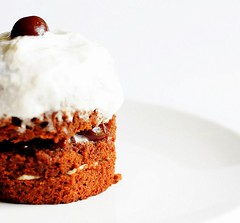
Black Forest Cupcake: Prototype Beta
The problem was the possession of an unusual palate, one fond of intense flavours and a variety of textures in one confection; one roused only by perceived complexity and depth. Few others commensurated. This meant it was fairly useless for taste-testing food to be eaten by other people. Therefore, man-on-the-SBS-bus guinea pigs cupcake testers had to be recruited for the purpose.

Black Forest Cupcake Prototype Beta: the consensus was that the cupcake was very rich (score!). This didn't stop people from scarfing most of it after a very full dinner while complaining about aforementioned richness.
Experimental Sponge Cupcakes: Self-raising Flour, Some Cake Flour, Some Cocoa Powder, More Butter, More Melted Chocolate, Black Cherry Jam, Lower Oven Temperature
Everyone also agreed that the sponge had the right texture and a good crumb, was nice and chocolatey and moist. I'd left them a bit fudgey which was a-ok with the testers. Apparently some cupcakes bought off homebakers through the internet had crumbled like dust and tasted like styrofoam, so they hadn't been expecting much better.
Black Forest Cupcake: Prototype Gamma - Layer of Kirsch-soaked Cherries
The proportion of alcohol was just right (I upped this for the alkie whose cupcake was deliberately doused with kirsch and as a consequence was happy for the rest of the afternoon). Opinion on the cream cheese frosting was varied: some liked how it cut through the uniform taste of the cake, some thought it introduced too many flavours, others thought it was too salty for what they perceived to be a sweet dessert, and still others just bore a grudge against cheese in all forms anyways. The kirsch-soaked half-globe cherry layer had some rabid fans but others thought them distracting. "How to pack the cherries to perfection so as to use as little cream as possible?" ask Tomaso Aste and Denis Weaire in The Pursuit of Perfect Packing. I just didn't use any cream lor. Which probably contributed to the lack of structural integrity.


Black Forest Cupcake: Prototype Gamma
Black Forest Cupcake Prototype Gamma, topped with thick cream and cream cheese whipped together and sprinkled with dark chocolate curls, was better received.

Black Forest Cupcakes ready to take over the world!
Take us to your leader!
The second problem was that, despite what all this baking and (cup)caking might suggest, I wasn't actually fond of sweets and desserts. Like how it had been with the chemistry kit, I just liked observing chemical reactions taking place. So naturally, was most keen on having the cool sort of housemates who'd be ecstatic about a bathtub splattered with chocolate.
Heston Blumenthal's "In Search of Perfection" - The Black Forest Gateau

These chaps were working on a recipe from Heston (Fat Duck) Blumenthal's In Search of Perfection. Which hot-blooded person wouldn't be excited about the power-tools macho-ness of assembling a black forest gateau with the aid of a vacuum cleaner, a paint spray gun and several canisters of nitrous oxide? The Times published a copy of the recipe here and The Independent, unsurprisingly, dissed it/its creator as pretentious.

Edison Chen, Nigella Lawson, Heston Blumenthal. Everyone loves to have a go at public figures. There is good money to be made by tabloids in putting people on pedestals and tearing them down later. The gossip rags in Zion/Jerusalem must have had a field day with King David.

The story is well-known. In spring, the time kings go out to battle, the glorious leader is slacking in the palace. After an idle lounge-about one afternoon, he steps out to the balcony to survey his kingdom and spies a very beautiful woman (in the words of 2 Samuel 11) bathing. He inquires as to her identity and is told that she is the wife of Uriah the Hittite, one of his own valiant men (1 Chronicles 11:41) who is away fighting David's wars for him. Whatever. David has the unfortunately-named Bathsheba is brought to him, he has his way with her and then sends her home. She later discovers that she is pregnant with his child.

David's first instinct is to cover up the deed by recalling Uriah from battle and trying to get him to sleep with his wife. Uriah refuses to even step into his own house. Damningly he reasons,"The ark and Israel and Judah dwell in booths, and my lord Joab and the servants of my lord are camping in the open field. Shall I then go to my house, to eat and to drink and to lie with my wife? As you live, and as your soul lives, I will not do this thing." (2 Samuel 11:11). His concern is for his compatriots, his king, his nation and God, not his personal desires and comfort.

But David is unrepentant. He then attempts to get Uriah drunk so Uriah might do everyone a favour and wander off home in his inebriated state. But even when plastered, Uriah remains resolute. So like a good mafia boss, David arranges to have him killed in battle. David then marries Uriah's grieving widow, Bathsheba.

This would have been a nice clean ending to the mess since pesky forensic detectives and democratic tabloids had yet to be invented. But someone was watching. He knew what David had done last spring (2 Samuel 11:27) and wasn't terribly pleased. And he had the power to do something about it.

But in the meanwhile, we tsk and tut at David's folly and expound on the dangers of giving in to lust and of open-air baths. But secretly, we are pleased. It is good to see a righteous man fall. It is good to hear of married pastors running off with their partners or of priests molesting young boys. It is good to know that people are scum like us so we won't have to try so hard to be godly; we can be content wallowing in our scuminess. In fact, we can go one better by riding past on our moral highhorse and spitting on these once great/respected men. (The hip-ness of environmentalism and animal welfare-ism can also be linked to this, but that's another post.)

The most satisfying thing about all the juicy "did you hear?", "did you know?" tattle is to gasp, hand to open mouth,"Who would have guessed?" Who would have guessed that David, God's own anointed king, the person God said was a man after his own heart, would have so nonchalantly committed adultery and murder?

But perhaps the right and smart response to all this is not to be smugly confirmed in our sinfulness but to be warned never to be fooled into being complacent about our lack of sin. Life isn't a moral high-horse race or a competition to convince ourselves that we are really good people. It is lived out under an all-seeing, all-knowing judge who will one day deal justly with all who do not live rightly according to the natural laws of his creation.
But the thing that David had done displeased the LORD. (2 Samuel 11:27)
____________________________________

Labels: , , , ,