Friday, September 05, 2008

Everything Changes But You: Neuroplasticity and Christian Belief, Klee and De Sté

Heraclitus' toe-dipping exercise might have encompassed the change of status that comes with marriage, the change in frequency of nights out that accompanies each new baby, the change of jobs that comes with being bored with the old one, the change of singer/musician for the night on account of the usual one being indisposed, the change in how we have our way with cocktails and chocolates...following the Moskva down to Gorky Park on an August summer night...

But the old Greek had nothing on neuroplasticity. If the hypotheses of neuroplasticity are indeed accurate, then the previously entrenched idea of the immutability of the brain (and hence of thoughts, personality, traits, talents etc) must itself be overhauled. Far from being hardwired from birth or childhood, or enslaved by genes, the adult brain can and does change physiologically according to experience, thinking and education.

Newtonian physics (as distinguished from the theories of the apple-pelted Newton himself) has been accused of promoting the tyranny of determinism in various fields including biology and neuroscience. As the discovery of quantum physics replaced belief in deterministic systems with probabilistic systems, it is also said that epiphenomenalism, the idea that consciousness has no casual impact on the brain but that the neurons fire first before the mind experiences decision-making, has now been replaced by neuroplasticity.
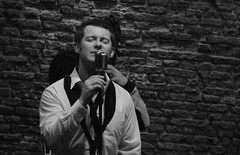
Timothy O'Dwyer at Bar Stop, Devonshire Road
The first time I tried to explain the concept of neuroplasticity, we were at Bar Stop, waiting for good mates to arrive and also Tim O'Dwyer and his saxophone in place of Anne Weerapass. A hopefully more lucid explanation follows.

Observing his father's recovery from a massive stroke, Paul Bach-y-Rita realised that our brains are more flexible than localisation would have us believe. His father recovered so well that he returned to lecturing at college, remarried, went hiking and travelling and enjoyed a fully energetic life until his death (from a heart attack while climbing a mountain). The autopsy revealed that his father had in fact been doing all this on 3% of the nerves that run from the cerebral cortex to the spine; the rest had been destroyed in the stroke. Where neurologists used to say that the visual cortex in our occipital lobe processes vision and the auditory cortex in our temporal lobe processes hearing, Paul showed that these areas are plastic and capable of processing a variety of input not just visual or auditory as the case may be. The blind can, for example, learn to "see" with their tongues and ferrets who had their retina fibres wired to their auditory pathways learned to "see" with their auditory cortex (Discover, 2003).

(But I guess while this sort of "see"-ing approximates the product of input from our retinas in the sense of perception and interpretation of light, it is unlikely to result in the exact same product that is derived from the retinas being connected by optic nerves to our visual cortex. I wonder then, when one sees with the tongue, if colours and shapes are interpreted as distinctive tastes. Anyway, whew. So it's not too weird that music and the sounds of certain instruments and voices has always been to me sometimes synonymous with certain shapes and lines of varying widths and colours, and also certain textures and tastes. Maybe there's a living to be made translating music to pleasing visuals to the tune of Tom Hingston, who did awesome cover work for one of my favourite bands, Massive Attack. Maybe such cover work can even be multimedia - encompassing texture and taste.)

Timothy O'Dwyer at Bar Stop, Devonshire Road
Later on, Michael Merzenich discovered competitive plasticity. The conventional view was that the brain was only plastic for a period of time (the critical period) during childhood after which it is too rigid to change its structure on a large scale, hence the Mozart Effect/Montessori/enrichment class crush so often observed amongst the progeny of parents who only want "the best" for them. Competitive plasticity suggests that adults have difficulty learning another language, musical instrument or skill not because their brains have already been hardwired, but because cerebral real estate is competitive and any bit left vacant is quickly taken over for other uses. So if two languages had been learned at the same time, then both would have shared in more or less equal parts, that bit of real estate.

Merzenich then started Posit Science - a company devoted to helping people ensure that occupancy levels continue to be high in their little plot of grey matter.

How to transfer occupancy in cerebral real estate? The Hebbian learning axiom that "neurons that fire together wire together" summarises the theory that "the persistence or repetition of a reverberatory activity tends to induce lasting cellular changes that add to its stability"; repetition helps neurons develop strong connections with one another when they are activated at the same moment in time, thereby leading to synaptic strength and a change in grey matter residency and therefore thought patterns and resultant behaviour.

This theory is the basis of programmes for children with learning disabilities in Arrowsmith School, and the Fast ForWord programme by Merzenich's other company, Scientific Learning.

If mere thinking or imagining, immaterial actions, leaves material traces, if each thought alters the physical brain, then it possible to sculpt our brains as we sculpt our bodies.

Klee, Bar at Wessex Village, Portsdown Road
My Drink Driving Spot Ran Over Your God Spot
So what of belief then? When determinism was in, it was fashionable to advocate a God Spot, or God Gene, to explain why certain people believed in a higher power and others didn't; a gene which gives these types a predisposition to episodes interpreted by some as religious experiences. There were several detractors including one Carl Zimmer who dismissed such claims saying that, given the low explanatory power of VMAT2, it would have been more accurate for the author of The God Gene: How Faith Is Hardwired Into Our Genes, Dean Hamer, to have named his book "A Gene That Accounts for Less Than One Percent of the Variance Found in Scores on Psychological Questionnaires Designed to Measure a Factor Called Self-Transcendence, Which Can Signify Everything from Belonging to the Green Party to Believing in ESP, According to One Unpublished, Unreplicated Study".
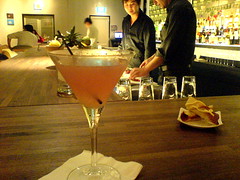
Grape-tini at Klee, Bar at Wessex Village, Portsdown Road
Scientific Study That Brain Activation Similar in Monks in Deep Meditation on Compassion and Friends Downing Cocktails at Klee Leads to Mixology Being Recognised As Official Religion
It is always good copy for the media to stir science up against what they term "religion" and sprinkle the word "controversial" liberally onto the mix. So who can resist pouncing on the theory of neuroplasticity as evidence that belief in God is nothing more than a mere rearrangement of synapse-firing without any basis in external reality, brought on no doubt by tyrannical repetition by relatives, friends and cultists.

Neurotheology (alas! Memories of Secondary 2 literature text horror, Aldous Huxley,'s Island!) purports to demonstrate that religious experience (and therefore the truth of religions) can be explained by cognitive neuroscience. Statisticians and fans of Freakonomics would quickly intone, correality (if any) does not necessarily mean causality.

Furthermore, neurotheologians mistakenly identify religion with specific experiences and feelings. Very few thoughtful Christians base their belief on some experience of a "mystical union with God" or transcendent rapture.

Plus, there is enough external evidence to prove the veracity of Christian truth claims. Oh but oooh, can we be sure that cognitive faculties are reliable enough to interprete that which we claim they interprete? In addition to the many obvious and common-sensical epistemological arguments, Alvin Plantinga calmly notes, in his usual fashion, that this sort of thinking is in fact itself subject to the rationality hiccups. (You had me at "vituperation", Mr. Plantinga.)
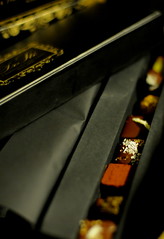
Chocolates from Stefano Deiuri's De Ste, The Riverwalk
Scientists Report Need for Further Research on Whether Increased Ingestion of Cocoa Matter Aids in Neuroplastic Sanctification Process
Now that that's out of the way, what is of interest is how neuroplasticity, *if true*, interacts with the event Christians term "conversion" and the process known as "sanctifcation". Laterz.

BarStop
6 Devonshire Road
Singapore 239844
Tel: 6735 6614

Klee
Klee, Bar at Wessex Village, Portsdown Road
5B Portsdown Road #01-04
Singapore 139311
Tel: 6479 6911
No menu, no wine, no beer, no straight shots, no bar snacks, no website but check out their Facebook fan site. Eh, said the drinking buddy, how to survive like that?

The premise of the place is that Singapore is a market mature enough for "bespoke cocktails". Why splash cash on hair-on-chest drinks that have to be thrown down the back of your throat because they are the embodiment of such great foulness? The cocktails indeed score nicely on the alcohol percentage test but remain smooth with layered flavours that reveal themselves through the life of the drink or mouthful. Earnest and friendly (but not overly-chatty) mixologists happily explain each ingredient as they muddle fresh fruits, pour in measures of Smirnoff Black, Belvedere, Bombay Sapphire gin or fruit liquers or a bit of Bols blue (I got a bottle of this duty-free on the ferry to Amsterdam and we had great fun back at halls because it turned our tongues blue and lent itself to all sorts of corny coastal/sea-themed cocktails) for a China Blue. On offer, as far as the memory goes were strawberrytinis, grape-tinis, kiwitinis, grapefruit martinis, Earl Grey martinis, mojito sherbets (mango this week, but, said Wijaya, I found some blackberry sherbet in the supermarket so maybe blackberry next week) made with freshly squeezed lime juice muddled with sugar and fresh mint leaves, cosmo royal, secret garden, flirtinis (somewhat like a French martini? It's the Chambord layer at the bottom of the glass). They've also connected their ice machine to a Hyflux Reverse Osmosis Drinking Water System to produce pure distilled ice that is free from contaminants (kinda like NEWater, no?).

Anyway, only managed to sample 2.2 of the unwritten menu, fearing that I might need to take the wheel. Fortunately, designated driver was sober enough for me to warm the passenger seat.

Still, there was the organic enjoyment of watching drinks being prepared in the pit. Wijaya said their bottle of Pimms had been relak-ing one corner since opening day because it was difficult to make a good cocktail out of its contents. Wonder if we could do a sort of volatile compound test, the way food pairings are done in molecular gastronomy, to discover new mixes for cocktails with ingredients that share common odorants or other organoleptic qualities. To poshify our lab work, we could market it as "molecular mixology". Imagine: pineapple, blue cheese and white wine! Oyster and kiwi! Liver and Jasmine! A few months ago, I discovered, after accidentally leaving a punnet of strawberries in the car, that hot strawberries smelled like tomatoes. Hot strawberry juice instead of tomato juice in your Bloody Mary p'haps? The cocktail experimenting paws were twitching.

DeSté, by Stefano Deiuri
20 Upper Circular Road
#01-39/41
The Riverwalk
Singapore 058416
Tel: 6536 1556
Intriguing experiments with chocolates. Choices include crunchy exotic fruit salad (pineapple, mango, peach), Cartagena (passionfruit and fleu de sel-caramel), lemon-mint, black sesame and ginger-lime, olive oil (!), rock chocolate (pumped full of air for light, melt-in-the-mouth texture)... Interesting looking cakes too. Curiousity wants to ring its doorbell repeatedly then run straight to the kitchen through the opened door.

The Brain That Changes Itself, Norman Doidge
Written in an enthusiastic, repetitive, American telemarketeering, individuals-are-in-control-of-their-lives style. I suppose time and even more research will tell if claims within are true?

Labels: , ,

Friday, May 30, 2008

Pomegranates, Pomegranate Ice-Cream and Psalms

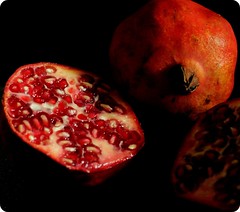
Pomegranate Cross-section
Until recently, she'd flitted only in the peripheral vision of our experience, mysterious and vague.

A friend from Dubai was back for a visit so we sat around into the early hours of the morning catching up and reminiscing about old times. At first, when we were wet behind the ears and new to the Middle East, we'd been amused to find pomegranate arils garnishing every single dish. I'd distinguished myself by poking them around and saying,"Red ruby ah?" They didn't add much in the way of flavour to anything. So I'd been surprised that anyone would have believed that Persephone sold her freedom for four pomegranate seeds in Hades.

In any case, when a mound of Iranian pomegranates winked at me at NTUC, I took a couple home and made pomegranate ice-cream*.
No-churn Pomegranate Ice-cream
This is Nigella Lawson's (even-a-monkey-with-half-a-brain-could-do-it) no-churn pomegranate ice-cream recipe.
Ingredients
2 pomegranates
1 lime
175g icing sugar
500ml double cream

Preparation
  1. Juice the pomegranates and the lime and strain the juices into a bowl.
  2. Add the icing sugar and whisk to dissolve.
  3. Whisk in the double cream and keep whisking until soft peaks form in the pale pink cream.
  4. Spoon and smooth the ice cream into the airtight container of your choice and freeze for at least 4 hours, or overnight.
  5. Scatter with some pomegranate seeds before you eat it.
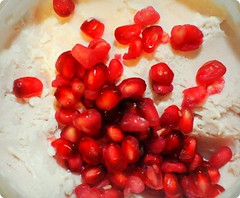
Obviously this monkey possesses less than half a brain since I didn't even have the patience to follow the recipe. Anyhoo, the ice-cream was fairly creamy and, in vast quantities that popped in your mouth like juicy salmon roe, the pomegranate arils were cold and sweet. Next time, might try reducing the pomegranate juice over fire to achieve a more intensely pomegranatey ice-cream.

Love the whole pomegranate look: the shape and colour somehow conspire to give the fruit the air of a relic from medieval times. But several thousand years before that, the LORD was already telling Moses to decorate the hem of his priestly robes with the fruit (Exodus 28:33-34). And even without Tim Gunn's fashion tips, these were good enough for ministering before God. (Actually, if Tim Gunn'd heard God's instructions on the priestly garments, he would have said,"That's a lot of look!" But even though divine taste might flunk out of Project Runway, guess who'll win in the end?) Later on, Solomon had pomegranate latticework done in bronze in the great temple dedicated to the LORD (1 Kings 7:18, 20, 42; 2 Chronicles 3:16; 2 Chronicles 4:13). When they rebuilt the temple centuries later, they did not neglect this detail (Jeremiah 52:22 - 23).

Like the vine and the fig, the pomegranate appears to be some sort of reminder to the agricultural Jews of God's divine provision and sustenance. I think.

Half-gnawed leftovers from our recent 2 Samuel studies include discussions on reading the Old Testament in light of the New Testament. The usual Sunday school/ARPC/Project Timothy/evangelical way insists that the answer is "Jesus". But what is the link? And how does one arrive at that certain conclusion?

Still much to think through but for consideration, Michael Reeves (via Dave Bish) handling the Psalms:
Mike Reeves - Psalm 1
Mike Reeves - Psalm 51

PS: In other news, I wish to record the utter shock of being told, at a wedding rehearsal in a Methodist church, that the wedding photographers were not to get up on the carpeted stage area that the pastor alternately termed "the altar" and "the holy place". "Free church people", he said, did not respect this. In order not to jeopardise the chances of the couple finally getting married, I desisted from pointing out that God was very capable of causing to suddenly fail to exist photographers (or errant OT temple priests) trespassing on holy ground, and that the flower arrangement in the "holy place" had wilted quite badly and started to decompose. Maybe I should have suggested a comely clutch of pomegranates.

*Says Robert L. Wolke in What Einstein Told His Cook 2:
"Does eating ice cream in hot weather cool you off?...The answer...is in fact, no. After all, we are warm-blooded creatures with thermostats set at 37 degrees celcius, and eating something cold cannot change that. Our cooling mechanism is purely a surface phenomenon: the evaporation of perspiration from our skins, assisted, when we're lucky, by a breeze that hastens the process. Putting ice cream into one's mouth serves only to cool the mouth. you'd do much better by smearing the ice cream all over your body."

Labels: ,

Friday, May 16, 2008

Dead Dogs, Dead Cows and Dead Men in 2 Samuel 19 - 20

Minature Schnauzers Dashing Out From Kitchen

Am grateful for the dogs in my life, none of whom I need to feed, bathe, walk or groom; my sole responsibilities vis-à-vis the cuddly canines being to play with them, kiss them unhygienically on their wet noses and use them as furry footrests during bible study.

Almost every week, we are greeted at the door by an ecstatic golden retriever, chew toy already in mouth, anticipating several hours of play time. And some weekends, there are three minature schnauzers completely mad for a stuffed (and well-chewed) puffer fish.

(Would have said that I was grateful for the babies in my life as well but, frankly, they are quite useless as footrests. Plus I don't kiss them.)

It was a source of great amusement to see that the prevailing turn of phrase in the Second Book of Samuel was "dead dog". "What is your servant, that you should show regard for a dead dog such as I?" asked Mephibosheth humbly of King David (2 Samuel 9:8). "Why should this dead dog curse my lord the king? Let me go over and take off his head." says Abishai of the disgruntled Shimei (2 Samuel 16:9). Being a dog and being dead was quite the pits, it seems.
Golden Retriever Not Camera-trained
In uni in the English countryside, the choice insult was "stupid cow". Biblical cows, it appears, were not stupid. The worst they got was thin and ugly (Genesis 41), unless of course they came from Bashan (Amos 4:1).

In any case, am also greatly fond of cows, this time especially of dead ones. During the sporadic days of rainy respite from the heat, we've been able to take side trips from wimpy fruit-centric meals to chow down on some dead cow.
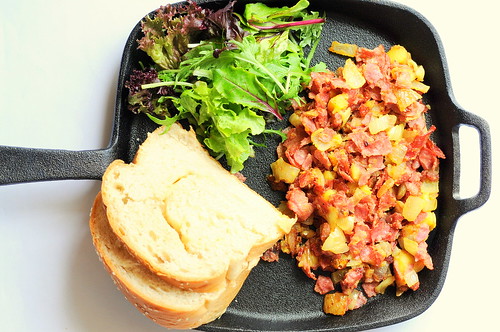
Corned Beef Hash Breakfast
Corned beef hash based on a recipe from Aun at Chubby Hubby. Had my corned beef sliced instead of chopped into chunks to increase the surface area available for crust-formation.

But corned beef hash didn't quite fulfil dead cow desires, so on we went.

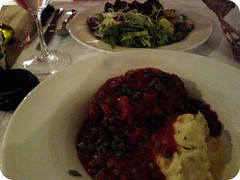
Ristorante Pietrasanta, Wessex Estate
squint to view dishes
At Ristorante Pietrasanta, sitting outside the renovated ex-Judo Federation headquarters in Wessex Village lined with herbs in plant boxes and hanging lamps, we had eyes only for one sort of meat. The table next door said this place'd been recommended by the chef at Valentino's and expected good things. The snails were well-pan-fried and appeared fully-infused with rich garlicky stewed tomato sauce. The osso buco, veal shank slow-cooked for four hours in un-traditional tomato-based stew, was tender and tasty though lacking in marrow. The tenderloin was fresh and tender but overwhelmed by crushed black pepper. Service staff ranged from efficient and knowledgeable (the English waitress) to grumpy and ignorant (the mainland Chinese waitress).

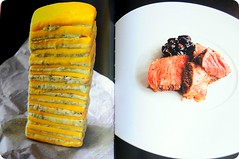
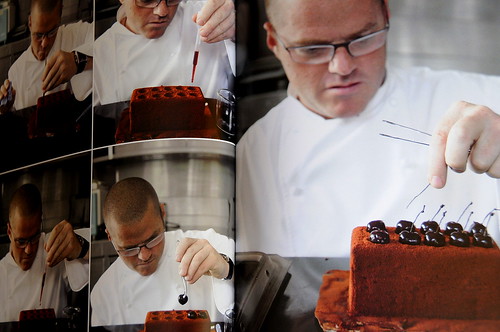
Steak Pictorial from Heston Blumenthal's "In Search of Perfection"
More dead cow beckoned. Heston "Fat Duck" Blumenthal in In Search of Perfection had suggested the use of blue-cheese-infused butter in cooking steak to approximate something of the spectacularly nutty, cheesy character of aged beef. Here's his 18-hour recipe for the perfect steak.

Some weeks ago, we were at Brewerkz Indoor Stadium and I was chuffed to find a blue cheese burger on the menu. Everyone to whom I'd spoken about blue-cheese-infused butter had gagged but the person who had more than half the shared burger said it was delish. There was hope, after all, for the combination in polite company. (Though, given that we'd have been equally happy sitting around with beers watching football as going for the MayDay concert if someone had forgotten the tickets, not sure how polite the company really was.)

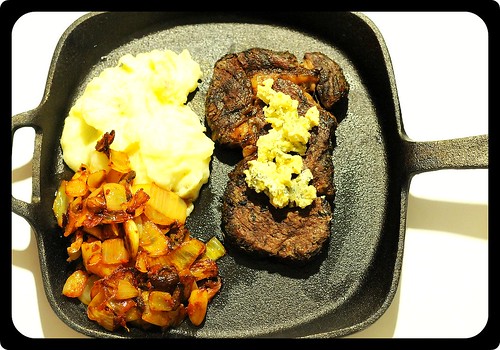
Steak Experiment
Some days later, I attempted a ribeye topped with Roaring Forties Blue Cheese just after it'd been taken off the fire. The cheese, being less mouldering-wet-sock-like than other blue cheeses did spectacularly well with the meat. However, if the definition of a good steak is one that is chargrilled on the outside but juicy and richly tender on the inside, this one didn't make it. The meat, though still pink on the inside was nevertheless still slightly tough.

A browse through Shirley Corriher's Cookwise and Peter Barham's The Science of Cooking yielded a smorgasbord of things that could have affected the tenderness and flavour of the final product. I probably scored top marks in them all. This is probably only interesting to me and to the cow. Oh wait, the cow just died of boredom:
Several books opined that in describing a piece of meat as tender, we mean, inter alia, that there is liquid between the fibres and that the proteins in the meat hold on to moisture. A piece of meat is tough when it is difficult to cut through and chew.

Part of the Dead Cow
In general, meat is tough if it is a much-used muscle and tender if it is a little-used muscle. Therefore muscles like the legs, hips, shoulders and neck are tough and the muscles in the center of the back of the animal (rib and loin) are tender. Tougher muscles that are used a lot may contain more myoglobin and may be deeper red in colour but are also very flavourful.

I'd used a ribeye which had been on sale at at discount at the butcher's. It contained streaks of fat (marbling) which would have melted in the cooking, flavouring and tenderising the meat by creating liquid between the fibres.

Rigor
But there's only so much that the cut of the beef influences tenderness. The moisture-holding ability of the proteins is influenced by acidity. Changes in acidity of the meat before, during and after rigor may influence meat tenderness, so even muscles that should be tender can be made tough if they are not allowed to go through rigor and relax again under proper conditions.

Rigor takes place after death because all animal muscles have their own storage supply of glycogen or carbohydrates, which they burn for energy. This process creates lactic acid as a waste product. When circulation stops, blood no longer flows through the muscles, and this lactic acid is not removed. In addition to the protein myosin, muscles contain actin, which normally slides past the myosin during muscle movement. When lactic acide builds up in the muscles, the actin and myocin that normally slide past each other react chemically to form acto-myosin. This causes muscles to contract tightly and become "stiff as a board".

Eventually, though, the muscles relax again. The temperature and the species are the two main determinants of how long it takes muscles to go into rigor and how long they stay in that state. Rigor takes about a day to pass in beef, but only about 6 hours in pork and chicken. Fish can take a few hours to a few days depending on the species.

Going through rigor improves meat in several ways. First it greatly improves the texture; meat that does not go through rigor has a gummy texture. Second, the increase in acidity slows spoilage of meat and also enhances the water-holding ability of the meat proteins. Meat that has been allowed to go through rigor properly is juicier than meat that has not.

One thing that will prevent proper rigor is the animal's being under stress or working very hard just before slaughter. When that does happen, the animal's muscles will have used up their supply of glycogen or carbohydrates and lactic acid will not have formed. The resulting meat will therefore be less acidic, darker in colour and more easily spoiled.

Meat is usually hung at moderate temperatures (16°C) for 16 to 20 hours postmortem to enhance its tenderness and ensure its proceeding into rigor. The hanging is done to stretch out the muscles before the rigor sets in. if the muscles are allowed to contract as the rigor starts, the bonding of the actin and myosin is stronger and the meat is tougher. The temperature is kept moderate because rapid chilling of meat before it goes into rigor will toughen it.

So a dark, poor-textured piece of meat or one that should be tender but is very tough may have been processed poorly.

Aging
Meat also benefits greatly from aging after rigor – in both texture and falvour. Aged meat has a buttery texture and a more intense meaty flavour. Meat should be held at 1-2.2°C to control bacterial growth. An optimal aging period for beef is 11 days. Aging can be hastened by holding meat at a warmer temperature 21°C for 2 days under high humidity (85-90 percent) to prevent moisture loss and with ultraviolet light to control bacteria. The meat found in most markets is fast aged and gets a little additional aging during shipping and in the store.

Meat can be aged wet (sealed in cryovac) or dry (exposed to air). Nearly all meat today is wet aged. Because of the moisture and weight loss of costly meat, dry-aged prime beef is extremely expensive. Even if you are willing to pay the price, it is difficult to find – obtainable only from a handful of specialty suppliers. You can age meat in your refrigerator at home. Place the unwrapped meat on a rack over a dish that is lined with a paper towel and leave uncovered 2 to 7 days in your refrigerator which is between 2.2 -4.4°C. It will turn dark, and the surface will dry out. When you are ready to cook, cut away the dried surface area.

Tenderising
The physical methods of tenderising consist of cutting or tearing long meat fibers across the grain. They can be ground or sliced and carved. Muscle fibers can be as long as a foot. When meat is sliced with the grain (that is, parallel to those fibers) you have a long, tough, uninterrupted fiber that may be unchewable. The same piece of meat thinly sliced across the grain has only a tiny length of fibre (the thickness of a slice) and is easy to chew. Even tough cuts of meat can seem tender when thinly sliced across the grain.

Chemical tenderisers such as enzymes papain and chymopapin from papayas and ficin from figs attack muscle proteins and there is a fungal enzyme, Rhozyme P-11, that attacks meat. The fresh ginger rhizome contains a single enzyme that attacks both muscle and collagen. Bromelain from pinapple is more active toward collagen than muscle. Even honeydew contains enzymes that attack meat proteins. These tenderizers work only when in direct contact with the meat, so unless they are injected into the meat, only the surface can be tenderised.

Acid-based marindes both tenderise and add flavour. The acid causes the denaturation or unwinding of long proteins. Anything acidic can be used as marinade – wine, fruit juice, buttermilk, milk, yoghurt. Oils that contain emulsifiers (mono- and di- glycerides) penetrated deeper and faster, thus making better marinades. Extra-virgin olive oil contains monoglycerides which will penetrate deeper nad faster than pure oilive, canola, corn or soyabean oil.

Heating/Cooking
When muscle fibres are heated above about 40°C, the proteins start to denature, that is they change their shape irreversibly. In muscle proteins, this change of shape involves the proteins coiling up. This coiling process inevitably causes some contraction of the muscle. As the muscles contract in cooking, so pieces of meat contract along the direction of the muscle fibres and the meat becomes harder. The longer you cook, the progressively tougher it gets.

Animal fats are solid in uncooked meats but melt during cooking and will often run out into the cooking pain. These fats provide a good deal of the flavour of meats – flavour comes from small molecules and in uncooked meats the only small molecules are the fats. The fats also act as a sort of lubricant so that if there is some fat close to a toughened muscle fibre it can act to make it appear less tough when we eat. For fats to act in this way, it is necessary that they are intimately mixed into the meat (marbled through the meat) and not well separated from the muscles as is often the case.

The remaining component of meat is water. Most of the meat (about 60%) is water making it the largest single component of meat. When meat is cut some water flows out and the meat becomes a little wet. However, most of the water in a piece remains locked-in ("bound water"); the water molecules are actually trapped by some of the proteins in the meat. When the proteins are denatured by heating some of this "bound water" can escape. You can see this when you fry meat after a short cooking time, some liquid will start to flow out of the meat and as it boils in the hot fat and "spit" at you.

Meats with low content of connective tissue should be cooked (grilled, fried, roasted) for short time whereas meats with a lot of connective tissue should be cooked (stewed) for a longer time. Muscle proteins start to denature at 40°C and coagulate into hard knotty lumps above 50°C. But connective tissue, collagen only denatures at 60°C.

This explains why Heston Blumenthal's perfect steak recipe calls for the fore-rib to bask gloriously in the oven at 50°C for a grand total of 18 hours.

Maillard Reactions
It is common kitchen lore that searing the meat "seals in the juices". Harold McGee, in On Food And Cooking, disproves this fiction and shows instead that more moisture is lost at higher temperatures (duh). What searing, cooking the surface of the food at very high temperatures, does though is to create flavour and give texture to the meat.

Maillard reaction is the term for a series of complex reactions between the amino acids in the proteins and the sugars in carbohydrates. In the first stage of the reactions, the proteins and carbohydrates are degraded into smaller sugars and amino acids. Next, the sugar rings open and the resulting aldehydes and acids react with amino acides to produce a wide range of chemicals. These new molecules then react amongst themselves to produce the main flavour compounds. One particularly important molecule, bis-2-methyl-3-furyl-disulphide, that is generated has been associated with meaty odours. If it is missing, the meaty smell is absent.

If you are cooking several steaks, you will find that the steak you cook last will brown most quickly. This may be because the Maillard reactions are autocatalytic. Once some of the reaction products (brown bits) have accumulated in the reaction vessel (frying pan), the reactions will go faster.
There was a different sort of butchering going on in 2 Samuel 19 - 20. David, in reclaiming his kingdom, made Amasa commander-in-chief of his army in place of Joab (2 Samuel 19:13). Amasa had only recently been Absalom's own commander-in-chief (2 Samuel 17:25) leading the fight against David. Now that Absalom had been defeated, David might have meant this as a reconciliatory gesture towards Judah who'd supported Absalom in his rebellion against David?

But whatever his motivations, David's first task to Amasa was to have him rally the men of Judah to David within three days to fight against the newest rebel, Sheba and the rest of the ten tribes of Israel (2 Samuel 20:4). But Amasa dallied and Sheba was getting near fortified cities. There was no time to be lost so David instructed Joab's brother Abishai (note, and still not Joab himself) to pursue Sheba. Assumedly, Joab was part of the contingent. He comes upon the tardy Amasa at a great stone landmark in Gideon and, well, the Bible tells it best:
Now Joab was wearing a soldier's garment, and over it was a belt with a sword in its sheath fastened on his thigh, and as he went forward it fell out. And Joab said to Amasa, "Is it well with you, my brother?" And Joab took Amasa by the beard with his right hand to kiss him. But Amasa did not observe the sword that was in Joab's hand. So Joab struck him with it in the stomach and spilled his entrails to the ground without striking a second blow, and he died. (2 Samuel 20:8b - 10b)
Amasa's wallowing in his own blood caused a jam on the highway because people were stopping for a gawk so someone took him and threw him over the hedge. Joab then concluded successful negotiations with a wise woman in Abel of Beth-maacah where Sheba was hiding and soon returned to David with Sheba's head.

2 Samuel 20 ends with Joab in command of all the army of Israel again.

There is much to understand from these two chapters - the reactions of Shimei, Mephibosheth and Barzillai to the returning king and David's demonstration of the restoration of his reign and kingship, and the folly of opposing God's plan and God's king, for example. But am intrigued by Joab.

The narrator of 2 Samuel makes no comment on Joab's actions. But David on his deathbed did. In 1 Kings 2, David instructed his successor, Solomon:
...you also know what Joab the son of Zeruiah did to me, how he dealt with the two commanders of the armies of Israel, Abner the son of Ner, and Amasa the son of Jether, whom he killed, avenging in time of peace for blood that had been shed in war, and putting the blood of war on the belt around his waist and on the sandals on his feet. Act therefore according to your wisdom, but do not let his gray head go down to Sheol in peace. (1 Kings 2:5-6)
It is interesting that despite common speculation to the contrary, David did not seem to have doubted Joab's loyalty to him. He did not fault Joab even for disobeying his explicit instructions and killing his son Absalom. Instead, his beef with Joab was that Joab had sinned; that he committed murder, that is, "avenging in time of peace for blood that had been shed in war", killing Abner (commander of Saul's army) for killing his brother Asahel (2 Samuel 2) and Amasa assumedly for fighting against David under Absalom.

Even more interesting is that David considered these murders a personal affront even though he was not himself harmed in any way. Having Abner and Amasa out of the way might in fact have made his reign as king more straightforward and secure. Most commentators suggest that David felt so strongly about these events because they threatened to destabilise his rule. People might think David an untrustworthy hypocrite for appearing to extend the olive branch to former enemies publicly but getting his commander-in-chief to off them privately.

Wonder if it would be too much of a stretch to say that if all sin is ultimately a sin against God, then it was also a sin against David, as God's representative ruler over his people. And so, to sin in the name of doing David's good/God's work/God's will was an affront to both David and God.

Also, I suppose in a similar way, to claim that sinning is alright in light of the greater good of ministry, eg. telling little white lies to get someone with proper theology elected to a position of greater influence or touting membership benefits to would-be converts never promised by God, is pretty perverted logic. Sinning in the name of doing God's work suggests that we don't trust God's word nor are we able to understand his view of the world. Sin is sin not because it just breaks a couple of arbitrary laws that can be held in abeyance once in a while when it is convenient to do so but that it goes against immutable laws that explain how God designed the universe to work and describe things that are of value to the unchanging Creator.

Minature Schnauzer Sitting Comfy on Human Sofa
Gratuitous picture of minature schnauzer and schnauzer sofa

Pietrasanta The Italian Restaurant
5B Portsdown Road #01-03 Wessex Estate
E-mail: pietrasanta@singnet.com.sg
Tel: 6479 9521

_________________________________________

Labels: , ,

Thursday, April 24, 2008

Black Forest Gateaux Cupcake Experiments and the Dosh on David in 2 Samuel 11

So there are colleagues who spend hours doing a screen-by-screen critique of Edison Chen's home movies and then there are colleagues who, despite declaring themselves old skool, cannot resist folding in references to Nigella Lawson and her ample posterior into every (baking) conversation:

"Hey, what chocolate do you think is best for this cake?"
"Well, Nigella would say 'best dark chocolate' but look at her now."

"Do you think I should up the proportion of butter?"
"Well, Nigella always heaves in a heckload of butter, but then that's how her ass got to the size of a Budweiser horse's."

"You know, everyone complains that Nigella's shows are porn, that she uses sex to sell food..." (Apparently the good lady spends alot of airtime licking things while staring meaningfully into the camera lens.) "...but I find her a disgusting glutton. At the end of every show, they have this bit where she sneaks into the kitchen in her nightie to steal food. There is nothing even remotely sexy about her inability to control herself. This is why the obese glutton flopped in France like the rancid lard-butt that she is whereas Trish Deseine is so popular."

Nigella made another appearance in our latest conversation on the infamous black forest gateaux project:
"If all else fails, you can adapt a recipe from How To Be A Domestic Goddess. Nigella recipes are so easy that even, if you pardon the expression, a half-brained monkey could whip them up."

But it became apparent late in the day that the recipe itself wasn't the problem.
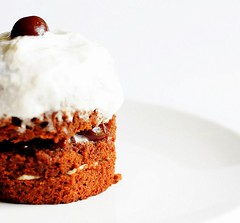
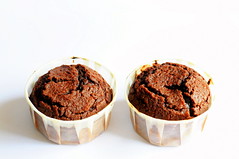
Black Forest Cupcake: Prototype Beta
The problem was the possession of an unusual palate, one fond of intense flavours and a variety of textures in one confection; one roused only by perceived complexity and depth. Few others commensurated. This meant it was fairly useless for taste-testing food to be eaten by other people. Therefore, man-on-the-SBS-bus guinea pigs cupcake testers had to be recruited for the purpose.

Black Forest Cupcake Prototype Beta: the consensus was that the cupcake was very rich (score!). This didn't stop people from scarfing most of it after a very full dinner while complaining about aforementioned richness.
Experimental Sponge Cupcakes: Self-raising Flour, Some Cake Flour, Some Cocoa Powder, More Butter, More Melted Chocolate, Black Cherry Jam, Lower Oven Temperature
Everyone also agreed that the sponge had the right texture and a good crumb, was nice and chocolatey and moist. I'd left them a bit fudgey which was a-ok with the testers. Apparently some cupcakes bought off homebakers through the internet had crumbled like dust and tasted like styrofoam, so they hadn't been expecting much better.
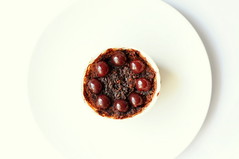
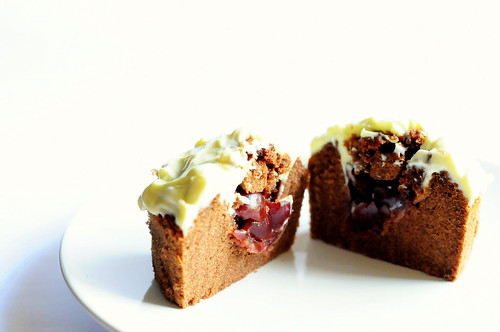
Black Forest Cupcake: Prototype Gamma - Layer of Kirsch-soaked Cherries
The proportion of alcohol was just right (I upped this for the alkie whose cupcake was deliberately doused with kirsch and as a consequence was happy for the rest of the afternoon). Opinion on the cream cheese frosting was varied: some liked how it cut through the uniform taste of the cake, some thought it introduced too many flavours, others thought it was too salty for what they perceived to be a sweet dessert, and still others just bore a grudge against cheese in all forms anyways. The kirsch-soaked half-globe cherry layer had some rabid fans but others thought them distracting. "How to pack the cherries to perfection so as to use as little cream as possible?" ask Tomaso Aste and Denis Weaire in The Pursuit of Perfect Packing. I just didn't use any cream lor. Which probably contributed to the lack of structural integrity.


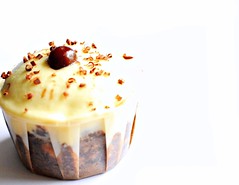
Black Forest Cupcake: Prototype Gamma
Black Forest Cupcake Prototype Gamma, topped with thick cream and cream cheese whipped together and sprinkled with dark chocolate curls, was better received.

Black Forest Cupcakes ready to take over the world!
Take us to your leader!
The second problem was that, despite what all this baking and (cup)caking might suggest, I wasn't actually fond of sweets and desserts. Like how it had been with the chemistry kit, I just liked observing chemical reactions taking place. So naturally, was most keen on having the cool sort of housemates who'd be ecstatic about a bathtub splattered with chocolate.
Heston Blumenthal's "In Search of Perfection" - The Black Forest Gateau

These chaps were working on a recipe from Heston (Fat Duck) Blumenthal's In Search of Perfection. Which hot-blooded person wouldn't be excited about the power-tools macho-ness of assembling a black forest gateau with the aid of a vacuum cleaner, a paint spray gun and several canisters of nitrous oxide? The Times published a copy of the recipe here and The Independent, unsurprisingly, dissed it/its creator as pretentious.

Edison Chen, Nigella Lawson, Heston Blumenthal. Everyone loves to have a go at public figures. There is good money to be made by tabloids in putting people on pedestals and tearing them down later. The gossip rags in Zion/Jerusalem must have had a field day with King David.

The story is well-known. In spring, the time kings go out to battle, the glorious leader is slacking in the palace. After an idle lounge-about one afternoon, he steps out to the balcony to survey his kingdom and spies a very beautiful woman (in the words of 2 Samuel 11) bathing. He inquires as to her identity and is told that she is the wife of Uriah the Hittite, one of his own valiant men (1 Chronicles 11:41) who is away fighting David's wars for him. Whatever. David has the unfortunately-named Bathsheba is brought to him, he has his way with her and then sends her home. She later discovers that she is pregnant with his child.

David's first instinct is to cover up the deed by recalling Uriah from battle and trying to get him to sleep with his wife. Uriah refuses to even step into his own house. Damningly he reasons,"The ark and Israel and Judah dwell in booths, and my lord Joab and the servants of my lord are camping in the open field. Shall I then go to my house, to eat and to drink and to lie with my wife? As you live, and as your soul lives, I will not do this thing." (2 Samuel 11:11). His concern is for his compatriots, his king, his nation and God, not his personal desires and comfort.

But David is unrepentant. He then attempts to get Uriah drunk so Uriah might do everyone a favour and wander off home in his inebriated state. But even when plastered, Uriah remains resolute. So like a good mafia boss, David arranges to have him killed in battle. David then marries Uriah's grieving widow, Bathsheba.

This would have been a nice clean ending to the mess since pesky forensic detectives and democratic tabloids had yet to be invented. But someone was watching. He knew what David had done last spring (2 Samuel 11:27) and wasn't terribly pleased. And he had the power to do something about it.

But in the meanwhile, we tsk and tut at David's folly and expound on the dangers of giving in to lust and of open-air baths. But secretly, we are pleased. It is good to see a righteous man fall. It is good to hear of married pastors running off with their partners or of priests molesting young boys. It is good to know that people are scum like us so we won't have to try so hard to be godly; we can be content wallowing in our scuminess. In fact, we can go one better by riding past on our moral highhorse and spitting on these once great/respected men. (The hip-ness of environmentalism and animal welfare-ism can also be linked to this, but that's another post.)

The most satisfying thing about all the juicy "did you hear?", "did you know?" tattle is to gasp, hand to open mouth,"Who would have guessed?" Who would have guessed that David, God's own anointed king, the person God said was a man after his own heart, would have so nonchalantly committed adultery and murder?

But perhaps the right and smart response to all this is not to be smugly confirmed in our sinfulness but to be warned never to be fooled into being complacent about our lack of sin. Life isn't a moral high-horse race or a competition to convince ourselves that we are really good people. It is lived out under an all-seeing, all-knowing judge who will one day deal justly with all who do not live rightly according to the natural laws of his creation.
But the thing that David had done displeased the LORD. (2 Samuel 11:27)
____________________________________

Labels: , , , ,

Monday, April 21, 2008

The Covalent Bonds of Cake-baking and the Covenantal Bonds of 2 Samuel 8-10

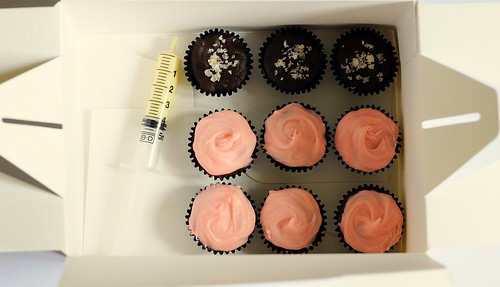
Mini chocolate cakes in their box
Made some petit fours for someone's birthday last week. She's a great fan of the colour pink so dyed the white chocolate topping pink and sprinkled pink sea flakes on the rest of the mini-cakes.

Mini chocolate cakes
They were accompanied by a small syringe of cream cheese - for those who might want a little extra on the side.

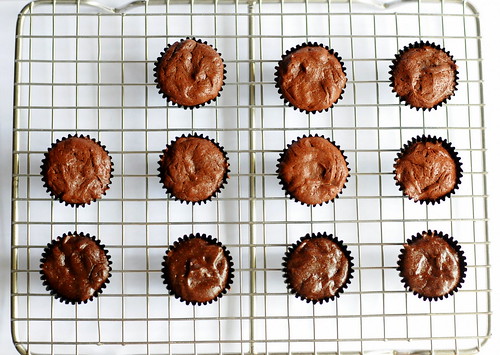
Mini chocolate cakes just hangin' around n' chillin'
The bottom row: the result of cake mixture baked in an oven that was moseying up to the desired temperature because someone couldn't be bothered to preheat it. The middle row: the result of cake mixture baked in a preheated (by default) oven. The empty space in the top row: the result of not putting up "Eat and Die!" signs when the cakes are cooling.


This week, someone else asked for a blackforest cake (black forest gauteux to Brits) for her birthday, at which point, Eddie Izzard's "Cake or Death" routine came to mind. In the context of my baking, the only response would be,"Oooh, I'll have the cake and the death please, if you don't mind."

There is no love lost between the BFG and I: sponge? Bland. Whipped cream? Boring calories. Maraschino cherries? Like eating plastic. Still, googled some recipes, all at some sort of variance with each other. At which point, baking recipes seemed a repository of old wives tales asking to be taken with a heavy dose of stupidly blind faith. Might as well believe that ugly people sour the cream, bathing naked under the full moonlight in the Singapore River will give you SKII-clear skin and praying over the new TV will keep the follically-endowed Sadako from emerging therefrom. Oh, wait. Some people do believe such things.

In line with the constant need to know the whys, hows and whatfors of things that used to traumatise teachers and make priests almost lose their faith, decided it was best to first investigate science behind a basic cake.

Alot of science is made up of theories about material phenomena and explanations of interactions and correlations between multiple phenomena. And theories are really mere hypotheses, to be confirmed for the meanwhile or to be disproved at the next experiment.

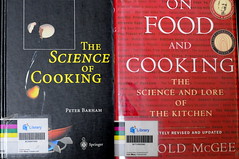
Food Science Books
Still, without adequate resources, equipment and guinea pigs to test all theories out for myself, we takes what we can gets for now. It's amazing how much complexity there is behind the 4 basic ingredients for a cake: eggs, sugar, flour and fat. It's also amazing the sort of books we have in the national/community libraries of Singapore.

Most recipes for sponge cake insist on either baking soda, baking powder or self-raising flour. From using sodium bicarbonate and diluted hydrochloric acid and red dye to simulate a stomach bursting under Japanese water torture in history class, and from whatever little knowledge gleaned from chemistry class, remember baking soda as an alkali. Therefore its use in sponge cakes is probably to, through its reaction with other ingredients, produce carbon dioxide that would make the cake rise into required sponginess.

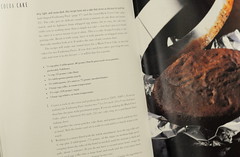
Pierre Herme's Cocoa cake Recipe
Pierre Hermé however, in Chocolate Desserts, does not require the addition of an alkali. Instead, he advocates the whipping of the egg whites and egg yolks separately, then folding the whipped whites and other ingredients into the yolks.

Some sort of sponge cake method? Peter Barham (of the famous Physics of the Black Forest Gauteux lectures at Bristol) gives this probably rather simplistic for-the-layman explanation in The Science of Cooking:

Genoese (Génoise) Sponge Cake
The best sponge cakes are those with most and smallest bubbles when cooked. Genoese sponge cakes do not use a raising agent as baking powder, but rather the bubbles are made before the cake is put in the oven. The bubbles are in the form of an egg foam. The other ingredients are then gently added to the foam so as not to break any of the carefully prepared bubbles and then the cake is cooked. The cake rises a little during the cooking as the air inside the bubbles expands and as some steam is generated. In the oven, the heat crosslinks and coagulates the egg proteins and so sets the cake.

Eggs
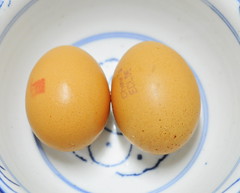
Chicken Eggs. Duh.
Egg whites are made of proteins. Proteins themselves are made up of amino acids held together by internal hydrogen bonds. Hydrogen bonds are...well, to paraphrase John Polyani "chemist-speak for 'it makes atoms stick together but we don't know why'."
The aim of whipping the egg white is to break down the hydrogen bonds from their natural state ("denaturation") to incorporate the air bubbles. Denaturation occurs by heat (egg proteins denature at 40 degrees celcius) and by stretching the molecules through agitation.
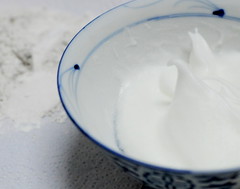
Egg Whites Whipped into Shape
Harold McGee in On Food And Cooking adds that ovalbumin, the major protein in egg white, is relatively immune to beating and doesn't contribute much to the raw foam. However, it is sensitive to hear, which causes it to unfold and coagulate. So when the raw foam is cooked, ovalbumin more than doubles the amount of solid protein reinforcement in the bubble walls. At the same time, much of the free water in the foam evaporates.

There is some fat present in the egg yolk, which decreases the ability of the proteins to foam well, analogous to the disappearance of washing up bubbles when oily dishes are added. Which is why Monsieur Pierre recommends the segregation of the white and yolk for whipping.

Also, not all eggs are created equal. McGee gives some pointers: old eggs at room temperature are often recommended on the grounds that the whites are thinner and therefore foam more rapidly. This is true, and very fresh eggs are said to be almost impossible to foam by hand. But fresh eggs are less alkaline and so make a more stable foam; the older thin white also drains from the foam more easily, and old eggs are more likely to leave traces of yolk in the white. Cold yolks are less likely to break as you separate them from the whites, and the whipping process quickly warms cold eggs anyway.

Both Barham and McGee concur about the apparent magical qualities of beating eggs in copper bowls: copper has the useful tendency to form extremely tight bonds with reactive sulfur groups: so tight that the sulfur is essentially prevented from reacting with anything else (sounds like TomKat to me). So the presence of copper in foaming egg whites essentially eliminates the strongest kind of protein bond that can form, and makes it harder for the proteins to embrace each other too tightly.

Sugar
Caster Sugar
If the egg foam is the tenous framework, then the sugar acts as the reinforcement bars. Sugar increases the viscosity or "thickness" of the egg.

McGee: by making the liquid thick and cohesive, sugar greatly slows drainage from the bubble walls and coarsening of texture. In the oven, the dissolved sugar hangs onto the water molecules and so delays their evaporation in the high heat after ovalbumin has had time to coagulate and reinforce the raw foam. And it eventually contributes reinforcement of its own in the form of fine by solid, cotton-candy-like strands of dry sugar.
McGee also warns that the addition of sugar early in the foaming process actually reduces the foam's ultimate volume and lightness. The delay comes from sugar's interference with the unfolding and bonding of the proteins. And the reduction in volume and lightness is caused by the syrupy sugar-egg mixture being harder to spread into thin bubble walls. Useful for equipment-challenged people like me who have to hand-whip the stuff.

Flour
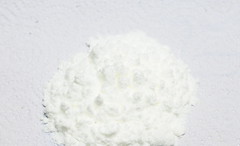
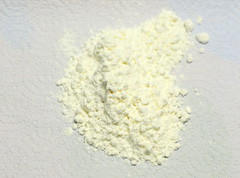
Plain Flour
The flour acts like concrete. The starch is a reinforcing agent which stiffens and strengthens the egg foam. Without starch, the egg foams even when cooked would not be strong enough to support the cake filling. There is also some cross-linking of proteins to starch during cooking.

Fat (butter or oil)
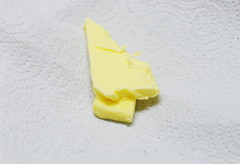
Unsalted Butter
This acts as an anti-staling agent which slows down the rate at which water consorts with the starch and turns the cake stale. It also adds flavour and texture to the cake. It is quite possible to make perfectly acceptable cakes without adding any fats but they would become stale in just an hour or two.

McGee opines that solid fats also retain air bubbles thanks to their semisolid consistency. When beaten together with sugar, the air carried along by the sugar crystals and beater becomes immobilised in the mixture of crystalline and liquid fat. And while butter is still the fat of choice for bakers who value flavour over lightness of texture, modern vegetable shortenings do a better job of incorporating air bubbles into cake batter.

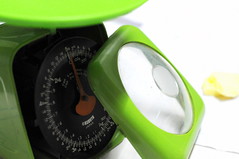
Retro Weighing Machine
Armed with these hypotheses, I came up with this plan for making the sponge layer of the BFG without chocolate:
  1. preheat oven (since it is a race against time to immobilise the air bubbles in the egg foam which would have started collapsing with the addition of the fat and egg yolk mixture. Also if the batter sets slowly, the expanding air bubbles can coalesce to produce a coarse, heavy texture)
  2. melt butter (ensures time taken to mix in butter is minimised, thus reducing amount of collapse of egg foam)
  3. repair very old weighing machine, then measure out flour and sugar (no sifting because unlike what most books say apparently, sifting does nothing to aerate the mixture later. The sifting was a historical requirement to preclude weevil or mouse-dropping flavoured cakes)
  4. whisk egg yolk and sugar together until pale yellow (colour being a guide to the size of the bubbles in the mixture. Theoretically, smaller particles will reflect back more light in all directions, making the object appear to be a colour nearer the white-side of the spectrum)
  5. whisk egg white, adding sugar only after soft peaks form
  6. fold in everything in quickly "with a light hand" (again to minimise collapse of egg foam)
  7. pop in oven
  8. remember to check oven
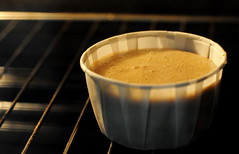
Sponge Cake Mixture in Oven: The Beginning
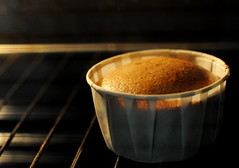
Sponge Cake Mixture in Oven: The Rise
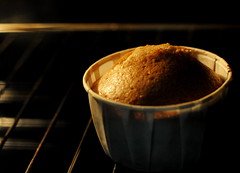
Sponge Cake Mixture in Oven: The Fissure
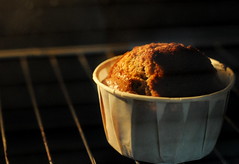
Sponge Cake Mixture in Oven: The Crusty Crack-over
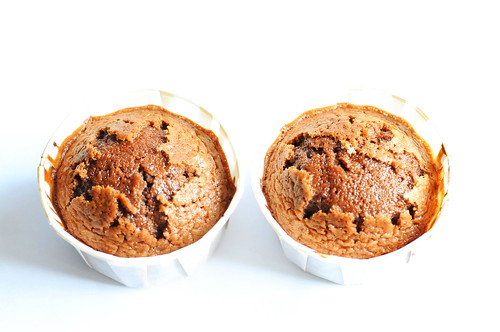
Despite assurances from Barham and McGee, I still marvelled at the rising of the cakes (in cupcake containers for experimental purposes) without the benefit of raising agents. This one was probably subject to too hot an oven.

Experimental Sponge Cupcakes: Plain Flour vs Cake Flour
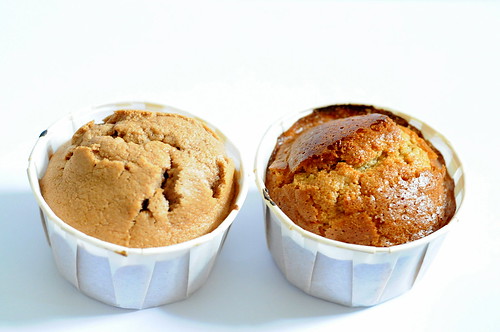
This first experiment was meant to test the difference between the use of plain flour and cake flour. Cake flour has less protein than plain flour and I wanted to see if this would result in less moisture retention and a more poofy cake. Unfortunately, I got too bored waiting for the cake-floured cake to bake, wandered off and left it in the oven for too long, thereby inadvertently introducing another variable into the experiment. I might also have used a different higher temperature for the second cake. Nevermind, I thought, I'll just do a taste test when I get home from work to see what can be gleaned. But when I got home, the cakes had been eaten by person or person(s) unknown. Their crushed containers lay empty in the bin. I bet Pierre and Marie Curie never had this sort of problem.

Anyway, someone owned up later by saying that although the cakes were very yummy, one of them was a bit on the dense side. Not quite the very sponginess the birthday girl had requested. The unwitting guinea pig not having paid much attention to which one he had eaten, I could only guess that the reference was to the cake flour model. Was this the consequence of its length of time in the oven, the low-protein of the flour or the ratio of flour to sugar and fat?

Experimental Sponge Cupcakes: Cake Flour, Cocoa Powder and Melted Chocolate
The second experimental batch spent less time in the oven. I replaced some of the flour with cocoa powder (Valrhona, therefore dutch-processed, cocoa powder apparently having the ability to take on some of the water-absorbing and structural duties of flour, being about 50% carbohydrate and 20% non-gluten protein) and added melted chocolate to the melted butter, thereby introducing far too many variables for this to be a proper experiment.

Black Forest Cupcake: Prototype Alpha
Black Forest Cupcake Prototype Alpha
These ugly chaps were tasty and small of crumb but still too dense for a spongey sponge. Did I fold in with too heavy a hand? Did the cocoa powder and chocolate take in too much water?

The experiments continue...

...as does our womble through the second book of Samuel. 2 Samuel 8-10 reminded me how, just as we put our faith in scientific theories because the stated results have been proved over and over again through numerous experiments, so we put our faith in God not with the blindfolds on but because he has proved over and over again that he can be trusted.

In 2 Samuel 7:9, God had promised to make for David "a great name, like the name of the great ones of the earth". Fast forward to 2 Samuel 8:1-14 and David did indeed defeat the Philistines, the Moabites, Hadadezer king of Zobah, the Syrians and the Edomites and he defeats the Ammonites in 2 Samuel 10. Through his conquests and victories, David made a name for himself (2 Samuel 8:13) or rather, it was God who made a great name for David, for it was God who gave David the victories (2 Samuel 8:6,14).

And not only were David's victories a fulfilment of God's promises to him, they were also a fulfilment of God's promises to Abraham about a thousand years before. In Genesis 15, God had covenanted with Abraham concerning roughly the same geographical area:
To your offspring I give this land, from the river of Egypt to the great river, the river Euphrates, the land of the Kenites, the Kenizzites, the Kadmonites, the Hittites, the Perizzites, the Rephaim, the Amorites, the Canaanites, the Girgashites and the Jebusites. (Genesis 15:18-21)
This was also the land God had promised Israel, the place where he would "plant them, so that they may dwell in their own place and be disturbed no more. And violent men shall afflict them no more, as formerly, from the time that I appointed judges over my people Israel" (2 Samuel 7:10).

God's promises were being fulfilled (in part) through his chosen king David and David too modelled some of God's covenantal faithfulness. In his younger days, desperate and fearful for his life, David had made a covenant with Jonathan not to cut off his steadfast love from Jonathan's house forever, even when the LORD cut off every one of David's enemies from the face of the earth (1 Samuel 20:14-15). With Jonathan dead and no witnesses to the covenant, David could easily have ignored it, or dismissed it as youthful folly. Instead, not only did he not kill Jonathan's remaining son, Mephibosheth, the obvious rival to the throne, he also heaped generous kindness on him: bestowing upon him the privilege of eating at the king's table (2 Samuel 9:7,9,13) and also restoring to him all the lands of his grandfather Saul and servants to work the land so that he and his family would be well-provided for (2 Samuel 9:7-13).

But, as suggested by the reference to a future king who would be both David's offspring and God's own son (2 Samuel 7:12-16) David was merely a foreshadowing of God's perfect anointed king to come. His name was Jesus, through whom (as Yuk Yee pointed out) God showed generous kindness to us: while we were still enemies, Christ died for us. Very rarely would anyone die for a righteous man, though for a good man someone might possibly dare to die. Yet Christ died for the benefit of undeserving sinners (Romans 5:6-8).

And through Jesus' death, he gained victory over more than physical territory. He destroyed the devil who had the power of death over us and so delivered us from the slavery of death (Hebrews 2:14-15). And having gained victory over more than just terra, Jesus' rule was and is over and above everything: all rule and authority and power and dominion, and above every name that is named, not only in this age but also in the one to come (Ephesians 1:21).

If Jesus rules over all things, then there is no opting in or out of his rule. The choice lies in acknowledging this reality or living as Jesus' enemies, to our future and eternal detriment.

__________________________________

Labels: , , , ,

Sunday, April 13, 2008

Operation Leftover Easter Stuff: Chocolate Experiments in the Physiology of Taste and 2 Samuel 7

So, there is nothing new under the sun.

At a sushi-and-chips dinner (sounds trashy but they're really rather complementary), I started to play with my food experiment with the resources at hand.

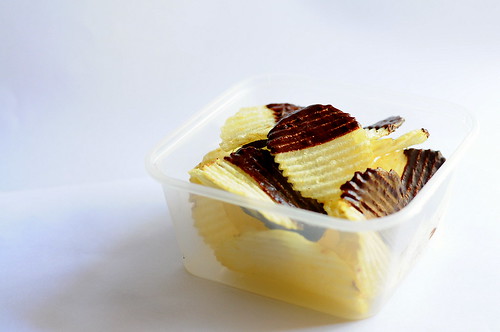
Ridged Chips (Crisps) Dipped in Dark Chocolate
Ridged chips/crisps dipped in dark chocolate = white trash, trailer park grub but as I have been soundly advised, it's all in the marketing. In a gourmet shop, this stuff would be ensconced in pretty tissue, nestled in a pretty box with pretty ribbons, labelled "hand-dipped" and cost you your first-born child.

Taking the theory of the action of salt on statuary from my cultural artifact preservationist days one step further, I put the chips in a hot oven before them dipping in the melted chocolate, on the hypothesis that the air in the salt-created cracks would expand and as the chips cooled and the air in the minute cracks contracted, they would pull in the chocolate. All the better for all-round tastiness.

Say José Miguel Aguilera and David W. Stanley in Microstructural Principles of Food Processing and Engineering far more competently on a not-totally-dissimilar matter:
Kinetic data suggests that oil migrates from the surface to the interior of the crust [of the fried potato product] after frying through fine capillary openings in the intercellular spaces, probably by two mechanisms: pressure flow promoted by a vacuum from condensing steam and capillary flow.
Coolness.

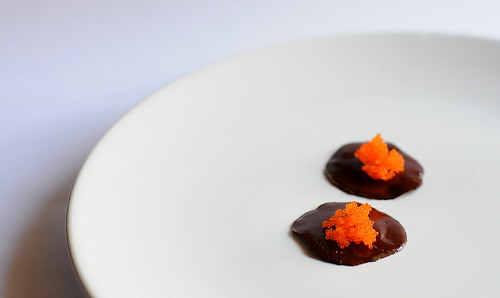
Tobikko on Dark Chocolate
Intrigued by the complementarity between saltiness and bittersweetness, I dropped some tobikko (salted flying fish roe, とびこ) (I think) onto Guanaja Valrhona dark chocolate. Not bad.

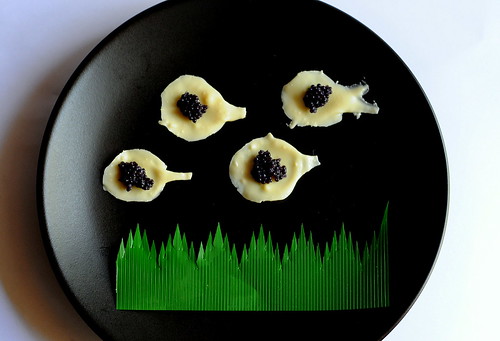
Caviar on White Chocolate
Unevolved prehistoric creatures! Yums.
Then tried Lumpfish caviar on white chocolate. Amazing. The more extreme saltiness and sweetness made for wonderful bedfellows. The trick was to let the white chocolate melt in the mouth before popping the caviar against the teeth, so that both flavours peaked in unison. Having multiple tastes and textures in a mouthful made it far more interesting. Blandness then, isn't a lack of flavour, it's having only one flavour and no contrasting texturezzzzz.

The next day, I told a colleague about my dinnertime experiment. She clutched my arm and her eyes were wild: white chocolate and caviar was the exact same combination she'd had at Ferran Adrià's El Bulli in Spain. A quick google showed that this was a classic molecular gastronomy pairing. In the Guardian, Heston Blumenthal of Fat Duck relates his white chocolate-caviar testimony. He dictates that only real caviar (ie, not my S$6 lumpfish roe and sturgeon caviar wannabe) is to be used but that's probably outside the purview of my stewardship of money.

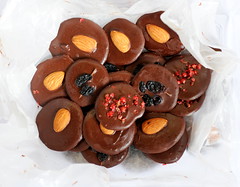
Chocolate Mendiants
In any case, was most chuffed. There were others like me! I was not an alien! Good to know because a few weeks back, I'd made chocolate mediants embedded with naked almonds, vodka raisins and crushed pink peppercorn. The pink peppercorns in particular made grown men cry for mercy, women cross themselves and children run into houses and shut the doors behind them. But guess what, it's a very Carlo Ponti-Sophia Lauren MC coupling! I can charge more than the entire shareholding of Bear Stearns for this! Oh wait, that's probably so cheap it'll make grown men cry.[1]

White chocolate embedded with dill and crushed pink peppercorns
Also tried crushed pink peppercorns with dill from the backyard herb garden on white chocolate. Didn't taste too bad, dill's pretty mild anyway and the peppercorns were more jangly in the white chocolate than in the bittersweet dark chocolate. Have to figure out what to do with the dill though - too chewy in its current state. And the tempering of white chocolate (termed "chocolate" only because of the presence of cocoa butter and not cocoa) obviously remains a great mystery to me. Shall turn to google for rescue.

Jean Anthelme Brillat-Savarin wrote in the very instructive (at least when I was in uni) La Physiologie du Goût that "the discovery of a new dish does more for human happiness than the discovery of a new star". There being nothing new under the sun, I very much doubt that all the classic molecular gastronomical pairings are unique and worthy of patent. 50 goblets of the chocolate + chilli combi, I think, was Montezuma's daily dosage several centuries back.

Even further back than that, David and Nathan were having a bit of a chat one day (2 Samuel 7). This can't be right, said David, my living in plush digs while the Ark of God, the symbol of God's presence, sits in a shabby tent. I'll build a nice house of cedar for it. Go on then, said Nathan the priest. Because, c'mon, who could argue with such piety? (2 Samuel 7:1-3)

Well, God disagreed. Who are you David, came the rhetorical question, that you should build a house for me? God had never asked for such a thing (2 Samuel 7:4-7) God wasn't some work of human hands who was so helpless that he needed to be carried around, showered at regular intervals and built nice houses of high-quality termite-free wood by the very creatures he'd created: he'd made David, a mere shepherd boy, prince over God's people, just as he had promised (2 Samuel 7:8); he gave David victory over his enemies, numerous and powerful as they were (2 Samuel 7:9a). A very powerful God.

And God would to do more. He would make David's name great and give him rest from all his enemies (2 Samuel 7:9b, 11b) and he would establish David's dynasty and kingdom forever (2 Samuel 7:11c-13). And he would give Israel their own land where they could dwell peacefully (2 Samuel 7:10-11a). Neither David nor Israel had done anything to deserve this. This was but a hint of God's undeserved grace to come.

While most promises and contracts have a timeframe, God's promises to David and Israel stretched into perpetuity ("forever" - 2 Samuel 7:13, 16, 19, 24, 26, 29). We know that God had been faithful to his promises thus far but forever was going to be, to put it mildly, a very long time. And from Israel's recent conduct of the Ark and their past dealings with God, everyone could expect that Israel would very quickly fail to be faithful to God. And David too would soon sin in a very spectacular and tabloidy way (2 Samuel 11). Would this disqualify God's promises?

It seems not. God did not impose conditions to his promises, yet he fully expected that both Israel and her king would turn away from him (2 Samuel 7:14-15) and still pledged to keep to his promises. How would God be able to remain faithful to his promises and yet be just and righteous in dealing with sinners as they deserved?

Like molecular gastronomy, God's covenant (contract) with David was not new. It was infact a continuation (yet expansion) of the covenants with Abraham and Moses hundreds of years before: the promises of God's people in God's land under God's rule (see eg. Genesis 12:6-7, Genesis 15, Exodus 19-24).

And like molecular gastronomy too, God's covenant with David was not the be all and end all of revelation. After many more hundreds of years passed, David's descendant Jesus, at once both fully man and fully God, sinless amongst all men, would come deal with the problem of how a righteous God could deal faithfully with sinners who deserved only death: he died in their place so that before God, all who put their faith in him would be attributed his own righteousness. And so Jesus opened the way for the fulfilment of God's promises.

Who are God's people then? And where is the land promised to them?

The land promised to God's people is not that Zionist hotspot in the Middle East. The Book of Hebrews argues that if possession of the physical land of Israel was the fulfilment of God's promise of a resting place for God's people, then David would not have, while king over the nation, spoken of a future rest (Hebrews 4:8). The promised land is the new city in the new heavens and the new earth which will be inaugurated at Jesus' second coming (Hebrews 11:16).

And who are God's people? Not the Israelites or their descendants, the Jews, but those who put their faith in Jesus to save them. The multicultural international nature of God's promises had already been hinted at thousands of years ago when God made a covenant with Abraham (Galatians 3:7-9, 29; Romans 9:6-8).

Coolness indeed.

[1] Good to know also that basic molecular gastronomy is about food hacking and culinary experiments rather than chi-chi expensive places with gold wheelchairs and where flipflops are discouraged!

__________________________________

Labels: , ,