Wednesday, April 13, 2011

The Pies of Pressing Petition


Banana bottom of Banoffee PIe
Assembled a chocolate, banana, toffee pie for the first time last Saturday. Unfortunately, it was for a newcomers' dinner at which several people, for whom banoffee pies were sacred, would be present. Hadn't been too fond of the same confections they'd said they'd enjoyed on account of stupid taste buds that only understand things in layers - that is, layers of taste and texture. So didn't think they’d like the stuff and wasn't sure anyone would take well to bananas in their dessert. But it couldn’t be helped - I'd volunteered to bring something and hadn't remembered till the last hour, there were relevant items near their expiry that needed to be in tummies pronto, I was in the midst of preparing a bible study on Genesis 32 involving a motley collection of Playmobil figurines pretending to be Jacob, camels and a heavenly wrestler… so needed something fast and easy.

Also, was rather nervous using dairy products that were near expiry - didn't want to obviate anyone’s opportunity to come into a saving relationship with God or dissuade them for coming for the Sunday meeting or Christianity Explored the next day.

So there was a bit of triangulating between the necessity of bringing something (the worried host had said that there wouldn't be enough food), how loving it might be to neighbour to bring something that they might not enjoy, and how the remaining few hours to the dinner should be spent.

In the end, the deed was done, tummies were filled, no food was wasted and no one was harmed (to my knowledge), but not before desperate petitions were sent heavenward that the dish not ruin the proposed welcome and fellowship.

Lush chocolate intrusion into Banoffee Pie
Later that night, the mental filing cabinet popped open at the tab labelled:

"prayer - empty parking lots"

Was it God-honouring to pray about such trivial matters? Added Phillip Jensen’s article to that folder:

Praying In Crisis: Helpful Or Hypocritical?
Originally Published:
25th February 2011


It is an old wartime saying that ‘there are no atheists in foxholes’. Leaving aside the silly arguments as to whether this is statistically true or an aphorism – is it a good thing? Will God be pleased to answer the prayers of those in danger? Is God honoured when we pray to him in times of trouble?

Prayer is one of the most basic human responses to trouble. When the doctor’s diagnosis is really grim, it is only natural to seek divine help. When our children are in danger, who doesn’t utter a quick prayer for safety?


But is prayer to be encouraged amongst people who ignore God except in times of crisis? Is God to be used as a 'phone-a-friend' when the going gets tough? Will God allow us to be his ‘fair weather friends’ – only calling upon him in times of difficulty?

This summer we have seen some dreadful tragedies with floods and cyclones in the Eastern States of Australia, fires in the West, and earthquakes in Christchurch. In the face of these disasters people can do little else but pray for God’s mercy and rescue. Politicians and journalists, not given to religious references, start talking of praying for people when confronted with the horrors of these catastrophes. Only the most rigorous of atheists will talk of our concern for others without mentioning praying for them. But is it a good thing or hypocrisy?

The trouble with unbelievers calling upon the name of the Lord in the face of disaster is that they lose their title deeds to the name “unbelievers”. They may still be doubters or superstitious or hypocrites, but they are no longer "unbelievers".

Even more importantly, the trouble with unforgiven sinners praying to God is that it compromises his holiness. The Psalmist wrote "If I had cherished iniquity in my heart, the Lord would not have listened." (Psalm 66:18). The book of Proverbs says: "If one turns away his ear from hearing the law, even his prayer is an abomination.” (Proverbs 28:9). And Isaiah explained how sin had set a separation between God and Israel so that he, who is able to hear prayers and rescue, did not hear their prayers (Isaiah 59:1f). And James wrote of the adultery of people who in love with this world prayed to God "wrongly to spend it on your passions" (James 4:3f). It is as the apostle Paul says “whatever does not proceed from faith is sin" (Romans14:23).

Here then is the problem: prayer is the articulation of faith. It is the expression of faith – putting trust into words. For in calling upon God in times of trouble we are saying that he cares and is willing and able to help. In other words, we express our belief that God is loving and powerful to save. Encouraging unforgiven sinners to pray in time of trouble may seem to compromise God’s holiness but not to encourage them to turn to God in prayer may be to deny his gracious compassion. Many of Jesus' miracles were performed in response to people asking for relief from their suffering, even though their faith was weak (Mark 9:24), their understanding limited (Mark 4:40) and their salvation not understood until after their healing (Mark 5:34, 10:51f, Luke 17:17f). In fact our English translators often have difficulty knowing whether to translate some passages as 'saved' or 'healed'.

Certainly there may be things we need to fix in our relationship with God. There may be a lifetime of rebellion against him or ignoring him. There may be crimes that need to be dealt with, lifestyle that needs repentance, sins that need to be forgiven and restitution that needs to be made. But turning back to God does not always come in a neat package of sorting out ‘first things first’, because turning back to God is the first thing.

Sometimes it is when we turn back to God that we become aware of the awfulness of our sin in the light of his burning holiness, and are moved by his gracious care to seek the forgiveness we need. It is entering the sanctuary that makes us aware of our unworthiness before God and of the judgement of God upon sinners (Psalm 73:17).

Martin Luther and John Newtown were not the first, nor the last, unforgiven sinners to call out in prayer during the peril of a storm. And Luther did not even call out to God but to St Anna(!) - the non-Biblical legendary grandmother of Jesus whose cult he later attacked. But God used that moment of confused prayer to start him on the pathway of salvation.

Copyright 2011 phillipjensen.com
Reproduced with permission from phillipjensen.com
(Desperate Chocolate Banana Toffee Pies

Base
- pound Digestives finely so the crumbs don't get stuck in people's loose dentures
- melt unsalted butter and brown
- mix in biscuit crumbs
- pat into base and sides of cake tin
- refrigerate

Bananas
- get a bunch of ripe bananas
- slice thinly
- lay onto biscuit base

Toffee
- pour contents of two tins of condensed milk (not evaporated milk) into glass container
- place glass container into a high-walled roasting dish and cover tightly with foil
- pour hot water into roasting dish around glass container
- place in oven and heat at 200 degrees celcius for 1 hour or until caramel-dom is achieved
- pour as much as possible onto banana layer

Add another layer of bananas.

Chocolate
- obtain a 72% Valrhona chocolate block from wholesaler
- melt chocolate
- stir in double cream into melted chocolate
- pour onto banana layer

Add another layer of bananas.
Add another layer of toffee/caramel.
Add another layer of bananas.
Press the whole lot down because you are running out of height space in cake tin.
Contemplate the meaning of life.

Cream
- whip together double cream and mascarpone and the contents of vanilla beans
- dump on top of last layer of bananas

Refrigerate the lot.
Shave remains of aforementioned chocolate block.
Dump shavings on before serving.)

Labels: ,

Wednesday, August 04, 2010

Don't Be Road Kill (1 Corinthians 9 - 11:1)

Enough fallen bodies by the wayside these past few months/weeks to be shocked into weeping and duly warned into remembering the sheer hard work and stubborn-mindedness needed to finish running the race (1 Corinthians 9:24-27).

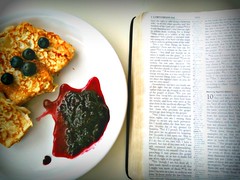
Pancakes, blueberries. Pancakes, blueberries, 1 Corinthians 9

It means nothing to have the "blessings" of this life (material or spiritual) - it is not enough to be "blessed" with fat o' the land in this life, to experience true miracles, to be supernaturally healed or saved from certain physical death, to be approved to lead/teach others, to be fruitful in multiplying one's ministry; none of these are conclusive evidence that God's favour is upon us.

Blueberry Cake

God loved and chose the Israelites. He rescued them from slavery in Egypt through more mighty miracles than the civilised world had ever experienced. He carefully and graciously brought them out and provided for them all along the way. Yet, with most of them he was not pleased and all but two perished in the wilderness (1 Corinthians 10:1-10).

Running race means doing all for glory of God (1 Corinthians 10:31). But we do not run aimlessly (1 Corinthians 9:26). There is no licence for doing what we think bring him glory; God is fairly clear on what he wants - for all people to be saved. God will be worshipped on his own terms and not ours. We are duly warned by the destruction of the Israelites to made a golden calf as part of their worship and gratitude to the God who saved them (1 Corinthians 10:7), the killing of those who took sins lightly (1 Corinthians 10:8), the destruction of those who distrusted God (1 Corinthians 10:9) and the proud (1 Corinthians 10:10).

Moneygami Orikane Ring
Moneygami Orikane Ring Moneygami Orikane Ring

How can we then be so blindly bold as to insist on our rights and so hinder people accepting the gospel and its blessings (cf 1 Corinthians 9:1-23)?

How can we then be so glibly presumptuous of our freedom that we are dismissive of our worship of demons? (1 Corinthians 10:14-22)

Yet, God tells us that we will do so. Sacrificing our rights, not stumbling others, being paranoid about whom we worship are not good-to-haves for Advanced Christians. They are matters of eternal life and eternal death. Even the apostle Paul himself was in danger of being disqualified in the race after having seen Jesus and spent a lifetime preaching the Way (1 Corinthians 9:27). What more, we?

Let us beat our bodies and keep them under control, lest we too fall by the wayside. We have no excuse, for God can be trusted not to let us be overwhelmed with the temptation to stop running the race; he will give us an escape route from sin (1 Corinthians 10:13).


*for future personal reference - David Burke/ORPC, NIECU, SMUCF grads, that which caused an elder to leave his church, old lady killer litter and the 4D hunter etc

Labels: ,

Monday, March 15, 2010

Breakfast. Idolatry. Cupcakes. God's Faithfulness. God's Discipline.

Yoghurt, Toasted Oats with Pecans and Walnuts, Apple Slices Slathered with Fauchon's Confiture de Lait Yoghurt, Toasted Oats with Pecans and Walnuts, Apple Slices Slathered with Fauchon's Confiture de Lait
Fauchon Confiture de Lait ESV Outreach Bible

One never quite acknowledges the presence of an idol in one's life until one rises in the morning to worship it, only to find it has been taken away in the night.

Humans were made for worship and so everyone worships something, even those who claim to be atheists. The sorrow and mourning with which one greets the disappearance of that which we worship and the resultant emptiness in our lives betray the identity of that god (some material thing, or a relationship, or a person, or even a talent or trait that we die die must have).

Surely it is useless to give one's all for a false god, a god who either promises much or whom we think promises much but cannot deliver. On the threshold of the Promised Land, the Book of Deuteronomy tells us that Moses reminded the Israelites of the faithfulness of God: how he had made a seemingly impossible promise to Abraham and Sarah, who were barren in their old age, that he would give them descendants more numerous than the stars in the sky (Genesis 22, Genesis 26) and how this had indeed been fulfilled (cf Deuteronomy 10:22). This was but a snapshot, a sample, of the overarching faithfulness of God who would go on to promise through various prophets (as recorded for us in the Old Testament) that he had seen the suffering and pain and death in this fallen world caused by the sin of man and that he could and was more than willing to save anyone who would avail himself/herself to his rescue. This rescue, the prophets said, would come through an anointed king who was God himself (Psalm 2), the Son of Man who would come to judge the world (Daniel 7), and also through a suffering servant of God (Isaiah 53).

When Jesus arrived, he proved to be able to do the things only God could do - not just healing the sick, lame, deaf, blind and casting out demons without any mumbo-jumbo, but also raising the dead, creating food and controlling "nature" (Mark 1:18-8:26). He acknowledged Peter's confession that he was the Christ, the promised anointed divine king, he said he was the Son of Man too but was also adamant that he was the suffering servant of God (Mark 8:27-31). All the promises of God, then, were focused in on one man, Jesus.

Our trust in God is no blind faith, since he has ensured sufficient evidence of his past acts of faithfulness and truthfulness. Jesus has shown that he is the cumulative fulfilment of God's promises and indeed that he is God himself.

The first commandment given to Moses was "I am the LORD your God, who brought you out of Egypt, out of the land of slavery. You shall have no other gods before me" (Exodus 20:2-3). A commandment to be obeyed, yet also a plain statement of fact (cf Deuteronomy 4:32-35). There is no other god to be worshipped besides the LORD.

So Jesus' commandment to those who would trust in him as Christ and Son of Man and Suffering Servant to "deny himself, take up his cross and follow me" (Mark 8:34) is also something to be obeyed, yet the first part also stems from a plain statement of fact: if God is God, there is no other to be worshipped and no other who can interpret reality and tell us of what is to come. Therefore, it is obvious that we must deny all attempts to interpret reality, all attempts to mold Jesus into the nice, hippie saviour we can be comfortable telling our friends about, all attempts to ascribe to God what he has never promised, all attempts to place importance on anything other than God and what God deems important (as expounded in Jesus' words and the gospel (Mark 8:35,38)).

All such delusional attempts will end in failure. Setting one's mind on anything but the things of God as revealed in Scripture has the stink of Satan about it (Mark 8:33). So unsurprisingly, the idolater will does this will lose his life and his soul and be rejected by Jesus when he comes again to judge the living and the dead (Mark 8:34-38).

But sadly, this doesn't stop us professing believers in Christ from wallowing, at times, in this carcinogenic sludge. Sure, one has the niggling feeling at times that perhaps one could be worshipping something other than the One True God (we speak of idols of the non-shiny kind of course, gold leaf being rather vulgar and crass these days cf a certain calf sculpture at the foot of Mount Sinai circa approximately 1,300 B.C.), but with a bit of stonewalling and a lot of dressing up with godly motives and reasons, the conscience soon had its naggy mouth taped over and we were free to enjoy the apparent pleasures offered by the aforementioned god. and the real extent of that cancer's hold on us.

In the cold light of day, our idolatry is starkly stupid. Did our idols create us that in their absence we perish? Would God have us waste our tears over the death of a folly, the removal of a trap of Satan? Do we forget that Moses said to the adulterous Israelites when the writing was still fresh on the covenantal stone:
Go down, for your people, whom you brought up out of the land of Egypt, have corrupted themselves. They have turned aside quickly out of the way that I commanded them. They have made for themselves a golden calf and have worshiped it and sacrificed to it and said, 'These are your gods, O Israel, who brought you up out of the land of Egypt!'" And the LORD said to Moses, "I have seen this people, and behold, it is a stiff-necked people. Now therefore let me alone, that my wrath may burn hot against them and I may consume them, in order that I may make a great nation of you. (Exodus 32:7-10)
Our worship of other gods is insulting to the One True God, and he who created us could have rightly destroyed us.

But if we are reading or typing this then he has not. Because in his immense grace and patience, God elects instead to forcibly remove the tumour, bit by bit. Yet we dare blame him for this and threaten to renounce our heavenly citizenship unless he reinstate the same, or even plead for him to take away our lifebreath now that we have no more reason to live.

Hazelnut Nutella CupcakesScripture about God disciplining us is "a word of encouragement" because it addresses us as God's children:
And have you forgotten the exhortation that addresses you as sons?

"My son, do not regard lightly the discipline of the Lord,
nor be weary when reproved by him.
For the Lord disciplines the one he loves,
and chastises every son whom he receives." (Hebrews 12:5)
We are not to respond to God's discipline with resentment but instead be comforted(!) that God does this because he loves us:
My son, do not despise the LORD’s discipline
or be weary of his reproof,
for the LORD reproves him whom he loves,
as a father the son in whom he delights. (Proverbs 3:11-12)
Moses reminded the Israelites of the same thing in Deuteronomy:
Know then in your heart that, as a man disciplines his son, the LORD your God disciplines you. (Deuteronomy 8:5)
God's discipline is in fact further evidence of God's faithfulness, for what God who promised to rescue will allow his sheep to stray into the mouths of wolves:
I know, O LORD, that your rules are righteous,
and that in faithfulness you have afflicted me. (Psalms 119:75)
Hazelnut Nutella CupcakesThe right response to discipline is not to chaff but to repent:
Those whom I love, I reprove and discipline, so be zealous and repent. (Revelation 3:19)
We repent not by gritting our teeth and chanting "all things work for the good of those who love him" or "this is the best of all possible worlds", but by turning back to God.

Perhaps the dichotomy of mind and heart as is popular in many Christian circles which say that head knowledge must then become heart knowledge must be addressed. While the acknowledgement of mere factual information about God never saved anyone since even the demons acknowledge there is one God and shudder (James 2:19), disobedience and thus idolatry come from error and unbelief in the mind - not comprehending the goodness and faithfulness of God, not trusting that God is God, or that his words are true.

When we find ourselves in sin, or by the grace of God, disciplined for our idolatry, then we must take heed to examine again God's Word and the record of his deeds throughout the whole of human history. Obedience and trust in God isn't quite a matter of applying what we have learnt in bible study; rather it is deepening a relationship with a stable, dependable Father whose ways are not as capricious as humans whose moods vary according to the amount of sleep they've had the previous night, how well they have been fed, the ambient temperature of their environment and how boring the present company.

Hazelnut Nutella Cupcakes

Thanks to Billy and Cindy Foote who kindly sent me their Not a god CD before mp3s were readily downloadable from the web:


You Are God Alone

You are not a god created by human hands
You are not a god dependent on any mortal man
You are not a god in need of anything we can give
By Your plan that's just the way it is

You are God alone, from before time began
You were on your throne, You were God alone
And right now, in the the good times and bad
You are on Your throne, You are God alone

You're Unchangeable, You're Unshakeable
You're Unstoppable, that's what You are

You're the only God whose power none can contend
You're the only God whose name and praise will never end
You're the only God who's worthy of everything we can give
You are God that's just the way it is

Labels: , , , , ,

Sunday, February 14, 2010

Chinese Lunar New Year, 2 Thessalonians 1

Scottish Wholewheat Oatmeal Barley Currant Scone with Clotted Cream and Homemade Marmalade
The Chinese Lunar New Year is usually heralded by transatlantic calls from relatives speaking in tongues, the parentals declining to build a spit in the backyard for roasting a suckling pig (why not go the whole hog for the guests, eh?) and a pot-luck of stapleszzz.

Jamon! Chorizo!
Jamon! Chorizo!

On the way for more groceries, the driver mentioned with great glee that a small present, just off the plane from Bilbao, awaited in a cooler bag in the backseat. Perfecto! Hasta la vista suckling pig, the dead Spanish pig for personal consumption cometh!

Chinese New Year Chicken Curry
The soundscape to accompany the peeling and chopping of a molehill of garlic and weeping into another molehill of onions started with The Mountain Goats' Life Of The World To Come, which like many an un-sermon, featured bible verses as inspiration for songs*. Half way through the garlic molehill, it seemed strange that Jack Johnson was singing about being made holy instead of, say, banana pancakes: Chris Rice's Deep Enough To Dream wasn't half-bad musically and fairly reasonable lyric-substance-wise, with a little more variety in Past The Edges and Smell The Color 9.

Trying to understand 2 Thessalonians 1:5 is also like trying to smell the colour 9, though in this case our faculties (and also late night discussions with people touting more well-oiled clogs) are meant to be of help. Perhaps it smells approximately like this:

2 Thessalonians 1
:3-4
The Thessalonians' faith, love and hope ("steadfastness", cf 1 Thessalonians 1:3) has grown and increased so that Paul is able to boast about them to the other churches of God. Not that Paul sees them as a good pad for his CV as evangelist and church planter and grower, for he thanks God for this since it is God who has wrought their growth in these things (cf 1 Thessalonians 4 - "more and more").

2 Thessalonians 1
:5-10
God considers it just (after all, who else can define "justice") to judge people according to how they respond to him (and his children): vengeance and the punishment of eternal destruction for those who do not know God and who do not obey the gospel of our Lord Jesus (1:8-9); relief to the Thessalonians and to Paul, Silas and Timothy from the afflictions they are suffering (most likely because of the gospel, cf 1 Thessalonians) (1:7); affliction to those who are persecuting those who know and obey God (1:6), who have been called by God to do his work and empowered by him to fulfil their task for which they are being afflicted (1:11). Squeaks of "Oh I thought the vengeful violent God was the God of the Old Testament" would be moot because God himself determines what is right, and since he made the world, it is naturally and necessarily right that he punish the bits of his creation who not only decline to worship their creator but in fact, hinder and afflict those who are trying to tell the world about him (1:10). This is the righteous judgment of God.

The suffering of the Thessalonians (whom Paul has already established are true children of God) for knowing God and obeying the gospel of the Lord Jesus is evidence of the righteous judgment of God (1:5). This sounds as silly as saying that the prison term for the man convicted for breaking into his own house because he lost his keys is manifest evidence of the righteousness of the Singapore legal system. How can the unfair situation facing the Thessalonians be evidence of the righteous judgment of God?

Perhaps in these ways:
(i) in the sense that because this is an unjust situation, therefore, the inevitability of a day when the just God will make all this right, when the wicked and the righteous will get what they deserve (as discussed above);

(ii) in the sense that because of (i), it is proof to the Thessalonians of their current and eventual eternal standing before God - that they will not be away from the glory of his might (1:9) but marvelling at him who will be glorified in them (1:10,12); and also

(iii) in the sense that on the Day of Reckoning, it will show that God's counting them worthy of the kingdom will be right because in their affliction for his work and word, for they would have made it manifestly obvious that they had been obedient to God. Conversely, the righteousness of punishing those who are vexing them for this very reason would also be plain.

(Which would mean that those who preach that peace, prosperity and security now are evidence of God's blessing and approval are dangerously misdirecting their audience.)

Even if we not currently suffering because of the gospel (though rare would be the Christian who never finds himself in tribulation for living out his beliefs and a request for more holiness please usually takes care of that lack!), is the imminence of the Day clouding our waking moments and our dreams?

Are we eager to, boldly without flinching, keep growing in works of faith, in labour of love and steadfastness of hope (cf 1 Thessalonians 1:3, 1 Thessalonians 4)? For we already have great comfort that even if nastiness comes upon our placid lives because of this, it is all the more proof of our status before God now and on the Last Day and the glory our perseverance will bring Him who enables us to persevere.

And whether or not we are amassing questions for the eternal question time in heaven, it would be strange if the desire has not been awakened in us to yearn for the presence of God, if Jesus is not the person we are missing most even if we can avail ourselves to the sentiment of (if not the coupley set dinner menus that inevitably accompany) Valentine's Day; if we are not looking forward to celebrating God's glory in the people who have believed the gospel.


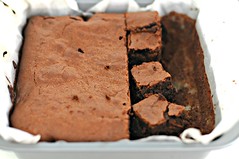
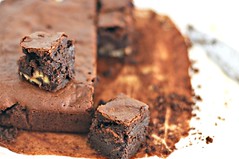
Nick Malgieri's Supernatural Brownie in Pan Nick Malgieri's Supernatural Brownie
Nick Malgieri's Supernatural Brownieszzz, with some AP flour swapped out for wholewheat, an addition of roasted pecans, underbaked by 20 minutes.

*The Mountain Goats, Life Of The World To Come

1 Samuel 15:23


Genesis 3:23


Hebrews 11:40


Romans 10:9


1 John 4:16


Matthew 25:21


Deuteronomy 2:10


Isaiah 45:23


Ezekiel 7 and the Permanent Efficacy of Grace

Labels: , ,

Wednesday, January 13, 2010

Fast (But Satisfying) Food (1 Thessalonians 1)

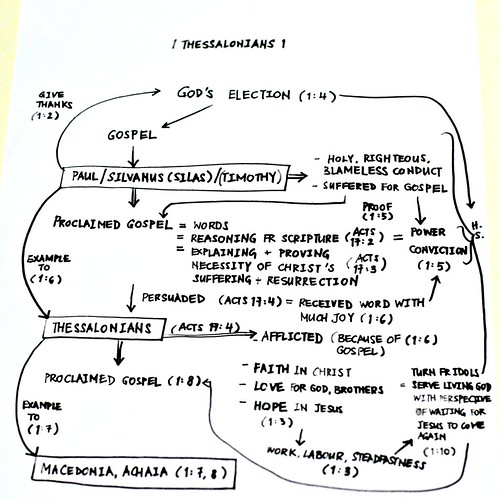
Paul and Silvanus (Silas) had served up some very good food indeed (the bread of life) in Thessalonica for three Sabbaths before they were forced to leave by jealous Jews (Acts 17:1-9).

Afraid that the Thessalonians might have gone on to ruin their lives with poisonous junk, they sent Timothy to check in on them and encourage them to keep feeding on the good stuff (1 Thessalonians 2:17-3:10).

Fruit Tart
Fruity

Paul, Silas and Tim were now writing to provide (further) assurance that they did really have the gospel of God and were on track.

1 Thessalonians 1

The gospel of Paul/Silas/Timothy/God had objective content. The Thessalonians had neither been persuaded by Paul/Silas' eloquence nor their cutting illustrations nor confident speech. Rather, they had been convinced (1) by proof from scripture (Acts 17:2-3) that Jesus was the Christ who had to suffer and rise from the dead; (2) by proof from the lives of Paul/Silas/Timothy (1 Thessalonians 1:5) that they were really convinced about their message - suffering for the proclamation of the gospel and leading holy, righteous and blamesless lives (Acts, 1 Thessalonians).

The Thessalonians then came to trust in objective realities: they had faith that Jesus was the Son of God, that he died on cross as an atoning sacrifice for sins, that he was raised from dead and that he would come to save them from God's coming wrath (1 Thessalonians 1:10). Knowing the love of God (1 Thessalonians 1:4), they loved others (1 Thessalonians 3:12, 4:9-10). They had a sure and certain hope of the future when God's Son would come from heaven and deliver them from the wrath to come.

Therefore, there was two-fold (or perhaps just one-fold) proof that they were alright by God: (1) that they were intellectually persuaded and had accepted the gospel; and (2) evidence that they had really accepted the gospel was that their lives had been changed and shaped by these doctrines (their faith worked, their love laboured and their hope was steadfast) because they had come into a relationship with God who was now their Father (1 Thessalonians 1:3). So the three letterwriters observe that the gospel had come to them not only in words but, as evidence that they had been chosen by God in power, in the Holy Spirit and in full conviction and so they received it with joy.

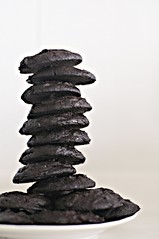
Tower of Double Chocolate Cookies - Remember Babel
Remembering Babel

If this is so, then:
- one cannot claim to be on a "mission trip" or be serving God if one is merely building houses in a developing country or being hospitable to all and patient to the longwinded and, by common consensus, irritating. These were certainly not the things Paul/Silas/Tim/the Thessies were concerned about and persecuted for. If it is the word (1 Thessalonians 1:5,6,8), and the work of the Holy Spirit (1 Thessalonians 1:5,6) through that word (and the choice of God ultimately), that transforms lives, then any work of God must include the proclaiming of the good news. After all, this was also why Jesus came to earth (Mark 1). And after all, this shows that one's own life has been transformed so to the service of the living and true God who wants all to be saved and not perish.

- while there is a place for bridge-building to, eg. the yet-unnamed post-cyberspace generations, it is the pure gospel that must be preached, not adulterated in the desperate but baseless hope that leaving out sin or Jesus might make "Christianity" much more attractive to unsubscribers. The God who is to be worshipped must be proclaimed in his full justice and glory so that he can be worshipped, and in so doing show that the preacher does actually worship this God. His Spirit will work in those who are his.

- we know we are alright by God and really believe the gospel not because we are in the right (Bible-believing) church or that the church leadership demonstrates their approval of us by appointing us to positions in the church hierarchy or because our friends so assure us, but by the proof in our lives that we have turned from idols to serve the living God, with love for all, while clinging steadily to the hope of Jesus' coming.

- elders, pastors, overseers, leaders and the like who have to account for their flock and who see their sheep wandering off cliffs and taking candy from wolves, need, themselves not to lose sight of the way God has designed lives to be turned back and transformed - by the Spirit, through the word - in both the sheep's lives and their own. Therefore, better music with emotional song leaders, a more persuasive and/or emotive preaching style, church-wide programmes for unity, love and service, a push to missions, more rules on what should or should not be done, accountability groups, topical comments on the latest scandal or political hot potato etc will, of themselves and despite the best of intentions, never bring anyone into a living relationship with God because they point to man rather than God. Better to be preoccupied with God and concentrate on teaching faithfully from the Bible the Christ to be worshipped (or rather, not to obfuscate God's word in proclaiming what God says about the his own glory) and praying, and also (and simultaneously by so doing) demonstrating the conviction of one's faith in one's life, setting the example of living according to the center of one's faith, love and hope. The gospel must first convict the undershepherds before they can so speak and so live in a way that, with the power of the Holy Spirit, generate conviction in the sheep.

********************

Fruit tart recipe from Keiko Ishida's Okashi.
Double chocolate cookie recipe from Donna Hay.

Animal Pasta! Mac & Cheese (or rather Animal Pasta & Cheese!)
Blood sugar high and failure to make much sense not completely attributable to Mark Bittman's macaroni animal pasta and cheese recipe (accidentally left for too long while Rabbids invaded the Phone).

Labels: , , , ,

Wednesday, December 30, 2009

They Built Their Houses with Paper and Gingerbread

Paper Houses as Gift Tags
If we were yet another spore in the mushrooming indie bandwagon (cheesy mixed metaphors due completely to all that Christmas cheese), we would call ourselves "The Paper Houses". Our eponymous debut album would contain the hit singles "People In Paper Houses Shouldn't Light Fires" and "Oh! My Soggy Foundations!".

Paper House Paper House
Fascination with Anna Torborg's paper house templates over at Twelve22 led several happy hours singing carols while trying to deflect attention from poorly wrapped presents with tiny personalised houses.

Paper House: Music Cafe
I liked the tension in the window of the music cafe best with its black cat eyeing a platter of cupcakes, a picture of feline self-control.

Gingerbread Houses for Mugs
The minature home-making continued with gingerbread houses that perched on the rims of mugs of hot tea (until the heat got to the icing) (cheers notmartha).

Podcasts for Cookie Baking
When the neighbours weren't busy being traumatised by the singing and the smell of burnt gingerbread, they might have caught snippets of podcasts from St. Matthew's Unichurch, Perth.

Thanks to Hayao Miyazaki's Howl's Moving Castle, Rory Shiner's exposition on Romans 6 brought to mind the image of Jesus as a flying home (interestingly The Flying House was a Christian anime series).

It is commonly said in some circles of living the Christian life that, well, the ceremonial law has been abolished but the law is still useful for holiness now that we've understood the gospel and that actually, grace and salvation are conditional on our morals and good behaviour.

But Paul says that the reason that Christians will not and cannot continue in sin because in Christ, we died to sin.

When a Christian puts his trust in Christ to save him from God's judgement on his sins, he does not sign a contract to perform services to God in exchange for salvation. But neither does he merely agree to abide by the terms of membership of the Christian club to follow Christ or be under the rule of Christ, nor is it only that the Spirit comes to live in him to enable him to live as a Christian. Far more than that, the Christian is in Christ - he is crucified with Christ, buried with Christ and raised with Christ (Romans 6:3-5); he is united with Christ.

Christ is a place and the Christian is in him. Christ is like the plane that goes from Singapore to Helsinki (SIN-HEL, haha) and if we are in that plane, we too go from Singapore to Helsinki. What happened to Jesus also happens to the Christian. The Christian participates in the full benefits of what Jesus has to offer and all his blessings, regardless of whether he is quivering in his seat or if he has taken off his shoes and started snoring even before take off.

Christians coming into Christ have, in fact and not as a metaphor, had their old selves killed and buried. Our old selves are not things that have to be beaten into submission so that they will one day; give up the ghost; they are already dead and buried.

If our old sinful selves are dusty history, then because this is true, we must live out the reality that we are dead to sin (Romans 6:11). The imperative is not to pretend for the purposes of the exercise that we are free, but, because our minds are so used to being enslaved to sin, to keep reminding ourselves that we are now, in fact, free from having to obey our sinful thoughts and desires. To return to sin would be as absurd as an emancipated slave running back to be chained to a galley with little food and water and to be ill-treated and then die a painful torturous death because "I can't help it, I just need to do it. My family background and genes compel me to do it." or "I cannot be happy and satisfied in life until I return to slavery" (Romans 6:12-23).

Organically, something has changed in the Christian. The Christian life is then about reckoning to ourselves what God has reckoned to us: freedom from the slavery of sin and freedom to fulfil our full potential as human beings - as slaves of God (Romans 6:15-23).

Suddenly, Monty realised he was but a cliché from 2009...
Monty, the cliché from 2009, says "Know the truth and the truth will set you free".

Labels: , , ,

Monday, November 02, 2009

Cakes for Kierkegaard and Sermon on the Mount as Existentialist Answer Perhaps (Matthew 6:1-18)

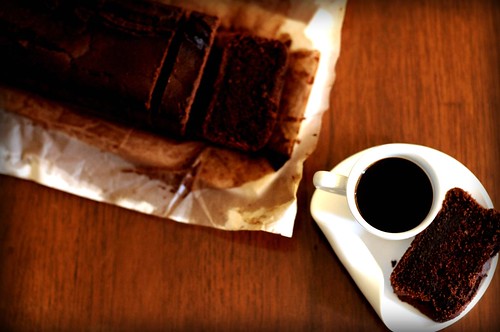
Dense Chocolate Loaf Cake and an Espresso
That which apparently tastes like the chocolate flavoured Sara Lee pound cake (though without the contents of a salt shaker having been emptied into it) and an espresso

One blustery rainy evening, possibly not unlike the one that came upon Nigel Slater (but without the napping cats and speckled brown eggs), there was indeed the warm wholesome smell of a dense chocolate loaf cake in the oven.*

Homey-ness and comfort? As much as might emanate from the Übermensch donning red gingham, the shade of standard issue Stepford wife aprons, for Halloween.

Belatedly clearing some boxes (physical and metaphorical), a mound of unopened birthday presents (physical) was uncovered. With all the archaeological skill of a woolly mammoth, a fossil strata (physical again) was unearthed and found to contain a glass jar of powderily mouldy poppyseeds and a box of more fascinatingly mouldy chocolate (grey mould tendrils reached out in all directions from what were once possiby yummy chocolate spheres). A spate of cake baking followed in an attempt to provide other organic matter an opportunity for the due fulfilment of the purpose of their existence, before being ravaged by the various forms of artistic death that would surely come upon them.

Kierkegaard might have baked them himself, for a pandemic of pantry despair and Sickness Unto Death** was imminent. Despair as a human condition, according to Mr. Poofy Coiffure, is a symptom of the failure to be human in the fullest sense. This despair could be (i) "the despair that is ignorant of being despair or the despairing ignorance of having a self and an eternal self"; (ii) "the despair that is conscious of being despair and therefore is conscious of having a self in which there is something eternal and then either in despair does not will to be itself or in despair wills to be itself" - the awareness of something more than this finite reality but refusing to define one's self by anything more than the immediate and the finite; or (iii) "the despair to will to be oneself" apart from God - accepting the eternal but refusing to accept the purpose for which one has been made, and therefore attempting to create itself according to its own desires (or so I read, probably badly, Anti-climacus anyway). The cure for despair is to become "eternally and decisively conscious of himself as spirit, as self, or (what is the same thing), "became aware and in the deepest sense received an impression of the fact that there is a God, and that he, he himself, his self, exists before this God".

(Kierkegaard's slap-up solution of taking the leap of faith seems as frivolous as frilly lace cuffs and assuring the terminally ill that a gâteau au yaourt with much lemon and many blueberries will surely make everything a-okay because they taste of citrus, which of course connotes summer sunshine. But that's for another time. Because of the lemurs.)

Lemon Blueberry Yoghurt Loaf Cake Lemon Blueberry Yoghurt Loaf Cake, A Spot of Mariage Frères Earl Grey and Some Good News for Breakfast
Gâteau au yaourt with enough lemon to pucker your dying lips and many blueberries because a little anti-oxidant never did no one no harm


There is another sort of despair that comes from reading the Sermon on the Mount as a Christian, with a conscious decisive desire to please God.

First there is the despair of ever hoping to keep the Law without fault and to attain the perfection of our heavenly Father (Matthew 5:17-48). Fortunately, this very accurate assessment of our situation helps to bring on the meekness and the dependence on God for salvation that brings us into the kingdom of God (Matthew 5:3). While the Kierkgaardian despairing man avoids self-examination and the most hurtful knowledge a human can ever acquire, the Christian thanks God for it because it is only the man who has truly seen himself for what he is who is likely to fly to God.

Unfortunately, it isn't happily ever after (at least for the meanwhile) for the Christian. It becomes rather obvious that life post-conversion isn't a panacean existence from the troubles of this life. It is full of difficulties, pitfalls and snares. There are struggles between whom we know we should be and who we are. There are contradictions between whom we know God to be and how we relate to him etc.

While ostensibly on our knees declaring our cannot-make-it-ness and clinging to God, it appears that our hearts and minds will give us the slip and go back to our bad old ways, but now under cover of Christianity (Matthew 6:1- 18). Works of righteousness ought to come out of having being brought into a right relationship with God. But we perversely turn them in vulgar showcases of our godliness so that people will praise us (Matthew 6:1-2, 5-6, 16). It is easy to diss the trumpets of the Pharisees but many of us will admire and praise the obviously saintly and aspire to be seen by others in the same way. Christian activity can look sincere and devout but we can engage in them without having a real relationship with God, being concerned rather on having the spotlight on ourselves. Public prayer is encouraged in the Bible and about encouraging others in their relation with the living God, but are we more concerned with our sonorous tone, the number of incidents of women falling to their knees and weeping as we pray, the right verses quoted to demonstrate the soundness of our theology? Singing songs and playing instruments encourage people to express their relationship with God but are we more concerned with showing the beauty of our voice or our competent musicianship or being the song leader that everyone remembers for his charisma and choice of songs with the most engaging yet biblical lyrics? Do we spread ourselves so thinly in our preaching engagements because we want the word of God to be preached to all men or is our full diary (so that we have little time and energy to prepare for each talk) a result of wanting to pad our preaching CV ("Pastor XXX, a regular speaker at the Very Exclusive Evangelical Conference")? What about how we lead bible studies or counsel people - is it really about pointing people to God or to be known as the go-to leader whose touch of Minas anointed wisdom and godliness always multiplies ministries a hundred-fold? Sin is turning the attention from God and onto ourselves and to continue to do so is encouraging others too to sin. So Jesus warns us: "Beware of practising your righteousness before other people in order to be seen by them, for then you will have no reward from your Father who is in heaven" (Matthew 6:1).

But perhaps even if we are not as uncivilised, even if we do our good works in secret, we do the less obvious: patting ourselves on the back when we have done good and kept to our spiritual disciplines, and recording our deeds in our little book of accounts with bonus points for doing all this in the secret, in the quiet, place. We might even thank God that we are not like those poor ungodly souls in church, because we are neither pastor, nor preacher, nor song leader, nor bible study leader, nor do we bother to serve in any ministry. We can put on a very good show for ourselves in the privacy of our own closet. The utter perversity of it all. So Jesus also warns "do not let your left hand know what your right hand is doing" (Matthew 6:3, cf Matthew 6:16). But not only is our relationship with other people (Matthew 6:1-3) and ourselves (Matthew 6:16) sickening and inauthentic, even the noblest, most important activity available to mankind, prayer, is tainted with petty self-interest and glorification (Matthew 6:5-6). Cue: the despair of ever doing anything with the right motives.

And as if that were not foul enough, we also have to deal with matters that seem inherently contradictory. So we are told to let our light shine before others so that they may see our good works and praise God (Matthew 5:16) yet also to give our alms in secret (Matthew 6:4), pray in secret (Matthew 6:6) and fast in secret (Matthew 6:18). We are meant to do both in the same act - the extremes of great ostentation and cloistered living (so fearful of self and self-glorification that one segregates the self from the world) are to be avoided.

What's to be done? Let every man examine himself.

Which is where the lemurs come in. Ok, sometimes it's lemmings, but they don't last long what with all that running off cliffs and stuff, so mostly, it's lemurs. They sit in the den that is my mind, ensconced in comfy cushy armchairs, smoking fat lazy cigars brought in by Cuban boat people, playing cards and arguing. They might also do so in Italian accents, while eating cannoli, but that's besides the point. The point is that it seems that the Christian life is such a delicate balance that it requires a committee to decide what one should say and do.
"I, Lemur One, would like to table the motion of participating in this new ministry opportunity."
"Lemur One, what is our motive for participating. Is it so that we can get our name in the church bulletin and get the praise of men?"
"Lemur Two, you have too sensitive a conscience! If everyone thought like you, nothing would ever get done for God's kingdom!"
"Lemur One, surely this is a pertinent question. Are you trying to dismiss the warnings of our Lord Jesus Christ?"
"Lemur Three, perhaps if this is such an issue for you guys, I'm gonna make you an offer you can't refuse: why don't we tell the church staff to leave our name out?"
"Ooh Lemur One, cunning you are. By so doing, would we not be trumpeting our "godliness" on the pretext of being godly?"
At which point, a visiting three-toed sloth might have piped up with a wise word but the lemurs would have been too furiously machine-gunning the stuffing out off each others' armchairs to pay much attention.

Perhaps the problem with the lemurs is firstly, legalism. If we are to take Jesus' teachings and warnings as rules, never the twain shall meet because they seem inherently contradictory. The second problem is that they are sitting in a smoky den arguing. This insular self-focus can do no good and is also very bad for the upholstery.

The focus should instead be on God, afterall, all this is about the relationship we have with him. If we have any relationship with God, if we are aware that God is our Father and also the Creator, Sustainer and Judge of the world (Matthew 6:9); if we are aware that God's desire for his kingdom to come in fullness to this world has the certainty of, well, the will of an omnipotent God (Matthew 6:10), then we would be seeking to please him and not ourselves. (The choice is always pleasing the self and God. When we want to please the others around us, when we desire their praise, it is really about us being concerned about having a good opinion of ourselves, and therefore wanting to please ourselves.)

It wouldn't say much about the relationship if we thought we could appear to be working for God but be moonlighting for ourselves on the sly. This would, in fact, be fairly insulting to God since we would be thinking little of his omnipresence and omniscience if we thought we could get away with this. In Matthew 6:1-18, Jesus reminds us that we are always in the presence of God. He sees our every action no matter how small, no matter how secret; he hears our every thought. So therefore, while we must keep examining ourselves, the solution to the possible impurity of our motives is not mulling ceaselessly over the purity of our hearts and spending our lives paralysed by the continuous dithering over whether or not to do this or that good work, but, by filling ourselves with more and more of his word, experiencing the very reality of having a relationship with an omniscient God. In the blinding light of his presence, all hypocrisy, pretence, sham, self-adulation and superiority would surely be moot.

Somewhat like the Kierkegaardian solution to Kierkegaardian despair, the answer to the despair of impure motives is by focusing on God and depending on him who gives us all things, from our daily sustenance to our salvation, and who controls all things (Matthew 6:11-13).

Addio lemurs?


A Trundle Through Sermon on the Mount
Earth Moves Under Feet, Kingdom Comes (Matthew 5-7)
This is the Sound of Inevitability (Matthew 5:1-6)
Breeding - We Hazs It (Matthew 5:7-12)
Coffee, Salt and Light, and the Essence and Use of the Christian (Matthew 5:13-16)
And the Missing Link is Jesus (Matthew 5:17-20)
Perfect Laws for Perfect Relationships (Matthew 5:21-48)
Cakes for Kierkegaard and Sermon on the Mount as Existentialist Answer Perhaps (Matthew 6:1-18)

Lam at Barclays Open Singapore 2009
*Thankfully, I ingested two thick slices of this chocolate loaf amounting to possibly 3 million calories on the final morning of the Barclays Open at the Serapong. Because by the time we found parking near someone's fetching house with a boat in the backyard, we were 3 planets away in Sentosa Cove, and had to board the complimentary inter-galactic shuttle to Sentosa Golf Club, where we discovered that we had only S$12 between us. This was spent on a S$4 bottle of 100 plus and a comparatively cheap S$8 wagyu burger.

** Sickness Unto Death:

So then in the Christian understanding of it not even death is the sickness unto death, still less everything which is called earthly and temporal suffering: want, sickness, wretchedness, affliction, adversities, torments, mental sufferings, sorrow, grief. And even if such things are so painful and hard to bear that we men say, or at all events the sufferer says, "This is worse than death" -- everything of the sort, which, if it is not a sickness, is comparable to a sickness, is nevertheless, in the Christian understanding of it, not the sickness unto death.

So it is that Christianity has taught the Christian to think dauntlessly of everything earthly and worldly, including death. It is almost as though the Christian must be puffed up because of this proud elevation above everything men commonly call misfortune, above that which men commonly call the greatest evil. But then in turn Christianity has discovered an evil which man as such does not know of; this misery is the sickness unto death. What the natural man considers horrible -- when he has in this wise enumerated everything and knows nothing more he can mention, this for the Christian is like a jest. Such is the relation between the natural man and the Christian; it is like the relation between a child and a man: what the child shudders at, the man regards as nothing. The child does not know what the dreadful is; this the man knows, and he shudders at it. The child’s imperfection consists, first of all, in not knowing what the dreadful is; and then again, as an implication of this, in shuddering at that which is not dreadful. And so it is also with the natural man, he is ignorant of what the dreadful truly is, yet he is not thereby exempted from shuddering; no, he shudders at that which is not the dreadful: he does not know the true God, but this is not the whole of it, he worships an idol as God.

Only the Christian knows what is meant by the sickness unto death. He acquires as a Christian a courage which the natural man does not know -- this courage he acquires by learning fear for the still more dreadful. Such is the way a man always acquires courage; when one fears a greater danger, it is as though the other did not exist. But the dreadful thing the Christian learned to know is "the sickness unto death."

Labels: , , ,

Sunday, October 18, 2009

And the Missing Link is Jesus (Matthew 5:17-20)

It would have been clear to Jesus' Jewish audience that the characteristics of members of the kingdom of heaven (= the real disciples of Jesus = Christians) and their relationship with the world (Matthew 5:3-16) was not unlike what they had been taught through the ages by God's prophets and written down in the Law and the Prophets. Viral meme word associations would have hit a chord in their (sub)consciousness, like "zipbra preens", "duck genes" and "boomz" to a Singaporean.

Snuffleupagus and the Laws of the Land

But the elephant in the room on that mountaintop might have had its trunk in a knot trying to fit Jesus' teaching into the Old Testament Hebrew worldview: how did the dots all join up? Was Jesus teaching a new thing and ought he then be stoned for heresy? No, said Jesus,
Do not think I have come to abolish the Law or the Prophets; I have not come to abolish them but to fulfil them. For truly, I say to you, until heaven and earth pass away, not an iota, not a dot, will pass from the Law until all is accomplished. Therefore whoever relaxes one of the least of these commandments and teaches others to do the same will be called least in the kingdom of heaven, but whoever does them and teaches them will be called great in the kingdom of heaven. For I tell you, unless your righteousness exceeds that of the scribes and Pharisees, you will never enter the kingdom of heaven." (Matthew 5:17-20)
This pushes off an astonishing teaching section on the connection between this seemingly new revelation and God's revelation through the centuries, and ends with Matthew 7:11 - "this is the Law and the Prophets".

Ok, cool. So it was clear that all the preceding commandments and teachings still stood. They were God's words afterall and one wouldn't expect revisionism from an all-powerful all-knowing God. And if these were still in effect, then entry into the kingdom of heaven would be by obedience to these words.

The scribes and the Pharisees apparently were well aware of this and were fastidious OCD keepers of the commandments...or well, the commandments were a bit vague you see so they put in a clarification here and a neatly packed some others and put them in colour-coded boxes within reaching distance filed by aleph-a-bet. It would be easy to fall in the pharisiacal did-God-really-say trap of concluding that it wouldn't be too difficult to top the righteousness of the Pharisees - after all they were all law no love nasty smug legalistic moralistic bullies with simpering voices who deserved their comeuppance. But the standard, Jesus emphasised, in case anyone was thinking otherwise, was far higher - "...be perfect, as your heavenly Father is perfect" (Matthew 5:48). Not an iota or a dot was to pass from the Law, and no part of the commandments was to be relaxed.

At this point, the elephant on the mountain might have fainted clean away, causing massive environmental damage by tsunami on the other side of the earth. Real, unwatered-down perfection? Impossible!

And just how impossible? From Jesus' six examples of how the Law and the Prophets had indeed not been diluted but were far more Extra Strength Man Sized than the wimpy righteousness promulgated by the Pharisees (see Matthew 5:21-48), infinitely impossible. The terrible overwhelming sinfulness of sin. This dreadful realisation would have driven anyone, screaming OMGOMG, to the poverty of spirit that characterises the person in Matthew 5:3 to whom is promised the kingdom of heaven.

No wait.

Are there two ways of entering the kingdom of heaven? Why have those contrite failures been promised the kingdom earlier in the Sermon (Matthew 5:3)? But doesn't the need for perfection strictly preclude any other backdoor (contrition) route? The ridiculousness of anything short of perfection managing to see God would be like singing the scary fat man song Rocka My Soul in the Bosom of Abraham in rounds in the crisp mountain air making everything alright in the world and with God.

Ah, the missing link is
...
...
...
wait for it
...
...
...
wait for it
...
...
...
Jesus!

Strawberry Tart with Valrhona Ganache
Unable to Follow Even Simple Tart-making Instructions Person is Obviously Needing Jesus

The rest of the Bible then explains how Jesus' death allows grossly imperfect people to enter into a relationship God. Huge and mind-boggling. Theological terms like substitutionary atonement, penal substitution, imputed righteousness, propitiation, expiation all go some way to attempting to explain this and obviously a paragraph can't do it justice. But regardless, this was the good news Jesus was to preach to the poor (Matthew 5:3 cf Matthew 11:5, Isaiah 61:1), that he had come to enable the scum of the earth to meet the perfect maker of heaven and earth. So Jesus fulfilled the Law and the Prophets (Matthew 5:17) not only by keeping them perfectly in the fullness of their meaning, but also by being the one to whom they had been pointing (qv Matthew 1:22, 3:15, 4:1-12, 4:14, 11:12-15). Therefore obeying the Law and the Prophets would necessarily require acknowledgement of Jesus as saviour and obedience to his words which, far from abolishing them, bring out the real significance of the Law and the Prophets. So some aspects of the law, eg. the ceremonies, priests, temple and sacrifices, no longer existed in their Old Testament form because the person to whom they had been pointing had arrived and the event/problem to which they had been anticipating was fulfilled/accomplished by Jesus.

If Jesus has fulfilled the Law and the Prophets, if all has been paid for already, does that mean we don't have to bother with them or with working on our righteousness?

To think so would be to fall into the same hole, on top of the bodies of the Pharisees and scribes littering the bottom. Such a view assumes that the commandments and instructions are but mechanical means of entry into heaven, so once these have been satisfied they can be tossed into the junkheap. It's just as erroneous to see these words as mere commandments to be kept so that God will give us a little pat on the head for being such an obedient boy/girl when we see him. Nor are they to be co-opted by those who love certainty and rules to live by as the perfect moral complement to their rigorous self-improvement, healthy mind and body regime. Nor are they in the first instance (though it is one of their purposes, see Romans 7) the evangelistic instrument by which God bats us out so we will be contrite in heart and poor in spirit. Just as the Law and the Prophets were first given to Israel when they became God's people and he became their God, Jesus' commandments are meant to teach us who have come to know God the character of God embedded therein and how to live in direct, living, true relationship with this God. The focus is on the living person of God not the letter of the law (and the inevitable pharisaical sub-laws, regulations and guidelines that trail not far behind).

And besides, if we are Christians who think the kingdom of heaven is ours, are we not then people who also hunger and thirst after righteousness (Matthew 5:6) surpassing that of the Pharisees and scribes (Matthew 5:20), and who are pure in heart and seek after God (Matthew 5:8)? If we treat the law lightly and teach others to do the same (Matthew 5:19), we demonstrate that we aren't what we say we are.


A Trundle Through Sermon on the Mount
Earth Moves Under Feet, Kingdom Comes (Matthew 5-7)
This is the Sound of Inevitability (Matthew 5:1-6)
Breeding - We Hazs It (Matthew 5:7-12)
Coffee, Salt and Light, and the Essence and Use of the Christian (Matthew 5:13-16)
And the Missing Link is Jesus (Matthew 5:17-20)
Perfect Laws for Perfect Relationships (Matthew 5:21-48)
Cakes for Kierkegaard and Sermon on the Mount as Existentialist Answer Perhaps (Matthew 6:1-18)

Labels: , , ,

Sunday, September 13, 2009

All That Jazz and God Transforming Sinful Natures

In another life, it might be nice to use some random postgraduate degree as an excuse to research a thesis on food blogs as carriers of cultural memes, with food as universal language, hunger and greed as international drivers, recipes as socially-transmitted information. Unfortunately for those lovely ladies slogging away in cavernous kitchens in the Middle Ages, the lack of the internets then and the lack of readily available plucked and washed swans in the supermarkets now means my collection of Medieval recipes shall languish sadly in their hotel rooms like craggy-faced Bill Murrays on the set of Lost In Translation.

Chocolate and Hazelnut Cake
So for the present, chocolate hazelnut cake as sappy nostalgia commodified into the product of flour, eggs, cocoa and heat; as bourgeois-aspirational Anglo-centric fetishistic faux-domesticgoddess/Stepfordwife-ness; as handy reference to the "original" Nigella Lawson Torta alla Gianduia, itself is a dessert that references other desserts and on and on until drowned out by liberal socialist types protesting the tyranny of the meta-dessert (or as Zizek might mumble through his chocolate and hazelnut-stained teeth, the Dessert of the Real).

Beo Crescent Teochew Porridge
In yet another life, the thesis would be about music as a barometer of societal values wherein freewheeling jazz was first subversion of object-oriented composition by oppressed minorities, but is now signification of modern/post-modern respectability, hegemony synonymous with the institutionalisation of improvisation, the entrenchment of laissez-faire composition. (With the great Dianne Reeves, however, jazz was secondary to The Voice. And what a fantastic concert at the Esplanade Concert Hall, well-supported by a tight band consisting of Peter Martin on piano, Reginald Veal on bass, Terreon Gully on drums. Much mirth at the gospelised lyrics. By the end of the second encore, the audience was engorged with two solid hours of mesmerising musicianship. Some discussion later about gospel as cultural heritage.)

Bunnahabhain Islay Single Malt Scotch Whisky
Oh yes, and in another, research would be on the symbiotic relationship of food and music as culture and so, taken as an interdisciplinary whole, as rhetoric and symbols of particular worldviews and thus their effect, exported, on foreign cultures.

But there aren't many alternate lives in which to spread these ironically inherently meaningless thesis-misses togged in obfuscating semiotics; there's one life now to deal with, then death and judgement.

Making Espresso from Segafreddo's Classic Espresso Ground Coffee in a Bialetti Venus
Of some help in the important desert-of-the-real stuff in this one life might be the self-improvement section-ly titled You Can Change by Tim Chester I helped a friend purchase. A flip-through while waiting for a morning espresso yielded some interesting pull-togethers of Scripture, inter alia:

Introduction and Chapter 1: What would you like to change?
In addition to the Vaughan Roberts-style run-through of being created in God's image, how that image was broken because of humanity's rejection of God, and how humans are re-created in God's image, sinful behaviour was set out not just in the passé terms of lust, pornography addiction, adultery and alcoholism, but also in terms of the constant worrier, the grumbling of respectable Christian servants and the insecurity of "good-value" diligent well-taught blokes.

Chapter 2: Why would you like to change?
An important point missed out by most books on the subject. Anyone who has tried to work at changing themselves will know that motives are always mixed. Perhaps we want to change so God will be impressed with us and save us or bless us in some way by giving us health, a job, a spouse, a child etc. Or perhaps we want people to be impressed - to fit in or win approval, to show that we are godly or spiritual. Or we might want to feel good about ourselves and boost our self-esteem by claiming that our former sins are comfortably behind us.

Chapter 5: What truths do you need to turn to?
Behind every sin and negative emotion is a lie. Sinful acts always have their origin in some form of unbelief. People are given over to sinful desires because "they exchanged the truth of God for a lie" (Romans 1:24-25). Recognising that behind every sin is a lie not only gives us a radical view of sin, it also points us to the road out of sinful behaviour and emotions - that road is trust in God:
1. God is great - so we don't have to be in control.
2. God is glorious - so we don't have to fear others.
3. God is good - so we don't have to look elsewhere.
4. God is gracious - so we don't have to prove ourselves.

Chapter 9: How can we support one another in changing?
God is in the business of change and he's placed us in a community of change. Individual sin impedes the growth of the community as a whole. It stops us from growing together as the body of Christ. Even our private, secret sins affect the community. But the Christian community is the best context for change because it's the context God has given. Therefore the church is a better place for change than a therapy group, a counsellor's office or a retreat centre. God has equipped each of us with a gift so that we can contribute to the community as a whole. Together, we grow towards maturity by speaking the truth in love to each other; by confessing, being accountable, encouraging and rebuking each other; by being honest, open and transparent about our struggles so that we rejoice to be in a messy community of broken people but a community of grace. Sadly, many Christian relationships and friendships are less about sanctification and preparing for judgement and more talismans against loneliness and low self-esteem, support groups and social clubs, and gossip exchanges. How can we make our Christian friendships more heaven-oriented as God intended?

Not really meant to be a summary of the book, but a scratch-and-sniff to say that it seems like one that might repay some reading, with a Berean mind and Bible at hand of course.

Labels: , , ,

Friday, May 29, 2009

Universal Declaration of Divine Rights (Exodus 19)

Scottish Wholewheat Oatmeal Barley Current Scones Scottish Wholewheat Oatmeal Barley Current Scones Posing with Double Cream and Raspberry Jam Scottish Wholewheat Oatmeal Barley Current Scones Slathered with Double Cream and Raspberry Jam
Scottish Wholewheat Oatmeal Barley Currant Scones, Double Cream, Raspberry Jam
Commissioning the sun as the morning alarm is risky business. It means that on rainy days, one wakes only at noon, and in some confusion. These "summer" days however, she props eyelids open at 7am, leaving a delicious sliver of quiet time before work for pottering around and making breakfast, slowly, hummingly, wafting the olfactory equivalent of a quick hug,

Mac & Cheese Truffled Mac & Cheese
and then, with the even slimmer sliver time left over, something to pack for lunch.

Then, because it is the season for mergers and acquisitions, investments and divestments, equity and debt financing, the madness begins.

Quick in-between rememberingtobreathe notes, before they're forgotten:

Exodus 19

Events in Exodus are seen collectively by the rest of the Bible as the greatest OT epiphany, most magnificent manifestation of living God to his people.
  • revealed character of God
  • demonstrated how God deals with his people
  • inaugurated the OT people of God
  • showed where people stood/stand in relation to God and how they must prepare to meet him (Exodus 19)
  • God's character enshrined in the law (Exodus 20)
  • 10 commandments instructed/instructs the redeemed people of God how they were/are to live in relationship with their God (Exodus 21-23 as detailed law code)
  • 10 commandments and other sub-legislation instructed/instructs the redeemed people how they are to live in relation with the rest of the world, how they are to be a kingdom of priests and a holy nation
  • official formalisation of relationship with God in the reading/signing of book of the covenant - I will be your God, you will be my people (Exodus 24)
We learn the truth about God so that we know how to live rightly in relationship with him. Doctrines are not theoretical, abstract theological propositions that lead only to intellectual arrogance and spiritual decline but practical and relational, and very humbling indeed. Massive truth - who God is and why he has a right over our lives.

19:3-6 as summary of whole book of Exodus?

(1) God reveals what he has already done for his people in their redemption.
  • They are reminded here that it was entirely God's work (people completely helpless).
  • And also utterly God's initiative (people didn't want to be rescued).
  • Grace.
  • God's faithfulness - Exodus 3 - evidence that what God said was true would be that the people would worship God on same mountain
  • And the purpose of redemption was relationship.
  • Highlights the care with which God preserved them. Not mere action hero but was concerned for intimacy with his people.
So it was not that by keeping the law that they became people of God. Law given to people who had already been rescued. Response to grace - trust and obedience.

(2) God reveals where his people stand in relation to him (rest of Exodus 19)
  • fearfulness of God's presence - visible presence, audible voice - so that people would trust
  • 19:16, 18 - people trembled, mountain trembled.
  • awesomeness
  • nothing casual about the presence of God. you don't just waltz into his presence
  • nothing unhealthy about trembling before god - Deuteronomy 5, Hebrews 12:18 - scary indeed but see that you do not refuse. God is a consuming fire. Call to fear God actually intensifies with progressive revelation rather than diminishes. Therefore, not that OT God = scary, NT God = cuddly. NT does not say relax in presence of God.
  • we are not fit to be in his presence
  • so there are limits, boundaries, between sinners and God. They cannot meet him face to face or they will die
Therefore proper preparations must be made before meeting with king of kings
  • external cleaniness is a reminder of internal purity
  • who will ascend the hill of the Lord? only those with clean hands and a pure heart
  • relationship with God must come first even before the most intimate intra-human relationship.
  • preparing to meet God requires our full attention and concentration.you must never forget with whom you are dealing
Then again, only a few can meet him. (Were the priests and elders in possession of purer hearts than rest of people? Unlikely given later behaviour. Suggests election of some sort. Clearer in other passages.)

Repetition of God's warning
  • God's severity
  • God's compassion. "lest" - doesn't want them to die. Isaiah 19:22
(3) God's rights
God ab initio has the right to be worshipped and obeyed even though the Israelites refused to worship and obey him, he has given them even more cause to do so.
  • what God has done precedes what he requires
  • covenant of grace
  • covenant is a rehash of Abe's covenant but in greater detail.
  • requires general wholehearted commitment regardless of details.
  • Romans 12:1-2 - in view of God's mercies (that is what has been set out in Romans 1-11). We owe god everything. All that is necessary is obedience. Grace alone secures blessing but obedience keeps channels open so God's covenant mercy and faithfulness can be their experience. Law's context is not justification but sanctification. Now law written on tablets of heart - to enable us to start living as his people.
(4) God's treasure chest
If the people did what was required of them, then God's intended design for them would come to pass: they would be his treasured possession, that is, God's private bank account, personal treasure chest. Elsewhere in the Bible, this means crown property, the personal property of a king in contrast to the general realm over which he rules and which is also his (cf 1 Chronicles 29:3, Ecclesiastes 2:8).

God's imposition of terms of relationship is already a mercy and grace because they only deserved death, not even the smidgeon of a relationship. It is therefore not a contract to wriggle and wraggle about. No negotiation.

Obedience is intimately connected with blessing. Not in arbitrary reward way but in a organic cause and effect because this is how the universe was created to work and how God is.

"because the whole world is mine" - suggests that the final purpose in calling Israel is not to sit around dolled-up and pretty but to address his concern for the world at large

(5) Foundation of people's relationship with God and with the world is holiness - "kingdom of priests and a holy nation"
  • holiness that the law/God defines
  • obedience to as a mark of holiness
  • holiness is being set apart and obedience to the law/God will set the people apart. Seen in their undivided allegiance to the Lord, they will reflect the character of their God and point others to him (ref also to Jethro's conversion in Exodus 18 when he heard what God had done for Israel in rescuing them from Egypt)
  • holiness also defines the priesthood. A priest is separate from the community he seeks to serve. He may only serve as long as separation is maintained. The holiness of God's people would enable them to serve God and serve (by serving?) the rest of the world. The Hebrew for "nation" - goy is rarely used of Israel in the OT, reminder of Abrahamic promises - Gen 12:2
If this came to pass, it would mark a vast improvement in divine-human relations. The people would know how God wanted them to act and as priests they would be able to communicate with him. Ref Exodus 18 and how Moses had the only hotline to God and the major traffic jam on the Moses end.

But just when things were looking up, we are reminded of the perversity of God's people. Moses had just gone up when God tells him to sprint down again. Assumedly, the barriers for their safety and really simple instructions ("don't go past the barriers") and their own fearful trembles had not put off some people from wanting to have a gawk at God and a mobile phone photo for Facebook.

How would God ever get this lot to the Promised Land? And instead of minimising his exposure to failure (to keep his promises), he is heaping on risk upon risk by adding promise upon promise*, seemingly throwing good money after bad. But from all that we've seen of God so far in Exodus, greater stakes means greater glory. The best is yet to be/come.

* even though this promise appears conditional, yet if God's intention is to reach out to the world and so far, he has only this straggly lot, then it is possible that he has implicitly promised to work through them.

Labels: ,