Wednesday, April 13, 2011

The Pies of Pressing Petition


Banana bottom of Banoffee PIe
Assembled a chocolate, banana, toffee pie for the first time last Saturday. Unfortunately, it was for a newcomers' dinner at which several people, for whom banoffee pies were sacred, would be present. Hadn't been too fond of the same confections they'd said they'd enjoyed on account of stupid taste buds that only understand things in layers - that is, layers of taste and texture. So didn't think they’d like the stuff and wasn't sure anyone would take well to bananas in their dessert. But it couldn’t be helped - I'd volunteered to bring something and hadn't remembered till the last hour, there were relevant items near their expiry that needed to be in tummies pronto, I was in the midst of preparing a bible study on Genesis 32 involving a motley collection of Playmobil figurines pretending to be Jacob, camels and a heavenly wrestler… so needed something fast and easy.

Also, was rather nervous using dairy products that were near expiry - didn't want to obviate anyone’s opportunity to come into a saving relationship with God or dissuade them for coming for the Sunday meeting or Christianity Explored the next day.

So there was a bit of triangulating between the necessity of bringing something (the worried host had said that there wouldn't be enough food), how loving it might be to neighbour to bring something that they might not enjoy, and how the remaining few hours to the dinner should be spent.

In the end, the deed was done, tummies were filled, no food was wasted and no one was harmed (to my knowledge), but not before desperate petitions were sent heavenward that the dish not ruin the proposed welcome and fellowship.

Lush chocolate intrusion into Banoffee Pie
Later that night, the mental filing cabinet popped open at the tab labelled:

"prayer - empty parking lots"

Was it God-honouring to pray about such trivial matters? Added Phillip Jensen’s article to that folder:

Praying In Crisis: Helpful Or Hypocritical?
Originally Published:
25th February 2011


It is an old wartime saying that ‘there are no atheists in foxholes’. Leaving aside the silly arguments as to whether this is statistically true or an aphorism – is it a good thing? Will God be pleased to answer the prayers of those in danger? Is God honoured when we pray to him in times of trouble?

Prayer is one of the most basic human responses to trouble. When the doctor’s diagnosis is really grim, it is only natural to seek divine help. When our children are in danger, who doesn’t utter a quick prayer for safety?

But is prayer to be encouraged amongst people who ignore God except in times of crisis? Is God to be used as a 'phone-a-friend' when the going gets tough? Will God allow us to be his ‘fair weather friends’ – only calling upon him in times of difficulty?

This summer we have seen some dreadful tragedies with floods and cyclones in the Eastern States of Australia, fires in the West, and earthquakes in Christchurch. In the face of these disasters people can do little else but pray for God’s mercy and rescue. Politicians and journalists, not given to religious references, start talking of praying for people when confronted with the horrors of these catastrophes. Only the most rigorous of atheists will talk of our concern for others without mentioning praying for them. But is it a good thing or hypocrisy?

The trouble with unbelievers calling upon the name of the Lord in the face of disaster is that they lose their title deeds to the name “unbelievers”. They may still be doubters or superstitious or hypocrites, but they are no longer "unbelievers".

Even more importantly, the trouble with unforgiven sinners praying to God is that it compromises his holiness. The Psalmist wrote "If I had cherished iniquity in my heart, the Lord would not have listened." (Psalm 66:18). The book of Proverbs says: "If one turns away his ear from hearing the law, even his prayer is an abomination.” (Proverbs 28:9). And Isaiah explained how sin had set a separation between God and Israel so that he, who is able to hear prayers and rescue, did not hear their prayers (Isaiah 59:1f). And James wrote of the adultery of people who in love with this world prayed to God "wrongly to spend it on your passions" (James 4:3f). It is as the apostle Paul says “whatever does not proceed from faith is sin" (Romans14:23).

Here then is the problem: prayer is the articulation of faith. It is the expression of faith – putting trust into words. For in calling upon God in times of trouble we are saying that he cares and is willing and able to help. In other words, we express our belief that God is loving and powerful to save. Encouraging unforgiven sinners to pray in time of trouble may seem to compromise God’s holiness but not to encourage them to turn to God in prayer may be to deny his gracious compassion. Many of Jesus' miracles were performed in response to people asking for relief from their suffering, even though their faith was weak (Mark 9:24), their understanding limited (Mark 4:40) and their salvation not understood until after their healing (Mark 5:34, 10:51f, Luke 17:17f). In fact our English translators often have difficulty knowing whether to translate some passages as 'saved' or 'healed'.

Certainly there may be things we need to fix in our relationship with God. There may be a lifetime of rebellion against him or ignoring him. There may be crimes that need to be dealt with, lifestyle that needs repentance, sins that need to be forgiven and restitution that needs to be made. But turning back to God does not always come in a neat package of sorting out ‘first things first’, because turning back to God is the first thing.

Sometimes it is when we turn back to God that we become aware of the awfulness of our sin in the light of his burning holiness, and are moved by his gracious care to seek the forgiveness we need. It is entering the sanctuary that makes us aware of our unworthiness before God and of the judgement of God upon sinners (Psalm 73:17).

Martin Luther and John Newtown were not the first, nor the last, unforgiven sinners to call out in prayer during the peril of a storm. And Luther did not even call out to God but to St Anna(!) - the non-Biblical legendary grandmother of Jesus whose cult he later attacked. But God used that moment of confused prayer to start him on the pathway of salvation.

Copyright 2011 phillipjensen.com
Reproduced with permission from phillipjensen.com
(Desperate Chocolate Banana Toffee Pies

Base
- pound Digestives finely so the crumbs don't get stuck in people's loose dentures
- melt unsalted butter and brown
- mix in biscuit crumbs
- pat into base and sides of cake tin
- refrigerate

Bananas
- get a bunch of ripe bananas
- slice thinly
- lay onto biscuit base

Toffee
- pour contents of two tins of condensed milk (not evaporated milk) into glass container
- place glass container into a high-walled roasting dish and cover tightly with foil
- pour hot water into roasting dish around glass container
- place in oven and heat at 200 degrees celcius for 1 hour or until caramel-dom is achieved
- pour as much as possible onto banana layer

Add another layer of bananas.

Chocolate
- obtain a 72% Valrhona chocolate block from wholesaler
- melt chocolate
- stir in double cream into melted chocolate
- pour onto banana layer

Add another layer of bananas.
Add another layer of toffee/caramel.
Add another layer of bananas.
Press the whole lot down because you are running out of height space in cake tin.
Contemplate the meaning of life.

Cream
- whip together double cream and mascarpone and the contents of vanilla beans
- dump on top of last layer of bananas

Refrigerate the lot.
Shave remains of aforementioned chocolate block.
Dump shavings on before serving.)

Labels: ,

Sunday, February 20, 2011

Boating, Transversing Park Connectors and What We Talk About When We Talk About Prayer (Colossians 4:2-4)

A pant-astic Saturday is:

Raffles Marina Lighthouse
being out in the waters off Raffles Marina, waving to coast guards and getting the power boat driving sorted (and also having the Dynaglass gorge out a bit of flesh from the shin),

Poly Marina, from West Coast Park
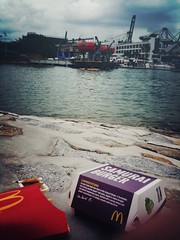
sitting on the breakers, chowing down a McDonald's Samurai burger meal while watching the test launches from the Singapore Poly Marina and commentating obnoxiously on the same (the obnoxiousness is intensified if one of you has a strong American drawl that carries across water),

Flying Pigeon bicycle, Tong Ah & Co
getting a Flying Pigeon from the old Tong Ah & Co bicycle shop,

Crankarm divorces crankset Teck Bee Brothers, Syed Alwi Road
only to have the right crankarm shear off from the crankset about an hour later, being rescued by an uncle who laughed at the assumption of a return policy or warranty of any sort, nodded his tight perm, stroked his small moustache with uncle-bling-ladden hand, directed me to Teck Bee Brothers on Syed Alwi for a fix, took me along backroads of Jalan Besar and Lavender to Kallang River where he offered his number, expressed fear for my safety, then left to continue his attempt to clear his head from last night's binge-drinking,

Park Connector Network Flying Pigeon, Park Connector Network (PCN)
riding the Kallang, Ang Mo Kio and Buangkok Park Connectors till it was too dark to see anything. (National Parks' more useful maps from 2009 are here: Kallang Park Connector, Ang Mo Kio Park Connector.)

A few photos from the trip:
Flying Pigeon, Bridge linking Lavender Street to Kallang Bahru
the bridge linking Lavender Street to Kampong Bugis across Sungei Rochor,

Loysel's Toy Flat White, Loysel's Toy
pitstop at Loysel's Toy at Kallang Bahru for flat white, croissant and water, where a light drizzle made some very nice strangers offer brollies to keep forever,

Flying Pigeon, Kallang Riverside Park
through Kallang Riverside Park, past the huffing dragonboaters, to cross Sir Arthur's bridge to use the underpass on the other side,

Disconnected part of Kallang Park Connector
dismounted and pushed bike along the edge of Geylang Lorong 1 Bus Terminal towards Kallang MRT and connected to the disconnected Kallang Park Connector across Sims Avenue,

Flying Pigeon, across the river from Chwee Kang Beo temple
swept past Chwee Kang Beo temple, crossed a bridge and paused to enjoy the view of the Singapore Flyer,

Flying Pigeon, The Rivervista @ Kallang
marvelled at the loveliness of staying in a HDB flat at The River Vista @ Kallang,

Overhead bridge across Bendemeer Road
carried the 20kg dead weight of F Pigeon up the overhead bridge across the very busy Bendemeer Road,


National Aerated Water Co. Ltd. - Kickapoo in glass bottles no more,


on the opposite bank of the Kallang River from National Aerated Water Co. Ltd. building where people were chatting and fishing,

Bridge near Moonstone Lane
crossed back over the Kallang River - this bridge had helpful grooves for bicycle wheels,

Turn right at Moonstone Lane
turned right through a little grove and then left onto Moonstone Lane, headed uphill and turned right towards Topaz Road while being amused by the gemstone road names (in the vicinity, "Ruby Lane" and "Opal Crescent"),

Crazy bridge over PIE to St. Andrew's
not so amused to be confronted with the mother of overhead bridges across the Pan-Island Expressway (PIE) to St. Andrew's Village, carted the 20kg dead weight across again, (at which point I wished I could, just like one toggles a weapon-change in RPGs, toggle my ride to the 10kg Strida...)

Bicycle path next to St. Andrew's St. Andrew's
pushed F Pigeon along a narrow path along the walls of the peach-pink Anglican Diocesan Centre, across another bridge where the view of the St. Andrew's bridge was lovely,

Underpass under the CTE
from then it was smooth cycling along the feeder into Kallang River with the charmingly un-upgraded Potong Pasir to my right, until I had to dismount and push F. Pigeon through the underpass under the Central Expressway (CTE) or risk a S$1,000 fine,

Bridge across Braddell Road
past the SBS Transit headquarters and ComfortDelgro Engineering, we were confronted with yet another overhead bridge across Braddell Road, this one fortunately with bicycle wheel grooves for the Fat Princess,

Flying Pigeon, Bishan MRT Depot Flying Pigeon, Warning Signs outside Bishan MRT Depot
another smooth ride along Sungei Kallang SMRT Train Depot to the right, which seemed to promise that trespassers would be electrocuted then shot,

Flying Pigeon, AMK Hub
skirted the edge of Bishan next to the artificial river that was being constructed to run through Bishan Park and turned right to the Ang Mo Kio Park Connector to Ang Mo Kio Town Garden West and crossed the road, pushed bike through the extremely busy Ang Mo Kio central to AMK Hub,

Flying Pigeon, Ang Mo Kio Avenue 5
moved up along Ang Mo Kio Avenue 8 under the MRT track and right onto Ang Mo Kio Avenue 5 to join the Buangkok? Park Connector towards Punggol Park, past Nanyang Polytechnic on the left, back under the CTE again, and Ang Mo Kio Industrial Park on the right.

Then we headed for dinner and bed. Adventures of F. Pigeon to be continued another day.


Just as references to rivers in Singapore's total defence classic This Is Home would be taken by most residents as metaphor ("alas unexplored blue spaces" say the URA planners), so prayer might be taken by many Christians as imagery and ideal rather than daily reality.

John Woodhouse's discerning application of Colossians 4 is well worth a think:

Moore College - John Woodhouse - Colossians 4:2-4 from Audio Advice


There are a small number of subjects that a preacher or Bible teacher can touch on, and be almost certain to stir the conscience of at least many of his Christian hearers. All but the most insensitive of us find certain topics awkward, threatening and guilt-arousing. This is partly because all of us have secrets. What we are, what we think, what we have done are things only partly known to those who know us, even those who know us well. How could it be otherwise? Among the hidden things abotu us there are things we really are glad are hidden (and we would like to remain hidden forever, even from ourselves, if that were possible). The word for how we feel about these things is "ashamed". When a preacher or Bible teacher starts to talk about one of these things, we cringe inside. Those of us whose consciences are sensitive can be troubled, not only about the matter of which we have been reminded, but by the very fact that it is secret: that our life is at this point a pretence. If you are a serious Christian person, you may be troubled, not only by your sense of guilt or shame, but also by your sense of hypocrisy. I am quite sure that most readers of this book know exactly what I am talking about.

...Whenever I speak about prayer, I know that if my hearers are Christian, then their consciences will be easily provoked.

...As the letter draws to a close, he speaks of prayer:
Continue steadfastly in prayer, being watchful in it with thanksgiving. At the same time, pray also for us, that God may open to us a door for the word, to declare the mystery of Christ, on account of which I am in prison - that I may make it clear, which is how I ought to speak (Colossians 4:24)
All the evidence suggests that Paul was a remarkable pray-er. At the beginning of this letter he spoke naturally about "when we pray for you" (1:3), and it is clear that this was not an occasional thing: "from the day we heard [of your faith, love and hope in Christ Jesus], we have not ceased to pray for you" (1:9). When you consider that Paul said something quite similar in letters to Christians in Rome (Romans 1:9,10), Ephesus (Ephesians 1:16), Philippi (Philippians 1:3,9) and Thessalonica (1 Thessalonians 1:2), as well as in his letters to Timothy (2 Timothy 1:3) and Philemon (Philemon 4), we can see that praying is something he took very seriously indeed. It must have taken a considerable amount of his time.

As this great man of prayer spoke of his own praying at the beginning of this letter, he now addresses his readers about their praying as the letter draws to a close.

Reading Paul's words, it is difficult for our minds not to turn to our secret failures in praying - how inadequate we feel as pray-ers - how little time and effort we give to prayer - how easily it is the first thing dropped from our daily activities - and so we could go on. Many Christians feel ashamed, even guilty, about their prayerlessness.

However, I want to suggest that God's Word does not work like that. Certainly here Paul is not playing on the sensitive consciences and guilt feelings of believers who do not pray as much or as diligently as they think they should.

(Preachers and Bible teachers take note. It is easy to achieve certain responses through playing on tender emotions in the hearers. There are various techniques, that come with just a little experience in public speaking, to manipulate the feelings of listeners. This is a significant temptation to the preacher, for the Word of God does deal with many sensitive subjects. It is ever so easy to stir up memories you know many of your hearers have (because you have them too!), to touch raw nerves you know so well (because they are raw for you too!). But is this the work of the Spirit of God? Is this what God's Word in fact does with these sensitive subjects? I am not suggesting that the Word of God does not search consciences, nor that shame and guilt are things we should ignore, deny or run away from. The Spirit of God does stir our emotions and our consciences by his Word. I am simply saying that the preacher's task is to ensure that God's Word does God's work rather than manipulative speaking doing the preacher's work. Faithful exposition of the Word of God allows Scripture to set the agenda, and this take great care. As a general principle, we should understand that the Word of God has not done its work if the hearer is left simply feeling terrible, or just determined to try harder in the future.)

The way in which Paul speaks to his readers about prayer is particularly striking.

A call to pray (Colossians 4:2)
The first thing we should notice is that 4:2 is certainly a call to pray - a serious call to pray. Indeed it is a call to follow the example of Paul himself, as we heard of his praying at the beginning of the letter.

The power of this call to prayer, however, comes from its context in the letter as a whole, not just from the words here in 4:2, heard as an isolated rule or command. Like all that we have heard through chapter 3 of the letter, the call to pray comes as a part of an exposition of the life of faith in Christ Jesus. Paul's theme is:"As you received Christ Jesus the Lord, so walk in him, rooted and built up in him and established in the faith, just as you were taught, abounding in thanksgiving (2:6,7). That will mean praying.

Why? The answer to the questions is: For the same reason that Paul himself had not ceased praying for the believers in Colossae from the day he heard about them (1:9). It is because something absolutely wonderful and extraordinary is going on. Our Lord Jesus Christ is the one through whom on and for whom all things have been made, and by his death on the cross God has reconciled all things to him (1:15-20). Through Christ, God is bringing the universe back together again: order out of chaos, peace out of hostility (2:15), reconciliation out of alienation (1:20). Christ among the nations is the hope of glory (1:27)!

This is why Paul prayed, "asking that you may be filled with the knowledge of his will in all spiritual wisdom and understanding, so as to walk in a manner worthy of the Lord, fully pleasing him, bearing fruit in every good work and increasing in the knowledge of God" (1:9,10). Paul prayed, not simply as a spiritual exercise or discipline, and certainly not in order to move an inactive God into action. Paul prayed because of the extraordinary work that God had done and that God was doing.

Yet it is even more than that. The call to pray in 4:2 comes to us because through faith in the Lord Jesus Christ, God is turning chaos to order, hostility to peace, alienation to reconciliation in our lives (1:21,22; 2:5). Praying is a characteristic of the reordered life. The new life in union with Christ in his death and resurrection has been the subject since 3:1. This life (see 3:12-17) is a stark contrast to the chaos (see 3:5-8). Prayer and peace with God go together. God's enemies do not pray. The reconciled pray; the alienated do not.

In other words, if we have been listening to the teaching in this letter, we will not hear the call to pray in 4:2 as an obligation that condemns and threatens and rouses the sense of guilt but as a gospel invitation. Listen to the particular way in which the call is expressed.

"Continue steadfastly"
"Continue steadfastly in prayer", says the apostle. Other English translations have "Devote yourselves to prayer" (TNIV). Similar expressions are found a number of times in the New Testament. It is what the apostles did in Acts 6:4: they devoted themselves to prayer and the ministry of the word. The three thousand who received the word on the day of Pentecost devoted themselves to the apostles' teaching and fellowship, to the breaking of bread and the prayers (Acts 2:42). Indeed it is what Jesus' disciples were doing immediately after his ascension as they waited in Jerusalem: they were devoting themselves to prayer (Acts 1:14).

Paul certainly calls for a commitment to praying. There is also a sense of privilege. When you know and understand the grace of God in Jesus Christ, praying is what you do. When we are conscious of what God has done and is doing and will do, we will pray. This is precisely what we heard Paul doing at the beginning of the letter. "We always thank God, the Father of our Lord Jesus Christ, when we pray for you, since we heard of your faith in Christ Jesus and of the love that you have for all the saints...And so, from the day we heard, we have not ceased to pray for you, asking that you may be filled with the knowledge of his will..." (1:3,9). Now he invites his readers to do likewise: continue steadfastly in prayer. Devote yourselves to prayer.

"Being watchful"
What will enable us to heed this call? It requires being watchful in it. Being awake. Praying is not the sleepy activity we may sometimes imagine (and perhaps sometimes practise!). It requires alertness. Yet this is not simply a call not to drift off to sleep as we pray, as the disciples did in the Garden of Gethsemane (Mark 14:37). As on that occasion, praying requires being awake to what is really happening. Don't lose sight of the fact that you have been raised with Christ (3:1), that you have died and your life is hidden with Christ in God (3:3). Keep awake to what is soon to happen. When Christ who is your life appears, then you also will appear with him in glory (3:4).

This characteristic of the Christian life is worth emphasising. Jesus taught it:"Therefore stay awake - for you do not know when the master of the house will come, in the evening, or at midnight, or when the rooster crows, or in the morning - lest he come suddenly and find you asleep. And what I say to you I say to all: Stay awake" (Mark 13:35-37); "Therefore, stay awake, for you do not know on what day your Lord is coming" (Matthew 24:42); "Watch and pray that you may not enter into temptation" (Matthew 26:41).

This wakeful watchfulness is alertness to the realities to which "you have heard in... the gospel" (cf 1:5). It is keeping our eyes of faith open. It is having the work of God in Christ and in his gospel in our consciousness. When we see life and the world in this brilliant light, when we understand what is going on, then we can properly hear this call to pray.

With thanksgiving
The third element in the call to pray in 4:2 settles the fact that this call is not intended to be guilt-driven. On the contrary, we are to pray with thanksgiving. Being watchful is not a matter of being frightened, worried, or anxious. On the contrary, like the whole Christian life, praying is energised by thankfulness.

This has been a repeated note through this letter, which has been described as "one of the most thankful documents in the New Testament". It began with Paul's own "We always thank God...since we heard of your faith in Christ Jesus" (1:3,4). Then his prayer for the Colossian believers climaxed with the request that they would be "giving thanks to the Father, who has qualified you to share in the inheritance of the saints in light" (1:12). Indeed the purpose of this letter includes that its readers will "abound in thanksgiving" (2:7). At one point in this letter, Paul simply and starkly says,"And be thankful" (3:15), and then speaks of the "thankfulness in your hearts to God" (3:16). Indeed the Christian life can be summed up as "whatever you do, in word or deed, do everything in the name of the Lord Jesus, giving thanks to God the Father through him" (3:17).

The words of 4:2 should move us to be serious about praying, but if we hear these words rightly we will be moved, not by guilt feelings, but by being "woken up" and by thankfulness.


Labels: , , , ,

Monday, February 23, 2009

Muaythai Aftermath and Two Cents on Sickness and Sin, and Prayer in James 5

The day after national fencing competitions, we used to wake with a start at 2pm on Sunday, after a night out at the local with the other uni teams and a long dangerous early morning drive back to campus bumping along unlit backroads in the Hungarian's Hungarian "it brought me to England from Hungary, it will bring us across this country!" car, and start craving salty food. Badly.
rye crispbread knäckebröd, salmon paste
As further evidence of the coral pinkness of my health, a similar situation arose after a single evening of muaythai where it was revealed that my punches were embarrassingly limpwristed, my stance had reverted to the fencing crab-crawl and my sprained right thumb was really sprained. Fortunately there was rye crispbread knäckebröd, salmon paste, smoked salmon and dill to be assembled with one hand into something saltily edible with the minimal agitation to the grumbly body. Bork bork bork!*
rye crispbread knäckebröd, salmon paste, smoked salmon and dill
If the body had been really sick though, in a serious bedridden sort of way, and this had been advertised on the Facebook status, then its person would have been inundated with well-meaning confident James 5:14-15 self-invites: "We'll bring some elders and a bit of oil!"

But if the elders and oil gig didn't turn the ship around, then caring Charismatic friends might have a quiet word about defectiveness in the faith of the sick person (cf James 1:6-8), defectiveness of the prayer or, perhaps, even defectiveness in the faith of the one praying (cf James 5:15). Catholic friends might recommend auricular confession (confession of sins through a priest) and then, when the end seemed near, extreme unction (last rites where a priest anoints and prayers with a specific form of words over someone who is dying). Evangelical friends would merely comment on sickness being part of the fallen world and a consequence of the general sinfulness of mankind and then ask for a list of songs for the wake.

If James thus far has been warning Christians of their double-mindedness in different circumstances then we can assume he continues to do so in this passage.

Experience within the church body will demonstrate that affliction and suffering (James 5:13a) can and does draw us away from God. So James' exhortation is that if suffering and affliction come to us, we should turn to God (James 5:13a) rather than turn away from him. Do not use this as an opportunity to slip away from him in despair.

Experience within the church body will also demonstrate that if all is going well and the Christian is successful not only in his personal life and career but also in church life and spiritual life, he too can be tempted to turned away from God, too confident that it is his self-made abilities and opportunities that brought him thus far and that his successes are his alone as well. To these, James reminds them to draw near to God too, in praise (James 5:13b) for their happiness.

Sickness is one of the chief things that draws us away from God. Too often, we are wrapped-up self-pity and caught up in the downward spiral of depression when we are in pain and uncomfortable and useless and a burden to those around us. (And if sin is cause of sickness, then God will seem very far away indeed.)

So whatever the circumstance in life, if we claim we believe in God, then we are not to be double-minded and not to wander from our professed confession of the reality of God and his truth.

If we are sick then, we should consider our illness in the light of God's word. The connection between sickness and sin is not necessarily causal. Some sickness is just a matter of not following the natural laws God set in the structure of the universe, for example, boxing with an injured finger is most likely to further injure the said finger. And besides, Jesus explicitly disabused his disciples of the legalistic notion of causality in the narrative of the man born blind in John 9:
His disciples asked him, "Rabbi, who sinned, this man or his parents, that he was born blind?"

"Neither this man nor his parents sinned," said Jesus, "but this happened so that the work of God might be displayed in his life..."
At the same time, there have also been biblical circumstances in which sickness and sin have been declared to be interlinked, for example, the situation in 1 Corinthians 11:17-33 where some brothers were weak and ill and had even died because of their sin.

Interestingly enough, the Corinthian situation was similar to the one in James, featuring inner doublemindedness exposed in the disgraceful lack of love and ill-treatment of each other within the church body. So it is possible that James the apostle, having some direct revelation from God, knew that this was the reason for sickness in this congregation.

James' chosen reference to Elijah the More Than Weatherman (James 5:17-18) is also interesting. Instead of plugging the spot-on short sweet example of Elijah Raises Widow's Son From The Dead (1 Kings 17:8-24) which would fit in nicely with the current situation, James instead uses the rather long drought narrative in the wider 1 Kings 17-18 chapters. The point of the Elijah narrative appears to hinge on 1 Kings 18:21 where Elijah asks Israel, God's chosen people,""How long will you go limping between two different opinions? If the LORD is God, follow him; but if Baal, then follow him." Perhaps then James 5:13-20 is not so much about the cause of sickness or the power of prayer as what James has been banging on about all this while: if God is God, then follow him and obey his commands, exude heavenly wisdom rather than the earthly wisdom that comes from this world and from the devil (James 3:13-4:17).

God is passionately concerned with the way we relate to one another. If we treat each other badly, it is a very serious matter and we come under judgement. A person who falls ill in that situation is encouraged to consider his possible sinfulness.**

What a different culture James is urging upon his audience who were mired in pride, self-confidence, self-righteousness, partiality, judgementalism, oppression and bullying, grumbling against each other, speaking badly against each other and using their tongues in all sorts of disgusting ways. Instead they are to humble themselves both before God and before other men, acknowledging before both God and men that they were unable to do this or that thing or to heal themselves. And they were to entrust each other with confessions of sins (a public health campaign), and to love and care for one another and to pray for each other! A most gut-wrenchingly ego-deflatingly difficult thing to do if they were entrenched in seething disagreements and barely-disguised hatred for each other.

But if they knew that God was God and how serious he was about relationships within the body that his holy law included the law of neighbourly love, then they must change or continue to sin and face judgement (both current sickness and final condemnation).

This possibly then fits in with James 5:19-20 where the salvation of the sinner is a reference back to salvation of the sick person.

*safer than having the Swedish Chef cook. From Seasame Street, we learnt that live ingredients were dangerous things - like the roast toorkey, roast peegy, toortle with a souped up-shell, strangling spaghetti, deadly dough, squirrels in a stew about squirrel stew and lobster banditos.

Ah but the wonders of food preparation assisted by a shotgun - like getting the holes in your donuts and getting your salad chopped and your brussel sprouts minimised and multiplied.

And then the chocolate moose! And the cakenschmoosher - hiyak!

**Efficacy of prayers? (1) When you are sick, you most often can't pray, so you humbly ask people to bear this burden. (2) When two or more gathered, there is the promised manifestation of the power of God. (3) One of the marks of immaturity in young Christians is arrogance. Perhaps elders being hopefully more mature would have better helped to put situation right especially where the cause was sin. (4) Prayer of faith (James 5:15): Dick Lucas thinks this is something specific - special power in prayer given to some Christians where they know the answer is yes. Andy Gemmill thinks it is prayers prayed for other people that God wants to hear, that is prayers of the faithful who are after God's heart rather than prayers of the doubleminded who are after their own selfish desires, wanting to spend on their own passions. Douglas Moo notes that "in the name of the Lord" doesn't mean just appending it to the end of the prayer but that the content of the prayer is to be according to the will of the Lord. So Elijah, a common sinful person, demonstrated great power in prayer because he prayed in this way.

So is all proper faithful prayer for healing efficacious? Moo says that if prayer in fact recognises the overruling providential purposes of God, then a prayer for healing must usually be qualified by a recognition that God's will in the matter is supreme. It is clear in the NT that God does not always will to heal the faithful. Infact, Paul's own prayer for his healing was not answered (2 Corinthians 12:7-9) and the thorn in the flesh remained. Also, Paul mentioned that he left Trophimus sick in Miletus in Titus 3:20.

Anointing with oil probably not medicinal but rather anointing as consecretion to God.

Saving or raising up (James 5:15) is probably with reference to the sick bed. If this is a situation where sin is connected with sickness - if the person is convicted of sin, repents and confesses, they will know that when they are healed they have also been forgiven.

James

Labels: , ,

Sunday, July 20, 2008

God as God Leads Us to Live with Integrity and Prayerfulness

A blur of a fortnight:
Macbeth as seen by the disgruntled backrow
the entire backrow walking out on World-In-Theatre's Macbeth with someone muttering,"Perhaps before experimenting with process-oriented approaches one should start with enunciation? Projection? Blocking? Iambic pentameter?" as we headed to drown sorrows in roti prata and maggi mee goreng next door, before returning to collect sweaty actors for supper, over which too much information was proffered on the follicular-distribution in one-half of a husband-husband couple,

Wine Garage
meltingly good skewers of pork belly and watermelon, equally good Kurobuta pork chop, and tasty whole roasted pink snapper at Wine Garage, while being encouraged by the perseverence of saints in very frustrating and uncertain circumstances,

U Crazy What?! Burger at Botak Jones
ending the virgin foray in a street soccer cage with a loose bigtoe-nail and a U CRAZY WHAT?! Botak Jones burger. Behold the pound of beef in its manly chesthair-inducing patty glory!

Hue Restobar at Amara Hotel Singapore
a birthday dinner with the lush lambs at Hue Restobar, Amara Hotel, where things here today and gone tomorrow were the subject of loud cheers and applause from the entire restaurant but the bland simulacra of Vietnamese food was far less well-received,

Wu Yue Tian Medley!
ending another birthday celebration with a midnight 五月天 (wuyuetian, May Day) medley at a karaoke joint complete with ecstatic use of tambourines,

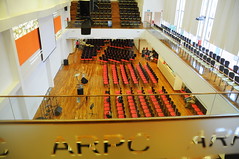
newARPC
saying goodbye at the last ARPC service at the Kuo Chuan Secondary School building in Bishan and hullo to the newARPC building back at 25 Adam Road.

The remaining time not spent eating was for listening to Mike Raiter speak on living with integrity on Wednesday and Thursday evening, prayer on Saturday morning and Romans 9 on Sunday morning. There is something about this sort of immersion in the word of God that causes dim eyes to make out, a little clearer than usual, for a little while, a little more of the flesh to the outline of the person of God.

Living the Christian life is not a matter of following rules, being "good" or having a strict morality; neither is it primarily about squabbling over the teachings of gurus - you follow John Calvin of the TULIP, I follow the free-form theology of Dance Praise 2 with extension packs. It is what being Christian is in the first place: having a relationship with God.

Who is this Father whom we are sons of and have a relationship with? It is interesting how fans hang on every act, every change in hair style, and every word of pseudo-wisdom that falls from the lips of their idols but we Christians who claim to worship God are far more concerned about what God can do for us than about knowing anything about him. Like meetings of obsessive fans and rabid stalkers, the focus of our sermons and Bible studies should be on God and his manifold and mightily admirable characteristics. No one who asks "How will knowing Master Chou 周大侠 help me get rich?" will last very long in a real Jay Chou 周杰倫 fan forum.

So we know that God the Father is the creator of the universe, it sustainer and its ultimate judge. He is all-powerful, all-knowing, all-good. But our minds are so befuddled by sin that we are hard put to make good use of this knowledge.

God as Judge
If God (or rather, his delegated authority Jesus) is all-knowing and the ultimate judge, then we live not to be judged by others; neither by our proud/disappointed parents, nor admiring/sneering peers, nor to make a mark in human history that generations might remember us. We live for an audience of one, with judgement day integrity.

Matthew 6:1 - 18 warns us not to practice our righteousness before other people in order to be seen by them, for then we will have no reward from our Father who is in heaven. There should be a oneness and unity within ourselves so that we are the same person at work, at church and at home. Our profession and expression must be the same. Why do we aspire to preach or lead the singing or a bible study or to go out to missions? It ought not be to be seen by others. If it is, then we will get what we deserve - a good reputation and the esteem of people...for now...and judgement of God on the Last Day.

God as Sustainer and Creator, God as God
Again, if God is our all-powerful and all-good sustainer, then we are dependent on God and not God on us. He does not need our time or money (although a church might need them to do its work for his glory) but we need him for our very life breath. Because we are dependent on God, we ask him for things: this is prayer.

If it is God we are asking for things, then praying for the purpose of impressing other people is absurd and bile-inducing. (Matthew 6:5 – 6)

And if it is an all-good God whom we are asking, then we do not have to spam him with empty phrases, manipulative 24 hour prayer marathons that go on and on all day long. As if God were deaf or unwilling to help. (Matthew 6:7 – 8)

And if this God is the ultimate of ultimates who should be our first love and object of worship, then we should feel strongly for his reputation and his name. We get angry when a righteous man is maligned, how much more indignant should we be when a good God is deprived of his rightful glory by people bowing down and glorifying idols made with their own 2 hands? In this way, the salvation of people is secondary to the glory of God. So we ought to pray first and foremost that God’s name be hallowed. (Matthew 6:9 – 10)

If this God is our creator, then he does not exist for us, a heavenly vending machine, but us for him to do his work and to give him glory. And if he is also sustainer and preserver, then we ask him for our daily bread: food and water and air to sustain our life, and also whatever we need to do his will and make his name known in this world. We ask for just enough to do his work, for he will not grant us perfect skill or perfect health because we can still do our jobs in our fallen incompetence as jars of clay, and through our cancers and migraines and amputations. (Matthew 6:11)

And if this God is all-powerful, then nothing in this world happens without his permission. Remember how Satan in the Book of Job had accused Job of loving God not for whom God was but for what God had given Job and asked permission to test Job to prove that once all these goodies were taken away, Job would throw a tantrum and curse God (Job 1:6 – 12). Remember also how Jesus had told Simon Peter that Satan had sought permission to sift him like wheat – oh sure it was cool to follow the all-curing, all-pontificating Jesus while he was free to roam and people adored him. But wait till Jesus was captured by the authorities and strung out to dry on a cross and see which rock the trusty disciples would be found cowering under. (Luke 22:31 - 34 for prediction of chicken-ness at rooster crow) We pray that in his mercy, God will not put us through these trials, but if it must be done, then we ask that he deliver us from the Accuser.

The things in the Lord's Prayer are hardly prayed for, possibly because of our terribly and unconscionably erroneous idea of the person of God in the first place.

Wine Garage
30 Merchant Road, #01-07
Riverside Point Singapore 058282
Tel: 6533 3188

Labels: , ,

Wednesday, March 19, 2008

Greek Masterpieces From Musée du Louvre and Peter O'Brien On Prayer

"We're back from the National Museum," gushed the parentals some months ago, waving about Greek Masterpieces From The Louvre brochures, "they've brought in sculptures from the Louvre. You must go and see them!"
"But we've seen them...at the Louvre!"
"Did not."
"We did. We went to the Louvre, you criticised I M Pei's pyramid, then you said you were bored and wanted to go shopping."
"Oh."
In any case, last Sunday, after Peter O'Brien'd delivered his 64th talk in the last 3 months, I popped across the road to the museum for a gawk.

Cheeky: "Surrounding David" by Titarubi
Surrounding David by Titarubi.
Poor old David's so commodified he's attained pink kebaya-cloth kitsch-ness.

The exhibition was fairly small but decently and thematically-curated. Peter O'Brien, being a bit of a scholar in Paul's New Testament letters, had, earlier in the day, painted many word-pictures and made many references to cultural context in which the letters had been written. Even though these statues preceded Paul by a century, there were probably quite a few of them still mooching around with their Augustan brothers when Paul gandered about Athens during the Late Roman Empire (Acts 17:16-34).

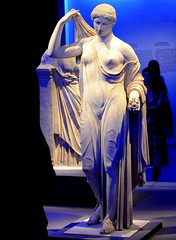
Aphrodite with wet himation
To my initial shame, having always been fond enough of Greek/Roman literature to have an entire bookcase on the subject and Greek/Roman-themed BBS rooms, my main reaction to some (because others looked like really bad copies) of these drapped bodies was one of great appreciation: the proportionality of facial features, bodies and limbs, the rendering of wet himations, and how nice it'd be to have a quiet empty museum for a sit around and a charcoal sketch.

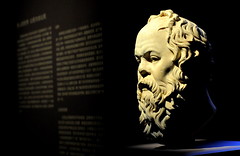
Socrates
But Paul, I thought when I got home and had a flip through the Book of Acts, had got it spot on. Upon seeing these beautifully proportioned idols, he did not bring out the sketchpad. Instead, his spirit was provoked within him. Barely able to contain himself, he went about arguing against the wisdom of that age, reasoning with Jews and devout persons and professional philosophers (Acts 17:16-34). So my reaction of great appreciation = FAIL. But someone later pointed out: all cultural lor. Not idols to ppl of our time liao.
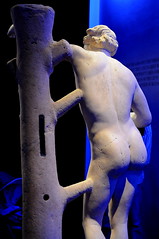
Cheater-buggery
Pardon me, but your butt is cracking.
Simulacra of the Roman simulacra of the Greek simulacra of...well, maybe no long-dead bird/hunk in particular; the Baudrillardic phase where the simulacra masks the absence of basic reality by being its own pure simulacra, these chipped blocks of marble may be, but they are not meaningless simulacra qua simulacra. Instead, they form part of a system of signification for the ancient Greeks and their Roman copiers/consumers. So the late night chat was a good reminder of the "nothing is a sign unless it is interpreted as a sign" of Charles Peirce, the cultural subjectivity of the signifier and the signified, and so the subjectivity of idolatry and therefore the necessary failure of any attempt at legalism.

Nevertheless, such utter incompetence in even identifying the right reaction in any given stimulus is probably a good impetus for prayer. (We had an interesting semiological debate in our DG about the word "prayer", but that's another post.)

Notes from Peter's talks on prayer:
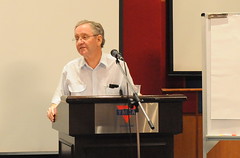
Peter O'Brien
Knowledge, wisdom and understanding and thanksgiving (Colossians 1)
In his letter to the Colossians, Paul tells them that he is constantly praying for them (Colossians 1:3,9). He asks of God because he knows that God is generous and will not withhold good things from his children. What does Paul pray for? He prays that they will be filled with knowledge so they will please the Lord (Colossians 1:9-10). He prays that they will have all spiritual wisdom and understanding. This wisdom and understanding is not what we think of as guidance from God, not "Lord, what do you want me to do?". Rather it is more about what God wants done in his world and how we can fit into God's plan for the world.

And what pleases God? Bearing fruit in every good work (Colossians 1:10b). This does not mean being successful in God's work by the world's standards, but having the fruit of the Spirit to be enabled to do things in a godly way, in growing in love for Christ, in wanting to know Jesus more and more.

It's all very well to talk about these things but how will we be able to do them? Through being strengthened in all power by the Spirit (Colossians 1:11). This same power, this same Spirit, raised Christ from the dead. So it's pretty lethal stuff.

Then Paul returns to thanksgiving. We have all been transferred from the dominion of darkness to the kingdom of light. Gaining citizenship of a country like Singapore or Australia's pretty difficult, but the difficulty level is nothing compared to trying to gain citizenship of heaven. Yet, Christians have achieved it through the forgiveness wrought for them in Jesus Christ. It is not only children who find it hard to say "please" and "thank you". Adults struggle as well. The writer of Hebrews tells us that we can now enter God's throne room with boldness. This should encourage us to pray prayers of thanksgiving.

Suffering and Weakness (Romans 8:18-30)
Voltaire was of the opinion that God either couldn't stop suffering or that he had the ability to do so but wouldn't.

We all live in the midst of suffering. But we are told that we are heirs of God and co-heirs with Christ. We will share in his suffering before we share in his glory. This tension is not just individual, it is also corporate.

Paul's thesis on suffering and glory is in Romans 8:18 - "For I consider that the sufferings of this present time are not worth comparing with the glory that is to be revealed to us". Paul was no stranger to suffering. In 2 Corinthians 1, he told the Corinthians that he was being utterly and unbearably crushed; he was so close to death that it was only a whisker away. Paul didn't have a silver spoon in his mouth. But he believed that the glory to come was a sure and certain thing. If it wasn't, then we would do all sorts of things to put our present suffering out of our minds, to try futilely to gain security, to distract ourselves.

The whole of creation is bound up with suffering (Romans 8:20). It was knocked off its perch of God-centredness because of Adam's sin. But again there is the promise that after this suffering will come glory when the sons of God come into glory (Romans 8:21-22). Suffering and glory go together.

And we Christians also groan inwardly (Romans 8:23). We were adopted as sons of God when we first trusted in Christ. But we now wait for that final adoption and the redemption of our bodies. Every time we have to visit the pharmacist or the doctor we are reminded of how our bodies have yet to be redeemed.

And as we wait in hope for this redemption, we continue to suffer and struggle. We are weak. Part of our weakness is that we don't know what we ought to pray for, "ought" meaning in accordance with God's will. This is part of our suffering. There are some people who approach the throne of God with such boldness that they keep telling God what they want over and over again. And when they don't get what they want, they blame God. There are other people who are just at a loss about what to pray for.

But, Paul says, the Spirit helps us in our weakness, interceding for us with groanings too deep for words (Romans 8:26). There is a content to the Spirit's prayer that we don't know about. Paul is not talking about speaking in tongues. The groanings of the Spirit are wordless. And God who searches hearts knows the mind of the Spirit, not just theoretically but the content of intercessions of the Spirit that are in line with his will. And God answers the intercessions of the Spirit. When we pray, we fire arrows at a target which may go far wide. The Spirit redirects the arrows to make sure we hit the bullseye everytime.
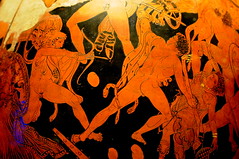
Hercules
When we were younger, we thought that we could do things on our own strength. But when we are older (and hopefully wiser), we rely more on God and his strength and his power. Nothing is too small for God. He numbers the hairs on our heads (Luke 12:7) and does not forget even the littlest bird, the sparrow (Luke 12:6-7).

For those who love God, all things work together for good (Romans 8:28). God works our good through things that were meant to harm us. Joseph, for example. was sold off by his jealous brothers (Genesis 37). After his many adventures in foreign lands, where he was ill-treated and thrown into prison, Joseph met his brothers again. He was now in a position of power and he could have had them killed (Genesis 42-45). But instead he recognised God's hand in his situation, even where his brothers meant evil, God meant it for good. God had sent him to Egypt before them to preserve their lives (Genesis 45:5-8). This does not mean that there are 2 different experiences but that the 2 are sandwiched into 1, the clearest example of this being the death of God's own Son. Wicked men meant for the destruction of Jesus and they will be held responsible for their actions, but their evil was used by God, and infact predestined by God, for good.

We are encouraged to call upon God. His answer to us will not be brilliance in analysing our situation or in summarising the problem. He will not answer us because our motivation is 100% pure because we are wretchedly corrupt. God will answer us because the Spirit intercedes for us.

And we know that God has infinite resources (Ephesians 3:20). Not only that, but also God doesn't hide away his resources like Scrouge. God gives lavishly. God wants to give abundantly. It's almost as if God is waiting to be asked so that he can give.

Faced with the reality of our own weakness, living in a world that is suffering, prayer is real and practical now. We do not need to wait until we are better before we can pray, nor must we do this or that before we can pray.

Prayer: slick? Unrealistic claims? Full of promises too good to be true? (Philippians 4:6-20)
Slick solution? (Philippians 4:6-9)
The poor Philippians were being pressured from without and being given a hard time. But whatever they were distressed about, Paul told them to be anxious about nothing and instead present their requests to God. ("Anxious"ness being unreasonable heresying care.) This sounds like a slick platitude but Paul was in prison then and knew what he was talking about.

God knows all needs. He clothes the lilies of the field etc (Matthew 6:28-33). They weren't to tell God about their needs because he didn't know them and needed to be updated. But by bringing their requests to him and laying their troubles upon him, they were to demonstrate their dependence on him. And this would strengthen their faith.

Did this mean that all our prayers will be answered? Philippians 4:7 promises one sure result: that the peace of God, which surpasses all understanding, will guard your hearts and your minds in Christ Jesus. Whether our particular petition is granted or not, we are assured of divine protection against everything. "Peace" isn't a feeling of peace but is that something objective that was done on the corss (Romans 5:1) - reconciliation and salvation. And this peace "transcends all understanding" and is more wonderful than they could imagine.

Philippi was settled by many retired soldiers who had the protection of a garrision or guard. This peace, said Paul, would similarly keep guard over their hearts and minds, those areas of their lives that were vulnerable to attack from desperate heresying care.

Do not be anxious but instead pray and God will guard your hearts and minds. The promise given in Philippians 4:7 is not slick. As I reflect on what God has done for me, this guards me against all sorts of wretched fears.

I can do everything! Unrealistic claim? (Philippians 4:10-13)
"I can do all things through him who strengthens me." says Paul. Will nothing be beyond our capabilities if we pray, if we had the same faith that Paul had? But yet, Paul had an extremely long list of things he still suffered (2 Corinthians 11). This is not a triumphalistic promise.

The context explains the promise. Paul says that he is content in all circumstances. He has experienced life at both ends of the economic spectrum and he knows how to live at both ends.

How does he do this? Through Christ who gives him strength. He can do all things, that is, be content in all things through Christ. Compare this with the Stoics who taught that the happy man was the content man. The content man was content in and of himself, due to his innate resources. But Paul knew that it was when he was most conscious of his inadequacy (2 Corinthians 12) that he could most rely on God.

Every need met! A promise that is too good to be true? (Philippians 4:14-19)
The doxology in Philippians 4:19-20 brings to a close the thanks to the Philippians. They have supplied Paul's needs, God will supply theirs. This is not a reciprocal tit-for-tat.

"Every need" does not mean just material things like money, but also the whole host of things that they were up against. They needed to stand firm in persecution (1:27-30), they needed unity where there were divisions (eg. between the 2 quarrelling ladies forever immortalised for posterity in the Bible), they needed to shine like stars in the universe even though they were under pressure.

"in glory" - these needs which they had would be met gradually and partially in the present but would be met fully at the end.

"in Christ Jesus" - Jesus is the only one in whom God's promises are fulfilled. Therefore, only when they are united with him fully would all their needs be met.

Our Spiritual Battle, the Devil and Prayer (Ephesians 6:10-20)
The spiritual dimension in Christianity is often ignored, whether in moral decay or in evangelism. This may have more to do with the Enlightenment than with Scripture. Scripture describes things from the world's viewpoint and also from a cosmic dimension. We neglect these things at our peril. We will not be seeing things as God sees them.

God has already won the decisive victory but the Devil and his minions still exist and still act even though they have lost. They will do anything to snatch away the Word when it is preached. This is especially so at morning tea after Sunday service when people will talk about anything but God's Word. The Devil distracts people so that they do not come to repentance.
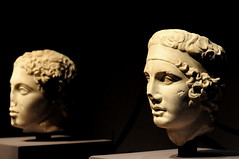
Ancient Jocks
In the Ancient Games, the most important, the blue-ribbon event was wrestling. So when Paul talked about wrestling not against flesh and blood, but against the rulers, against the authorities, against the cosmic powers over this present darkness, against the spiritual forces of evil in the heavenly places, he was emphasizing that the battle with evil is close-contact, hand-to-hand combat. If we think that when we evangelise, we are up against flesh and blood, we have misread the battle. We are up against evil.

The attacks against us can be one temptation over and over again. But the Devil can also switch tactics. He has variety and range. The attacks can be internal and external. Uncontrolled anger and the telling of falsehoods are not from the Devil but he can use them to cause strife within the body of Christ.

What is our strategic objective in the battle? It is to stand firm (Ephesians 6:11, 13,14), to stand up against evil powers. We are not to move ahead (which infact, might be a serious wrong) but to stand firm.

Can we take on such a formidable foe with just our own resources? No. But we can do this by relying on the power of God (Ephesians 6:13ff). In actual fact, the victory has already been won by Jesus Christ on the cross. The Devil's final defeat is imminent. Soon, everything will be subject to Christ. We don't have to try to win that victory over and over again. But for the battles in the meanwhile, God has provided mighty armour for us. This is the same armour that the Lord of Hosts fights in in Isaiah 59 and the armour that God's Messiah wears when he goes out to do battle in Isaiah 11. This armour that God himself wears we also wear. This armour is made of truth, righteousness and salvation - aspects of God himself. When we put on the Lord Jesus Christ at conversion, we put on his aspects, his armour.

The breastplate of righteousness is protection in knowing that we are right with God. We can't be blackmailed. The Devil cannot tell us that we aren't a good Christian because we haven't read the Bible or haven't prayed. Who will condemn us when Jesus has died for us? If we aren't sure of ourselves, we won't share the gospel. This is the ploy of the Devil.

The sword for battle, the sword of the Spirit, is also the same one used by the Messiah in battle.
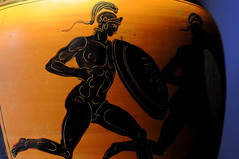
The shield of faith refers not to that little round shield which doesn't protect the head or the limbs in a battle but to the full-length one that covered the whole body. It was soaked in water and could quench dangerous missiles - arrows dipped in tar and then lit and shot. The Devil will try to attack us not just with temptation but also persecution and false teaching. We must trust in God's ability to keep us in the midst of battle.

Prayer is essential and crucial to our being armed. Standing firm and prayer are interlinked.

Summary
Thanksgiving is a mark of being Christians. The world may raise complaints and concerns to an art form, but the Christian is forever thankful because we have been transferred from darkness to light.

The Christian may find it difficult to pray aright. But the Spirit, who intercedes for us, hits the bullseye everytime.

There are some promises in Scripture that aren't what we want them to be. They must be read in their contexts.

We need to pray because our struggles are also in the cosmic dimension. The world is natural, the flesh is natural but the Devil is supernatural. If we live only as if there is the world and the flesh but no Devil, we misread the battle. There are ministers of Satan who will tell falsehoods and who are disguised as ministers of the gospel.

But when Jesus clothed us at conversion, he clothed us with armour that the Devil cannot destroy.

Labels: , , , , , , ,

Tuesday, February 06, 2007

Novus, Guilty Pleasures and Displeasures, and The Why of Prayer

An absolutely brilliant weekend.
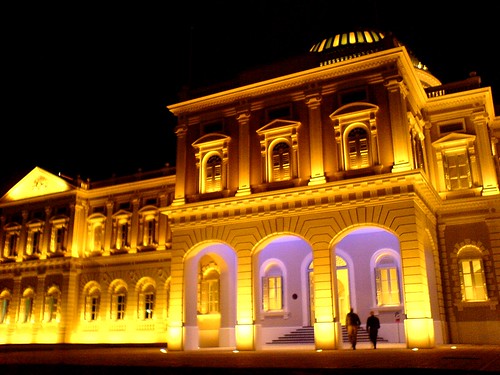
National Museum of Singapore
The Celebratory One bought a celebratory dinner at Novus. In a wing of the National Museum of Singapore, there was a wonderful high ceiling marred by squares of blue lights (leftovers from someone's zhng-ed white Subaru WRX?), large room mirrors for gossiping about other patrons discretely, gazpacho topped with shredded crab meat, very good pan-fried foie gras and a crisp strip of prosciutto, and seared scallops with braised pork belly and chestnut puree, and slow-roasted veal cutlet with poached slipper lobster and potato gratin, and slabs of tender wagyu beef poached and then seared, with crisp bone marrow and braised lyonnaise potatoes.
Novus Novus Novus Novus
("What's so special about wagyu beef?"
"The cows drink milk and listen to classical music."
(Buying more than just dinner!)"Issit?"
"No lah, actually, they drink sake. To make their meat more tender."
"Oh, so they're like: MoooOOOoooOoo *hic* MmmmOOooooOOooo *hic*!" [This probably only makes sense to people who've heard the mad cow joke. But then again...]

Well, apparently, wagyu is none of the above.)

Having ascertained that Ang Song Ming's Guilty Pleasures (nothing to do with suburban Massive Attack, Dave.i.d, more like The Guardian's list) had been well and truly put to bed, we sat curbside, U2 and Bruce Springsteen (and a very poor cover of The Killers' Mr. Brightside) throbbing from Timbre, swigging and catching up some more.

(Farcical photo thing, with apologies to Trevor Nunn:
Midnight

Cheap Wine
Not a sound from the pavement.

Moon Obscured By Cloud Cover
Has the moon lost her memory? She is obscured by cloud cover.

Withered Leaves Gathering at Feet

In the lamplight, the withered leaves collect at my feet.

Tunnel
And the wind, begins to moan (sound of Lamborghini contingent zipping into Fort Canning Tunnel).)

We discussed how evangelicals are given to talking about God as a concept, not a person; a wonderful abstraction, not a concrete entity. Then we said,"Ah, we must pray together!".

Prayer: Guilty Displeasure
A common (but guiltily unconfessed) view of prayer, especially congregational, combined prayer is that it is one of those good-to-do but really boring chores, akin to changing a senile old man's soiled diapers. "We'll have a short study today," says the DG leader,"and then we'll have more time to pray at the end." and the group looks distinctly uncomfortable. When it is time to share prayer requests, there is an awkward silence and everyone avoids eye-contact. Some excuse themselves and make a quick getaway. Finally, finally, as the closing prayer crawls to an end, the last "Amen" resounds like a collective sigh of relief, and shoulders unknot, fists unclench and everyone starts interacting happily.
If this is our discomfort in public prayer, what of our practice of private prayer? Do we pray at all?

None can answer this question but each of us, individually. Whether we go for weekly service or not, our pastors and friends know. Whether we pray in small groups or in prayer groups or as a family or not, our mates and relations know. But whether we pray in private or not, is a matter solely between ourselves and God.

Sometimes, snug under the covers at night, we think, wearily, that we really ought to say our prayers...then fall asleep without bothering.

It is a shame, we all say, that we think so poorly of prayer, or that we don't pray enough. Well, hey, at least we try, right? Haha.

But the horror of such a middle-finger-to-God deserves far harsher treatment.

Why pray?
David F Wells points out, simply, that theology without prayer is idolatry:
Theology without trusting, submissive prayer is no longer good theology; it is merely an academic exercise which may itself pose as a substitute for the process of knowing God. Where this happens, the means has become the end in a kind of perverse idolatry.
Trust the Puritans to be far more garrulous and slightly less polite:
It is the manner of hypocrites, after a while, in a great measure to leave off the practice of this duty. We are often taught, that the seeming goodness and piety of hypocrites is not of a lasting and persevering nature. It is so with respect to their practice of the duty of prayer in particular, and especially of secret prayer. They can omit this duty, and their omission of it not be taken notice of by others, who know what profession they have made. So that a regard to their own reputation doth not oblige them still to practice it. If others saw how they neglect it, it would exceedingly shock their charity towards them. But their neglect doth not fall under their observation; at least not under the observation of many. Therefore they may omit this duty, and still have the credit of being converted persons. (Jonathan Edwards, Hypocrites Deficient In The Duty Of Prayer)
Prayerless friend, I can only warn you; but I do warn you most solemnly. I warn you that you are in a position of fearful danger. If you die in your present state you are a lost soul. You will only rise again to be eternally miserable. I warn you that of all professing Christians you are most utterly without excuse. There is not a single good reason that you can show for living without prayer.

Oh, prayerless man, who and what are you that you will not ask anything of God? Have you made a covenant with death and hell? Are you at peace with the worm and the fire? Have you no sins to be pardoned? Have you no fear of eternal torment? Have you no desire after heaven? Oh, that you would awake from your present folly! Oh, that you would consider your latter end! Oh, that you would arise and call upon God! Alas, there is a day coming when men shall pray loudly, "Lord, Lord, open to us," but all too late;—when many shall cry to the rocks to fall on them, and the hills to cover them, who would never cry to God. In all affection I warn you. Beware lest this be the end of your soul. Salvation is very near you. Do not lose heaven for want of asking. (J.C. Ryle, Practical Religion - A Call to Prayer)
But J.C. Ryle is no Armenian:
I hold salvation by grace as strongly as any one. I would gladly offer a free and full pardon to the greatest sinner that ever lived. I would not hesitate to stand by his dying bed, and say, "Believe on the Lord Jesus Christ even now, and you shall he saved." But that a man can have salvation without asking for it, I cannot see in the Bible. That a man will receive pardon of his sins, who will not so much as lift up his heart inwardly, and say, "Lord Jesus, give it to me," this I cannot find. I can find that nobody will be saved by his prayers, but I cannot find that without prayer anybody will be saved.
Prayerfulness as a mark of God's people
A habit of prayer is one of the surest marks of a true Christian.

It is one of the common marks of all the elect of God; "They cry unto Him day and night." (Luke 18:1) The Holy Spirit, who makes them new creatures, works in them the feeling of adoption, and makes them cry, "Abba, Father." (Rom. 7:15) The Lord Jesus, when He quickens them, gives them a voice and a tongue, and says to them, "Be dumb no more." God has no dumb children. It is as much a part of their new nature to pray, as it is of a child to cry. They see their need of mercy and grace. They feel their emptiness and weakness. They cannot do otherwise than they do. They must pray.

I find it mentioned as a characteristic of the godly, that "they call on the Father," that "they call on the name of the Lord Jesus Christ." I find it recorded as a characteristic of the wicked, that "they call not upon the Lord." (1 Peter 1:17; 1 Cor. 1:2; Psalm 14:4)

And I say furthermore, that of all the evidences of real work of the Spirit, a habit of hearty private prayer is one of the most satisfactory that can be named. A man may preach from false motives. A man may write books, and make fine speeches, and seem diligent in good works, and yet be a Judas Iscariot. But a man seldom goes into his closet, and pours out his soul before God in secret, unless he is in earnest.

I know that the elect of God are chosen to salvation from all eternity. I do not forget that the Holy Spirit, who calls them in due time, in many instances leads them by very slow degrees to acquaintance with Christ. But the eye of man can only judge by what it sees. I cannot call any one justified until he believes. I dare not say that any one believes until he prays.
A Christian by definition is one who knows that he is completely dependent on God for every aspect of his puny existence and so submits to God in everything (how can he not?). His natural expression of this dependence is prayer, communicating with God, out of the fullness of his heart, just as a baby naturally cries when it is hurt or a child laughs when it is happy. Prayerlessness, then, is an indication that something has gone horribly wrong.

(If it is out of our relationship with God and our understanding of our relationship with God that we pray to him, then Bible-reading/study and prayer cannot be parted. Without knowing God's word to us in the Scriptures, we would not have a relationship with him, nor will we know how he wants us to relate to him. So theology and prayer must walk together, hands clasped tightly, into the sunset. Or something.)
Botanic Gardens
The next day, we sat on the green grass of the Singapore Botanic Gardens, beyond Mr. Tumnus' Narnian lamppost, planning the next few months and praying. Later, the Fluey Ones cooked pasta and we sat around talking and rebuking and encouraging, late into the night. And it was good.

Yet while sermons, and Christian books, and ministry meetings, and praying together, and the company of men who love God, are all good in their way, they will never make up for the neglect of private prayer.

This week, an ennui of mendaciousness will descend when we are foisted onto fine private dining establishments, black-suited like the mafia, and lean against the starched white tablecloth, and swirl wine and talk earnestly about antique watch-collecting, the utter reasonableness of US$10,000 psf housing, yachting and marinas, sale-and-leaseback facilities for Cessna fetishes and the delightfulness of power and ruling countries and moving financial markets; things that will soon pass away.

Where we continue to be in danger of being tempted by the illusory playthings of this world, constant immersion in God's word will remind us of their valuelessness. And we will pray that God will lead us away from temptation to harden our consciences to such idolatry and keep us on his road to his kingdom.

To be continued...

Labels: ,