Wednesday, December 30, 2009

They Built Their Houses with Paper and Gingerbread

Paper Houses as Gift Tags
If we were yet another spore in the mushrooming indie bandwagon (cheesy mixed metaphors due completely to all that Christmas cheese), we would call ourselves "The Paper Houses". Our eponymous debut album would contain the hit singles "People In Paper Houses Shouldn't Light Fires" and "Oh! My Soggy Foundations!".


Paper House Paper House
Fascination with Anna Torborg's paper house templates over at Twelve22 led several happy hours singing carols while trying to deflect attention from poorly wrapped presents with tiny personalised houses.

Paper House: Music Cafe
I liked the tension in the window of the music cafe best with its black cat eyeing a platter of cupcakes, a picture of feline self-control.

Gingerbread Houses for Mugs
The minature home-making continued with gingerbread houses that perched on the rims of mugs of hot tea (until the heat got to the icing) (cheers notmartha).

Podcasts for Cookie Baking
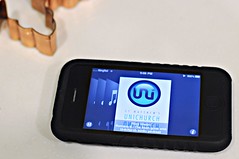
When the neighbours weren't busy being traumatised by the singing and the smell of burnt gingerbread, they might have caught snippets of podcasts from St. Matthew's Unichurch, Perth.

Thanks to Hayao Miyazaki's Howl's Moving Castle, Rory Shiner's exposition on Romans 6 brought to mind the image of Jesus as a flying home (interestingly The Flying House was a Christian anime series).

It is commonly said in some circles of living the Christian life that, well, the ceremonial law has been abolished but the law is still useful for holiness now that we've understood the gospel and that actually, grace and salvation are conditional on our morals and good behaviour.

But Paul says that the reason that Christians will not and cannot continue in sin because in Christ, we died to sin.

When a Christian puts his trust in Christ to save him from God's judgement on his sins, he does not sign a contract to perform services to God in exchange for salvation. But neither does he merely agree to abide by the terms of membership of the Christian club to follow Christ or be under the rule of Christ, nor is it only that the Spirit comes to live in him to enable him to live as a Christian. Far more than that, the Christian is in Christ - he is crucified with Christ, buried with Christ and raised with Christ (Romans 6:3-5); he is united with Christ.

Christ is a place and the Christian is in him. Christ is like the plane that goes from Singapore to Helsinki (SIN-HEL, haha) and if we are in that plane, we too go from Singapore to Helsinki. What happened to Jesus also happens to the Christian. The Christian participates in the full benefits of what Jesus has to offer and all his blessings, regardless of whether he is quivering in his seat or if he has taken off his shoes and started snoring even before take off.

Christians coming into Christ have, in fact and not as a metaphor, had their old selves killed and buried. Our old selves are not things that have to be beaten into submission so that they will one day; give up the ghost; they are already dead and buried.

If our old sinful selves are dusty history, then because this is true, we must live out the reality that we are dead to sin (Romans 6:11). The imperative is not to pretend for the purposes of the exercise that we are free, but, because our minds are so used to being enslaved to sin, to keep reminding ourselves that we are now, in fact, free from having to obey our sinful thoughts and desires. To return to sin would be as absurd as an emancipated slave running back to be chained to a galley with little food and water and to be ill-treated and then die a painful torturous death because "I can't help it, I just need to do it. My family background and genes compel me to do it." or "I cannot be happy and satisfied in life until I return to slavery" (Romans 6:12-23).

Organically, something has changed in the Christian. The Christian life is then about reckoning to ourselves what God has reckoned to us: freedom from the slavery of sin and freedom to fulfil our full potential as human beings - as slaves of God (Romans 6:15-23).

Suddenly, Monty realised he was but a cliché from 2009...
Monty, the cliché from 2009, says "Know the truth and the truth will set you free".

Labels: , , ,

Sunday, August 17, 2008

Last Temptation of Stamford Raffles, Illustrated Guide to Surreal Botany and Romans 15:7 - 33

Lazy Sunday Breakfast
going for service on saturday = a lazy sunday in

a pretty sunday morning. a soft breeze under a blue-sky sun. breakfast is in bed because of renos. gryphon tea company's queen's tea. a delish cottage cheese muffin from a lovely person. the full heft of absolute dark knight.

So lazy a Sunday that later in the week, there had to be a massive lunch-time Romans 15 mug before DG that night. :-p For future reference (a few questions copyright of cldg leader):
Launch questions:
Q: What would you recommend to a new Christian for his growth?
Q: What would you recommend to a mature Christian for his growth?


Read Romans 15:7-33

Romans 15:5-6
Q: What does Paul urge the Romans to do? (15:5)

live in harmony with one another

Why does Paul urge them to do this? (15:6)
that they may with one voice glorify God

Romans 15:7-13
Q: What does Paul urge the Romans to do here? (15:7)

welcome one another

Q: Why? (15:7)
for the glory of God

Q: In so doing, who were they to imitate? (15:7)
Christ

Q: What did Christ become? (15:8)
a servant to the circumcised (could mean physical circumcision but more probably circumcision of the heart)

Q: In what way was Christ a servant?
incarnation and death in our place

Q: Why did he go through all this? (15:8)
to show God's truthfulness

Q: How is God's truthfulness shown (15:9)?
Christ's servanthood
  • confirms the promises made to the patriachs; and
  • compels the Gentiles to glorify God for his mercies
Q: Paul then quotes from Scripture to substantiate the points he has just made. How do the quotations substantiate the points?
promises, probably: adoption as God's children, covenants of land, blessing -> ultimately, salvation is, in God's plan, intricately tied in with the nations glorifying God
(sub-Q: Why would the Gentiles/nations glorify God for his mercies? What were "his mercies"?)

Q: How does God's truthfulness bring him glory?

Q: How should we react to confirmation of God's truthfulness?
believe, get joy and peace from that, so that by the power of the Holy Spirit you may abound in hope (sub-Q: What is this hope in?)

Q: What is the common goal in all that Paul exhorts us to do and in all that Jesus has chosen to do?
the glory of God

Romans 15:14-21
Q: What does Paul say is the problem with the Romans? (15:14)

haha, trick question. nothing's wrong with them. Paul is satisfied about them, that they were full of goodness, filled with all knowledge and able to instruct one another. Paul was not a flatterer.

Q: Then why has Paul written them this letter? (15:15)
as a reminder

Q: What does this tell us about how Christian growth takes place?
not by new and exciting revelations but by being reminded of the same gospel. same for new and mature Christians. gospel not just launchpad to other things.

Q: What does Paul see as his God-given life's work? (15:15-16)
"to be a minister of Christ Jesus to the Gentiles in the priestly service of the gospel of God, so that the offering of the Gentiles may be acceptable, sanctified by the Holy Spirit"
(minister = servant)

Q: Why does Paul describe his ministry as "priestly service"? How is his ministry similar to that of a priest (OT)? How is it different?
similarity: he is seeking to present acceptable sacrifices to God
differences: not to mediate for people. presenting living Gentiles not dead animals. he will present them as acceptable sacrifices by preaching the gospel to them (see 15:18-20) so that in believing, they are sanctified by the Spirit and thus rendered acceptable to God. (cf Romans 12)

Q: What does Paul think of his work for God? (15:17)
he's proud of it

Q: What about his work does Paul take pride in? (15:18-19)
bringing the Gentiles to obedience to God

Q: To what factors does Paul attribute the success of his work? (15:17-19)
work of Christ Jesus, power of Holy Spirit

Q: How does Paul's goal in ministry challenge our own ministry?
Q: How does Paul's method in ministry challenge our own ministry?

BooksActually, Ann Siang Hill
Someone'd wanted to meet up with an old friend who'd illustrated A Illustrated Guide To Surreal Botany and was hustling for company for the book launch. "I'm gonna have enough surreal botany of my own that night," came one reply,"seeing that I'll be sharing a stage with a walking, talking Rafflesia".

(The next night, no one was particularly pleased with the purple walking, talking Rafflesia who appeared to be merely reprising her role as one of the overacting witches of the unforgettably foul Macbeth by World-In-Theatre (in this instance, foul not = fair (Macbeth 1.1.11-12)). It did not help that her accent was so odd that it was difficult to understand what she was saying.

The shadow puppets (courtesy of Candice de Rozario and Ivan Tan) were entertaining but extremely underused. Wong Chee Wai did good work on the raked stage and the use of the enormous bed as the deck of a ship. And we liked James Tan's clever use of silhouettes.

Over bowls of XO fish beehoon and claypots of frog-leg porridge later, the consensus was that Ng Yi-Sheng's script was probably more suited to a short story than a play with all that saggy pontificating dialogue, and even then, it was said, it would have lacked the tautness and bite of a good commentary. Rafflesia and untoward events as chaos vs control and civilisation? Only somewhat evident towards the end, slightly mitigated by the hint of commentary via plot device of the closing scene mirroring the opening one except that it was the white-clad, white-washed, slogan-spewing soul of Raffles ("I'm not used to blowing smoke up my own ass" Ivan Tan) who was lying on his deathbed. So much for giving OCBC Singapore Theatre Festival another go. Love the concept of supporting local plays but Christopher Nolan's Last Temptation of Harvey Dent would have been (and was in fact) far better and much cheaper.)

Cookies and Tea, BooksActually
The book launch at BooksActually at Ann Siang Hill was fairly crowded. There were cookies and tea and questions about Two Cranes Press world domination, friendly greetings like,"Ooo, I smell a bitch!" and "Get your homophobia out of my face!", a very obnoxious 9-year old trailing Marmee crumbs, heated discussions on how destroying painting = destroying soul of artist and, despite written requests to cease and desist from such action,
Cake the Cat, BooksActually
tapping on the glass to tease Cake, the BooksActually "I'm not a skinny cat, I'm a kitten" cat.

So we sat around nursing cuppas and nibbling on biscuits and chatting with random strangers until it was time to pop by Drama Centre to pick the Last Temptation of Stamford Raffles people for supper. Tony Trickett, substituting for Ivan Heng on the second night we supposed (who was himself apparently substitute director in place of Christina Sergeant who'd gone off to be with her ailing mother), was hanging around front of house PR-ing and seeing the actors off and unfortunately, heard us poking fun at the improbable names of some W!ld Rice Angel sponsors. "XXX is a wonderful supporter, actually!"

Macau Cafe, Siglap
By the end of supper at C.NAI Macau Cafe at Siglap, there'd been reminiscing about past shows and Brian Seward, collective insistence of the iconic importance of the I Theatre chicken, typos spotted in the LTSR brochure ("if Raffles was born in 1819, he was 7 years old when he died after marrying several wives, fathering several children and catching syphilis!"), laughing at an earnest 19-year old who'd asked about the functionality of pillowy lips, detailed discussions on involuntarily ascending scrota and "cryptozoological accoutrements"...

By 2am, there'd been updates on the latest divorces and who'd been cheating on who, and someone boo-ed for still being a virgin (he said it was difficult to beat his cousin's record of losing his virginity to 2 girls at the same time but the rest of the table pointed out that technically, even if the story was to be believed, his dear cousin could only have lost his virginity to one of the girls first).

Why not support divorces that would do the currently marrieds good, freeing them so that they could go find the person out there who would bring them happiness and satisfaction? 36 girls already amassed at age 17? So what? And so what about the sleeping around that allegedly (but is probably too much of a generalisation) characterises the drama/music scene? What's wrong with you narrow-minded, legalistic, repressed, wet-blanket Christians? some one might have been thinking but was too polite to say when the conversation led to her theory that Satan was God's crony, and that they were playing at a goodcop-badcop thing. So either God's written word is a lie or it is not.

I suppose the short answer would be that Christians have the designer and manufacturer's operating manual for the world. And they trust him (first, perhaps, because of external historical authenticity, then later because of his inherent consistency and constancy through the ages, delivering on promises he made hundreds of years before) to be all truthful and all good and to work everything for the good, even evil. And they are far more concerned with living up to their full potential by bringing glory to this inventor God (the purpose for which all humans have been made) than bothering about the keeping up with the latest trend in stab-in-the-dark human-fulfilment human-satisfaction theory that will inevitably prove false with time. In any case, partaking of poorly-lit knife-ridden parties generally increases the risk of having one's eye poked out.

BooksActually
No. 5 Ann Siang Road
Singapore 069688
Tel: 6221 1170

C.NAI Macau Cafe
378 East Coast Road
Tel: 6440 3808

Labels: ,

Saturday, August 09, 2008

Sodagreen 苏打绿 Sing With Me 陪我歌唱 Concert, Futsal Tournament, Romans 13

Sodagreen 苏打绿 Sing With Me 陪我歌唱Concert, Singapore Expo Max Pavillion
Not a Sith was found amongst the fans


At the Sodagreen 苏打绿 Sing With Me 陪我歌唱 Concert at Singapore Expo's Max Pavilion, the front rows were filled with sponsors whose bottoms had politely declined to leave the comfort of their chairs and were consequently the subject of endless ribbing by Qing Feng 青峰 who asked if they were especially bothered by something that night.

Was particularly taken by the wide-ranging timbre of Qing Feng 青峰's voice, his indie use of the megaphone and the theremin, sometimes simultaneously, and his getai diva, cheeky teenager, chatty, slightly angsty persona. Exhibit 1 : 小情歌 - Qing Feng 青峰sounding like a recently pubescent boy, looking like a girl dressed as a boy. Exhibit 2: 小宇宙 - Qing Feng 青峰 sounding like a later-adolescent boy, looking slightly less like a girl dressed as a boy. So that there is no doubt on the matter, the man is 26 years old this year.

Many thanks to J and A for this very interesting experience and the third evah Chinese concert of my entire life.

Futsal Tournament at Sports Planet, East Coast Parkway
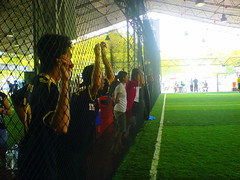
A few hours later, at the futsal tournament, fuelled by a carton of Del Monte bananas, we swept through the semi-finals, then proceeded to clinch the champions' trophy on sudden death saves. There was great cheering, vigorous hand-shaking and the spraying of bottled water (no champagne lah). Hooray the goalie with both presence of mind as well as body!

C. Nai Hong Kong Cafe 师奶茶餐厅
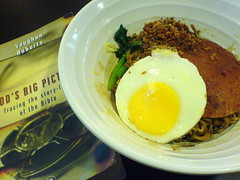
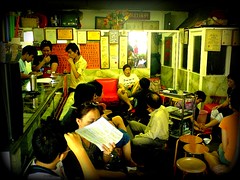
After, non-banana nourishment took the form of lunch at C. Nai Hong Kong Cafe 师奶茶餐厅 and a quick run through of the first chapter of Vaughan Robert's God's Big Picture with the group. Then staggered back to the car and promptly konked off for an hour in the afternoon heat before dinner.

Thinking through the implications of the glib phrases that Christians so often profess unthinkingly made for an amusing afternoon. Eg: God the Creator (Genesis 1 - 2).
"So what did God make?"
Chorus: "Everything!"
"What didn't God make?"
Chorus: "Nothing. He made everything!"
A small voice: "But he cannot have made the serpent, what."
"What did God make?"
Same small voice: "Everything. But he couldn't have made the serpent..."
In a similar fashion, finally happened upon a glimpse of how the latter part of Paul's letter to the Romans, living as erm living sacrifices, is essentially a logical outworking of what we profess of God in the first place:

God is sovereign over all things
It is fashionable to be disgruntled with authority, to bitch about bosses, to gripe against governments. But God's word, unsurprisingly, is remarkably and refreshingly clear on the matter.

If God is sovereign over all things, then no authority exists on earth except that which comes from God and has been instituted by him (Romans 13:1). Therefore, every authority (including every Saul-like kingship and unpopular government) has been given authority and instituted by God. Therefore, to rebel against such an authority would be to rebel against God's appointed authority, which would be to rebel against God himself. And rebellion against God = sin = judgement (Romans 13:2).

Naturally, Paul was not talking about blind submission nor about being socially or politically apathetic. Yet he did not make like a Pharisee and dictate thick scrolls of subsidiary regulations to legislate when and to what extent one should be subject to the authorities. Our renewed minds must do the hard work of working this out in our circumstances in full dependence on God. While the old mind would find this an absolute burden and therefore delight in naming all the situations in which Paul's teaching would not apply, the new mind applies this teaching in all situations unless such obedience to authority causes us to disobey our ultimate authority, God.

For a bit of direction, Dick Lucas expands on Romans 13:1 - 7 here:
God is Creator
If we are to pay to all what is owed to them: taxes to whom taxes are owed, revenue to whom revenue is owed, respect to whom respect is owed, honour to whom honour is owed, then what do we owe people who are not in positions of authority over us?

Why, love, says Paul and does not proceed to sing Andrew Lloyd Weber's Love Changes Everything. In popular thought, love and human rights ride away into the sunset together. But not so in the mind of God.

As a pagan, I'd actually written up most of my final year thesis on human rights and had been offered internships in the United Nations and the International Labour Foundation when I realised sadly that the theory of human rights was itself baseless and could not, in integrity, submit the work nor proceed with the internships. A few years later after a bit of an overhaul of the mind, someone approached me for help on her final year thesis on human rights. She claimed to find basis for the general theory from the Bible and could not accept that the Bible did not in fact speak of rights but only of obligations.

Romans 13:8 - 10 seems pretty clear on this. And throughout the Bible the language is always skewed so that we view ourselves as debtors and obligors, rather than people to whom debts are owed and who have the right to sue for payment. Obligations do not necessarily engender rights. And God calls these human obligations "love" - the way he'd designed humans to relate to one another. Pretty far out from the you-complete-me, you-turn-me-on, you-light-up-my-life, self-centred self-gratification the world terms "love".

Even more crushing to the red rose and candlelight industry, Paul links love intimately with the Law given to the Israelites by God and says that love is infact the fulfilment of that Law. For if love is about the other and seeking the good of the other, and all good is defined by God alone (as revealed in the Law), then everything done under the auspices of love must obviously be in obedience to the Law. Therefore, to claim that it is alright to lie or commit sexual sin as long as it is done "lovingly" is a perversion of God's words and our design. (Which is why, for example, the seemingly pleasurable habit of flattery is so abhorrent to God.)

Too much to think about now? Will put it aside to sort out another day?

Paul bookends the entire section (Romans 12-13) with a reminder that we are both compelled and enabled by God's mercies to live as he made us to, in true worship of him, then with a warning to look to the time:
you know the time, that the hour has come for you to wake from sleep. For salvation is nearer to us now than when we first believed. The night is far gone; the day is at hand. So then let us cast off the works of darkness and put on the armor of light. Let us walk properly as in the daytime, not in orgies and drunkenness, not in sexual immorality and sensuality, not in quarreling and jealousy. But put on the Lord Jesus Christ, and make no provision for the flesh, to gratify its desires. (Romans 13:11 - 14)
Cepat jalan.


C. Nai Hong Kong Cafe 师奶茶餐厅
1000 East Coast Parkway
Singapore 449876

_______________________________________

Working through current series on Romans:
First Thai, Jay Chou's Birthday Concert and Romans 1
Feasting and Larval Thoughts on Faith and Romans 4
Privé, Cilantro and the Marvellous Comfort of Romans 8:1 - 16
Basil Alcove and the Pre-destination-based Comfort of Romans 8:17 - 39
Kapok at Newton and Romans 9 - 11
Tin Hill Wine Bar & Bistro, The White Rabbit at Dempsey, Dim Joy, True Worship and Romans 12:1 - 2
Sodagreen 苏打绿 Sing With Me 陪我歌唱 Concert, Futsal Tournament, Romans 13

Labels: ,

Wednesday, July 30, 2008

Tin Hill Wine Bar & Bistro, The White Rabbit at Dempsey, Dim Joy, True Worship and Romans 12:1-2

Veggie Dinosaur
At the birthday party of a three year old, there were veggie dinosaurs and chicken patties made to look like teddy bear faces, fancy balloons that got little hands entangled, abandoned drumsets, new electronic keyboards for drumming on, a back-patio barbecue, toy cars running over adult toes, chatter and laughter, and a bit of fighting.

In another time, in another place, these little ones running around so free and (mostly) happy might have been laid struggling and crying upon cold stone and sacrificed by their desperate parents in a fruitless bid to win the favour of their gods. We remember sick account of the time the king of Moab was beseiged by Israel and could not break through their ranks, and how, in a vain attempt to bribe his god to give him victory, he took his eldest son and sacrificed him as a burnt offering on the wall (2 Kings 3:26 - 27).

Behold the gods of human invention: we make them in our own fallen image but assign them more power. So it follows that pagan worship is like curry-favouring a corrupt official; it is all about twisting the arm of a reluctant deity who has better things to do with his time and apparent power.

And so how immensely sweet and wonderful the true God is, who (as we have seen from Romans 1 - 11) is not only a good God but has willingly worked for the good of his people even before they knew what help to ask for: despite man deliberately sinning, God saved them from his own righteous wrath; he grafted Gentile who were not his people into his own family tree; he delayed judgement so that people could be saved; he proved the Law so that blind, conscience-challenged humans might have some idea of how far wrong they'd gone in the first place; and he provided his only son to pay for the sins of the world.

So what is it like to be engaged in true worship that the true God desires?

(Why would we want to worship God? Because that is the precise reason for which we were made. Until we live under his loving rule, we will never achieve our "potential". If we do not worship God, we are missing the whole point of our existence. Plus, refusing to worship God is the heart of sin.)

True worship is a response (Romans 12:1)
If it is God that always takes the initiative in saving us and making us his children, then true worship must always a response. This is what the "therefore" in Romans 12:1 is there for. In light of what God has done as spelt out by Paul in the preceding 11 chapters, true worship cannot be about us seeking to secure God's favour, for that is the basis of pagan worship. It is about us responding to God's favour already given; it is about living in the light of what God has already done for us: we are already justified, we are already holy and acceptable to him. No amount of fasts or prayers or pilgrimages will bring us closer to God...if we are Christian, we are already children of God. That is the marvellous difference between Christian and pagan worship.

Therefore, no church leader or song leader or holiness retreat can bring us closer to God than we already are. Nothing will bring us into the holy of holies because when we believe in Christ and are granted access to God through his blood, we are already in the holy of holies (Romans 5:1 - 2). When we lead a meeting of Christians we are not leading worship but giving clear statements of what God has already done for us so that people can respond appropriately.

(Singing in church then is about us responding to God in thanksgving and praise. It is also us encouraging each other and filling our minds with the truth of what God has done. All the psalms give a reason for why we are praising God. The purpose of us singing songs is to remind and share with one another what God has done for us so that we can worship acceptably - here and when we go out. Bad singing (not tuneless singing) is singing that is not biblical, that does not draw on the promises of God, or singing that is all about me. Good singing should reflect on the goodness of God.)

And do we think we can offering God anything? We have nothing we can offer to God except what he has already given, in response to what he has already done.
Compared to Knowing Jesus
Nothing I can offer to heaven
Nothing I can bring to make peace
Nothing in the way that I sing his songs
Nothing in the way that I pray

Though I can say that I love him
Though I can lift up my hands
Though I have actions and words of grace
Though I hold my head up high

There's nothing in the world or in my life
That doesn't disappear or fade away
Everything I've come to know I count as loss
Compared to knowing Jesus, my Lord

If I am right with my maker
It is through faith in my Lord
If I have goodness it comes from him
If I am pure I give thanks

I want to know Jesus my saviour
I want to know his power to rise from the dead
I want to have fellowship in his grief
I want to be raised up with him!
© Mark Peterson
True worship is everywhere, all the time (Romans 12:1)
Futsal Cage, Sports Planet, East Coast Park
Even in the futsal cages of Sports Planet, East Coast Park

True worship is not confined to a particular place and particular time. God does not insist that it be done in a "holy" place or in a church building nor through a specially consecrated priesthood/pastor-hood/anointed few. In fact, to think so would be a denial of Jesus' work on the cross.

True worship is everywhere, all of the time, in all of life. Presenting our bodies as a living sacrifice, holy and acceptable to God (Romans 12:1) consists of 3 different ideas.

The idea of presenting one's body is taken from the command to the priestly family of Levites to present themselves to God at the temple. It is to minister and serve...as a priest! We do not need a pastor or a priest to bring us into the holy of holies because we have gained access through the blood of Christ!

The idea of a living sacrifice appears rather ironic since a sacrifice was an animal that gave its life so that the Jews could approach God. But now that Jesus has died as a sacrifice for our sins, there is no more sacrifice to be made.

A sacrifice had to be unblemished or else it would not be acceptable to God. But what Paul is saying is not try to be holy and try to be blameless. He is saying that in view of what God has done for us, we are already holy and blameless! We can do what the high priest could only do once a year after elaborately purifying himself could do, appear before God himself. Now Christ's death has washed us clean, now God already sees us as holy. We don't swish in and out of the presence of God trailing the scent of frankinsence and myrrh. We live in the presence of God 24 hours a day, 365 days a year, every year, in every situation. 360 degrees.

The implication of this is that everywhere is a place of worship: our office, the driving seat of our cars, the family meal table, tennis court and even the side of the goal post in a futsal cage. The view of worship only taking place in the austerity of a monastic retreat in the cool mountains or in a consecrated space vehemently denies the Christian faith altogether.

And true worship is immensely earthy - it is in driving the car, in honouring marriage, in giving someone a meal, in leading our Christian families...all in response to what God has already done for us.

Do we trust in Jesus to save us from our sins? Then we have been justified by God and we are part of God's family. You are a priest as much as another Christian. Now that you are finally freed from the shackles of the consequences of your sins, now that you can see and hear, worship God.

(The Monday after spending a weekend stuck into Romans 12 when, after I'd told my Christian colleagues that Don Carson was in Singapore for the Living Word series organised by the Anglican Diocese of Singapore at St. Andrew's Cathedral and they'd expressed complete ignorance of his person, we got into a good discussion about why we believed in the Christian faith in the first place, the interpretation of the Bible, dinosaurs and intelligent design and the 7 days of creation, and then there was a beautiful sunset - a glowing red orb sinking behind the silhouettes of, erm, oil refineries, and I wanted to burst out singing:
All Heaven Declares
All heaven declares the glory of the Risen Lord;
Who can compare with the beauty of the Lord?
Forever He will be the Lamb upon the throne;
I gladly bow the knee and worship Him alone.

I will proclaim the glory of the Risen Lord;
Who once was slain to reconcile man to God.
Forever You will be the Lamb upon the throne;
I gladly bow the knee and worship You alone.
© Noel and Tricia Richards
Fortunately, I remembered that my life was not a musical and stopped in time. But, maaan, the joy of proclamation of the good things of God in a situation so unused to the sound of his name. Yet not just this time but every minute should be lived in light of the reality of this marvellous God.)

True worship is mindful and not mindless
"Spiritual worship" in the ESV is a strange translation. The Greek word is logicos - we get the word "logical" from it. So the NIV translation of "reasonable worship" or "rational worship" is better. As we fill our minds with all that God has done for us, then the response we make is a rational, reasonable one. Falling over and making animal noises or whatever the current fashion of the age is, is not the worship God requires.

True worship comes from a mind, a changed mind, the mind that God has renewed or changed in a Christian. Without a changed mind, we cannot worship God pleasingly.

In the Bible, the mind does not simply mean the intellect. The mind points to what we think about things and feel about things. The heart is used to mean almost the same thing. The heart is not just about feeling but also the control centre. Both are metaphors for what we are on the inside, the core of our being.

True worship can only come from a renewal of the mind
Chinese Chiropractor, Banda Street
Things needing straightening out

Some things need only a bit of painful straightening out, but what true worship requires is for the worshipper's old mind to be completely recreated.

The renewal of the Christian's mind is a one-off event when God breaks into a person's life and renews what we are on the inside. It is our conversion and it is not on-going. What is on-going is the work of God by the power of his Spirit which he has given us and the Spirit's work has life-long implications.

We know from Romans 1:28 that the action of God as judgement for our non-worship of him is to deaden what we are on the inside so that we cannot truly worship him. From this debased mind which God gives us up to comes all manner of unrighteousness, evil, covetousness, malice. It is because of our debased minds that we are full of envy, murder, strife, deceit, maliciousness; that we are gossips, slanderers, haters of God, insolent, haughty, boastful, inventors of evil, disobedient to parents, foolish, faithless, heartless, ruthless (Romans 1:29 - 31). This means that any of us having a debased mind and given the right opportunity would have been an Austrian dungeon dad, a corrupt politician or a maniacal tyrant. This is what anybody could be if we were not with God. No amount of policing or laws or education would help that. It is only by washing us clean and literally recreating our minds from the inside that God gives us new desires and ambitions. We are literally a new creation; born again. And Jesus says that unless a man is born again, unless God's Spirit breaks in and renews the mind, then that person can never enter the kingdom of god.

True christian worship flows out of this renewed mind.

Romans 8 reminds us that those who are in the flesh cannot please God. For so long as we fail to recognise Jesus as Lord, we are not born again. Our inability to see his kingly rule means that we are conformed to the false advertising of this world, unable to break out of its mould, and cannot worship God acceptably, no matter what we do or how hard we try or how creative we get. We could be the archbishop or the pope or Mother Teresa or the winner of the Nobel Peace prize but we would not be able to worship God acceptably if we were not born again.

True worship requires careful prayerful consideration
We are told to be transformed by the renewing of our minds. The transformation is something that happens to us, Paul is not telling us to get out there and transform ourselves. For if it is the Spirit that renews our mind and thus transforms us, then we would not be able to do anything on our own. We could not force ourselves or screw up our eyes and think we can, think we can.

Yet this transformation is also a command. It does not say just lie back, let go and let God; hot-tub holiness. Instead, we are to take action. The tense is present continuous - go on being transformed for 6 months, 6 years, 6 decades.

God expects us to be so transformed and renewed to go on working on this project of transformation. Once we were so depraved, we couldn't and wouldn't think of how to please God. So now that we have a renewed mind, how we will change to please God! In our personal thought, in our careful application of his word, in our prayerful activity.

There is no set pattern, no rule book, no route to follow. If we have renewed minds, if we are truly Christian, God expects us to set our new minds to work to figure out how to truly worship him.

True worship is the proof of the pudding

Tin Hill Bistro Winebar
Happy reviews of TinHill were not proved right in the snapper bouillabaisse pie which was thin and fishy, nor the pork which was smelly and bland (though the blachan made it edible), nor the nutella cupcake which had the taste and consistency of cardboard until we got them to nuke it, nor the passable sticky date pudding which wasn't terribly tasty even with the toffee sauce.

The White Rabbit, Dempsey
Unhappy reviews of The White Rabbit were not proved right either at least in the post-dinner drinks department. The enjoyable makeover of the gin fizz has made the old cocktail shaking hand tingle. Now to find guinea pigs for experiments before I bust a liver.

Dim Joy, Neil Road
But Dim Joy (despite the omnious name, lack of central air-conditioning and the long wait) lived mostly up to the hype. The pork and chives wo tie were delicate and tasty, and the prawns in the har gow were fresh with the right crunch. Opinions on the char siew baos and grilled pork porridge however, differed.

Unlike the uncertainty (or rather, certain inconsistency) of food/restaurant reviews which may depend on whether the cook or waitstaff or customer had a bad day or their different tastes, Paul says with great assurance that a Christian may taste and approve/prove the will of God. We can prove the will of God in the same way we prove metal or a second car; we see that it is what it says it is.

This is not the arrogant judgement of a mere human on the work of God. It is God's intention is the ordinary Christian be so transformed by the renewal of his mind, as to be able themselves responsibly, in light of gospel and fellowship of the faithful, to prove that God is doing what he had always said he would do - to make for himself a people, to both save mercifully and judge righteously. It is not that we find out his specific will/calling for us but that in our lives we demonstrate that what God has said is true. God's great will is that people will be like his son Jesus in how they think and behave.

And what about Christians who still sin terribly? Christians have renewed minds and it is the renewed mind that keeps transforming the Christian. He is not yet perfect. And how do we know the mind is renewed? Because we keep coming back in repentance.


Tin Hill Wine Bar & Bistro
797 Bukit Timah Road
Tel: 6463 3811

The White Rabbit
39C Harding Road, Dempsey
Tel: 6473 9965

Dim Joy
80 Neil Road
Tel: 6220 6986

Sports Planet, East Coast Park
1020 East Coast Parkway
Tel: 9326 6635

Lee Thian Kay Medical Hall
Blk 5 Banda Street, #02-80

_______________________________________

Working through current series on Romans:
First Thai, Jay Chou's Birthday Concert and Romans 1
Feasting and Larval Thoughts on Faith and Romans 4
Privé, Cilantro and the Marvellous Comfort of Romans 8:1 - 16
Basil Alcove and the Pre-destination-based Comfort of Romans 8:17 - 39
Kapok at Newton and Romans 9 - 11
Tin Hill Wine Bar & Bistro, The White Rabbit at Dempsey, Dim Joy, True Worship and Romans 12:1 - 2
Sodagreen 苏打绿 Sing With Me 陪我歌唱 Concert, Futsal Tournament, Romans 13

Labels: , , ,

Sunday, July 27, 2008

Kapok at Newton and Romans 9 - 11

He was a "tourist" enroute home to Hong Kong via Sydney and Singapore, so naturally Sunday lunch was at Newton Hawker Centre.
The "Tourist" at Newton Hawker Centre
"I've had brunch, so I'm only a little bit hungry," he claimed as he picked at the barbecued stingray and baby kailan, then ordered a plate of popiah, then wandered off for chicken satay, then (after being almost tricked into S$5 chicken mutabak marketed as "very special! chicken prata!") fried carrot cake, ice kachang, then teh si siew dai.

A Puff of Kapok Clinging to Bowl
Beset by drifting clouds of airbourne kapok, mired in the details of each others' lives and also the largest current dispute in China - Danone v Wahaha, the largest current dispute in Asia - The State of Brunei Darussalam and Brunei Investment Agency v. His Royal Highness Prince Jefri Bolkiah, the quality of legal representation in the International Court of Justice hearings on Sovereignty Over Pedra Branca/Pulau Batu Putei and the problem of demarcation, we lost track of time until his flight to Hong Kong was to depart in 2 hours and there was a mad rush home to pick up luggage.

The existence of contracts assumes the general untrustworthiness of humans. So it probably comes as no surprise that, when faced with the promise of God to save and glorify all who trust in Christ (Romans 8), the hardnosed types sniff warily at it and immediately demand some due diligence on the credit-history of God:

What about God's past promises to Israel? Did he not once call them his people? Did he not give them the Law and promise them many sweeties if they were good and kept his commandments? Was it all a big hoodwink then? If God had dealt sneakily with the Jews, how can we trust that he isn't handing us snakes disguised as strawberry-flavoured candy shoelaces or bean-boozling us with rotten-egg or booger-tasting jellybeans disguised as buttered popcorn or juicy pear ones?

Paul defends God's character by demonstrating the Jews' shoddy understanding of God's revelation in the first place:
(1) God had never promised that all physical Israel was his people (Romans 9:6 - 8)
The fact that not all who are descended from Abraham were counted as true children of Abraham who would inherit God's promises to Abraham
(Isaac did but Ishmael did not), and that not all the physical descendents of Jacob (Israel) would be part of God's people Israel, should have already alerted the Jews to this.

(2) God had always worked out his plan for his people through an elected few (Romans 9:9 - 13)
It is easy to nod our heads in agreement when someone praises the all-encompassing sovereignty of God but we baulk when faced with the implications of this. As would have been evident from Jacob's story, it is God and not man who determines to whom God's promises apply. Neither our desires nor our deeds are the deciding factor. For God had announced his choice of Jacob rather than Esau before either of the unborn twins had done anything to earn God's favour or disfavour.

(3) At the same time, salvation had always been through faith (Romans 9:30 - 10:13)
But hang on, did God hoodwink Israel by giving them the Law and telling them if they followed it, they would be right with him? No! Paul says. Scripture had always exhorted the Jews to depend not on their own righteousness but to trust in God for righteousness. Leviticus 18:5 - "You shall therefore keep my statutes and my rules; if a person does them, he shall live by them: I am the LORD." This was already evident when Moses said, after predicting that Israel would fail to keep God's commands, that the commandments were not impossible for the Jews to keep.
It is not in heaven, that you should say,'Who will ascend to heaven for us and bring it to us, that we may hear it and do it?' Neither is it beyond the sea, that you should say, 'Who will go over the sea for us and bring it to us, that we may hear it and do it?' But the word is very near you. It is in your mouth and in your heart, so that you can do it. (Deuteronomy 30:12 - 14)
What Moses meant, says Paul, in the matter of mouth and heart was that "with the heart one believes and is justified, and with the mouth one confesses and is saved" (Romans 10:10) - the fundamentals of salvation by faith. A bit of a stretch, eh Paul? But we must remember that the New Testament writers were not just commentators of the Old Testament; they were purveyors of God's extra revelation.

And Paul goes on to demonstrate that the prophets were tuned into the same radio station too (Romans 10:11 - 13). For Isaiah said,"Everyone who believes in him will not be put to shame." (Isaiah 28:16) and Joel said "everyone who calls on the name of the Lord will be saved." (Joel 2:32), that is, that salvation has always been a matter of the heart and mouth; a matter of faith.

This leaves us with many questions.

Is God's choice of some and not all unjust? How can he blame anyone for not having faith if he himself had hardened their hearts so they could not understand and accept in the first place?

It is always a nice little ego-boost to think that with just the right skills and processes in place, we can fathom all mysteries and make well-informed decisions. Prove to us God that, in light of all this dodgy predestination/election stuff, you're really as good as you say you are. Arrogant human confidence accuses: look here God, the creation stuff and the penal substitution stuff I can handle. But this election stuff? And the hardening of people's hearts? Aiyoh. What an oversight on your part. Embarrassing lah. I really can't believe you said these things. But don't worry, I won't really hold them against you. I'll just pretend you didn't talk about them in the first place.

And we grumble that our questions have not been adequately answered. But God's words through Paul are cutting and humbling indeed.
But who are you, O man, to answer back to God? Will what is moulded say to its moulder, "Why have you made me like this?" Has the potter no right over the clay, to make out of the same lump one vessel for honourable use and another for dishonourable use? What if God, desiring to show his wrath and to make known his power, has endured with much patience vessels of wrath prepared for destruction, in order to make known the riches of his glory for vessels of mercy, which he has prepared beforehand for glory — even us whom he has called, not from the Jews only but also from the Gentiles? (Romans 9:20 - 24)
When faced with these mysteries, how dare we clay pots purport to take the potter to task about his apparent lapses in mercifulness, or undertake, patronisingly, to turn a blind eye to these embarrassing abnormalities? How dare we stubbornly and arrogantly refuse to believe these truths that must naturally flow from the supreme sovereignty of God? The only right response from us clueless creatures is to meet these facts head on and fully embrace their reality by crashing down to our knees and praising our Creator for his obviously magnificent greatness revealed by these mysteries:
Oh, the depth of the riches and wisdom and knowledge of God!
How unsearchable are his judgments and how inscrutable his ways!
"For who has known the mind of the Lord,
or who has been his counselor?"
"Or who has given a gift to him
that he might be repaid?"

For from him and through him and to him are all things.
To him be glory forever. Amen. (Romans 11:33 - 36)

See also Mark Ashton, The Green-Fingered God (Romans 11:1 - 36).

_______________________________________

Working through current series on Romans:
First Thai, Jay Chou's Birthday Concert and Romans 1
Feasting and Larval Thoughts on Faith and Romans 4
Privé, Cilantro and the Marvellous Comfort of Romans 8:1 - 16
Basil Alcove and the Pre-destination-based Comfort of Romans 8:17 - 39
Kapok at Newton and Romans 9 - 11
Tin Hill Wine Bar & Bistro, The White Rabbit at Dempsey, Dim Joy, True Worship and Romans 12:1 - 2
Sodagreen 苏打绿 Sing With Me 陪我歌唱 Concert, Futsal Tournament, Romans 13

Labels:

Wednesday, July 09, 2008

Basil Alcove and the Pre-destination-based Comfort of Romans 8:17 - 39

Lunch at Basil Alcove, Fortune Centre
Meant to start on Vaughan Roberts' God's Big Picture, an overview of the entire Bible, after lunch with the group at Basil Alcove. But they'd wanted to discuss Romans 8. I could not say no.

Salmon Sticks at The Coffee Connection
So we crossed Middle Road to The Coffee Connoisseur where we ran through Romans 8:1-17 (people pausing once every few minutes to, alternately, explore various garden paths and critique the canvases Nanyang Academy of Fine Arts students were dragging past for an exhibition). Afterwards, to my great surprise and encouragement, they'd wanted more. God's word is addictive stuff indeed.

Singapore Botanical Gardens at Sunset
Pity we didn't have time for Romans 8:17 - 39, a marvellous bit of assurance against the enemy without, suffering and death, that might shake our confidence in our salvation.

Christians, especially the older believer, may find themselves shaken by the apparent unprofitability of their work in Christ. When faced with suffering, in the words of John Calvin, "sorrow takes possession of our minds and takes away all consolation and confidence". We seem such failures: our friends and family may have abandoned us; our ministries may not seem to have borne any fruit, and we ourselves are bogged down by our continuing ability to sin.

Who shall bring any charge against God's elect? (Romans 8:33) Who is to condemn? (Romans 8:34) Why, staring down into the depths of our own depravity and sin with our regenerated minds, we are quite willing to bring such a charge against ourselves and condemn ourselves.

In this present time, the world finds that there is nothing about us that show that we are God's children. The quotation from Psalm 44 in Romans 8:36 is particularly illuminating:
For your sake we are being killed all the day long;
we are regarded as sheep to be slaughtered.
It is the bewilderment of a godly, God-fearing people at their present suffering. The believer indwelt by the Spirit does not live the victorious Christian life; he groans (Romans 8:23). We may have the firstfruits of the Spirit (Romans 8:23b) but we still await the full harvest - our adoption as sons and the redemption of our bodies. There is no promise of rosy cheeks and supple healthy bodies now, for our aging and ultimately dying are our punishment for sin (see Genesis 3).

And the groaning doesn't just come from the humans in their painful mortality, but also from all of creation which was subject to futility and corruption (Romans 8:20). Friedrich Nietzsche and Jean-Paul Sartre et al were not wrong to observe the existential absurdity of the world.

And to add to the cacophony of groans from humans and the rest of creation, even the Spirit groans as he intercedes for us (Romans 8:26). Perhaps he is expressing his deep sorrow at the circumstances in which he finds himself! For so perverted and corrupted are we that we do not even know how or what to ask God to help us in (Romans 8:26a)!

But thanks be to God, through all these things, there are gleams of glory, glory that is to be revealed to us in the future (Romans 8:18). And when we become in mind and heart truly sons of God (Romans 8:19), then the rest of creation will be redeemed together with us (Romans 8:21). So the world will never be saved by the reduction of hothouse gases, climate change control or the Svalbard Global Seed Vault (aka the Doomsday Vault). Whatever it is going through now is merely the birthpangs and the pains of childbirth (Romans 8:22), the necessary suffering, before ultimate fulfilment in the future.

Because this glory is future, in this life, we live by a solidly-based hope and not by sight, which, really, is rather faulty in any case and does not see what is really happening. For in this hope we were saved. Hope that is seen is not hope. For who hopes for what he sees? But if we hope for what we do not see, we wait for it with patience. (Romans 8:24-25)

And meanwhile, what does the Spirit pray for? What is the Spirit interested in? Not that we know him more or grow in his gifts or that we be preachers of the Spirit. Rather, it is that we be conformed to the image of God's son, that we be like Christ (Romans 8:29).

Romans 8:28 - "we know that for those who love God all things work together for good, for those who are called according to his purpose" has been misused in far too many a kitchen calendar and inspirational poster. It often abused, crassly and insensitively, polluted salt in the wounds of suffering Christians. What God does not promise is greenhouse holiness - a nice little patch in the conservatory protected from bitter frost and sweltering heat tended to by competent loving gardeners. Monastaries and the spirituality of Ignatius of Loyola will not work. What God does promise is that he will work through all the failure and hurt and weakness of Romans 8 to conform us to the likeness of his son, to make us holy.

Is this promise effective enough? Why, of course! If God is for us, who can be against us? (Romans 8:31) Who shall bring any charge against the people God has elected? It is God who justifies (Romans 8:33). And who is to condemn? Christ Jesus is the one who died — more than that, who was raised - who is at the right hand of God, who indeed is interceding for us (Romans 8:34). Satan the Accuser doesn't have a chance in, erm, hell.

And how can we be sure God will do as he promises? Well if he did not spare his own Son but gave him up for us all, will he not also with him graciously give us all things? (Romans 8:32)

God may be trustworthy, but we know ourselves too well to be confident that we will be able to cling on till the end. And so the doctrine of pre-destination and election is given not so that humans can rile against the perceived injustice of God nor so they can shrug hopelessly and say "Why should I bother to believe if I am not choosen and elected?"; it is given to believers for their comfort when their confidence in their own salvation is deeply shaken by circumstances and sin. For those whom he predestined he also called, and those whom he called he also justified, and those whom he justified he also glorified (Romans 8:30).

And who shall separate us from the love of Christ? Shall tribulation, or distress, or persecution, or famine, or nakedness, or danger, or sword? (Romans 8:35)
No, in all these things we are more than conquerors through him who loved us. For I am sure that neither death nor life, nor angels nor rulers, nor things present nor things to come, nor powers, nor height nor depth, nor anything else in all creation, will be able to separate us from the love of God in Christ Jesus our Lord. (Romans 8:37 - 39)

Basil Alcove
190 Middle Road, #01-07, Fortune Centre
Tel: 63361318

_______________________________________

Working through current series on Romans:
First Thai, Jay Chou's Birthday Concert and Romans 1
Feasting and Larval Thoughts on Faith and Romans 4
Privé, Cilantro and the Marvellous Comfort of Romans 8:1 - 16
Basil Alcove and the Pre-destination-based Comfort of Romans 8:17 - 39
Kapok at Newton and Romans 9 - 11
Tin Hill Wine Bar & Bistro, The White Rabbit at Dempsey, Dim Joy, True Worship and Romans 12:1 - 2
Sodagreen 苏打绿 Sing With Me 陪我歌唱 Concert, Futsal Tournament, Romans 13

Labels:

Saturday, July 05, 2008

Privé, Cilantro and the Marvellous Comfort of Romans 8:1 - 16

Lunch at Privé Bakery CaféWine and Cake
After months of working through structural permutations and cultural differences (interrupted occasionally by lunch on private islands and cake and wine in offices), weekends of ploughing through Chinese hieroglyphics and scrawls, several working breakfasts of parties exchanging the previous night's a-dragon-ate-our-project! nightmares, documents were signed and exchanged, accompanied by firm handshakes and optimistic wide grins immortalised in pixels.

Just in time for the arrival of the ex-roommate from London via Melbourne and the investment banker posse, here to mount a hostile takeover of Singapore and paint it redder than OPI's Vodka & Caviar. Except that they got promptly lost in the shopping maze that is Vivocity.

After everyone had found each other and noshed and beered and discussed the future of derivatives and securitisation and exchanged phone cam photos of newly-purchased apartments and yachts, the ex-roomie slipped me a litte piece of paper when no one was looking. "I lit a candle for you at St. Paul's Cathedral, Melbourne" it said. And I really did, said the ex-roomie. But don't give me any theological flak ok. Just know that I did it for you.

Another night found us sitting in a shop-space in Bukit Merah. Can I...can I..., the person making the reservation had stuttered. You want the foie gras right? said the astute waitress at Cilantro. And so it came to pass that we came into knowledge of S$12 of panfried crispy outside and meltingly creamy inside goodness.
Cilantro - Panfried Foie Gras
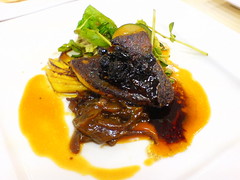
The foie gras, true to Leslie Tay's description at ieatishootipost, was "served with an excellent brown sauce reduction flavoured with truffle oil and topped with raisins which have been soaked in black vinegar and sweetened with rock suger". It was plated with mango slices and caramelised onions.

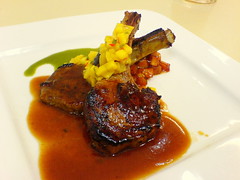
Cilantro - Lamb Rack
The rather tiny tender lamb rack was "marinated with lemon grass and other spices before grilling and served with a piquant brown sauce" and accompanied by chopped mango, potato in sweet and sour sauce and mint sauce.

Cilantro - Escargot
The "curried butter" (and cheese?) escargot was decent but a bit gritty.

Even better food awaits next week, courtesy of Andrew Reid and Mike Raiter (as if titles meant anything, currently lecturer in Old Testament and Hermeneutics at Ridley College Melbourne and principal of the Bible College of Victoria respectively). [EDIT: Mike Raiter at the ARPC Equip Conference 2008 here.]

This week, getting stuck into Romans 8 was priceless ("there is no charge for awesomeness...or attractiveness"). Good for an afterwork wind-down; brilliant as a nightcap and a tuck-in, far better than the mauled-by-bear/survived-1-month-in-Amazon/conquered-drug-addiction feel-good Readers' Digest literature; marvellous for Christians getting long in the teeth and starting to flail about faint-heartedly in dark waters.

The young Christian convert is always full of untempered optimism, certain that he can convert the whole world and that sin can no longer corrupt his redeemed body. He is scornful of older Christians struggling to put to death the sin in their own bodies and wonders if, good gracious!, they were really converted in the first place.

But the older Christian is wiser and hopefully, more humble. And the apostle Paul concurs:
For I do not understand my own actions. For I do not do what I want, but I do the very thing I hate. Now if I do what I do not want, I agree with the law, that it is good. So now it is no longer I who do it, but sin that dwells within me. For I know that nothing good dwells in me, that is, in my flesh. For I have the desire to do what is right, but not the ability to carry it out. For I do not do the good I want, but the evil I do not want is what I keep on doing. Now if I do what I do not want, it is no longer I who do it, but sin that dwells within me.

So I find it to be a law that when I want to do right, evil lies close at hand. For I delight in the law of God, in my inner being, but I see in my members another law waging war against the law of my mind and making me captive to the law of sin that dwells in my members. Wretched man that I am! Who will deliver me from this body of death? (Romans 7:15 - 24)
Who will deliver us from this body of death? Why, Jesus Christ of course. And Romans 8 shows us how. The point of Romans 8 is not that we return to the new-born naivety of earlier days but to look our enemies, both within and without, who shake our confidence in our salvation, full in the face.

The enemy within is the sinful nature of which all of us are only too cognisant. We are all sinners deep deep down. Our sinful nature is not a foreign body that can be cast off easily like a garment. It is our skin, our flesh, our inner-most me. There is no one good, not even one. As many a preacher has said, if we knew what was in the heart of the most gifted godly speaker, we wouldn't listen to them for a moment. And if the speaker knew the hearts of the congregation, he wouldn't speak to them for a moment either. If the only way we could judge if we are right with God is our current state, then it would be no wonder that we grow faint-hearted at our utter depravity and perversion. How can Paul then say, cheerfully, "there is therefore now no condemnation for those who are in Christ Jesus" (Romans 8:1)? Hello, major non sequitur, no?

No. It is perfectly logical that still-sinful believers will not be condemned. This is not because we are somehow enabled to live perfect lives and fulfil God's law but because Christ has perfectly fulfilled God's law on our behalf, his sacrifice in our place has paid for the right punishment for our sin so that we do not have to pay the price (= eternal death) for our own sin (Romans 8:1 - 4). Therefore, says Romans 5:1 - 5,
since we have been justified by faith, we have peace with God through our Lord Jesus Christ. Through him we have also obtained access by faith into this grace in which we stand, and we rejoice in hope of the glory of God. More than that, we rejoice in our sufferings, knowing that suffering produces endurance, and endurance produces character, and character produces hope, and hope does not put us to shame, because God's love has been poured into our hearts through the Holy Spirit who has been given to us.
The Spirit is not an impersonal force but a person. He is given to us at our conversion. We do not get converted first and then, when conditions are optimal, the Spirit saunters along to make us holier-than-thou. When we were unregenerate people, our unregenerate minds were set only on things of the flesh. And so our minds condemned us because to set the mind on anything but God is death. Yet we were completely unable to see our situation, much less turn back to God and be saved. We were unable to change our own mindset and had no hope of pleasing God. (Romans 8:5 - 8)

But God gave us his Spirit, the Spirit of life (Romans 8:2) so called because by wonderfully overhauling our minds, he drags us from death (as just punishment for rebelling against God) to life (because we are able to repent and take hold of the sacrifice of Christ on our behalf). We can now desire what God desires and strive to please him.

The Spirit is also the Spirit of Christ. If Christ is seated at the right hand of God in heaven, how can he be in us? (Romans 8:9 - 10) It is not that Christ is physically in us but his Spirit is, and he establishes Christ's lordship and rule in us. We do not make Christ our Lord. It is Christ who is making us his servants; it is Christ who controls us by his Spirit, which is why we live such painful lives: indwelling sin with indwelling Spirit together in us.

And this Spirit of life and of Christ is also the Spirit of God who raised Christ from the dead. If he is dwelling in us, then he is God's guarantee to us that God will also spare us from death from condemnation. (Romans 8:11)

The Spirit not only plays a part in overhauling our worldview so that we can turn back to God and be saved through the blood of Christ; he also leads us to mortify the misdeeds of the body (not that the body/flesh per se is bad. Rather, the body is a metaphor for our entire being that is set against God). He constantly renews our mindset and strengthens our godly desires. Repentance is a life-long matter. We have to keep saying "no" to our sinful natures. When the Spirit draws us back to God, it is not cheap grace. We take brutal steps to severe all ties with the sin we formerly clung so dearly to. (Romans 8:12 - 14)

And we soon realise that we are failing all the time. In the agony of Romans 7:15 -24 above, it is easy to quickly fall into despair when we are disobedient. Surely we are not worthy of God. Surely God will now pull away the rug (or the trapdoor of the gallows) from under our feet.

Well, we were never worthy of God in the first place, so that's a fairly moot point. But when God, in undeserved mercy, gave us his Spirit, this Spirit was also the Spirit of adoption as God's sons. We became children of God. The Spirit was not one of slavery so that we need to do something to gain God's attention or approval and become fearful when we don't perform up to KPI expectations. (Romans 8:15 - 17)

If we have repented of our rebellion against God and acknowledged Christ as Lord, then we have the Spirit of life. And if we have the Spirit of life, of Christ, of God who raised Jesus from the dead, we have the Spirit of the adoption as God's sons. And we can be certain that the same grace and power that raised Jesus from the dead, and that gave us access to our Father's presence so that we can pray to him and cry "Abba! Father!" and be sure that he hears us, will ensure that we do not fall away as we keep turning back to God and relying on the work of Christ to save us.

Enemy without (Romans 8:17 - 39) - akan datang here

Privé Bakery Café
2 Keppel Bay Vista
GF Marina @ Keppel Bay
Tel: 6776 0777

Cilantro Modern Asia
Blk 28 Jln Bukit Merah, #01-4476 S(152028)
Tel: 9795 0289
(Cilantro is not the place to go for mushroom soup. Even if you are a Campbell's fan.)

Dick Lucas' talks on Romans 8 at Proclamation Trust's Evangelical Ministry Assembly in 1997 are excellent even if the dear man is rather late in getting to the point. Listen to Romans 8:1 - 17.

_______________________________________

Working through current series on Romans:
First Thai, Jay Chou's Birthday Concert and Romans 1
Feasting and Larval Thoughts on Faith and Romans 4
Privé, Cilantro and the Marvellous Comfort of Romans 8:1 - 16
Basil Alcove and the Pre-destination-based Comfort of Romans 8:17 - 39
Kapok at Newton and Romans 9 - 11
Tin Hill Wine Bar & Bistro, The White Rabbit at Dempsey, Dim Joy, True Worship and Romans 12:1 - 2
Sodagreen 苏打绿 Sing With Me 陪我歌唱 Concert, Futsal Tournament, Romans 13

Labels:

Wednesday, March 19, 2008

Greek Masterpieces From Musée du Louvre and Peter O'Brien On Prayer

"We're back from the National Museum," gushed the parentals some months ago, waving about Greek Masterpieces From The Louvre brochures, "they've brought in sculptures from the Louvre. You must go and see them!"
"But we've seen them...at the Louvre!"
"Did not."
"We did. We went to the Louvre, you criticised I M Pei's pyramid, then you said you were bored and wanted to go shopping."
"Oh."
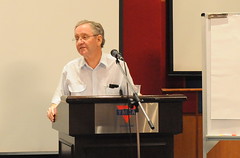
In any case, last Sunday, after Peter O'Brien'd delivered his 64th talk in the last 3 months, I popped across the road to the museum for a gawk.

Cheeky: "Surrounding David" by Titarubi
Surrounding David by Titarubi.
Poor old David's so commodified he's attained pink kebaya-cloth kitsch-ness.

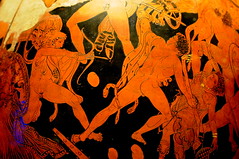
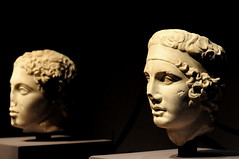
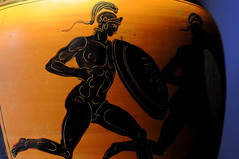
The exhibition was fairly small but decently and thematically-curated. Peter O'Brien, being a bit of a scholar in Paul's New Testament letters, had, earlier in the day, painted many word-pictures and made many references to cultural context in which the letters had been written. Even though these statues preceded Paul by a century, there were probably quite a few of them still mooching around with their Augustan brothers when Paul gandered about Athens during the Late Roman Empire (Acts 17:16-34).

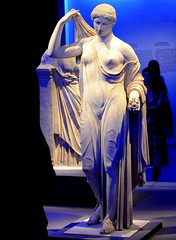
Aphrodite with wet himation
To my initial shame, having always been fond enough of Greek/Roman literature to have an entire bookcase on the subject and Greek/Roman-themed BBS rooms, my main reaction to some (because others looked like really bad copies) of these drapped bodies was one of great appreciation: the proportionality of facial features, bodies and limbs, the rendering of wet himations, and how nice it'd be to have a quiet empty museum for a sit around and a charcoal sketch.

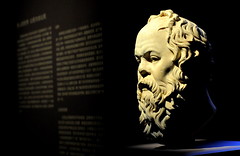
Socrates
But Paul, I thought when I got home and had a flip through the Book of Acts, had got it spot on. Upon seeing these beautifully proportioned idols, he did not bring out the sketchpad. Instead, his spirit was provoked within him. Barely able to contain himself, he went about arguing against the wisdom of that age, reasoning with Jews and devout persons and professional philosophers (Acts 17:16-34). So my reaction of great appreciation = FAIL. But someone later pointed out: all cultural lor. Not idols to ppl of our time liao.

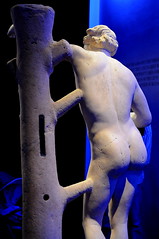
Cheater-buggery
Pardon me, but your butt is cracking.
Simulacra of the Roman simulacra of the Greek simulacra of...well, maybe no long-dead bird/hunk in particular; the Baudrillardic phase where the simulacra masks the absence of basic reality by being its own pure simulacra, these chipped blocks of marble may be, but they are not meaningless simulacra qua simulacra. Instead, they form part of a system of signification for the ancient Greeks and their Roman copiers/consumers. So the late night chat was a good reminder of the "nothing is a sign unless it is interpreted as a sign" of Charles Peirce, the cultural subjectivity of the signifier and the signified, and so the subjectivity of idolatry and therefore the necessary failure of any attempt at legalism.

Nevertheless, such utter incompetence in even identifying the right reaction in any given stimulus is probably a good impetus for prayer. (We had an interesting semiological debate in our DG about the word "prayer", but that's another post.)

Notes from Peter's talks on prayer:

Peter O'Brien
Knowledge, wisdom and understanding and thanksgiving (Colossians 1)
In his letter to the Colossians, Paul tells them that he is constantly praying for them (Colossians 1:3,9). He asks of God because he knows that God is generous and will not withhold good things from his children. What does Paul pray for? He prays that they will be filled with knowledge so they will please the Lord (Colossians 1:9-10). He prays that they will have all spiritual wisdom and understanding. This wisdom and understanding is not what we think of as guidance from God, not "Lord, what do you want me to do?". Rather it is more about what God wants done in his world and how we can fit into God's plan for the world.

And what pleases God? Bearing fruit in every good work (Colossians 1:10b). This does not mean being successful in God's work by the world's standards, but having the fruit of the Spirit to be enabled to do things in a godly way, in growing in love for Christ, in wanting to know Jesus more and more.

It's all very well to talk about these things but how will we be able to do them? Through being strengthened in all power by the Spirit (Colossians 1:11). This same power, this same Spirit, raised Christ from the dead. So it's pretty lethal stuff.

Then Paul returns to thanksgiving. We have all been transferred from the dominion of darkness to the kingdom of light. Gaining citizenship of a country like Singapore or Australia's pretty difficult, but the difficulty level is nothing compared to trying to gain citizenship of heaven. Yet, Christians have achieved it through the forgiveness wrought for them in Jesus Christ. It is not only children who find it hard to say "please" and "thank you". Adults struggle as well. The writer of Hebrews tells us that we can now enter God's throne room with boldness. This should encourage us to pray prayers of thanksgiving.

Suffering and Weakness (Romans 8:18-30)
Voltaire was of the opinion that God either couldn't stop suffering or that he had the ability to do so but wouldn't.

We all live in the midst of suffering. But we are told that we are heirs of God and co-heirs with Christ. We will share in his suffering before we share in his glory. This tension is not just individual, it is also corporate.

Paul's thesis on suffering and glory is in Romans 8:18 - "For I consider that the sufferings of this present time are not worth comparing with the glory that is to be revealed to us". Paul was no stranger to suffering. In 2 Corinthians 1, he told the Corinthians that he was being utterly and unbearably crushed; he was so close to death that it was only a whisker away. Paul didn't have a silver spoon in his mouth. But he believed that the glory to come was a sure and certain thing. If it wasn't, then we would do all sorts of things to put our present suffering out of our minds, to try futilely to gain security, to distract ourselves.

The whole of creation is bound up with suffering (Romans 8:20). It was knocked off its perch of God-centredness because of Adam's sin. But again there is the promise that after this suffering will come glory when the sons of God come into glory (Romans 8:21-22). Suffering and glory go together.

And we Christians also groan inwardly (Romans 8:23). We were adopted as sons of God when we first trusted in Christ. But we now wait for that final adoption and the redemption of our bodies. Every time we have to visit the pharmacist or the doctor we are reminded of how our bodies have yet to be redeemed.

And as we wait in hope for this redemption, we continue to suffer and struggle. We are weak. Part of our weakness is that we don't know what we ought to pray for, "ought" meaning in accordance with God's will. This is part of our suffering. There are some people who approach the throne of God with such boldness that they keep telling God what they want over and over again. And when they don't get what they want, they blame God. There are other people who are just at a loss about what to pray for.

But, Paul says, the Spirit helps us in our weakness, interceding for us with groanings too deep for words (Romans 8:26). There is a content to the Spirit's prayer that we don't know about. Paul is not talking about speaking in tongues. The groanings of the Spirit are wordless. And God who searches hearts knows the mind of the Spirit, not just theoretically but the content of intercessions of the Spirit that are in line with his will. And God answers the intercessions of the Spirit. When we pray, we fire arrows at a target which may go far wide. The Spirit redirects the arrows to make sure we hit the bullseye everytime.
Hercules
When we were younger, we thought that we could do things on our own strength. But when we are older (and hopefully wiser), we rely more on God and his strength and his power. Nothing is too small for God. He numbers the hairs on our heads (Luke 12:7) and does not forget even the littlest bird, the sparrow (Luke 12:6-7).

For those who love God, all things work together for good (Romans 8:28). God works our good through things that were meant to harm us. Joseph, for example. was sold off by his jealous brothers (Genesis 37). After his many adventures in foreign lands, where he was ill-treated and thrown into prison, Joseph met his brothers again. He was now in a position of power and he could have had them killed (Genesis 42-45). But instead he recognised God's hand in his situation, even where his brothers meant evil, God meant it for good. God had sent him to Egypt before them to preserve their lives (Genesis 45:5-8). This does not mean that there are 2 different experiences but that the 2 are sandwiched into 1, the clearest example of this being the death of God's own Son. Wicked men meant for the destruction of Jesus and they will be held responsible for their actions, but their evil was used by God, and infact predestined by God, for good.

We are encouraged to call upon God. His answer to us will not be brilliance in analysing our situation or in summarising the problem. He will not answer us because our motivation is 100% pure because we are wretchedly corrupt. God will answer us because the Spirit intercedes for us.

And we know that God has infinite resources (Ephesians 3:20). Not only that, but also God doesn't hide away his resources like Scrouge. God gives lavishly. God wants to give abundantly. It's almost as if God is waiting to be asked so that he can give.

Faced with the reality of our own weakness, living in a world that is suffering, prayer is real and practical now. We do not need to wait until we are better before we can pray, nor must we do this or that before we can pray.

Prayer: slick? Unrealistic claims? Full of promises too good to be true? (Philippians 4:6-20)
Slick solution? (Philippians 4:6-9)
The poor Philippians were being pressured from without and being given a hard time. But whatever they were distressed about, Paul told them to be anxious about nothing and instead present their requests to God. ("Anxious"ness being unreasonable heresying care.) This sounds like a slick platitude but Paul was in prison then and knew what he was talking about.

God knows all needs. He clothes the lilies of the field etc (Matthew 6:28-33). They weren't to tell God about their needs because he didn't know them and needed to be updated. But by bringing their requests to him and laying their troubles upon him, they were to demonstrate their dependence on him. And this would strengthen their faith.

Did this mean that all our prayers will be answered? Philippians 4:7 promises one sure result: that the peace of God, which surpasses all understanding, will guard your hearts and your minds in Christ Jesus. Whether our particular petition is granted or not, we are assured of divine protection against everything. "Peace" isn't a feeling of peace but is that something objective that was done on the corss (Romans 5:1) - reconciliation and salvation. And this peace "transcends all understanding" and is more wonderful than they could imagine.

Philippi was settled by many retired soldiers who had the protection of a garrision or guard. This peace, said Paul, would similarly keep guard over their hearts and minds, those areas of their lives that were vulnerable to attack from desperate heresying care.

Do not be anxious but instead pray and God will guard your hearts and minds. The promise given in Philippians 4:7 is not slick. As I reflect on what God has done for me, this guards me against all sorts of wretched fears.

I can do everything! Unrealistic claim? (Philippians 4:10-13)
"I can do all things through him who strengthens me." says Paul. Will nothing be beyond our capabilities if we pray, if we had the same faith that Paul had? But yet, Paul had an extremely long list of things he still suffered (2 Corinthians 11). This is not a triumphalistic promise.

The context explains the promise. Paul says that he is content in all circumstances. He has experienced life at both ends of the economic spectrum and he knows how to live at both ends.

How does he do this? Through Christ who gives him strength. He can do all things, that is, be content in all things through Christ. Compare this with the Stoics who taught that the happy man was the content man. The content man was content in and of himself, due to his innate resources. But Paul knew that it was when he was most conscious of his inadequacy (2 Corinthians 12) that he could most rely on God.

Every need met! A promise that is too good to be true? (Philippians 4:14-19)
The doxology in Philippians 4:19-20 brings to a close the thanks to the Philippians. They have supplied Paul's needs, God will supply theirs. This is not a reciprocal tit-for-tat.

"Every need" does not mean just material things like money, but also the whole host of things that they were up against. They needed to stand firm in persecution (1:27-30), they needed unity where there were divisions (eg. between the 2 quarrelling ladies forever immortalised for posterity in the Bible), they needed to shine like stars in the universe even though they were under pressure.

"in glory" - these needs which they had would be met gradually and partially in the present but would be met fully at the end.

"in Christ Jesus" - Jesus is the only one in whom God's promises are fulfilled. Therefore, only when they are united with him fully would all their needs be met.

Our Spiritual Battle, the Devil and Prayer (Ephesians 6:10-20)
The spiritual dimension in Christianity is often ignored, whether in moral decay or in evangelism. This may have more to do with the Enlightenment than with Scripture. Scripture describes things from the world's viewpoint and also from a cosmic dimension. We neglect these things at our peril. We will not be seeing things as God sees them.

God has already won the decisive victory but the Devil and his minions still exist and still act even though they have lost. They will do anything to snatch away the Word when it is preached. This is especially so at morning tea after Sunday service when people will talk about anything but God's Word. The Devil distracts people so that they do not come to repentance.

Ancient Jocks
In the Ancient Games, the most important, the blue-ribbon event was wrestling. So when Paul talked about wrestling not against flesh and blood, but against the rulers, against the authorities, against the cosmic powers over this present darkness, against the spiritual forces of evil in the heavenly places, he was emphasizing that the battle with evil is close-contact, hand-to-hand combat. If we think that when we evangelise, we are up against flesh and blood, we have misread the battle. We are up against evil.

The attacks against us can be one temptation over and over again. But the Devil can also switch tactics. He has variety and range. The attacks can be internal and external. Uncontrolled anger and the telling of falsehoods are not from the Devil but he can use them to cause strife within the body of Christ.

What is our strategic objective in the battle? It is to stand firm (Ephesians 6:11, 13,14), to stand up against evil powers. We are not to move ahead (which infact, might be a serious wrong) but to stand firm.

Can we take on such a formidable foe with just our own resources? No. But we can do this by relying on the power of God (Ephesians 6:13ff). In actual fact, the victory has already been won by Jesus Christ on the cross. The Devil's final defeat is imminent. Soon, everything will be subject to Christ. We don't have to try to win that victory over and over again. But for the battles in the meanwhile, God has provided mighty armour for us. This is the same armour that the Lord of Hosts fights in in Isaiah 59 and the armour that God's Messiah wears when he goes out to do battle in Isaiah 11. This armour that God himself wears we also wear. This armour is made of truth, righteousness and salvation - aspects of God himself. When we put on the Lord Jesus Christ at conversion, we put on his aspects, his armour.

The breastplate of righteousness is protection in knowing that we are right with God. We can't be blackmailed. The Devil cannot tell us that we aren't a good Christian because we haven't read the Bible or haven't prayed. Who will condemn us when Jesus has died for us? If we aren't sure of ourselves, we won't share the gospel. This is the ploy of the Devil.

The sword for battle, the sword of the Spirit, is also the same one used by the Messiah in battle.

The shield of faith refers not to that little round shield which doesn't protect the head or the limbs in a battle but to the full-length one that covered the whole body. It was soaked in water and could quench dangerous missiles - arrows dipped in tar and then lit and shot. The Devil will try to attack us not just with temptation but also persecution and false teaching. We must trust in God's ability to keep us in the midst of battle.

Prayer is essential and crucial to our being armed. Standing firm and prayer are interlinked.

Summary
Thanksgiving is a mark of being Christians. The world may raise complaints and concerns to an art form, but the Christian is forever thankful because we have been transferred from darkness to light.

The Christian may find it difficult to pray aright. But the Spirit, who intercedes for us, hits the bullseye everytime.

There are some promises in Scripture that aren't what we want them to be. They must be read in their contexts.

We need to pray because our struggles are also in the cosmic dimension. The world is natural, the flesh is natural but the Devil is supernatural. If we live only as if there is the world and the flesh but no Devil, we misread the battle. There are ministers of Satan who will tell falsehoods and who are disguised as ministers of the gospel.

But when Jesus clothed us at conversion, he clothed us with armour that the Devil cannot destroy.

Labels: , , , , , , ,