Sunday, October 17, 2010

Entering The Promised Land - The Partial Kingdom

In the repurposed utility room at the back of the house, past the hanging brooms and cleaning equipment and empty planters, there is a pastor preparing his Sunday sermon. In the living room, someone is working on church accounts and someone else has laid out bedsheets over some old sofa cushions and fallen asleep. The children are watching a group of Sunday school teachers prepare the craft while making up songs about the Ten Commandments. A 2 minute walk away, music practice is going on in a shophouse lot in Bandar Sunway that CERC is rapidly outgrowing.
CERC
It seems that God is working as he worked in those wonderful times of old, calling people to himself.

How did the Israelites end up in Egypt?
- Jacob and family needed to escape the famine in Canaan (Genesis 45-46)
- God's will: wanted to preserve a remnant through Joseph (Genesis 45:7), instructed Jacob to go and promised that that would be where he would fulfil the people promise to Abraham ("great nation").

Was this a good or bad thing?"
Good - preserved the Israelites through the severe famine, Israelites could be fruitful and multiply (Exodus 1:7)

Bad - because there were too many people and because this was not their land, the Pharaoh felt threatened and oppressed them and also carried out an official infanticide progom (Exodus 1:8-22)

How did this threaten the people promise?

What did Moses attempt to do for his people? How successful was this?
Exodus 2:11-15

How different was this from what God wanted to do for his people?
Exodus 2:23-25ff

What do we know about God so far from our study of Genesis?

How does God identify himself? How does God's name encapsulate what we know about God so far?
Exodus 3:6 - I am the God of your fathers
Exodus 3:14 - I AM WHO I AM
a God who will be known by his actions

...but not only that but we will come to know God by paying close attention to what he does in the future.

What does God promise to do?
Exodus 3:7-10 - I have come down to deliver them out of the hand of the Egyptians and to bring them up out of that land to a good and broad land, a land flowing with milk and honey, to the place of the Canaanites the Hittites, the Amorites, the Perizzites, the Hivites, and the Jebusites.

Exodus 3:17-20 - I promise that I will bring you out of the affliction of Egypt to the land of the Canaanites, the Hittites, the Amorites, the Perizzites, the Hivites, and the Jebusites, a land flowing with milk and honey.

I will stretch out my hand and strike Egypt with all the wonders that I will do in it

I will give this people favour in the sight of the Egyptians

Exodus 4:11-12 - I will be with your mouth and teach you shall speak

Did Moses believe him?
No
Exodus 3:13
Exodus 4:1
Exodus 4:10
Exodus 4:13

What sign did God give Moses that the promises would be fulfilled?
The confirmation comes after obedience.

Did Pharaoh believe God?
Exodus 5:2

Why not?
Exodus 7:13 - Pharaoh's heart was hardened
Exodus 7:14 - Pharaoh's heart was hardened
Exodus 8:15 - he hardened his heart
Exodus 8:19 - Pharaoh's heart was hardened
Exodus 8:32 - Pharaoh hardened his heart
Exodus 9:7 - heart was hardened
Exodus 9:12 - LORD hardened heart of Pharaoh
Exodus 9:35 - heart was hardened

What was the point of the ten plagues?
Exodus 6:1-8
Exodus 7:16-18
Exodus 10:1-2

What do Israelites need to do to be saved?
have faith in God's word in Moses that the firstborn of all would indeed be killed and demonstrate their trust by doing what God instructed would save them from the tenth plague

Why are they also affected by the killing of the firstborn?
They were as sinful as the Egyptians because they too rejected God as God. This taught them that a sacrifice was needed to pay for their sins.

What does the institution of the memorial of an event before that event actually occurs demonstrate about God? (Exodus 12:14-27)

Why does God allow the Egyptians to pursue the Israelites?
Exodus 14:17-18 - "And I will harden the hearts of the Egyptians so that they shall go in after them, and I will get glory over Pharaoh and all his host, his chariots, and his horsemen. And the Egyptians shall know that I am the LORD, when I have gotten glory over Pharaoh, his chariots, and his horsemen."

Exodus 14:30-31 - "Thus the LORD saved Israel that day from the hand of the Egyptians, and Israel saw the Egyptians dead on the seashore. Israel saw the great power that the LORD used against the Egyptians, so the people feared the LORD, and they believed in the LORD and in his servant Moses."

Where did God bring the people after their rescue from Egypt? Why the pitstop?
- it was the sign that he was trustworthy (cf Exodus 3:12)
- escape was not the main aim, relationship with God (= blessing) was
- the law did not give them a way of being right with God but taught them how to live in relationship with the God who had saved them for this purpose (God's rule promise)

How were the people right in their response?
Exodus 20:18-20 - "Now when all the people saw the thunder and the flashes of lightning and the sound of the trumpet and the mountain smoking, the people were afraid and trembled, and they stood far off and said to Moses,"You speak to us, and we will listen; but do not let God speak to us, lest we die." Moses said to the people, "Do not fear, for God has come to test you, that the fear of him may be before you, that you may not sin."

Exodus 24:3 - "Moses came and told the people all the words of the LORD and all the rules. And all the people answered with one voice and said,"All the words that the LORD has spoken we will do.""

What was the point of all the instructions on interior decoration and blood splattering?
- seeming fulfilment of the God's rule promise (Exodus 29:42-46). Great comfort and assurance to have God himself with the people!
- implies that despite prior positive response, people will still continue to sin and have to make atonement for sin

How soon do the people demonstrate their need for atonement by blood?
Exodus 32. They are really no better than the Pharaoh, and much whinier.

What surprising thing does God do?
Exodus 34

What was the role of the tabernacle?
God's presence with the people

What was the role of purification rites?
Demonstrate that God was holy and need to be clean to meet God (Exodus 40).

Why was Leviticus so important (and not a boring old book to be skipped on the way to Numbers)?
Detailed instructions how to live under God (relationship rules) and to make things right with God when they inevitably sinned. Atonement, holiness.
Blessing for obedience, terrible curses for disobedience (Leviticus 26).

How is God upping the stakes in being able to fulfil his promises?
Israelites' short track record not terribly good.

How long were the Israelites at Mount Sinai before they set off?
Numbers 10:11

How long did it take for them to distrust God again?
Numbers 11:1-9
Numbers 12

What effect did this have on being able to receive the land that was promised to them?
Numbers 13:1 - so close!

How do the people, even at this juncture, manage to shut themselves out from the land?
Numbers 14:1ff

How else could God have fulfilled his promises?
Numbers 14:11ff

Why does God make the concession he makes in Numbers 14:20-25?

What demonstrates that the people haven't truly repented?
Numbers 14:39-45 Did not trust God's word!

How was even the method by which the people could make atonement for their sin jeopardised?
Numbers 16

What hope was there in all the law-giving that the younger generation would inherit the land as promised?
Numbers 33:50-35

In Deuteronomy, Israel is again on the brink of entering the promised land after wandering in the desert for 40 years. How does Moses warn the people?
Deuteronomy 7:6
Deuteronomy 10:12-13
Deuteronomy 28:15
Deuteronomy 28:63-64

Was the promise of land fulfilled?
Joshua 21:43-45

What the repeated warning? Why is it given?
Joshua 23:12-13

What have we learnt about God through his actions since that is how we are to know him?

What have we learnt about man?

Having this in mind, what is the outlook for the Israelite's continued enjoyment of the land and God's blessings?

Labels:

Friday, May 29, 2009

Universal Declaration of Divine Rights (Exodus 19)

Scottish Wholewheat Oatmeal Barley Current Scones Scottish Wholewheat Oatmeal Barley Current Scones Posing with Double Cream and Raspberry Jam Scottish Wholewheat Oatmeal Barley Current Scones Slathered with Double Cream and Raspberry Jam
Scottish Wholewheat Oatmeal Barley Currant Scones, Double Cream, Raspberry Jam
Commissioning the sun as the morning alarm is risky business. It means that on rainy days, one wakes only at noon, and in some confusion. These "summer" days however, she props eyelids open at 7am, leaving a delicious sliver of quiet time before work for pottering around and making breakfast, slowly, hummingly, wafting the olfactory equivalent of a quick hug,

Mac & Cheese Truffled Mac & Cheese
and then, with the even slimmer sliver time left over, something to pack for lunch.

Then, because it is the season for mergers and acquisitions, investments and divestments, equity and debt financing, the madness begins.

Quick in-between rememberingtobreathe notes, before they're forgotten:

Exodus 19

Events in Exodus are seen collectively by the rest of the Bible as the greatest OT epiphany, most magnificent manifestation of living God to his people.
  • revealed character of God
  • demonstrated how God deals with his people
  • inaugurated the OT people of God
  • showed where people stood/stand in relation to God and how they must prepare to meet him (Exodus 19)
  • God's character enshrined in the law (Exodus 20)
  • 10 commandments instructed/instructs the redeemed people of God how they were/are to live in relationship with their God (Exodus 21-23 as detailed law code)
  • 10 commandments and other sub-legislation instructed/instructs the redeemed people how they are to live in relation with the rest of the world, how they are to be a kingdom of priests and a holy nation
  • official formalisation of relationship with God in the reading/signing of book of the covenant - I will be your God, you will be my people (Exodus 24)
We learn the truth about God so that we know how to live rightly in relationship with him. Doctrines are not theoretical, abstract theological propositions that lead only to intellectual arrogance and spiritual decline but practical and relational, and very humbling indeed. Massive truth - who God is and why he has a right over our lives.

19:3-6 as summary of whole book of Exodus?

(1) God reveals what he has already done for his people in their redemption.
  • They are reminded here that it was entirely God's work (people completely helpless).
  • And also utterly God's initiative (people didn't want to be rescued).
  • Grace.
  • God's faithfulness - Exodus 3 - evidence that what God said was true would be that the people would worship God on same mountain
  • And the purpose of redemption was relationship.
  • Highlights the care with which God preserved them. Not mere action hero but was concerned for intimacy with his people.
So it was not that by keeping the law that they became people of God. Law given to people who had already been rescued. Response to grace - trust and obedience.

(2) God reveals where his people stand in relation to him (rest of Exodus 19)
  • fearfulness of God's presence - visible presence, audible voice - so that people would trust
  • 19:16, 18 - people trembled, mountain trembled.
  • awesomeness
  • nothing casual about the presence of God. you don't just waltz into his presence
  • nothing unhealthy about trembling before god - Deuteronomy 5, Hebrews 12:18 - scary indeed but see that you do not refuse. God is a consuming fire. Call to fear God actually intensifies with progressive revelation rather than diminishes. Therefore, not that OT God = scary, NT God = cuddly. NT does not say relax in presence of God.
  • we are not fit to be in his presence
  • so there are limits, boundaries, between sinners and God. They cannot meet him face to face or they will die
Therefore proper preparations must be made before meeting with king of kings
  • external cleaniness is a reminder of internal purity
  • who will ascend the hill of the Lord? only those with clean hands and a pure heart
  • relationship with God must come first even before the most intimate intra-human relationship.
  • preparing to meet God requires our full attention and concentration.you must never forget with whom you are dealing
Then again, only a few can meet him. (Were the priests and elders in possession of purer hearts than rest of people? Unlikely given later behaviour. Suggests election of some sort. Clearer in other passages.)

Repetition of God's warning
  • God's severity
  • God's compassion. "lest" - doesn't want them to die. Isaiah 19:22
(3) God's rights
God ab initio has the right to be worshipped and obeyed even though the Israelites refused to worship and obey him, he has given them even more cause to do so.
  • what God has done precedes what he requires
  • covenant of grace
  • covenant is a rehash of Abe's covenant but in greater detail.
  • requires general wholehearted commitment regardless of details.
  • Romans 12:1-2 - in view of God's mercies (that is what has been set out in Romans 1-11). We owe god everything. All that is necessary is obedience. Grace alone secures blessing but obedience keeps channels open so God's covenant mercy and faithfulness can be their experience. Law's context is not justification but sanctification. Now law written on tablets of heart - to enable us to start living as his people.
(4) God's treasure chest
If the people did what was required of them, then God's intended design for them would come to pass: they would be his treasured possession, that is, God's private bank account, personal treasure chest. Elsewhere in the Bible, this means crown property, the personal property of a king in contrast to the general realm over which he rules and which is also his (cf 1 Chronicles 29:3, Ecclesiastes 2:8).

God's imposition of terms of relationship is already a mercy and grace because they only deserved death, not even the smidgeon of a relationship. It is therefore not a contract to wriggle and wraggle about. No negotiation.

Obedience is intimately connected with blessing. Not in arbitrary reward way but in a organic cause and effect because this is how the universe was created to work and how God is.

"because the whole world is mine" - suggests that the final purpose in calling Israel is not to sit around dolled-up and pretty but to address his concern for the world at large

(5) Foundation of people's relationship with God and with the world is holiness - "kingdom of priests and a holy nation"
  • holiness that the law/God defines
  • obedience to as a mark of holiness
  • holiness is being set apart and obedience to the law/God will set the people apart. Seen in their undivided allegiance to the Lord, they will reflect the character of their God and point others to him (ref also to Jethro's conversion in Exodus 18 when he heard what God had done for Israel in rescuing them from Egypt)
  • holiness also defines the priesthood. A priest is separate from the community he seeks to serve. He may only serve as long as separation is maintained. The holiness of God's people would enable them to serve God and serve (by serving?) the rest of the world. The Hebrew for "nation" - goy is rarely used of Israel in the OT, reminder of Abrahamic promises - Gen 12:2
If this came to pass, it would mark a vast improvement in divine-human relations. The people would know how God wanted them to act and as priests they would be able to communicate with him. Ref Exodus 18 and how Moses had the only hotline to God and the major traffic jam on the Moses end.

But just when things were looking up, we are reminded of the perversity of God's people. Moses had just gone up when God tells him to sprint down again. Assumedly, the barriers for their safety and really simple instructions ("don't go past the barriers") and their own fearful trembles had not put off some people from wanting to have a gawk at God and a mobile phone photo for Facebook.

How would God ever get this lot to the Promised Land? And instead of minimising his exposure to failure (to keep his promises), he is heaping on risk upon risk by adding promise upon promise*, seemingly throwing good money after bad. But from all that we've seen of God so far in Exodus, greater stakes means greater glory. The best is yet to be/come.

* even though this promise appears conditional, yet if God's intention is to reach out to the world and so far, he has only this straggly lot, then it is possible that he has implicitly promised to work through them.

Labels: ,

Thursday, May 21, 2009

Shakespeare in Love, Deserted in the Desert (Exodus 15:22-17:16)

In the dusty hungry thirsty light of our current leg of Exodus (Exodus 15:22 - 17:16), the past few weeks laid out in photos were an embarrassing smörgåsbord of nom-nom-nom-ing in air-conditioned comfort, eg:

Folk Food, Iluma Balsamic Salad, Brat and Beans, Truffle Mac n Cheese, Folk Food, Iluma
a satisfying Sunday brunch of truffled mac and cheese (better than the Spruce fiasco), balsamic salad (distinguished from all such generic salad by sunflower seeds) and brat with beans at Folk Food, Illuma, 15% off because a bear liked my ordering style, with a little of Dale Ralph Davis' The Word Became Fresh on the side under the filtered sunlight;

Canele, Raffles City
catching up with old DG mates at Canelé, Raffles City, each one navigating vastly different streams of life since we were last in the same Bible study group but all as cackly and ravenous as ever, meant 4 people talking at once at the top of their lungs, ordering everything on the menu, and making wide gestures that caused waiters to step back to save themselves from unseasonally smacked;

Beef Noodles, Liu San, Bukit Timah Plaza
accompanying the Stateless One in her neverending search for the perfect beef noodle soup - Liu San at Bukit Timah Plaza was decent and the service from the Chinese ladies who offered arriving customers a squirt of anti-bacterial no-wash hand lotion and fridgespace for their NTUC Finest groceries good, but still not the beef noodle soup of her dreams;

Zam Zam Waiter Mutton Murtabak, Chicken Briyani, Zam Zam Restaurant
the Brunei Resident finally getting, after many failed attempts, to sample the food of Zam Zam, pronouncing the chicken briyani very good, then very loudly discussed the merits of pork. (On the theme of things porcine, back home for dinner for once, while tucking into babi assam (assam pork), the Dad came along with a syringe, swabbed my left arm and innoculated me against H1N1 ("swine flu" in pop lingo). The irony. B's mom's recipe for the babi assam, however (or also?), was spot on.) ;

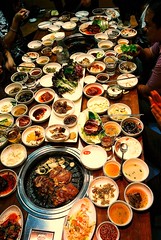
Ju Shin Jung Korean Charcoal BBQ
surely the very definition of smörgåsbord - Ju Shin Jiung Korean Charcoal BBQ for a birthday dinner.

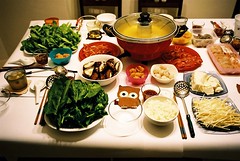
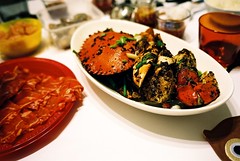
Steamboat Black Pepper Crab
Another night, there were a rowdy 8 crammed at a table laden with a communal steamboat pot, seafood and meat and veggies and 2 plates of finger-lickin' good fresh black pepper crabs and randomly-concocted alcoholic cocktails. As the drinks got more bizarre, the reminisces of good old Japan got more enthusiastic.

Unfortunately, being unable to give as good as we got, the picnic basket at Singapore Repertory Theatre's Shakespeare in the Park: Much Ado About Nothing was fairly dismal. But because the play was adequately and engaging acted, because of the cool night air and the company of friends (and perhaps also because it was a real bargain with tickets 50% off thanks to Keppel Nights), we came away excited by the theatrics.

This was how it was discovered that the whole Exodus 15:22 - 17:7 passage can be described in decontextualised Shakespearan verse.

Tis true that "An honest tale speeds best, being plainly told" (Richard III), and so the post-rescue antics of the Israelites are thus recorded.

Three mere days from the mass sing-a-long by the Red Sea beach, the Israelite contingent ran into a potable water supply situation. They had been thrust out of Egypt by the Egyptians in haste and hadn't enough time to prepare any provisions for themselves (Exodus 12:39) for the journey to the Promised Land.

For a bunch of people armed for war (Exodus 13:18), they couldn't even get the basics of a military campaign right.
Military logistics 101 (line of communication, main supply route) = NIL = FAIL.

Despite all that royal education in his youth and the defeat of the entire Egyptian army, it looked as if Moses wouldn't be gracing the bookshelves of army staff and command colleges any time in the future.
"What's in a name?" (Romeo and Juliet)
"The king's name is a tower of strength" (Richard III)
But perhaps Moses didn't need to be any good at warfare because it had been God the Warrior who had fought for Israel (see Exodus 15:1-21). It had been God in his mighty power and majesty who put out a finger to judge Egypt with the ten plagues and it was his breath that had decimated the Egyptian armed forces in the Red Sea.
"Action is eloquence." (Coriolanus)
All God's actions in the rescue of his people from Egypt were meant to reveal his name to them; an opportunity for them to understand his character - his perfect goodness, perfect trustworthiness, perfect might, his complete lordship over all existence. The Israelites seemed to have known this three days ago when they sang as much by the seaside.
"For you and I are past our dancing days" (Romeo and Juliet)
But bizarrely, when faced with undrinkable water, standing together and singing I Will Glory In My Redeemer and How Great Is Our God was the furthest thing from their minds. Instead they grumbled against Moses, God's representative, saying,"What shall we drink?" (Exodus 15:24)
"How use doth breed a habit in a man." (The Two Gentlemen of Verona)

"The devil hath power
To assume a pleasing shape." (Hamlet)

"Like one
Who having into truth, by telling of it,
Made such a sinner of his memory,
To credit his own lie.
Praising what is lost makes the remembrance dear." (All's Well That Ends Well)

"Ill deeds are doubled with an evil word." (The Comedy of Errors)
They get even more stunningly stupid as the days passed when, faced with the inevitable food supply situation, they grumbled against Moses and Aaron in the wilderness, saying "Would that we had died by the hand of the LORD in the land of Egypt, when we sat by the meat pots and ate bread to the full, for you have brought us out into this wilderness to kill this whole assembly with hunger." (Exodus 16:2-3)

And then, when faced with another water crisis, they quarrelled again with Moses, saying,"Why did you bring us up out of Egypt, to kill us and our children and our livestock with thirst?" and but obviously still had enough energy to threaten to stone him (Exodus 17:2-4).
"To be, or not to be: that is the question" (Hamlet)
After all the wonders that God had worked for them, after his unmistakably demonstration that he was more than willing and able to do all things for the good of the Hebrews, the people choose not to be his people and refused to acknowledge his God-ness. All they had to do was trust and obey - trust and obey enough to ask the Creator for sustenance. But instead they chose to distrust his character and his motives.

What an insult to God. In the circumstances, they set themselves up against their own God in behaviour worse than Pharaoh's, probably suggesting hearts far more hardened than his (Exodus 16:28 cf 10:3).

It was as if, as someone fetchingly put it a la Hosea, after consummation on the wedding night, the bride, who had been redeemed from a tough grotty life of prostitution and graciously accepted by the groom, spits in his face and sneers that actually, it hadn't been to bad at all touting her wares in the red light district and that she'd really rather be back there than be with him. Pah.
"For aught that I could ever read,
Could ever hear by tale or history,
The course of true love never did run smooth." (A Midsummer Night's Dream)

"Love sought is good, but giv'n unsought is better" (Twelth Night)
Still, instead of giving them the sticky end that they deserved, God carried them as a father carries his son (Deuteronomy 1:31), giving them sweet water to drink and food to eat and fighting their battles for them; sustaining them so that they lacked nothing - even their clothes did not wear out nor their feet swell (Nehemiah 9:21). Which, if one has been following the 4 Deserts Race (go Philipp!), was an amazingly comfy situation to be in.
"Nothing emboldens sin so much as mercy." (Timon of Athens)
Psalm 78 spells out rather starkly, the recalcitrant faithlessness of Israel:
"They did not keep God’s covenant,
but refused to walk according to his law.
They forgot his works
and the wonders that he had shown them.
...

Yet they sinned still more against him,
rebelling against the Most High in the desert.
They tested God in their heart
by demanding the food they craved.
They spoke against God, saying,
"Can God spread a table in the wilderness?
He struck the rock so that water gushed out
and streams overflowed.
Can he also give bread
or provide meat for his people?"

Therefore, when the LORD heard, he was full of wrath;
a fire was kindled against Jacob;
his anger rose against Israel,
because they did not believe in God
and did not trust his saving power.
Yet he commanded the skies above
and opened the doors of heaven,
and he rained down on them manna to eat
and gave them the grain of heaven.
Man ate of the bread of the angels;
he sent them food in abundance.
He caused the east wind to blow in the heavens,
and by his power he led out the south wind;
he rained meat on them like dust,
winged birds like the sand of the seas;
he let them fall in the midst of their camp,
all around their dwellings.
And they ate and were well filled,
for he gave them what they craved."

"Tempt not a desperate man" (Romeo and Juliet)

"Lord, what fools these mortals be!" (A Midsummer Night's Dream)

"There are more things in heaven and earth, Horatio,
Than are dreamt of in your philosophy." (Hamlet)

"Though this be madness, yet there is method in 't." (Hamlet)

"Sweet are the uses of adversity, which, like a toad, though ugly and venomous, wears yet a precious jewel in its head."
Why did God put Israel to the test to see if they would trust in his continual saving power, to see whether they would follow his law to obey him (Exodus 15:25, 16:4)? It wasn't as if God could not know their hearts and had to keep seeking affirmation of their commitment to him like some whiny insecure spouse. He knew very well that their hearts were not steadfast towards him even though they flattered him with their mouths and lied to him with their tongues (Psalm 78:36-37).

Instead, his continous acts of mercy in withholding his wrath from them was to give them the chance to repent as his provision would confirm and "double confirm" that it was the LORD who had brought them out of Egypt and who would continue to save them as long as they kept depending on him. When they responded rightly to adversity by continuing to trust him, they would find their trust richly rewardly.

But we know the end of that story, how those who had been saved from Egypt rebelled again and again in the wilderness and how they got their just reward in the end. And ironically, it was not God who brought them out of Egypt to kill them in the wilderness but they who brought the judgement of death upon themselves by their distrust and disobedience:
before they had satisfied their craving,
while the food was still in their mouths,
the anger of God rose against them,
and he killed the strongest of them
and laid low the young men of Israel. (Psalm 78)

"A wretched soul, bruised with adversity,
We bid be quiet when we hear it cry;
But were we burdened with like weight of pain,
As much or more we should ourselves complain" (The Comedy of Errors)
There is much to be said about Jesus as the True Israel who was tested in the wilderness for 40 years and found to be true. But to forestall further complaints about the lengthiness of these posts...

Anyway, in the same way that God revealed his magnificence and great attractiveness to the Israelites through their rescue from slavery Egypt, so his reveals his same qualities (even more so) to us in our rescue from slavery to sin.

And better than the water from the rock is the spring of living water that wells up to eternal life (John 4); better than the manna that rained from heaven that sustained them in the wilderness is the heavenly bread that is Jesus who gives life to the world (John 6). Whereas God was with them in the form of a pillar of cloud and fire, Jesus the Emmanuel was with us in the flesh and the Spirit is in us who believe.

So what of we who have drunk the living water and eaten the heavenly bread, that is, who have tasted the goodness of Jesus (1 Corinthians 10:1-4)? There is a warning for us in fate of our predecessors who too tasted the goodness of God but hardened their hearts, did not believe God and so displeased him, and were put to death in the wilderness (Hebrews 3; 1 Corinthians 10:5).

Yet, despite the better water and bread, we easily cease to believe in God, to trust in his goodness and promises, and to obey him. In fact, we are quite happy to write in exclusion clauses to trusting and obeying for "life-threatening situations" - a two-pronged insult to God by claiming that (i) when it comes to the crunch, he and his ways cannot be trusted and (ii) that the cravings of our hearts and therefore our assessment of our lives are the only truth.

If we are honest, we know that there are things in the world that tempt us - perhaps the oft-preached material trio of possessions, status, sex and relationships, or perhaps things off the usual pastoral radar. We also know that there are things in our own personal makeup that no other human knows about, things we struggle with (hopefully) and despair that we will ever change.

So hampered with sticky sins, we might think our future uncertain. If God puts us to the test, to test our faith and our obedience, how will we stand up under it? How will we ever get to the Promised Land of the End of Days? Paul assures us that no temptation will come upon us that is not common to man. And God is faithful - he will not let us be tempted beyond our ability, but with temptation he will also provide the way of escape, that we may be able to endure it (1 Corinthians 10:13).

So we face tests and temptation in no different way from the way we were redeemed and saved, with full knowledge that God is sovereign and that he knows what he is doing, that he is a person of steadfast love and limitless power and providential care, and nothing is beyond his resources, and so full dependence on his strength and his salvation. We will not be more godly if we were taken out of a difficult situation but if we persevere in faith and obedience under it. If we stand firm under the heat, we will prove to ourselves that our faith is genuine and that God is true, all for greater end of bringing greater glory to God (1 Peter 1:6-7). Difficult circumstances are not so we can find out more good things about ourselves but so we can find out more about God so we can praise him and give him glory. He has shown, and will show more of, his constancy. He will not let us down because, as Moses too knew, his glory is at stake.

Yet, at the same time, let us not test God with our unbelief and disobedience to see if he really means what he says, to check if what we have been told will come true, to make an assessment of whether this judgement thing (how awfully unfashionable) will be proved right. God will pass that "test" with flying colours.

Labels:

Thursday, May 14, 2009

Hallelujahs for the Hell-bound, Verses for Vengeance, Jumping for Judgement By Beach Boy & Co (Exodus 15:1-21)

Song of Moses and The Stolen Guitar Pick
Music-centric conversations these past few weeks have included: one on the football music of Basque country, lingering for a time on a macho cheer concerning dried cod fish; badger-ment about playing some Bach please leading naturally to the Glenn Gould discussion on the vulgarity (on the part of the pianist) and the sick voyeurism (on the part of the audience) of performance; a colleague's husband agreeing that non-Christmas carol/congregational song/pop ditty piano-playing is a very private affair done most authentically, if one didn't have a soundproof room to lock oneself in, on an electric piano with weighted keys and the earphones plugged in; guitar accompaniment in quiet time prayer; music as performance in far too many congregations; the ipod (plugged-in) generation being immersed in a continuous soundscape so that specific song-associated experiences of yesteryear will be alien to them, as will the sound of silence; the hyperreality of denizens of developed countries actually vocalising trite telly/movie sounds to accompany their daily lives... then, the soaring strings backing tender Benedick-Beatrice moments at Singapore Repertory Theatre's Shakespeare in the Park: Much Ado About Nothing leading to some giggling amongst certain members of the audience (though Shakespeare's outright plundering of biblical themes cause even more mirth).

A question for the blockbuster-weaned generation then: what music ought to accompany God's judgement, God's vengeance, when in wrath and righteousness, he condemns his enemies to everlasting death?

Music? Surely an event so horrible and fearful can call forth no words or music fit to describe or convey the terror felt by the damned - the screaming, the weeping, the gnashing of teeth, the heartrending pleas for mountains to fall on them to hide them.

If pressed (possibly not by the Revelation 14:19-20 winepress) to provide music, the amassed musical types might vote for a lone mournful bugle or Mozart's Dies Irae (for context*) played sotto voce, and respectfully, after the last scream has gurgled away. (Poor Verdi's Dies Irae** would probably be overlooked for great-tragedy-has-arrived obvious-ness.)

The ideal response, however, is set out in Exodus 15: joyful music and dancing at the mass deaths of the Egyptians.

This is terribly un-PC in this day and age. As a sign of her progressiveness, our school principal once banned announcements about "trashing" another school at this or that match or any mention that our opponents had in fact been ineffectual limp pushovers. What more rejoicing at the deaths of fathers and husbands and lovers. And oh, those poor horses too!

But there is a difference between dancing on graves in acapella groups Schadenfreude-ly smirkingly singing Sink Like An Egyptian while miming actions of people drowning and indulging in the flippant precursor (luggage notwithstanding) to Belgian Central Train Station mass dancing, and singing and dancing in celebration of what God has done. The difference is that is not done for the sake of the flash mob thrill of doing per se, nor the exaltation of self, but the exaltation of God.

God's Self-Revelation
Previously, God had told Moses that he would reveal himself to his people so that they would know him in a way that their forefathers would never have known him. And this revelation would be in his rescue of his people from slavery in Egypt. While it might be all very well to academically list his good qualities, God wanted the Israelites to taste and see and so understand his very goodness. A personal subjective experience of God was not what God wanted, he wanted to objectively unmistakably reveal himself through his works. Afterall, the most amazing fantasies of all the humans in the world from creation onwards could never approximate his real magnificence. And the goal of his self-revelation was to get glory.

God's Concern for His Glory and His Name
Earlier chapters of Exodus had already made clear that God's main aim was to get glory for himself. His self-revelation to the Israelites and to the Egyptians was to achieve just that. So the drowning of a good portion of the studly men of Egypt should not primarily elicit cries of pity for the dead creatures but cries of victory for the living God in vindicating his own name.

For if we know anything about God, it is that he was (and is) passionate about his glory and hence his name.

Therefore, he cannot be the accidentally tarred-and-feathered god that Steve Chalke has made up whose "unwillingness to distance himself from the people of Israel and their actions meant that at times he was implicated in the excessive acts of war that we see in some of the books of the Old Testament" (Steve Chalke, The Lost Message of Jesus). God has always been so concerned with his name that any erroneous implication would have been quickly and publically set straight.

We know how the LORD opposes everyone who does not acknowledge his perfect goodness, perfect trustworthiness, perfect might. This, rather than the tasty fruit of the Tree of the Knowledge of Good and Evil itself, was the temptation in the Garden of Eden. Anyone who thinks and speaks badly of him and so fails to honour him is his enemy; anyone who thinks and speaks badly of perfect good is evil. Pharaoh and the Egyptians would not listen to God's words even though God had shown them signs and wonders. Instead they hardened their hearts and thought so lowly of God that they fancied they could easily defeat his people. Already they had visions of victory:"I will pursue, I will overtake, I will divide the spoil, my desire shall have its fill of them. I will draw my sword; my hand shall destroy them." (Exodus 15:9). What baseless swaggering self-confidence; what epitome of evil - standing against God over and over and over again. But when the chips were down, they failed to deliver.The destruction of Pharaoh and the Egyptians was therefore the destruction of evil.

Chips Down, Prive Bakery Cafe, Keppel Island
the chips were down

God the Winning Warrior
And so far from being the unfortunate father having to sit through accusations of poor parenting at yet another PTA meeting, it was the LORD himself who was the perpetrator; he was the warrior, the man of war (Exodus 15:3), who fought for his own name. He was personally and directly involved in the destruction of the Egyptians - the horse and his rider he threw into the sea (Exodus 15:1), Pharaoh's chariots and his host he cast into the sea, Pharaoh's specially chosen elite officers were sunk in the Red Sea (Exodus 15:4); it was the LORD's right hand that shattered the enemy (Exodus 15:6).

God the Magnificent Majesty
Of course God as Warrior was metaphor in that it put a pictorial in puny minds as to what God was doing. God was also a father providing for his firstborn son, a rescuer redeeming his people from slavery... But God was still more than all that combined because, well, since he made everything, he could/can easily do anything he wants to, to anything in the world.

The People of This God
Faced with such massive revelation of God's power and majesty, the people gave God glory not by joining hands, swaying, and hypnotically singing "I glorify your name, O Lord" 1000 times but by fearing and trusting God (Exodus 14:31).

Pig Trotters and Groundnuts, TurfCity
not a trotter left behind

God does not change. He is still concerned today about his glory. Because he is perfect, he cannot take lightly the people who defame him.

And the image of the warrior God showing his might and bringing death to his enemies isn't just an Old Testamental bit of anger here, a flare up there, blood and gore everywhere embarrassment in these enlightened times. 'Gentle Jesus meek and mild" Jesus of the trinitarian Godhead was not. While Jesus was still in the womb, Mary, dewy-skinned and glowing with baby, sang of the fearsome judgement of God (Luke 1:46-55). And the child she would bear would be the executor of this judgement:
He disarmed the rulers and authorities and put them to open shame, by triumphing over them in him. (Colossians 2:15)

Then comes the end, when he [Jesus] delivers the kingdom to God the Father after destroying every rule and every authority and power. For he must reign until he has put all his enemies under his feet. (1 Corinthians 15:24-25)

Then I saw heaven opened, and behold, a white horse! The one sitting on it is called Faithful and True, and in righteousness he judges and makes war. His eyes are like a flame of fire, and on his head are many diadems, and he has a name written that no one knows but himself. He is clothed in a robe dipped in blood, and the name by which he is called is The Word of God. And the armies of heaven, arrayed in fine linen, white and pure, were following him on white horses. From his mouth comes a sharp sword with which to strike down the nations, and he will rule them with a rod of iron. He will tread the winepress of the fury of the wrath of God the Almighty. On his robe and on his thigh he has a name written, King of kings and Lord of lords.

Then I saw an angel standing in the sun, and with a loud voice he called to all the birds that fly directly overhead,"Come, gather for the great supper of God, to eat the flesh of kings, the flesh of captains, the flesh of mighty men, the flesh of horses and their riders, and the flesh of all men, both free and slave, both small and great." And I saw the beast and the kings of the earth with their armies gathered to make war against him who was sitting on the horse and against his army. And the beast was captured, and with it the false prophet who in its presence had done the signs by which he deceived those who had received the mark of the beast and those who worshiped its image. These two were thrown alive into the lake of fire that burns with sulfur. And the rest were slain by the sword that came from the mouth of him who was sitting on the horse, and all the birds were gorged with their flesh. (Revelation 19:11-21)
Jesus is presented as a man of war, a warrior. At the cross, he triumphed over evil, over Satan, and rose victorious from the grave. All who are against God/him will face certain obliteration at the end of days.

This is our God, not just the God of Christians or Jews but the God of the world. This is who God has revealed himself to be. To reduce him to a pocket-sized tchochtke is to defame him. And Revelation 19 is pretty clear what happens to defamers.

If God is jealous for his name, if God has absolute power and nothing can prevent him from executing justice, then their end is certain and rather bloody. Arguments against (eg. on the basis of "human rights") are laughable because the only rights any creature has are those given by their Creator. And temporal distractions are useless because if judgement is really coming for those who do not honour God as God, we must repent and believe now, and we must evangelise not to win top honours in another MLM game but like those who yelled frantically "come inside! come inside!" to those wandering obstinately in the open Egyptian fields before the hailstorm came and crushed every tree, animal, person. And that shelter that protects us is Christ.

But when judgement comes, the time for weeping and warning will be over and the time for unabated rejoicing will be ushered in.

In the penultimate verse of the mass sing-along song by the sea, the Israelites sang as if Philistines, Edomites and Canaanites were already defeated. Seems like a set-up for a hubric fall akin to that of the Egyptians? No, it was never about hubris per se but hubris in the face of God, against God. The Hebrew verses of certain victory, being in line with God's plan and in fact, displaying trust in God's promises and preserving care and protection, instead brought glory to his name.

The triumphant victory song to be sung in the last days, however, like that sung in Revelation 19 will not look forward to a future event but back to victory consummated, and faith fulfilled.

Choong Chee Pang often told the story of an earnest young man from China who'd asked him: Will we still have our memories in heaven? CCP replied that he thought we might. Then the young man said, with tears in his eyes,"Then how can we be rejoicing in heaven if we remember everyone we have loved on earth and know that they are in hell?" CCP said he did not have an answer for him.

Perhaps the answer is this: this is not unconsidered by God; it is not a point that has slipped past the hard heart of God, for Jesus wept for an unbelieving Jerusalem and Paul agonised in Romans 9 over his unbelieving kinsmen. But perhaps in that Day, our love and our loyalty will finally be centred solely on the person on which they were made to center on - God and God alone.

Yet meanwhile, while God's patience has not yet come to an end, while our loved ones still live, God does not want any one to perish but desires that all be saved through the blood of his Son. But the offer is for a limited time only.

Sunset, Keppel Bay

*Wolfgang Amadeus Mozart, Requiem, Dies Irae


**Verdi, Requiem, Dies Irae

Dies irae
Dies illa
Solvet saeclum en favilla
Teste david cum sybilla

Quantus tremor est futurus
Quando judex est venturus
Cunta stricte discus surus

Dies irae
Dies illa
Solvet saeclum en favilla
Teste davidcum sybilla

Quantus tremor est futurus
Quando judex est venturus
Cuncta stricte discus surus

Quantus tre-e-mo-or e-est fu-u-turus
Dies irae, Dies illa
Quantus tre-e-mo-or e-est fu-u-turus
Dies irae, Dies illa
Quantus tre-e-mo-or e-est fu-u-turus
Quando judex est venturus
Cuncta stricte discus surus

Cuncta stricte
Stricte discus surus
Cuncta stricte
Stricte discus surus


Current Read/Think-through of Exodus

Labels: , ,

Wednesday, May 06, 2009

Egyptians Sink To New Depths, God Gets Gobs of Glory (Exodus 13-14)

Last Monday, charity tickets for Lee Chin & Friends, part of the Raffles Girls' School Alumni Tribute Series, meant the sitting through a truly disappointing unsatisfying main course by Siow Lee Chin. In the audience there was one lady right in the middle of the stall seats who had either excellent cellphone reception or a very persistent phone alarm, the rabid pained scribbling of notes and then, the walking out citing severe emotional distress. Later at a comfort food supper for frayed nerves, descriptors such as "screechy", "scratchy", "thin tone", "faulty intonation" surfaced repeatedly. G summed up the performance as "very schoolgirl". Lee Chin seems to have been battling these problems for about a decade. Two reliably frank Inkpot reviews in 1998 and 2000 complain of the same thinness and screechiness and intonation problems.
RGS String Ensemble Waiting for President Nathan. Lee Chin & Friends, Esplanade Concert Hall
Back in 1998, Isaak Koh referred to Lee Chin playing a Strad (or was it the Guadagnini?) and suggested that the Italian instrument was responding adversely to the tropical climate. He also kindly proposed that the acoustics of the Victoria Concert Hall were in issue. And for good measure, thought that Siow's failure to direct the soundboard of the violin towards the audience resulted in the loudness of the instrument wavering as she moved with the music. Suffice to say that Vadim Rapin, when he performed in the same hall, in the same era, with a Ruby Strad (I think) didn't have these issues. Granted this time, she was probably playing the Deconet.

Perhaps this time, the acoustics of the large cavernous Esplanade Concert Hall were to blame for the thinness of sound? Previous experiences with the un-"critically acclaimed": Ang Shao Wen in private recital and Chua Lik Wuk in violin and piano recital with Lim Yan in the Esplanade Recital Studio had been by contrast vastly delightful.

But then, assuming the recording below is as-is, surely the state-of-the-art Esplanade could not do worse than the Ganz Hall in Chicago. Gallia Kastner on violin playing Pablo Sarasate's Zigeunerweissen on a copy of the "ex-Soldat" Guarneri del Gesu violin by Peter Seman (2008), didn't have projection problems in a former banquet hall.

Hot Chocolate, Cappucino, Banana Walnut Cake, Privé Bakery Café, Keppel Island Hot Chocolate, Privé Bakery Café, Keppel Island
Regardless, an audience, whether subject to evergreen crowd-pleasing classics, new world wonders or stock showpieces, should feel secure in the hands of the violinist. They should be able to sit back and relax with their choice of tasty beverage, and not have to bite their nails and wonder what the next note might bring.

Our lives in the hands of the living God should be in a far better situation than our ears in the hands of the best violinist the world has ever known. Afterall, the late greats, Szeryng, Oistrakh, Heifetz, Kreisler, Siedel, Elman, Perlman, Rabin, Menuhin, were never completely consistent and the still living seem far more mastered by their instruments than masters of them.

Well, all very easy to say snuggled safe in Singapore where the biggest news any local has been aware of for a fortnight concerns the sloppily-drafted constitution of a women's group, an AGM, an EGM and media-goaded fights between "the old committee" and "the new committee". Hardly the sort of life-threatening situation Israel faced after they hastily exited Egypt while, after a night of horror, the Egyptians buried their dead firstborns.

So there they were, 600,000 Israelite men and many more women and children and others (Exodus 12:37-38), rich with plunder (Exodus 12:35-36), accompanied by very much livestock, both flocks and herds (Exodus 12:38), hosts of the LORD (Exodus 12:51, 14:19) macho-ly armed for battle (Exodus 13:18), the fresh air of freedom in their nostrils, striding purposefully towards the Promised Land. They were led by the LORD himself, in a pillar of cloud by day and a pillar of fire by night (Exodus 13:21-22). God spared them an early fight with the Philistines and led them over uncontested lands. Perhaps they had been singing "I Will Follow Him" in rounds for the Nth time when Moses was told to make a sharp right (Exodus 14:1-2) and they ended up in a scary cul-de-sac, hemmed in by the wilderness on one side, the Red Sea on another. About 3,000,000 pairs of eyes might have stared down an obliviously cheery little voice singing "there isn't an ocean too deeeep" as the entire military force of Egypt darkened the horizon. Pharaoh had decided that Egypt was not going to face financial ruin just because of some night terrors, nevermind that these were all too real (Exodus 14:5). His heart had been hardened (Exodus 14:4) and he had come for the ex-slaves with everything he could muster: his chariot, his horsemen and his army, plus 600 extra chosen chariots and, for good measure, all the other chariots of Egypt with officers over all of them (Exodus 14:6,7,9). A bunch of civilians (with women and children) on foot whose idea of a fight was fisticuffs in the sand (cf Exodus 2:13) vs the most highly-trained professional army in the ancient world on horseback and in chariots? Sure, some pre-alpha Command and Conquer programmers might possibly have coded MASSIVE FAIL right about here.

But only very recently, Moses had drilled into them the eternal festivals/rituals/markers that were to commemorate their successful escape from Egypt under the strong hand of the LORD - the changing of the Hebrew new year and the Passover (Exodus 12:1-13, 24-27, 43-49), the Feast of the Unleavened Bread (Exodus 12:14-20, 13:3-10) and the Consecration of the Firstborn (Exodus 13:1-2, 11-16). The institution of such festivals and rituals was as good as God's specific promise to them that they would be rescued successfully and settle somewhere where they could celebrate these things and spend many hours recounting the rescue story to their children and grandchildren and they to their grandchildren etc for all generations.

Could God fulfil his promise of rescue? Had they not just witnessed God's finger - the ten plagues on Egypt? Had it not already been rather obvious that the LORD was in control over everything in the universe, everything anyone could think of and everything no one hadn't half a brain to think of?

Would God fulfil his promise of rescue? Hadn't everything God had said through Moses so far come true? Didn't old Jacob's mummy with/without its sarcophagus (cf. Genesis 50:26) that they had packed away in their luggage (Exodus 13:19) demonstrate that God had kept/was in the process of keeping his word - because already the multitude of refugees meant that Abraham's descendants were growing to be as numerous as the stars in the heavens (cf Genesis 15:5), and though they were sojourners and servants in a land that was not theirs, they were coming out with great possessions (cf Genesis 15:13-14) and being brought to the land God swore to Abraham, Isaac and Jacob (cf Genesis 50:24)?

Well, whatever. The Israelites took one look at the heaving horses and without hesitation accused God of being an incompetent guide. No, wait. That's too mild. They accused God of being completely untrustworthy, a liar, an evil being bent on their destruction. (Exodus 14:11-12). They'd known better than to have put their faith in him. Why, didn't they say to Moses "Leave us alone, don't rescue us, we're perfectly jolly being slaves to our oppressors" (Exodus 14:12)?

Which part of I AM the LORD, trust and obey, there's no better way didn't they understand? Well, probably most of that "I AM the LORD" bit which led to the lack of the "trust and obey" bit. If God's attributes, namely his eternal power and his divine nature could be clearly perceived, ever since the creation of the world, in the things that have been made (Romans 1:20) then all men have always been without excuse in claiming not to know God and so not worshipping him. So God's direct communication with Abraham, Isaac, Jacob and lately Israel through Moses would have been quite a concession. The faithful Hebrew midwives way back at the start of the story (Exodus 1) didn't even need that much to fear God instead of Pharaoh. Still, the Israelites did not really know the LORD in all his might and power and God-ness. Not only did they not think him trustworthy, or his character only good all the time, they failed to grasp that as the supreme and ultimate being in the world, if he'd wanted them dead, they would have had already been six feet under or mummified or tipped into a common slave grave, regardless of geographical location.

Actually, God would have been quite justified in doing just that to the Israelites. Afterall, the punishment for sin has always been death. So why didn't a voice boom out of the clouds:
Attention! Attention! Due to disbelief, the way through the Red Sea has been cancelled.*

Good bye.
The psalmist tells us the reason God withheld his hand from decimating them inspite of their dastardly distrust and disobedience:
Our fathers, when they were in Egypt,
did not consider your wondrous works;
they did not remember the abundance of your steadfast love,
but rebelled by the sea, at the Red Sea.
Yet he saved them for his name’s sake,
that he might make known his mighty power.
He rebuked the Red Sea, and it became dry,
and he led them through the deep as through a desert.
So he saved them from the hand of the foe
and redeemed them from the power of the enemy.
And the waters covered their adversaries;
not one of them was left.
Then they believed his words;
they sang his praise. (Psalm 106:7-12)
He was concerned for his own name. One can't tell everyone that one is saving one's people from the Egypt and bringing them to the land promised to their forefathers and then either cause a giant heavenly piano to fall on the lot of them or inflict fatal trauma to their nervous systems with a heavenly violin screech or less supernaturally, allow them to be killed by Pharaoh & Co, no matter how much they deserved it. God had a reputation to keep.

A mass slaughter would not have impacted the fulfilment of his promises to Abraham, Isaac and Jacob, for God could easily
have recreated the entire people, ver 2.0 - even greater and mightier, through Moses the Recently Faithful alone. He suggests as much later in Numbers 14:12. But this mercy in desisting from killing them would give him more glory in the eyes of the world.

We are usually rather quick to explain how the Israelite's lack of trust at the Red Sea might have to do with their socio-economic background, their poor upbringing, their tiredness... well, basically, it was really all rather reasonable. But perhaps our excuse-mongering should warn us of our own lack of understanding of God and what he requires of us.

God has always been concerned with his glory and he has always required the world to give him due honour - in worship, in trust, in obedience. God has worked to achieve this in direct, bare, supernatural ways, eg. the ten plagues, to demonstrate his great power, that there is no god like the LORD; he has also works by the great withholding of his great power. So, briefly, we see, at least:
  • the glory of God's care - in not allowing his people to be tempted beyond what he knows they can bear (Exodus 13:17 cf. 1 Corinthians 10:13);
  • the glory of God's power in the helplessness of his people - he can do what we think is impossible, when we can't contribute anything, even our faith;
  • the glory of God's steadfastness in face of the fickleness of his people - God doesn't need to wait for a proper response before acting to save in his infinite mercy;
  • the glory of God's trustworthiness that justifies the faith that his people put in him;
  • the glory of God's in his judgement of his enemies. God does not subscribe to uttering politically-correct contentless PR phrases when speaking of his enemies. He boasts openly of the decimation of his enemies by his hand because this shows the powerful and just God he is (Psalm 9:16). When God carries out judgement, he isn't terribly sorry about it; it's part of his glory and his fame. And so we too should not be ashamed of this. The God of the OT is the same God of the NT, so just as the LORD was given glory when the Egyptians realised what the sort of LORD they were dealing with ("Let us flee from before Israel, for the LORD fights for them against the Egyptians." (Exodus 14:25)), we are told in 2 Thessalonians 1 that the saints will glorify God when "the Lord Jesus is revealed from heaven with his mighty angels in flaming fire, inflicting vengeance on those who do not know God and on those who do not obey the gospel of our Lord Jesus. They will suffer the punishment of eternal destruction, away from the presence of the Lord and from the glory of his might";
  • the glory of God's mysteries making sense (to us eventually)
A massive picture of God and still only a glimmer of the whole. And as Vizzini might have said,"And that's not all! Wait till I get going!" The Bible's just getting started! It'll probably take us literally all eternity to even try to absorb this. We can't even respond rightly to the little that we know despite repeated exhortation and careful explanation. How myopic we are to think that the seashore showdown is all about us and how God will fight for us oppressed people suffering under a psycho parent/teacher/boss, or that the Exodus is the biblical basis for sociopolitical liberation. It has never been primarily about us but about God and what he will do to display his glory and how we are to uphold his glory by trusting and obeying his word.

Boat Asia 2009
Being "still" never meant not doing anything, "letting go and letting God". If stoning had been the proper response, the Israelites and their descendants would have been rooted to that same seashore to this day. Being still wasn't about being on a pleasure cruise. It was about not working to save oneself (cf Exodus 14:13 - see the salvation that God will work for you today; also Psalm 37:7, Psalm 46:10, Zechariah 2:13) but, again, about trusting that God would do his will and obeying him: trusting that God's words were true, trusting that God could and would make good his promises and then putting feet to faith by obeying his commands. The writer of Hebrews generously records that by faith the people crossed the Red Sea as on dry land (faith at least that God could and would wall up the sea on both sides while the lot of them passed through!), but the Egyptians, when they attempted to do the same, were drowned (Hebrews 11:29). The Egyptians could not benefit from the promises made to the Israelites because they were not counted as God's people.

And this sea-crossing was only a little foreshadow of God calling his people out of a damned existence in slavery to Satan and sin into his glorious realm. God has already won the victory over the prince and principalities of this world. We need only depend on his victory and obey his commandments while still on this earth.

Too often, our failure to trust God (so that we either try on our own strength to save ourselves or improve on our godliness or think we need neither salvation nor godliness) stems from a dim view of God himself.

Beerfest Asia 2009
Perhaps we think him not quite omniscient - sulking around church buildings and "holy places" but otherwise quite clueless about the happenings in the world. At Beerfest Asia, a former full-time Christian ministry worker was recounting how she came upon a young father having a surreptitious fag in a quiet corner. He was later red-faced and very apologetic that she had witnessed this. She suggested that actually, this was a matter of his conscience and if his conscience was so convicting him that he was sinning against God, then it was between him and God, who, btw, could see him even in his little dark corner. God did not need Christian-worker gossip to keep him updated on the latest news.

Perhaps we think that God, like everyone else we interact with, can only see the masks we put on in the morning. Nevermind our impure motives for doing this or that, as long as we couch it in Christian terms, as long as influential church members or highly-regarded Christians are our friends and endorse our actions, we think ourselves in the clear and, actually, since our own hype is so powerful, rather mature and godly.

Perhaps we think God doesn't really care about his own name or his glory so much so that there will be a judgement day at the end of history for all humans who have ever existed and live our lives intent on glorifying ourselves.

Or perhaps we manage to recognise that God is sovereign and then surmise that he, therefore, must be responsible for taunting us with suffering and trials, not trusting that God has the good of his people at heart and is concerned with refining us through difficulties so that our faith may be proved genuine.

Or perhaps we do realise that God is concerned for his glory and his name but needs the latest in human thinking to reach out to more people, to make hardened criminals and booze-soaked celebreties weep, to build a kingdom for himself. But God can take care of his own name and kingdom, thank you very much. He only asks that you walk in his ways, not the ways of the world that has thrown up yet another foolproof (more like fool-enticing) method for growing the church. (See Tony Payne's little article on Being Biblical Or Doing What Works?.)

Or perhaps again we think that God needs a bit of help in justice and enforcement department and resort to sinful means to dealing with those we consider his enemies, forgetting that the LORD works in his own time and has a far better clear-eyed grasp of the actual situation that we Coke-bottled ones.

Or perhaps yet again we think God's commandments unreasonable, illogical and really against decent common-sense. We know better than to follow them completely and so make convenient exceptions.
...I want you to know, brothers, that our fathers were all under the cloud, and all passed through the sea, and all were baptised into Moses in the cloud and in the sea... Nevertheless, with most of them God was not pleased, for they were overthrown in the wilderness. (1 Corinthians 10:1-5)
These things took place as examples for us, that we might not desire evil as they did (1 Corinthians 10:6). Therefore, flee from idolatry (1 Corinthians 10:14). Therefore, do all things to the glory of God (1 Corinthians 10:31).


*Dale Ralph Davis, God Gets Gobs of Glory

Prive Bakery Cafe
2 Keppel Bay Vista
GF Marina @ Keppel Bay
Tel: 6776 0777

Boat Asia 2009
Marina @ Keppel Bay
An Audi iceberg, a helicopter, the requisite Heineken, Paulaner, Grey Goose waterholes, powerboats, catamarans, luxury yachts, and our favourite, sailing yachts. We went for a spin in RSYC's little J-24(?) keelboat. The salty sea wind, the sunset as we were sailing back, aroused the appetite for more of the same please.

Beerfest Asia 2009
Behind the Singapore Flyer
We got there late enough to hear the end of Hell's Belles - the female AC/DC tribute and almost be run over by their Harley-riding supporters. Frank fellow-imbiber: "Good thing we got complimentary tickets. Otherwise we would have paid S$37.50 each for this noise." At Kelong Seafood, the chips were fat and hot and crunchy and the fresh Fijian tuna lightly pan-seared was very good with a squirt of balsamic vinegar. The satay ladies were well-dressed but lacked experience in counting out and transferring the sticks of very tasty meat to styrofoam cups and then scooping the gravy in. Somewhere apparently the wiseonesthatbe determined that beer is actually "cooling" and therefore good for drinking on hot nights. Good then that the beers were fairly cheap starting from S$3 a pint/bottle. Eschewed the usual Fosters, Vic Bitters, Chimay, Duvel, Hoegaarden, Stella, Carlsberg, Erdinger, Grolsch, San Miguel, Sol, Corona crowd for Flying Dog Brewery offerings. I blame my Ralph Steadman fandom from his Oddbins days for leading me to them light sweet brews.
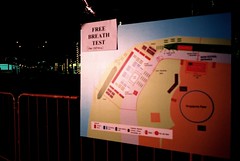
Free Breath Test, Beerfest Asia 2009
At midnight, we found out that the folk who were supposed to test our free breath had gone home early. :-(

Current Read/Think-through of Exodus

Labels: , , ,

Wednesday, April 29, 2009

Easter Bunny Spared, Goose Cooked, Lamb Slaughtered, Israelites Painted Town Red, Dough Failed to Rise to Occasion (Exodus 12)


Bunneh
For years, the assumption was that the first Passover consisted of tasty meat - like sweet tender rabbit. This probably contributed to the tendency to draw bunnies with a big chomp taken out of the back of their necks. I blame the juvenile conflation of Passover, Easter and the so-called Easter Bunny for the confusion. This was despite the Children's Bible referring specifically to lamb rather than rabbit.

Goose Confit for Two
By simultaneous free association on the subject of cute farmyard animals, there was the notion that the animal to whom the meat recently was recently attached was somewhat small. It was only until I was cooking confit d'oie for dinner that it actually hit me that a whole lamb would not fit into any sort of cast-iron pan and the entire carcass would have had to be thrust through a spit outside the house and roasted on an open fire. (No, please don't sing that Christmas Song.) (The Cold Storage-Les Amis Catering partnership can now do this for your dinner parties.)

There would certainly have been no running commentary on the satisfactory crunch of the goose skin as a metal utensil cut through into the slip-and-fall-off the bone flesh beneath, or on the goodness of baby potatoes sprinkled with salt and roasted in the goose fat, or on the role of naked spinach leaves sparsely adorned with cold red pomegranate jewels in balancing the richness of the dish.

(For how to confit a goose, refer to Michael Ruhlman's Charcuterie or be lazy and grab a jar/can from Culina.)

When the psalmist urged people to "taste and see" that the LORD was good (Psalm 34), he probably had more in mind than the umami-ness of one-year-old organic grass-fed roast lamb, accompanied by unleavened bread and bitter herbs. But just what God had in mind has been the subject of much late-night/early-morning wrestling over the last week or so. And it'll probably take much more time, revelation, brainpower to hope to suck all the marrow out of Exodus 12.

Still this is the little that has been gleaned:

Wedding Festivities
The Passover and the Feast of the Unleavened Bread were not to be mere celebrations of liberation from oppressors or the birth of a nation like those marked by every country. The people weren't to be rallied amidst mass dances and patriotic song sessions to take pride in and fight for their country. They were celebrations that looked outwards and upwards to Israel coming into relationship with the one and only God – he becoming their God and they becoming his people.

But God is not someone you call up on a whim and cast away when something more interesting comes along. As someone politely put it, God was redeeming a people for himself not for a night's fling but for a long-term marriage relationship. So no one could celebrate the beginning of this relationship (ie, the Passover) if they had not demonstrated their commitment to this relationship by the act of circumcision (Exodus 12:48-49) regardless if they were Israelite or foreigner.

Groom God's Self-Revelation
And who was this God to whom they were to commit themselves?

God had been building up to this rescue from Exodus (or even Genesis!) not just as escape from Egypt but the event by which the Israelites and the Egyptians would know who he was and what it meant for him to be the I AM (see Exodus 5 - 7:7).

The divine self-revelation afforded by this rescue was so earth-shakingly important (it should be!) that God not only instituted the Passover celebration and the Feast of the Unleavened Bread to commemorate it (Exodus 12), he also stipulated severe penalties for failing to keep its ordinances (eg. a nibble on leavened bread during that special set-apart time would result in the offender being cut off from the congregation of Israel, and by association, from the promises of God and a relationship with God - the only thing that would matter to any Israelite or indeed any human. Exodus 12:19). This celebration was so important that there would be no exceptions for the unclean or the journeying (Numbers 9). To highlight, bold, double-underline and frame with dancing zenon-lights how marvellous it really was for Israel to come into relationship with God (to be his people, to serve and worship him), and because Israel was completely clueless about the immense privilege they were about to receive, God decreed that the Hebrew new year would henceforth commence on that very month of rescue (Exodus 12:2).

What else did God intend to reveal about himself in the rescue from Egypt? Perhaps we are tipped off by the specifically-ordained elements of the Passover/Unleavened Bread festivals:

Passover
(1) the selection of a firstborn male without blemish (Exodus 12:5) - oh the cuteness overload (see, eg, Farmgirl's 2009 lambing season)! must have made the next step all the more horrific for the kawaii-kult.)
(2) the lamb:household ratio (Exodus 12:3-4)
(3) the killing of the lamb (Exodus 12:6)
(4) the painting of the blood on the doorposts (Exodus 12:7)
(5) the roasting of the lamb "its head with its legs and its inner parts" (Exodus 12:9), that is, roasting the lamb whole (Exodus 12:46). Roasting and not boiling it. And no raw lamb sashimi either (Exodus 12:8-9, 46).
(6) the eating it with unleavened bread and bitter herbs (Exodus 12:8)
(6) the burning of the remains (Exodus 12:10)
(7) the eating in haste with all one's travelling clothes on (Exodus 12:11)

Feast of the Unleavened Bread
(1) will last seven days from the fourteenth day of the first month of the year, fourteenth evening and twenty-first evening inclusive (Exodus 12:15,18)
(2) no leaven may be found in any house and no leavened bread may be eaten during the feast (Exodus 12:15,19,20)
(3) on the first and seventh day, a holy assembly is to be held and no work is to be done but food prep (Exodus 12:16)

God the Absolutely and Completely Sovereign
The statutes were instituted while the Israelites were still sitting in their little houses in Goshen, Egypt and no one could ascertain, using any definable human measurements, that what God had said would happen would actually occur. But God did not instruct Moses to put out tentative party balloons which could easily be taken down if the outcome was not as positive as expected; he was so certain of victory that he instructed him to commemorate this every year unto eternity (Exodus 12:17). What a great demonstration of God's absolute and complete control over events.

And it came to pass that God's prior commands worked out "naturally" in subsequent events so that the later annual commemoration of those events was both obedience to those prior commands as well as a re-enactment of the actual events that took place: eg, God's prior command to Moses was for unleavened bread to be included in the festive meal (Exodus 12:8) and a whole week of the Feast of the Unleavened Bread (Exodus 12:14-20). Actual events were such that the Israelites were chased out so urgently that they had to grab their dough before it was leavened and had to exit with their kneading bowls in their cloaks on their shoulders (Exodus 12:34) and subsequently, as they journeyed from Rameses to Succoth (Exodus 12:37) baked unleavened cakes of the dough that they had brought out of Egypt. "It was not leavened, because they had been thrust out of Egypt and could not wait" (Exodus 12:39).

Grand stuff and of course, God had already demonstrated his sovereignty in the plagues and Pharaoh's coronary problems – hardening Pharaoh's heart just as Pharaoh was said to have hardened his own heart.

God the Trustworthy Promise-Keeper
Absolute power didn't corrupt absolutely. Despite having no higher authority to crackdown on his failure to keep his promises to Abraham, Isaac and Jacob, and despite most if not all the Israelites having already forgotten about the existence of such promises, God insisted on keeping them, starting with taking Israel out of Egypt (Deuteronomy 7:8). This was the sort of steadfast God it would be good to be in a long-term relationship with.

Again, the bunny-like multiplication of people in their 430 years in Egypt (in Fibonacci sequence or not) from a cosy 70 person party to Pharaoh's nightmare of a host of 600,000 men (excluding women and children and foreigners) (Exodus 12:39-41) should have already informed the alert that God's promises were being kept.

God Who Loves
The self-revelation of an infinite perfect creator to finite imperfect creatures would surely be limited to the capacity of the latter to fully comprehend what was being communicated. So the rest of the Bible keeps coming back to the Exodus adding layer upon magnificent layer of meaning to the event.

We are told later that God's rescue also showed his love for the Israelites:
And because he loved your fathers and chose their offspring after them and brought you out of Egypt with his own presence, by his great power (Deuteronomy 4:37)

but it is because the LORD loves you and is keeping the oath that he swore to your fathers, that the LORD has brought you out with a mighty hand and redeemed you from the house of slavery, from the hand of Pharaoh king of Egypt. (Deuteronomy 7:8)

to him who struck down the firstborn of Egypt,
for his steadfast love endures forever;
and brought Israel out from among them,
for his steadfast love endures forever;
with a strong hand and an outstretched arm (Psalm 136)

When Israel was a child, I loved him,and out of Egypt I called my son. (Hosea 11:1)
God Who Judges Those Who Do Not Acknowledge Him As God
Most importantly however, the "tenth plague" or the horror movie mass killing of the first-born of every living thing in the land of Egypt: from the firstborn of Pharaoh who sat on his throne, to the firstborn of the slave girl who was behind the handmill, and all the firstborn of the cattle (Exodus 11:5) was a judgement on the Egyptians and their gods (Exodus, Numbers 33:4) whom they claimed existed and were powerful and therefore worshipped. It was a judgement that was partly penal (but not completely since that would have resulted in the death of every single person in Egypt) and partly revelatory – it showed them who's God.

Unfortunately for the Israelites, God was/is not primarily a God of Equal Rights For All, or a God of the Emancipation of Slaves (Begone Ye Evil Oppressors). He was/is a God concerned primarily about himself and his own name (which was/is quite right if he was/is the God of the world).

So the Israelites, after 9 plagues' worth of sitting on the sidelines with their munchies going kekeke at their Egyptian oppressors being beset by bloody water, slimy frogs, itchy gnats, swarming flies, dead livestock, painful boils and sores, hail and rain and thunder and fire at the same time, nibbly locusts (Exodus 7 – 10), find themselves coming face to face with the tenth which they were to avert with lamb blood (Exodus 12:13,23).

Why were they too subject to the tenth plague? It seems that God had not laid his hand on them previously not because they did not deserve the same punishment as the Egyptians but because he wanted to show that he made a distinction between Egypt and Israel, the people to whom he had given his promises and commitment, to demonstrate to the whole world that he was a God unlike any other.

We are told that the Israelites in Egypt had forgotten God's steadfast love and like the Egyptians and the immensely blind and stubborn Pharaoh, did not consider God's wondrous works (Psalm 106:7). Like the Egyptians, they too worshipped the false Egyptian gods (Joshua 24:14) rather than the LORD.

In Ezekiel 20, the LORD explains:
On the day when I chose Israel, I swore to the offspring of the house of Jacob, making myself known to them in the land of Egypt; I swore to them, saying, I am the LORD your God. On that day I swore to them that I would bring them out of the land of Egypt into a land that I had searched out for them, a land flowing with milk and honey, the most glorious of all lands. And I said to them, Cast away the detestable things your eyes feast on, every one of you, and do not defile yourselves with the idols of Egypt; I am the LORD your God. But they rebelled against me and were not willing to listen to me. None of them cast away the detestable things their eyes feasted on, nor did they forsake the idols of Egypt.

"Then I said I would pour out my wrath upon them and spend my anger against them in the midst of the land of Egypt. (But I acted for the sake of my name, that it should not be profaned in the sight of the nations among whom they lived, in whose sight I made myself known to them in bringing them out of the land of Egypt. So I led them out of the land of Egypt and brought them into the wilderness.
So their eagerness to kowtow to Pharaoh as his servants and their terrible treatment of Moses and God in Exodus 5 had probably less to do with their oppression and more to do with their acknowledgement of Pharaoh as god!

God Who Is Merciful
This was why the killing of the lamb was termed as a "sacrifice" (Exodus 12:27), the lamb being substituted in death for the firstborn of the households of Israel. And the LORD is commemorated in the Passover not only for rescuing them from Egypt but also rescuing them/sparing them from his wrath (Exodus 12:27).

The option of the sacrificial lamb was given as a way out from under the rightful judgement of God on the Israelites. That God did not decree an automatic passing over of a household if a critical number of members were God-fearing is interesting. God had previously demonstrated that he was quite capable of aiming his plagues in the right direction and at the people they were meant for so the blood-painted door frames were hardly for marking the right houses in bright colours so the LORD might know which houses to protect from destroyer (Exodus 12:23). Nor was the blood an effectual talisman in itself that kept death at bay. It was, God said, a sign for the Israelites (Exodus 12:13). God knew their hearts so he didn't need this as a sign of their trust in him and faith (Hebrews 11) in his words through Moses. It was a sign to themselves that they trusted in God and had faith in him.

This then, at least, is the God revealed by the Exodus – a God who is all powerful and all mighty, yet is faithful and trustworthy and stands fast on his promises, who judges those who do not acknowledge him as God yet chooses to loves a community of these sinners and gives them a way out from his wrath.

God Who Is Jesus Who Is Israel and Passover Lamb
It would be too much to try to trace the immense wealth of ways in which all the elements of the first Passover was paralleled and fulfilled in Jesus the Christ.

Suffice to say that he was/is the God who rescued the Israelites (Jude 1:5), Israel (Matthew 2:15) and also the Passover lamb – firstborn, male, without blemish or guilt (1 Corinthians 5:7). And this is not even getting started on the mindblowing-ness of God's directing the whole of history towards this Son with eg, the setting apart of the firstborns (Exodus 13:11-16, Numbers 3:11-13, Numbers 8:9-19, etc), the promise of the servant who would bear the sins of many (Isaiah 53), the sacrifices (Hebrews 9-10)). Or even the eschatological framework of the Passover.

However, this should alert us, who stand looking back after the cross, to the fact that God was not destructiveness and grumpiness in the Old Testament and love and softness in the New Testament. God then as now continues to be concerned about his name and that people worship him and him alone.

Jesus the Passover Lamb should not so much be associated with meekness and mildness (though there is that connotation in relation to his submission to God) as the lamb in Revelation standing at the centre of the throne, looking as if it had been slain (Revelation 5:6). And he had to be slain for the same reason the Passover Lamb had to be killed – for the sins of others, that the judgement of God might pass over them. We are these guilty sinners.

As it was with the Israelites in the past, we have a way out from God's wrath through the blood of the lamb. Will we acknowledge that God is God, that there is coming judgement for refusing to worship him, that there is salvation from his wrath if we trust his words and take hold of the blood of his Son?

And thereafter, will we clear out the leaven, the old false gods, and continue to worship him alone?

Not sure if there is much coherence (or proper grammar) in this post. Too much for the human mind to comprehend all at once. Good thing Jesus left the Spirit to help explain things. Still, shall adjourn for a drink to collect bits of grey and red matter strewn across room.

Current Read/Think-through of Exodus

Labels: ,