Egyptians Sink To New Depths, God Gets Gobs of Glory (Exodus 13-14)
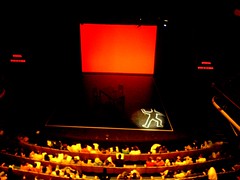
Last Monday, charity tickets for Lee Chin & Friends, part of the Raffles Girls' School Alumni Tribute Series, meant the sitting through a truly disappointing unsatisfying main course by Siow Lee Chin. In the audience there was one lady right in the middle of the stall seats who had either excellent cellphone reception or a very persistent phone alarm, the rabid pained scribbling of notes and then, the walking out citing severe emotional distress. Later at a comfort food supper for frayed nerves, descriptors such as "screechy", "scratchy", "thin tone", "faulty intonation" surfaced repeatedly. G summed up the performance as "very schoolgirl". Lee Chin seems to have been battling these problems for about a decade. Two reliably frank Inkpot reviews in 1998 and 2000 complain of the same thinness and screechiness and intonation problems.

Back in 1998, Isaak Koh referred to Lee Chin playing a Strad (or was it the Guadagnini?) and suggested that the Italian instrument was responding adversely to the tropical climate. He also kindly proposed that the acoustics of the Victoria Concert Hall were in issue. And for good measure, thought that Siow's failure to direct the soundboard of the violin towards the audience resulted in the loudness of the instrument wavering as she moved with the music. Suffice to say that Vadim Rapin, when he performed in the same hall, in the same era, with a Ruby Strad (I think) didn't have these issues. Granted this time, she was probably playing the Deconet.
Perhaps this time, the acoustics of the large cavernous Esplanade Concert Hall were to blame for the thinness of sound? Previous experiences with the un-"critically acclaimed": Ang Shao Wen in private recital and Chua Lik Wuk in violin and piano recital with Lim Yan in the Esplanade Recital Studio had been by contrast vastly delightful.
But then, assuming the recording below is as-is, surely the state-of-the-art Esplanade could not do worse than the Ganz Hall in Chicago. Gallia Kastner on violin playing Pablo Sarasate's Zigeunerweissen on a copy of the "ex-Soldat" Guarneri del Gesu violin by Peter Seman (2008), didn't have projection problems in a former banquet hall.


Regardless, an audience, whether subject to evergreen crowd-pleasing classics, new world wonders or stock showpieces, should feel secure in the hands of the violinist. They should be able to sit back and relax with their choice of tasty beverage, and not have to bite their nails and wonder what the next note might bring.
Our lives in the hands of the living God should be in a far better situation than our ears in the hands of the best violinist the world has ever known. Afterall, the late greats, Szeryng, Oistrakh, Heifetz, Kreisler, Siedel, Elman, Perlman, Rabin, Menuhin, were never completely consistent and the still living seem far more mastered by their instruments than masters of them.
Well, all very easy to say snuggled safe in Singapore where the biggest news any local has been aware of for a fortnight concerns the sloppily-drafted constitution of a women's group, an AGM, an EGM and media-goaded fights between "the old committee" and "the new committee". Hardly the sort of life-threatening situation Israel faced after they hastily exited Egypt while, after a night of horror, the Egyptians buried their dead firstborns.
So there they were, 600,000 Israelite men and many more women and children and others (Exodus 12:37-38), rich with plunder (Exodus 12:35-36), accompanied by very much livestock, both flocks and herds (Exodus 12:38), hosts of the LORD (Exodus 12:51, 14:19) macho-ly armed for battle (Exodus 13:18), the fresh air of freedom in their nostrils, striding purposefully towards the Promised Land. They were led by the LORD himself, in a pillar of cloud by day and a pillar of fire by night (Exodus 13:21-22). God spared them an early fight with the Philistines and led them over uncontested lands. Perhaps they had been singing "I Will Follow Him" in rounds for the Nth time when Moses was told to make a sharp right (Exodus 14:1-2) and they ended up in a scary cul-de-sac, hemmed in by the wilderness on one side, the Red Sea on another. About 3,000,000 pairs of eyes might have stared down an obliviously cheery little voice singing "there isn't an ocean too deeeep" as the entire military force of Egypt darkened the horizon. Pharaoh had decided that Egypt was not going to face financial ruin just because of some night terrors, nevermind that these were all too real (Exodus 14:5). His heart had been hardened (Exodus 14:4) and he had come for the ex-slaves with everything he could muster: his chariot, his horsemen and his army, plus 600 extra chosen chariots and, for good measure, all the other chariots of Egypt with officers over all of them (Exodus 14:6,7,9). A bunch of civilians (with women and children) on foot whose idea of a fight was fisticuffs in the sand (cf Exodus 2:13) vs the most highly-trained professional army in the ancient world on horseback and in chariots? Sure, some pre-alpha Command and Conquer programmers might possibly have coded MASSIVE FAIL right about here.
But only very recently, Moses had drilled into them the eternal festivals/rituals/markers that were to commemorate their successful escape from Egypt under the strong hand of the LORD - the changing of the Hebrew new year and the Passover (Exodus 12:1-13, 24-27, 43-49), the Feast of the Unleavened Bread (Exodus 12:14-20, 13:3-10) and the Consecration of the Firstborn (Exodus 13:1-2, 11-16). The institution of such festivals and rituals was as good as God's specific promise to them that they would be rescued successfully and settle somewhere where they could celebrate these things and spend many hours recounting the rescue story to their children and grandchildren and they to their grandchildren etc for all generations.
Could God fulfil his promise of rescue? Had they not just witnessed God's finger - the ten plagues on Egypt? Had it not already been rather obvious that the LORD was in control over everything in the universe, everything anyone could think of and everything no one hadn't half a brain to think of?
Would God fulfil his promise of rescue? Hadn't everything God had said through Moses so far come true? Didn't old Jacob's mummy with/without its sarcophagus (cf. Genesis 50:26) that they had packed away in their luggage (Exodus 13:19) demonstrate that God had kept/was in the process of keeping his word - because already the multitude of refugees meant that Abraham's descendants were growing to be as numerous as the stars in the heavens (cf Genesis 15:5), and though they were sojourners and servants in a land that was not theirs, they were coming out with great possessions (cf Genesis 15:13-14) and being brought to the land God swore to Abraham, Isaac and Jacob (cf Genesis 50:24)?
Well, whatever. The Israelites took one look at the heaving horses and without hesitation accused God of being an incompetent guide. No, wait. That's too mild. They accused God of being completely untrustworthy, a liar, an evil being bent on their destruction. (Exodus 14:11-12). They'd known better than to have put their faith in him. Why, didn't they say to Moses "Leave us alone, don't rescue us, we're perfectly jolly being slaves to our oppressors" (Exodus 14:12)?
Which part of I AM the LORD, trust and obey, there's no better way didn't they understand? Well, probably most of that "I AM the LORD" bit which led to the lack of the "trust and obey" bit. If God's attributes, namely his eternal power and his divine nature could be clearly perceived, ever since the creation of the world, in the things that have been made (Romans 1:20) then all men have always been without excuse in claiming not to know God and so not worshipping him. So God's direct communication with Abraham, Isaac, Jacob and lately Israel through Moses would have been quite a concession. The faithful Hebrew midwives way back at the start of the story (Exodus 1) didn't even need that much to fear God instead of Pharaoh. Still, the Israelites did not really know the LORD in all his might and power and God-ness. Not only did they not think him trustworthy, or his character only good all the time, they failed to grasp that as the supreme and ultimate being in the world, if he'd wanted them dead, they would have had already been six feet under or mummified or tipped into a common slave grave, regardless of geographical location.
Actually, God would have been quite justified in doing just that to the Israelites. Afterall, the punishment for sin has always been death. So why didn't a voice boom out of the clouds:
A mass slaughter would not have impacted the fulfilment of his promises to Abraham, Isaac and Jacob, for God could easily have recreated the entire people, ver 2.0 - even greater and mightier, through Moses the Recently Faithful alone. He suggests as much later in Numbers 14:12. But this mercy in desisting from killing them would give him more glory in the eyes of the world.
We are usually rather quick to explain how the Israelite's lack of trust at the Red Sea might have to do with their socio-economic background, their poor upbringing, their tiredness... well, basically, it was really all rather reasonable. But perhaps our excuse-mongering should warn us of our own lack of understanding of God and what he requires of us.
God has always been concerned with his glory and he has always required the world to give him due honour - in worship, in trust, in obedience. God has worked to achieve this in direct, bare, supernatural ways, eg. the ten plagues, to demonstrate his great power, that there is no god like the LORD; he has also works by the great withholding of his great power. So, briefly, we see, at least:

Being "still" never meant not doing anything, "letting go and letting God". If stoning had been the proper response, the Israelites and their descendants would have been rooted to that same seashore to this day. Being still wasn't about being on a pleasure cruise. It was about not working to save oneself (cf Exodus 14:13 - see the salvation that God will work for you today; also Psalm 37:7, Psalm 46:10, Zechariah 2:13) but, again, about trusting that God would do his will and obeying him: trusting that God's words were true, trusting that God could and would make good his promises and then putting feet to faith by obeying his commands. The writer of Hebrews generously records that by faith the people crossed the Red Sea as on dry land (faith at least that God could and would wall up the sea on both sides while the lot of them passed through!), but the Egyptians, when they attempted to do the same, were drowned (Hebrews 11:29). The Egyptians could not benefit from the promises made to the Israelites because they were not counted as God's people.
And this sea-crossing was only a little foreshadow of God calling his people out of a damned existence in slavery to Satan and sin into his glorious realm. God has already won the victory over the prince and principalities of this world. We need only depend on his victory and obey his commandments while still on this earth.
Too often, our failure to trust God (so that we either try on our own strength to save ourselves or improve on our godliness or think we need neither salvation nor godliness) stems from a dim view of God himself.

Perhaps we think him not quite omniscient - sulking around church buildings and "holy places" but otherwise quite clueless about the happenings in the world. At Beerfest Asia, a former full-time Christian ministry worker was recounting how she came upon a young father having a surreptitious fag in a quiet corner. He was later red-faced and very apologetic that she had witnessed this. She suggested that actually, this was a matter of his conscience and if his conscience was so convicting him that he was sinning against God, then it was between him and God, who, btw, could see him even in his little dark corner. God did not need Christian-worker gossip to keep him updated on the latest news.
Perhaps we think that God, like everyone else we interact with, can only see the masks we put on in the morning. Nevermind our impure motives for doing this or that, as long as we couch it in Christian terms, as long as influential church members or highly-regarded Christians are our friends and endorse our actions, we think ourselves in the clear and, actually, since our own hype is so powerful, rather mature and godly.
Perhaps we think God doesn't really care about his own name or his glory so much so that there will be a judgement day at the end of history for all humans who have ever existed and live our lives intent on glorifying ourselves.
Or perhaps we manage to recognise that God is sovereign and then surmise that he, therefore, must be responsible for taunting us with suffering and trials, not trusting that God has the good of his people at heart and is concerned with refining us through difficulties so that our faith may be proved genuine.
Or perhaps we do realise that God is concerned for his glory and his name but needs the latest in human thinking to reach out to more people, to make hardened criminals and booze-soaked celebreties weep, to build a kingdom for himself. But God can take care of his own name and kingdom, thank you very much. He only asks that you walk in his ways, not the ways of the world that has thrown up yet another foolproof (more like fool-enticing) method for growing the church. (See Tony Payne's little article on Being Biblical Or Doing What Works?.)
Or perhaps again we think that God needs a bit of help in justice and enforcement department and resort to sinful means to dealing with those we consider his enemies, forgetting that the LORD works in his own time and has a far better clear-eyed grasp of the actual situation that we Coke-bottled ones.
Or perhaps yet again we think God's commandments unreasonable, illogical and really against decent common-sense. We know better than to follow them completely and so make convenient exceptions.
*Dale Ralph Davis, God Gets Gobs of Glory
Prive Bakery Cafe
2 Keppel Bay Vista
GF Marina @ Keppel Bay
Tel: 6776 0777
Boat Asia 2009
Marina @ Keppel Bay
An Audi iceberg, a helicopter, the requisite Heineken, Paulaner, Grey Goose waterholes, powerboats, catamarans, luxury yachts, and our favourite, sailing yachts. We went for a spin in RSYC's little J-24(?) keelboat. The salty sea wind, the sunset as we were sailing back, aroused the appetite for more of the same please.
Beerfest Asia 2009
Behind the Singapore Flyer
We got there late enough to hear the end of Hell's Belles - the female AC/DC tribute and almost be run over by their Harley-riding supporters. Frank fellow-imbiber: "Good thing we got complimentary tickets. Otherwise we would have paid S$37.50 each for this noise." At Kelong Seafood, the chips were fat and hot and crunchy and the fresh Fijian tuna lightly pan-seared was very good with a squirt of balsamic vinegar. The satay ladies were well-dressed but lacked experience in counting out and transferring the sticks of very tasty meat to styrofoam cups and then scooping the gravy in. Somewhere apparently the wiseonesthatbe determined that beer is actually "cooling" and therefore good for drinking on hot nights. Good then that the beers were fairly cheap starting from S$3 a pint/bottle. Eschewed the usual Fosters, Vic Bitters, Chimay, Duvel, Hoegaarden, Stella, Carlsberg, Erdinger, Grolsch, San Miguel, Sol, Corona crowd for Flying Dog Brewery offerings. I blame my Ralph Steadman fandom from his Oddbins days for leading me to them light sweet brews.
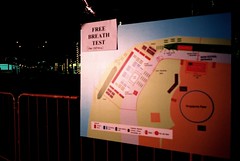
At midnight, we found out that the folk who were supposed to test our free breath had gone home early. :-(
Current Read/Think-through of Exodus
Perhaps this time, the acoustics of the large cavernous Esplanade Concert Hall were to blame for the thinness of sound? Previous experiences with the un-"critically acclaimed": Ang Shao Wen in private recital and Chua Lik Wuk in violin and piano recital with Lim Yan in the Esplanade Recital Studio had been by contrast vastly delightful.
But then, assuming the recording below is as-is, surely the state-of-the-art Esplanade could not do worse than the Ganz Hall in Chicago. Gallia Kastner on violin playing Pablo Sarasate's Zigeunerweissen on a copy of the "ex-Soldat" Guarneri del Gesu violin by Peter Seman (2008), didn't have projection problems in a former banquet hall.
Our lives in the hands of the living God should be in a far better situation than our ears in the hands of the best violinist the world has ever known. Afterall, the late greats, Szeryng, Oistrakh, Heifetz, Kreisler, Siedel, Elman, Perlman, Rabin, Menuhin, were never completely consistent and the still living seem far more mastered by their instruments than masters of them.
Well, all very easy to say snuggled safe in Singapore where the biggest news any local has been aware of for a fortnight concerns the sloppily-drafted constitution of a women's group, an AGM, an EGM and media-goaded fights between "the old committee" and "the new committee". Hardly the sort of life-threatening situation Israel faced after they hastily exited Egypt while, after a night of horror, the Egyptians buried their dead firstborns.
So there they were, 600,000 Israelite men and many more women and children and others (Exodus 12:37-38), rich with plunder (Exodus 12:35-36), accompanied by very much livestock, both flocks and herds (Exodus 12:38), hosts of the LORD (Exodus 12:51, 14:19) macho-ly armed for battle (Exodus 13:18), the fresh air of freedom in their nostrils, striding purposefully towards the Promised Land. They were led by the LORD himself, in a pillar of cloud by day and a pillar of fire by night (Exodus 13:21-22). God spared them an early fight with the Philistines and led them over uncontested lands. Perhaps they had been singing "I Will Follow Him" in rounds for the Nth time when Moses was told to make a sharp right (Exodus 14:1-2) and they ended up in a scary cul-de-sac, hemmed in by the wilderness on one side, the Red Sea on another. About 3,000,000 pairs of eyes might have stared down an obliviously cheery little voice singing "there isn't an ocean too deeeep" as the entire military force of Egypt darkened the horizon. Pharaoh had decided that Egypt was not going to face financial ruin just because of some night terrors, nevermind that these were all too real (Exodus 14:5). His heart had been hardened (Exodus 14:4) and he had come for the ex-slaves with everything he could muster: his chariot, his horsemen and his army, plus 600 extra chosen chariots and, for good measure, all the other chariots of Egypt with officers over all of them (Exodus 14:6,7,9). A bunch of civilians (with women and children) on foot whose idea of a fight was fisticuffs in the sand (cf Exodus 2:13) vs the most highly-trained professional army in the ancient world on horseback and in chariots? Sure, some pre-alpha Command and Conquer programmers might possibly have coded MASSIVE FAIL right about here.
But only very recently, Moses had drilled into them the eternal festivals/rituals/markers that were to commemorate their successful escape from Egypt under the strong hand of the LORD - the changing of the Hebrew new year and the Passover (Exodus 12:1-13, 24-27, 43-49), the Feast of the Unleavened Bread (Exodus 12:14-20, 13:3-10) and the Consecration of the Firstborn (Exodus 13:1-2, 11-16). The institution of such festivals and rituals was as good as God's specific promise to them that they would be rescued successfully and settle somewhere where they could celebrate these things and spend many hours recounting the rescue story to their children and grandchildren and they to their grandchildren etc for all generations.
Could God fulfil his promise of rescue? Had they not just witnessed God's finger - the ten plagues on Egypt? Had it not already been rather obvious that the LORD was in control over everything in the universe, everything anyone could think of and everything no one hadn't half a brain to think of?
Would God fulfil his promise of rescue? Hadn't everything God had said through Moses so far come true? Didn't old Jacob's mummy with/without its sarcophagus (cf. Genesis 50:26) that they had packed away in their luggage (Exodus 13:19) demonstrate that God had kept/was in the process of keeping his word - because already the multitude of refugees meant that Abraham's descendants were growing to be as numerous as the stars in the heavens (cf Genesis 15:5), and though they were sojourners and servants in a land that was not theirs, they were coming out with great possessions (cf Genesis 15:13-14) and being brought to the land God swore to Abraham, Isaac and Jacob (cf Genesis 50:24)?
Well, whatever. The Israelites took one look at the heaving horses and without hesitation accused God of being an incompetent guide. No, wait. That's too mild. They accused God of being completely untrustworthy, a liar, an evil being bent on their destruction. (Exodus 14:11-12). They'd known better than to have put their faith in him. Why, didn't they say to Moses "Leave us alone, don't rescue us, we're perfectly jolly being slaves to our oppressors" (Exodus 14:12)?
Which part of I AM the LORD, trust and obey, there's no better way didn't they understand? Well, probably most of that "I AM the LORD" bit which led to the lack of the "trust and obey" bit. If God's attributes, namely his eternal power and his divine nature could be clearly perceived, ever since the creation of the world, in the things that have been made (Romans 1:20) then all men have always been without excuse in claiming not to know God and so not worshipping him. So God's direct communication with Abraham, Isaac, Jacob and lately Israel through Moses would have been quite a concession. The faithful Hebrew midwives way back at the start of the story (Exodus 1) didn't even need that much to fear God instead of Pharaoh. Still, the Israelites did not really know the LORD in all his might and power and God-ness. Not only did they not think him trustworthy, or his character only good all the time, they failed to grasp that as the supreme and ultimate being in the world, if he'd wanted them dead, they would have had already been six feet under or mummified or tipped into a common slave grave, regardless of geographical location.
Actually, God would have been quite justified in doing just that to the Israelites. Afterall, the punishment for sin has always been death. So why didn't a voice boom out of the clouds:
Attention! Attention! Due to disbelief, the way through the Red Sea has been cancelled.*The psalmist tells us the reason God withheld his hand from decimating them inspite of their dastardly distrust and disobedience:
Good bye.
Our fathers, when they were in Egypt,He was concerned for his own name. One can't tell everyone that one is saving one's people from the Egypt and bringing them to the land promised to their forefathers and then either cause a giant heavenly piano to fall on the lot of them or inflict fatal trauma to their nervous systems with a heavenly violin screech or less supernaturally, allow them to be killed by Pharaoh & Co, no matter how much they deserved it. God had a reputation to keep.
did not consider your wondrous works;
they did not remember the abundance of your steadfast love,
but rebelled by the sea, at the Red Sea.
Yet he saved them for his name’s sake,
that he might make known his mighty power.
He rebuked the Red Sea, and it became dry,
and he led them through the deep as through a desert.
So he saved them from the hand of the foe
and redeemed them from the power of the enemy.
And the waters covered their adversaries;
not one of them was left.
Then they believed his words;
they sang his praise. (Psalm 106:7-12)
A mass slaughter would not have impacted the fulfilment of his promises to Abraham, Isaac and Jacob, for God could easily have recreated the entire people, ver 2.0 - even greater and mightier, through Moses the Recently Faithful alone. He suggests as much later in Numbers 14:12. But this mercy in desisting from killing them would give him more glory in the eyes of the world.
We are usually rather quick to explain how the Israelite's lack of trust at the Red Sea might have to do with their socio-economic background, their poor upbringing, their tiredness... well, basically, it was really all rather reasonable. But perhaps our excuse-mongering should warn us of our own lack of understanding of God and what he requires of us.
God has always been concerned with his glory and he has always required the world to give him due honour - in worship, in trust, in obedience. God has worked to achieve this in direct, bare, supernatural ways, eg. the ten plagues, to demonstrate his great power, that there is no god like the LORD; he has also works by the great withholding of his great power. So, briefly, we see, at least:
- the glory of God's care - in not allowing his people to be tempted beyond what he knows they can bear (Exodus 13:17 cf. 1 Corinthians 10:13);
- the glory of God's power in the helplessness of his people - he can do what we think is impossible, when we can't contribute anything, even our faith;
- the glory of God's steadfastness in face of the fickleness of his people - God doesn't need to wait for a proper response before acting to save in his infinite mercy;
- the glory of God's trustworthiness that justifies the faith that his people put in him;
- the glory of God's in his judgement of his enemies. God does not subscribe to uttering politically-correct contentless PR phrases when speaking of his enemies. He boasts openly of the decimation of his enemies by his hand because this shows the powerful and just God he is (Psalm 9:16). When God carries out judgement, he isn't terribly sorry about it; it's part of his glory and his fame. And so we too should not be ashamed of this. The God of the OT is the same God of the NT, so just as the LORD was given glory when the Egyptians realised what the sort of LORD they were dealing with ("Let us flee from before Israel, for the LORD fights for them against the Egyptians." (Exodus 14:25)), we are told in 2 Thessalonians 1 that the saints will glorify God when "the Lord Jesus is revealed from heaven with his mighty angels in flaming fire, inflicting vengeance on those who do not know God and on those who do not obey the gospel of our Lord Jesus. They will suffer the punishment of eternal destruction, away from the presence of the Lord and from the glory of his might";
- the glory of God's mysteries making sense (to us eventually)
And this sea-crossing was only a little foreshadow of God calling his people out of a damned existence in slavery to Satan and sin into his glorious realm. God has already won the victory over the prince and principalities of this world. We need only depend on his victory and obey his commandments while still on this earth.
Too often, our failure to trust God (so that we either try on our own strength to save ourselves or improve on our godliness or think we need neither salvation nor godliness) stems from a dim view of God himself.
Perhaps we think that God, like everyone else we interact with, can only see the masks we put on in the morning. Nevermind our impure motives for doing this or that, as long as we couch it in Christian terms, as long as influential church members or highly-regarded Christians are our friends and endorse our actions, we think ourselves in the clear and, actually, since our own hype is so powerful, rather mature and godly.
Perhaps we think God doesn't really care about his own name or his glory so much so that there will be a judgement day at the end of history for all humans who have ever existed and live our lives intent on glorifying ourselves.
Or perhaps we manage to recognise that God is sovereign and then surmise that he, therefore, must be responsible for taunting us with suffering and trials, not trusting that God has the good of his people at heart and is concerned with refining us through difficulties so that our faith may be proved genuine.
Or perhaps we do realise that God is concerned for his glory and his name but needs the latest in human thinking to reach out to more people, to make hardened criminals and booze-soaked celebreties weep, to build a kingdom for himself. But God can take care of his own name and kingdom, thank you very much. He only asks that you walk in his ways, not the ways of the world that has thrown up yet another foolproof (more like fool-enticing) method for growing the church. (See Tony Payne's little article on Being Biblical Or Doing What Works?.)
Or perhaps again we think that God needs a bit of help in justice and enforcement department and resort to sinful means to dealing with those we consider his enemies, forgetting that the LORD works in his own time and has a far better clear-eyed grasp of the actual situation that we Coke-bottled ones.
Or perhaps yet again we think God's commandments unreasonable, illogical and really against decent common-sense. We know better than to follow them completely and so make convenient exceptions.
...I want you to know, brothers, that our fathers were all under the cloud, and all passed through the sea, and all were baptised into Moses in the cloud and in the sea... Nevertheless, with most of them God was not pleased, for they were overthrown in the wilderness. (1 Corinthians 10:1-5)These things took place as examples for us, that we might not desire evil as they did (1 Corinthians 10:6). Therefore, flee from idolatry (1 Corinthians 10:14). Therefore, do all things to the glory of God (1 Corinthians 10:31).
*Dale Ralph Davis, God Gets Gobs of Glory
Prive Bakery Cafe
2 Keppel Bay Vista
GF Marina @ Keppel Bay
Tel: 6776 0777
Boat Asia 2009
Marina @ Keppel Bay
An Audi iceberg, a helicopter, the requisite Heineken, Paulaner, Grey Goose waterholes, powerboats, catamarans, luxury yachts, and our favourite, sailing yachts. We went for a spin in RSYC's little J-24(?) keelboat. The salty sea wind, the sunset as we were sailing back, aroused the appetite for more of the same please.
Beerfest Asia 2009
Behind the Singapore Flyer
We got there late enough to hear the end of Hell's Belles - the female AC/DC tribute and almost be run over by their Harley-riding supporters. Frank fellow-imbiber: "Good thing we got complimentary tickets. Otherwise we would have paid S$37.50 each for this noise." At Kelong Seafood, the chips were fat and hot and crunchy and the fresh Fijian tuna lightly pan-seared was very good with a squirt of balsamic vinegar. The satay ladies were well-dressed but lacked experience in counting out and transferring the sticks of very tasty meat to styrofoam cups and then scooping the gravy in. Somewhere apparently the wiseonesthatbe determined that beer is actually "cooling" and therefore good for drinking on hot nights. Good then that the beers were fairly cheap starting from S$3 a pint/bottle. Eschewed the usual Fosters, Vic Bitters, Chimay, Duvel, Hoegaarden, Stella, Carlsberg, Erdinger, Grolsch, San Miguel, Sol, Corona crowd for Flying Dog Brewery offerings. I blame my Ralph Steadman fandom from his Oddbins days for leading me to them light sweet brews.
Current Read/Think-through of Exodus
- Convalescent Food, Lemon Poppyseed Yoghurt Cakelets and Exodus and the People of God
- Not the Physiology of Taste x Exodus 1
- Moses the Non-Rescuer and Exodus 2 - 4
- Rescue Plans Hit Brick Wall. Israelites Draw Short Straw. (Exodus 5 - 7:7)
- God Shows Hand, Gives Egyptians the Finger (Exodus 7 - 10)
- Easter Bunny Spared, Goose Cooked, Lamb Slaughtered, Israelites Painted Town Red, Dough Failed to Rise to Occasion (Exodus 12)
- Egyptians Sink To New Depths, God Gets Gobs of Glory (Exodus 13-14)
- Hallelujahs for the Hell-bound, Verses for Vengeance, Jumping for Judgement By Beach Boy & Co (Exodus 15:1-21)
Labels: *Exodus, All Given For Food: Beer, Amateur Sportiness: Sailing and Boating, Jubal's Legacy: Violin