Friday, July 03, 2009

The Pop! Goes Our Hearts Partnership (Philippians 1:1-11)

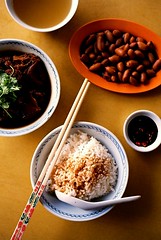
Breakfast!

At the CIMB Singapore International Piano Festival last week, Vladimir Feltsman strode on stage to polite applause before sitting down perfunctorily and launching into J.S. Bach's Partita No. 1 in B-flat major. The initial excitement of the audience soon gave way to the dawning realisation that there was something very familiar about his style - it had all the symptoms of a child being forced by proud and somewhat musically-clueless parents into playing his Hanon exercises for visitors. Feltsman's use of rubato seemed merely an attempt to allay his boredom rather than to add colour to the piece. Chopin's Polonaises and Ballade No. 3 fared little better though Feltsman actually showed a bit of interest in Mussorgsky's Pictures at an Exhibition with glimpses of technical brillance and even, emotion. Later, I thought his first encore piece really did sound like piano exercises and recently ex-fan R was insulted by the triteness of his second encore piece.
Vladimir Feltsman, Victoria Concert Hall, Singapore
Travel-weary performing-monkey syndrome theory was put to rest by reports that Feltsman was similarly uninspired in his adopted homeland. The South Florida Classical Review likened "his stage personality and musical style" to "that of an impatient, vaguely irritated professor who wants to get class over with as quickly as possible". Though describing his interpretation was individualistic, The Philadelphia Inquirer noted that "Feltsman's moments of boredom [were] unfortunately obvious". (Edit: Chang Tou Liang's review in the Straits Times probably attempted to be far more constructive and positive.)
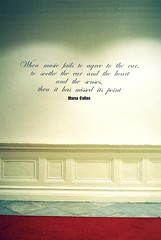
Wall, Victoria Concert Hall
What a great contrast between the pianist free to practise his art in front of a willingly-adoring audience and the effusive Paul fettered and mired in opposition as he writes the letter to the Philippians.

Astonishingly, the letter is in a joyous major key with I, IV, V chord progressions, with the main themes of partnership (Philippians 1:7, 4:14-15. 1:27, 2:1, 3:10 (I want to partner in his suffering), 4:2) and what standing firm in partnership might look like (Philippians 1:27 - 4:1), always with an eye on the last day (Philippians 1:11, 4:17).

In his various letters, Paul uses different imagery to describe the relationships between the church and God, and between the members of the church: God is the Father and we are his children and members of one family; Christ is the head and we are parts of one body etc.

Here, he appears to be using the imagery of partnership (κοινωνί). It is not just the loosely bandied "fellowship" which Christians term just about every gathering regardless that there is little difference between such chowtimes/ weekend football sessions/ gossip meet-ups and the gatherings of pagans. The partnership to which he refers is akin (hehheh) to that found in the business world, where people get together and commit to working singlemindedly, and do indeed work passionately, towards a common objective. William Taylor suggests the active, energetic picture of a takeover situation where the accountants, lawyers, business people are working hard overnight with a common target in sight. But more than that, the partners in a partnership relationship are stakeholders; they are in close relationship, each contributing his part, and each sharing in the ups and downs - directly reaping the profits of the success of their enterprise and also directly bearing the losses of the failure of their business.

There is partnership between Christ and the church, and the members of the church with each other. It's not just a shake-hands commercial deal with one eye always on protecting oneself and being ready to sue the other for breach of contract but a real teamship, a heartfelt joint venture. Just as the "affection of Christ" was no Saturday night whisper to be melted away by the stark sunshine of Sunday, but shown in his sacrificial death on the cross, so Paul's love for the Philippians is real - shown in his concern and affection for his partners (Philippians 1:3-4, 1:7, 1:8) and the amazing joy welling up even in his private prayers (Philippians 1:4) because he can see they are keeping in partnership with him (Philippians 1:5, 1:7) even as they all partner with Christ (see later chapters). The evidence of this is their monetary support, their being faced with the same opposition and their standing firm in the gospel (Philippians 1:7).

Post-Concert Late-Night Prata, Serangoon
Christians find each others' testimonies tearduct-tickling. It was really wonderful to hear R's 11-year journey to the faith through the unlikely help of a Nobel Prize winner's book on Barrabas and the Christian (heritage) of favourite poets. Heck. God's sovereignty being, err, really sovereign, even The Simpsons can be his messengers through which he calls his people.

It's easy to start out strong and full of promise (this is a general comment and not specific to prata-buddy's future!). Think of the childstars who crashed and burned when they were no longer cute enough to hide their lack of (other) talent, or the one-hit wonders, or the sportspeople who grew old and weary and then retired to collect royalties from their eponymous range of sports equipment, until those too were retired because their achievements had been eclipsed by others.

How do we know we will last in this partnership with Christ to the end in a world full of temptation and opposition and suffering? And furthermore, churches fester with all sorts types, how can we manage to remain in such intimate partnership with people we can't quite stand the sight of?

Well, we didn't discover the faith under our own steam or through dumbass good luck, but God ultimately who first called us to this salvation. So unsurprisingly, it is he who began a good work in us who will bring it to completion at the day of Jesus Christ (Philippians 1:6). And our sharing in Paul's imprisonment (facing the same conflict and opposition and persecution he faced), and our sharing in the defense and confirmation of the gospel (confirmed no doubt also by our standing firm in it), far from being signs that God is punishing us, are signs that God's approval is on us - for Paul considers these part of the grace, the undeserved favour given to us by God (Philippians 1:7)

And yet, in that familiar both-and scenario that is replete through the Bible, we are to rest on God but not on our laurels. Paul prays that the Philippians' love may abound more and more, with knowledge and all discernment, so that they may approve what is excellent, and so be pure and blameless for the day of Christ, and in the same letter, tells them how they are to do this. No instant makeover from God. Wounds, difficulties, pain and suffering to follow.

Choosing Games at Revision Party
Christian camps: camaraderie in the cause of Christ. The joy of Christian service together (and silly games and sillier photographic memories of the same).


This is all with the aim to bring praise and glory to God on that Last Day (Philippians 1:11, 4:17) through our fruits of righteousness, overwhelming evidence of his work in us, a massive harvest, an overflowing bank account because of our faithful gospel partnership.

But more on what remaining in true partnership, what abounding love with knowledge and discernment, looks like to come. Yay!

Labels: , ,

Thursday, May 14, 2009

Hallelujahs for the Hell-bound, Verses for Vengeance, Jumping for Judgement By Beach Boy & Co (Exodus 15:1-21)

Song of Moses and The Stolen Guitar Pick
Music-centric conversations these past few weeks have included: one on the football music of Basque country, lingering for a time on a macho cheer concerning dried cod fish; badger-ment about playing some Bach please leading naturally to the Glenn Gould discussion on the vulgarity (on the part of the pianist) and the sick voyeurism (on the part of the audience) of performance; a colleague's husband agreeing that non-Christmas carol/congregational song/pop ditty piano-playing is a very private affair done most authentically, if one didn't have a soundproof room to lock oneself in, on an electric piano with weighted keys and the earphones plugged in; guitar accompaniment in quiet time prayer; music as performance in far too many congregations; the ipod (plugged-in) generation being immersed in a continuous soundscape so that specific song-associated experiences of yesteryear will be alien to them, as will the sound of silence; the hyperreality of denizens of developed countries actually vocalising trite telly/movie sounds to accompany their daily lives... then, the soaring strings backing tender Benedick-Beatrice moments at Singapore Repertory Theatre's Shakespeare in the Park: Much Ado About Nothing leading to some giggling amongst certain members of the audience (though Shakespeare's outright plundering of biblical themes cause even more mirth).

A question for the blockbuster-weaned generation then: what music ought to accompany God's judgement, God's vengeance, when in wrath and righteousness, he condemns his enemies to everlasting death?

Music? Surely an event so horrible and fearful can call forth no words or music fit to describe or convey the terror felt by the damned - the screaming, the weeping, the gnashing of teeth, the heartrending pleas for mountains to fall on them to hide them.

If pressed (possibly not by the Revelation 14:19-20 winepress) to provide music, the amassed musical types might vote for a lone mournful bugle or Mozart's Dies Irae (for context*) played sotto voce, and respectfully, after the last scream has gurgled away. (Poor Verdi's Dies Irae** would probably be overlooked for great-tragedy-has-arrived obvious-ness.)

The ideal response, however, is set out in Exodus 15: joyful music and dancing at the mass deaths of the Egyptians.

This is terribly un-PC in this day and age. As a sign of her progressiveness, our school principal once banned announcements about "trashing" another school at this or that match or any mention that our opponents had in fact been ineffectual limp pushovers. What more rejoicing at the deaths of fathers and husbands and lovers. And oh, those poor horses too!

But there is a difference between dancing on graves in acapella groups Schadenfreude-ly smirkingly singing Sink Like An Egyptian while miming actions of people drowning and indulging in the flippant precursor (luggage notwithstanding) to Belgian Central Train Station mass dancing, and singing and dancing in celebration of what God has done. The difference is that is not done for the sake of the flash mob thrill of doing per se, nor the exaltation of self, but the exaltation of God.

God's Self-Revelation
Previously, God had told Moses that he would reveal himself to his people so that they would know him in a way that their forefathers would never have known him. And this revelation would be in his rescue of his people from slavery in Egypt. While it might be all very well to academically list his good qualities, God wanted the Israelites to taste and see and so understand his very goodness. A personal subjective experience of God was not what God wanted, he wanted to objectively unmistakably reveal himself through his works. Afterall, the most amazing fantasies of all the humans in the world from creation onwards could never approximate his real magnificence. And the goal of his self-revelation was to get glory.

God's Concern for His Glory and His Name
Earlier chapters of Exodus had already made clear that God's main aim was to get glory for himself. His self-revelation to the Israelites and to the Egyptians was to achieve just that. So the drowning of a good portion of the studly men of Egypt should not primarily elicit cries of pity for the dead creatures but cries of victory for the living God in vindicating his own name.

For if we know anything about God, it is that he was (and is) passionate about his glory and hence his name.

Therefore, he cannot be the accidentally tarred-and-feathered god that Steve Chalke has made up whose "unwillingness to distance himself from the people of Israel and their actions meant that at times he was implicated in the excessive acts of war that we see in some of the books of the Old Testament" (Steve Chalke, The Lost Message of Jesus). God has always been so concerned with his name that any erroneous implication would have been quickly and publically set straight.

We know how the LORD opposes everyone who does not acknowledge his perfect goodness, perfect trustworthiness, perfect might. This, rather than the tasty fruit of the Tree of the Knowledge of Good and Evil itself, was the temptation in the Garden of Eden. Anyone who thinks and speaks badly of him and so fails to honour him is his enemy; anyone who thinks and speaks badly of perfect good is evil. Pharaoh and the Egyptians would not listen to God's words even though God had shown them signs and wonders. Instead they hardened their hearts and thought so lowly of God that they fancied they could easily defeat his people. Already they had visions of victory:"I will pursue, I will overtake, I will divide the spoil, my desire shall have its fill of them. I will draw my sword; my hand shall destroy them." (Exodus 15:9). What baseless swaggering self-confidence; what epitome of evil - standing against God over and over and over again. But when the chips were down, they failed to deliver.The destruction of Pharaoh and the Egyptians was therefore the destruction of evil.

Chips Down, Prive Bakery Cafe, Keppel Island
the chips were down

God the Winning Warrior
And so far from being the unfortunate father having to sit through accusations of poor parenting at yet another PTA meeting, it was the LORD himself who was the perpetrator; he was the warrior, the man of war (Exodus 15:3), who fought for his own name. He was personally and directly involved in the destruction of the Egyptians - the horse and his rider he threw into the sea (Exodus 15:1), Pharaoh's chariots and his host he cast into the sea, Pharaoh's specially chosen elite officers were sunk in the Red Sea (Exodus 15:4); it was the LORD's right hand that shattered the enemy (Exodus 15:6).

God the Magnificent Majesty
Of course God as Warrior was metaphor in that it put a pictorial in puny minds as to what God was doing. God was also a father providing for his firstborn son, a rescuer redeeming his people from slavery... But God was still more than all that combined because, well, since he made everything, he could/can easily do anything he wants to, to anything in the world.

The People of This God
Faced with such massive revelation of God's power and majesty, the people gave God glory not by joining hands, swaying, and hypnotically singing "I glorify your name, O Lord" 1000 times but by fearing and trusting God (Exodus 14:31).

Pig Trotters and Groundnuts, TurfCity
not a trotter left behind

God does not change. He is still concerned today about his glory. Because he is perfect, he cannot take lightly the people who defame him.

And the image of the warrior God showing his might and bringing death to his enemies isn't just an Old Testamental bit of anger here, a flare up there, blood and gore everywhere embarrassment in these enlightened times. 'Gentle Jesus meek and mild" Jesus of the trinitarian Godhead was not. While Jesus was still in the womb, Mary, dewy-skinned and glowing with baby, sang of the fearsome judgement of God (Luke 1:46-55). And the child she would bear would be the executor of this judgement:
He disarmed the rulers and authorities and put them to open shame, by triumphing over them in him. (Colossians 2:15)

Then comes the end, when he [Jesus] delivers the kingdom to God the Father after destroying every rule and every authority and power. For he must reign until he has put all his enemies under his feet. (1 Corinthians 15:24-25)

Then I saw heaven opened, and behold, a white horse! The one sitting on it is called Faithful and True, and in righteousness he judges and makes war. His eyes are like a flame of fire, and on his head are many diadems, and he has a name written that no one knows but himself. He is clothed in a robe dipped in blood, and the name by which he is called is The Word of God. And the armies of heaven, arrayed in fine linen, white and pure, were following him on white horses. From his mouth comes a sharp sword with which to strike down the nations, and he will rule them with a rod of iron. He will tread the winepress of the fury of the wrath of God the Almighty. On his robe and on his thigh he has a name written, King of kings and Lord of lords.

Then I saw an angel standing in the sun, and with a loud voice he called to all the birds that fly directly overhead,"Come, gather for the great supper of God, to eat the flesh of kings, the flesh of captains, the flesh of mighty men, the flesh of horses and their riders, and the flesh of all men, both free and slave, both small and great." And I saw the beast and the kings of the earth with their armies gathered to make war against him who was sitting on the horse and against his army. And the beast was captured, and with it the false prophet who in its presence had done the signs by which he deceived those who had received the mark of the beast and those who worshiped its image. These two were thrown alive into the lake of fire that burns with sulfur. And the rest were slain by the sword that came from the mouth of him who was sitting on the horse, and all the birds were gorged with their flesh. (Revelation 19:11-21)
Jesus is presented as a man of war, a warrior. At the cross, he triumphed over evil, over Satan, and rose victorious from the grave. All who are against God/him will face certain obliteration at the end of days.

This is our God, not just the God of Christians or Jews but the God of the world. This is who God has revealed himself to be. To reduce him to a pocket-sized tchochtke is to defame him. And Revelation 19 is pretty clear what happens to defamers.

If God is jealous for his name, if God has absolute power and nothing can prevent him from executing justice, then their end is certain and rather bloody. Arguments against (eg. on the basis of "human rights") are laughable because the only rights any creature has are those given by their Creator. And temporal distractions are useless because if judgement is really coming for those who do not honour God as God, we must repent and believe now, and we must evangelise not to win top honours in another MLM game but like those who yelled frantically "come inside! come inside!" to those wandering obstinately in the open Egyptian fields before the hailstorm came and crushed every tree, animal, person. And that shelter that protects us is Christ.

But when judgement comes, the time for weeping and warning will be over and the time for unabated rejoicing will be ushered in.

In the penultimate verse of the mass sing-along song by the sea, the Israelites sang as if Philistines, Edomites and Canaanites were already defeated. Seems like a set-up for a hubric fall akin to that of the Egyptians? No, it was never about hubris per se but hubris in the face of God, against God. The Hebrew verses of certain victory, being in line with God's plan and in fact, displaying trust in God's promises and preserving care and protection, instead brought glory to his name.

The triumphant victory song to be sung in the last days, however, like that sung in Revelation 19 will not look forward to a future event but back to victory consummated, and faith fulfilled.

Choong Chee Pang often told the story of an earnest young man from China who'd asked him: Will we still have our memories in heaven? CCP replied that he thought we might. Then the young man said, with tears in his eyes,"Then how can we be rejoicing in heaven if we remember everyone we have loved on earth and know that they are in hell?" CCP said he did not have an answer for him.

Perhaps the answer is this: this is not unconsidered by God; it is not a point that has slipped past the hard heart of God, for Jesus wept for an unbelieving Jerusalem and Paul agonised in Romans 9 over his unbelieving kinsmen. But perhaps in that Day, our love and our loyalty will finally be centred solely on the person on which they were made to center on - God and God alone.

Yet meanwhile, while God's patience has not yet come to an end, while our loved ones still live, God does not want any one to perish but desires that all be saved through the blood of his Son. But the offer is for a limited time only.

Sunset, Keppel Bay

*Wolfgang Amadeus Mozart, Requiem, Dies Irae


**Verdi, Requiem, Dies Irae

Dies irae
Dies illa
Solvet saeclum en favilla
Teste david cum sybilla

Quantus tremor est futurus
Quando judex est venturus
Cunta stricte discus surus

Dies irae
Dies illa
Solvet saeclum en favilla
Teste davidcum sybilla

Quantus tremor est futurus
Quando judex est venturus
Cuncta stricte discus surus

Quantus tre-e-mo-or e-est fu-u-turus
Dies irae, Dies illa
Quantus tre-e-mo-or e-est fu-u-turus
Dies irae, Dies illa
Quantus tre-e-mo-or e-est fu-u-turus
Quando judex est venturus
Cuncta stricte discus surus

Cuncta stricte
Stricte discus surus
Cuncta stricte
Stricte discus surus


Current Read/Think-through of Exodus

Labels: , ,

Wednesday, July 25, 2007

Designing Liveable Cities, Idolatry and Prayer

Because of the job, which, as everyone knows, involves plotting over undeveloped countries like a pantheon of SimCity gods* and turning Dullsville into an exciting metropolis in a decade, we have been thinking vastly and deeply about what makes cities tick.

*Joke, lah. How come only Mini-Me is laffing?

Monocle's criteria for a liveable city is one with:
  • international, long-haul connections combined with a well-managed, thoughtfully designed airport;
  • low murder rates and domestic burglaries;
  • good state education and health care;
  • decent hours of sunshine and average temperatures;
  • great communications and connectivity;
  • tolerance;
  • ease in getting a drink after 01.00;
  • the cost of public transport and taxis is low but the quality is high;
  • strong local media and availability and range of international print media;
  • access to nature and a good amount of green space;
  • and finally, key environmental initiatives.
So, someone asked, you think how? Singapore can make it anot?
Aiyah, depends what it means to be liveable mah. Monocle criteria is only for Monocle.
I think liveable cities must be happening lor. Must have place to chiong lor.

So there was an exchange of the happenings of the past few weeks. Fine. (Plus I get a place to dump these photos.) (Plus someone's unwitting confessions shall be blackmail fodder for years to come.)

Black Pepper Crab at Newton Food Centre
Two Fridays ago, finger-lickin' black pepper crab amidst the tourists at Newton food centre,

Ricky Martin's "She Bangs" About To Be Massacred......By William Hung
then K-Box karaoke in English and Chinese (and a gobsmackingly terrible demonstration of hiphop moves) at Selegie until about 4am on Saturday.

Floor Tiles At CHIJMES
A few hours later, a wedding at the lovely chapel at CHIJMES where the morning sun shone through the stained glass onto the new couple, and there was someone sniffing that the Sainte-Chapelle looked much better, miscellaneous catching-up with people, then Taiwanese bubble tea at Paradiz served up by a Malay family,

Demspey HillThe Ranch Home at Dempsey Hill
then lunch at The Ranch Home on Dempsey Hill where the food needs a lot more tweaking. And from afar, Wong Toon King, who, other than fiddling about with SilkRoute Ventures, Z-Fencing and Ben & Jerry's also used to coach me in foil (the only fencing teacher who was willing to waste any time on me and to whom I'll always be grateful).

Sashimi and Such at Meidi-Ya Supermarket
Later, birthday presents were sought and found amongst the crazy maze of little indie set-ups at Far East Plaza and salmon and tuna sashimi were grabbed at Meidi-Ya,

Japanese Theme at DinnerAlcohol and Dessert
just in time for a birthday dinner with Japanese theme. The hosts, one of whom might be a closet alcoholic, were generous with desserts: Want some plums? Soaked in Choya. Care for some cherries? Griottines soaked in kirsch. The fruits that weren't to be dredged up from with some sort of alcohol had been incorporated into ice-cream. All good. So sometime into the night, the conversation got to the point where there was a debate about french fries and someone was saying,"Well, there is a certain attractiveness about limp fries". Halfway through having to go on the mobile to sort out how to meet a friend of a friend, a German lass who'd met the friend, now in Hong Kong, in London. Then the drivers, being really responsible, trialled Marvel: Ultimate Alliance until they looked less like they'd overdone the blusher.

More of the Hasselblad
Sunday, babies hugged and harrassed, German girls lost and found (except they turned out to be really Latvian-near-the-Black-Sea but with German passports), a good Chinese lunch and playing with a very nice Hasselblad (are there Hasselblads that aren't nice?).

Monday, a proud sms announcing that Food For Thought was now open for breakfast, lunch and dinner. And so it will be checked out because there is the promise of indie-ness and cake together.

Another night, Harry Potter and the Order of the Phoenix, where the choice of movie snacks was bak kwa and McDonalds chocolate milkshake. I am afraid of being found out, said the (voluntary) courier of illegal goods. But when we got to our seats, from the sea of movie-goers around us came the bold rustling of bags of illegal burgers and illegal fries and the cracking open of illegal drinks and the crackling of illegal packets of chips. And all was well.

Steak Sandwich at TuckshopThe Bandits at Tuckshop
Thursday, The (not-illegal) Bandits were acoustic-ing it up at Tuckshop. The summary quote of the night: They sound good! But I wouldn't want to put on their CD at home.

Wedding Dinner Mosaic
Friday, an old friend had conned a girl into marrying him so there was a wedding at Shangri-La where there was mega-catching-up and laughing, and ex-fencers telling about TK and B&J's and how they didn't score any discounts from him and how also they'd now switched from foil to epee to dispense with having to remember rights-of-way (difficulty increases proportionally with age), and where the groom's dad, an editor with a Chinese newspaper, spoke at length and with many elegant literary phrases about Overbearing Wives And What To Do With Them. We were plied with great amounts of wine and beer and had to keep shoo-ing away waiters who were trying, surreptitiously, to refill our glasses.

Mimolette Mosaic
Saturday, a sleep-in then a late and lazy breakfast at Mimolette, through whose tall windows you could see sturdy brown horses trotting past.

Then,
LOLHURYPUTR
(Amid the run-up to Deathly Hallows, because we are forever associated in each other's minds with The Boy Who Lived, an ex-roommate emailed from London to say he had cleared his whole saturday so as to be able to curl up with the book, and also that if I so happened, perhaps, out of the overflowing goodness of my generous heart, to sms him spoilers before he was done, he would take the next 13-hour flight out of Heathrow and personally strangle me. Obviously, my friends are exceptionally cheerful people.)

So it was good that a frantic dinner mate called last minute to apologise: I can't meet you for dinner! I'm on a dare to get 7 dates in 7 days and the last one cancelled on me last night which means I need to find 2 tonight! Argh! (Sorry, I can't count you.)

Yay!

Ding Tai FungA Piano Called Hyundai
Sunday, Bible study was intended but after a good lunch at Ding Tai Fung where migration plans and the leaving behind of things and people were discussed, the majority of us succumbed to severe food comatose. Later, tooling around on a piano called Hyundai.

Food For Thought Mosaic
Monday, we were up for checking out the aforementioned Food For Thought, whose food a chef described as "Le Cordon Bleu meets local ingredients" and indeed, the Chicken Caesar Salad was Hainanese chicken rice and ginger and sesame oil. There was Mama Heng's Spicy Pork where Mama Heng was the mama of David Heng the Smiley Chatty Chef, there was Peter Boyer the Other Chef who kept dumping stuff down sinks they shouldn't be dumped down, there were platforms (cake stands, really) for home chefs to step out of the closet onto, there was speculating whether Mrs. Kang (of Mrs. Kang's Fresh (and retro) Durian Cake) had a house on Sixth Avenue that smelt of durian, or a kitchen that was huge and airy or very patient neighbours, or all of the above.

Later this week, there are grand plans for drinks and dinners but can't remember them all, and to add forgetfulness upon forgetfulness, have also lost the 2 organisers I got for Christmas which were meant to help me remember these things. Don't think Rememberalls would have been much use either. Fortunately, the delivery of team jerseys today reminds me that there will be a basketball tournament.

Like that, is quite chiong-able, mah, he said. Then Singapore can lor. Hor?

Not sure.

Maybe what makes a city is sunshine and low crime, parks and good healthcare. Maybe what makes a city is access to a flowing buffet of new and interesting stuff to do. Maybe what makes a city is having friends about you to chiong with. (Friends who are also family seal the deal.)

Regardless, the nice comfy thing about urban design is that it is about community, about the big picture, about the wonderfulness of create living spaces for people and making life better for them.

Yet, taken too far, relied upon too much, it is something like being addicted to SimCity. It is the elevation of architecture or urban design or city planning to the status of a panacea to all city problems and urban ills; it is the fantasy of attaining complete control that is, at its heart, ungodly and idolatrous.
Idolatry is also the ever-present danger of thinking that it might be possible for us to effect our own redemption by our obedience, our enlightenment. God's world is so good and God has endowed humanity with such gifts that we can be tempted to believe that we are sufficient unto ourselves...Prayer is the protest against idolatry. In prayer, we give the Creator what is due, acknowledging the joyful surprise that we exist. Moreover, in prayer, we claim our existence as a gift, grace. The Decalogue is God's gift to Israel continually to teach Israel how to live, not by wits, but through gift. (Stanley Hauerwas and William Willimon, The Truth About God: The Ten Commandments in Christian Life)
************

The Ranch Home/Ben & Jerry's
Blk 8 Dempsey Road
#01-14
Tel: 6473 3231

Tuckshop (happenin' like a KTV but not)
Where to finded them?
21 Tanjong Pagar Road
#01-05
Tel: 6534 9287

Mimolette
55 Fairways Drive
Singapore 286846
Tel: 6467 7748

Food For Thought
420 North Bridge Road
North Bridge Centre
#01-06
Singapore 188727
Tel: 63348773

Labels: , , ,

Friday, June 29, 2007

Cyprien Katsaris, Liszt's Thing About Funerals and Death, and the Mystery of Job's Suffering

Victoria Concert Hall and Theatre
While there was tussling over where a certain warm body will be come Sunday, I ran like a robber's dog out of the office and scored a cheap-seat at the evening's Singapore International Piano Festival.

(The bad joke about the Singapore International Piano Festival 2007 is that when someone asked what'd happen if last-minute cheapseat tix to Cyprien Katsaris' gig weren't be had, the reply was that I'd be Liszt-less.)
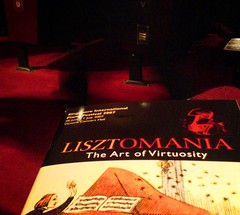
Lisztomania
Because this is the generation of the ipod and of life having a soundtrack, my earworm set Mike Reeves' latenight tasty taster of Job to the amazing Cyprien's repertoire.

(The first amazing thing about The Amazing Cyprien is his wonderful list of late Liszt, past long-maned showmanship and into contemplation of suffering, death and redemption:
LISZT, Trauervorspiel und Trauermarsch
LISZT, Nuages gris
LISZT, Hungarian Rhapsody No. 5 (Héroïde-élégiaque)
LISZT-KATSARIS, Czárdás obstiné
LISZT, Bénédiction de Dieu dans la solitude
LISZT, Am Grabe Richard Wagners (I hope he wasn't spitting on it)
WAGNER-LISZT, Isoldes Liebestod

(The other crowd-pleasing stocking stuffers were:
SCHUBERT-LISZT, Three Song Transcriptions: Ständchen - Der Müller und der Bach - Ave Maria
CHOPIN, Waltz in A minor, Op. 34 No. 2
CHOPIN, Nocturne in E-flat major, Op. 9 No. 2
CHOPIN, Berceuse in D-flat major Op. 57
CHOPIN, Fantaisie Imprompet Op. 66
BACH-SILOTI, Prelude in B minor
BACH-KATSARIS, Toccata and Fugue in D minor, BWV565))

(The more amazing thing about The Amazing Cyprien is that he can keep track of all ten digits in the midst of noodling up and down the ebonies and ivories and leapfrogging and reverse leapfrogging and making sounds like there are actually 4 hands on board or like church bells tolling over the grave of his son-in-law or like lovelorn young men beside babbling brooks or as in the Gottschalk encore: cheeky banjos in American minstrel shows. He is able to ensure, for example, that those fingers haven't noodled clean off the keyboard and started tickling some nice lady in the front row. Man. He ought to be in a circus alongside the bearded lady, the lion tamer and the sword swallower.)

(The even more amazing thing about The Amazing Cyprien is that there wasn't even a whiff of burning despite the enormous amount of air friction his high-speed fingers must have generated.)

(The further more amazing thing about The Amazing Cyprien is his distinct familial resemblance to Bobo the Clown. (Mind, this is said without meaning any offence to clowns (or The Amazing Cyprien), having myself been the Sad Clown in a now-defunct Clown Ministry.) "Doesn't he look like Bobo the Clown?" I texted someone sitting in the slightlymoreexpensiveseats. "No, Krusty. :)" Which was spot on. The Amazing Cyprien would look just right, back in his room after 3 encores, flinging his tux and corset at the monkey butler in a corner and, alternately fagging 3 ciggies simultaneously and taking huge swigs from bottles of XXX, cussing the coughing, sniffling, rustling, jangling, muttering Singapore audience for being worse than a colony of obstinate tuberculosis-ridden gossipy bag-ladies.)

But really truly gobsmackingly amazing thing of the night was the suffering of Job, the grand mystery of suffering: why a good and sovereign God would allow an innocent man like Job to suffer. The thing about a Mystery is that you can't throw neurons at it and expect to understand it. Like the gospel (itself a Mystery), the answer to a Mystery needs to be revealed to us.

Job's comforters (humans, not duvets) thought they were pretty sorted folk. The reason, they said, for Job's suffering was really quite simple: people get what they deserve (Job 4 etc). Don't plead innocent, Job, when it is obvious from all that has happened to you that you are somewhat guilty. But we learn that God's anger burns against Job's friends because they have not spoken of God what is right (Job 42:7). The reason for suffering is not simple cause-and-effect.

The story of Job's friends would have concluded with their death for blaspheming the name of God. But God graciously allows them a way out: the sacrifice of seven bulls and seven rams. Poor innocent bulls and rams. What did they ever do to deserve to die so horribly? Nothing. They suffered because God was angry with Job's friends. There is a such a thing as innocent suffering.

God calls Job "my servant" at least 4 times in the book and as God's servant, Job is called to be a mediator to his friends – to pray for them. Just as Job pleads for his friends not to be dealt with by God as they deserve, he knows that there is someone in heaven who pleads for him, not to be dealt with by God as he deserves (Job 16).

Even to a casual reader of the New Testament, the Book of Job seems to point inevitably to the cross. And indeed, it is at the cross that the problem of suffering is asked and answered. The Mystery of Jesus, though wholly innocent, suffering for the sin of the whole world. At the cross, we see that through greatest suffering comes the greatest blessing. We do not know why we are afflicted with particular suffering. But we know that there is no suffering that God doesn't care about and no suffering that God is powerless to stop. God is intimately involved with the suffering of his Son on the cross. There is no senseless suffering. God only allows suffering so that he can bless us through it. However inexplicable and horrendous our own suffering, the Book of Job and the story of the gospel tell us that we will never lose any thing by our suffering. We can only gain. Let us not rage and despair in our darkest hours. Let us turn to the cross and know that God uses our pain to bless us more. Trust God that he knows what he is doing. Trust God for better or worse, richer or poorer, in sickness or in health.

What comes of Job's suffering? At beginning of the Book of Job, we read that Job is a man in charge of many animals in a garden in the east. Alot like Adam in Genesis 2, huh. And at the end of the Book of Job, Job is blessed with twice as much as he had before. Very Isaiah 61 indeed. Furthermore, the blessing of Job is not just material. Note that he grants his daughters an inheritance along with their brothers (this was hundreds of years before Moses). And later, we know that it is only because of inheritance by a woman that Jesus inherited the line of David. Very cool.

The end to all the hints and nudges and winks and wriggling of eyebrows is this: we can learn from Job that no suffering is senseless, though it may in this lifetime appear inexplicable. God is still trustworthy throughout our suffering, and we must continue to trust him and treat him as God and hold to his word as true. This is not the blind trust of people who are groping about for a psychological analgesic. This is a trust built on the good foundation of Job's vindication and Jesus' resurrection from the dead. This is a trust that Job's mediation for his friends was only a picture of the real mediator's work. This is a trust that the blessing of Job was only a model of the true blessing to come for humanity.

James tells us that it is through suffering that the goal and purpose of creation is attained. So hold steady in the midst of suffering.
Behold, we consider those blessed who remained steadfast. You have heard of the steadfastness of Job, and you have seen the purpose of the Lord, how the Lord is compassionate and merciful. (James 5:11)
It is like the sentiment of Les Préludes from Alphonse de Lamartine's Nouvelles méditations poétiques that so moved Liszt that his prefaced his revised score with:
What else is life but a series of preludes to that unknown hymn, the first and solemn note of which is intoned by Death? Love is the enchanted dawn of all existence; but what fate is there whose first delights of happiness are not interrupted by some storm, whose fine illusions are not dissipated by some mortal blast, consuming its altar as though by a stroke of lightning? And what cruelly wounded soul, issuing from one of these tempests, does not endeavor to solace its memories in the calm serenity of rural life? Nevertheless, man does not resign himself for long to the enjoyment of that beneficent warmth which he first enjoyed in Nature's bosom, and when the 'trumpet sounds the alarm' he takes up his perilous post, no matter what struggle calls him to its ranks, that he may recover in combat the full consciousness of himself and the entire possession of his powers.
It is also like the Lamartine poem excerpt (Liszt was quite a fan) that The Amazing Cyprien read before the performance of Bénédiction de Dieu dans la solitude:
D'où me vient, ô mon Dieu ! cette paix qui m'inonde?
D'où me vient cette foi dont mon cœur surabonde?
A moi qui tout à l'heure incertain, agité,
Et sur les flots du doute à tout vent ballotté,
Cherchais le bien, le vrai, dans les rêves des sages,
Et la paix dans des cœurs retentissants d'orages.
A peine sur mon front quelques jours ont glissé,
Il me semble qu'un siècle et qu'un monde ont passé;
Et que, séparé d'eux par un abîme immense,
Un nouvel homme en moi renaît et recommence.

(Whence, O God, comes this peace which floods over me?
Whence comes this faith with which my heart overflows?
To me who, not long ago, uncertain, restless,
And tossed on waves of doubt by every wind,
Sought the good, the true, in the dreams of worldly sages
And peace in hearts resounding with tempests?
Scarcely have a few days brushed past my brow,
And it seems that a century and a world have passed away,
And that, separated from them by an immense abyss,
A new man is reborn and begins again in me.)
Only, the answer is more than just Romantic affection and perfumed bosoms but in Job pointing forward to the gospel.

It is like Frodo and Sam during the Nazgûl attack where Frodo is about to give up:
Frodo: I can't do this, Sam.

Sam: I know. It's all wrong. By rights we shouldn't even be here. But we are. It's like in the great stories, Mr. Frodo. The ones that really mattered. Full of darkness and danger, they were. And sometimes you didn't want to know the end. Because how could the end be happy? How could the world go back to the way it was when so much bad had happened? But in the end, it's only a passing thing, this shadow. Even darkness must pass. A new day will come. And when the sun shines it will shine out the clearer. Those were the stories that stayed with you. That meant something, even if you were too small to understand why. But I think, Mr. Frodo, I do understand. I know now. Folk in those stories had lots of chances of turning back, only they didn't. They kept going. Because they were holding on to something.

Frodo: What are we holding on to Sam?

Sam: That there's some good in this world, Mr. Frodo… and it's worth fighting for.
Only, this hope is more than just a fantasy. It is a hope with a sure and happy ending, one far better than even the best novelist could ever imagine or begin to describe.

Job's story is our story. Because of Jesus, we will not be dealt with as we should. Because of Jesus, we will be brought like Job through our suffering to God's blessings. There awaits for us a new body, a new family, a new much more excellent inheritance. We are looking forward to a future that is more wonderful anything this world has ever seen, a future more marvellous than Eden. A future in which Satan will be finally defeated. A future where there will be no more death and no more destruction. A future which is not just paradise regained but creation perfected.
I know that my Redeemer liveth, and that he shall stand at the latter day
upon the earth. And though worms destroy this body, yet in my flesh shall
I see God. (Job 19:25-26)

For now is Christ risen from the dead, the first fruits of them that
sleep. (1 Corinthians 15:20)
And there remains only one tragedy: that some will not be able to enjoy this because they do not realise that they need to be saved from being dealt with as they deserve, eternal destruction for ignoring God. They will not have Jesus plead for them as Job prayed for his friends.

Go to my servant Jesus, God says. He has already sacrificed himself for you. Go to him and ask him to pray for you and I will accept his prayer and not deal with you as you deserve. And do it soon, before the time has passed and it is too late.

Labels: , , , ,

Saturday, March 31, 2007

March Wrapup: Pies, Taxi Drivers, Titoudao and Myers-Briggs Type Indicator

Pies on Pi Day
Pie on Pi Day: huge!

Newton Hawker Food
Newton Circus: black-pepper crabs, barbecued chicken wings, satay, stir-fried kailan and true-life accounts of public-spirited taxi-driver uncles, attempting to boost the morale of physically unattractive girls by asking them out on dates, being mistaken for cheekopeks by the freaked-out.

Titoudao - Chua Enlai Needs The LooTitoudao - Beatrice Richmond-Chia as Scaredy-Cat EmperorTitoudao - Pick-Up Line: You Want To Go To Hell?Titoudao - Cabaret
Toy Factory Ensemble's Titoudao: a blend of Hokkien, Mandarin, Cantonese and English ("can you spek Engrish proprry?"); the backstage of the wayang (street opera) as stage; Pam Oei jibbing a latecomer - "Ah see, yan dao sit right in front. Yan dao, I look very young, right?"; interplay between the stories of (1) Titoudao - servant of a decidedly unmacho scholarly master Ti Boon Long betrothed to a Chua Enlai-ugly boo-worthy un-PC rich girl, and (2) Madam Oon Ah Chiam - once a farmgirl who ate chicken defecation who became a nanny in Johor Bahru, who became a wayang star, who became a housewife bullied by the evil preggers Beatrice Chia-Richmond mother-in-law, who became a getai cabaret singer (whose backup dancer Karen Tan looked like a drag queen), who became, err, a 60 year old; Aidli 'Alin' Mosbit looking like Andre the Giant from Princess Bride; a passable pickup line:"DO YOU WANT TO GO TO HELL?"; errant audience meowing at a particularly poignant scene.

Supper
Later at supper: an angsty frog leg porridge uncle with a killer glare; the future hit song:I'm Looking At You Through The Bones of My Chicken Wing; claypots with the Star of David; Pam Oei in many incarnations; theatre awards to appease the unhappy parents of theatre practitioners.

Romanticism
Copious amounts of homemade chendol with extra gula meleka: Romanticism in art being shocking rebelliousness in its time but utter tameness in ours; Romanticism spawning the goth movement and black eyeliner; Eugene Delacroix's Death of Sardanapalus recalling the emasculated bochap men in Titoudao; Ludwig (the Scowl) van Beethoven being of the same era; Vladimir Ashkenazy's dramatic pauses playing Chopin's Polonaise making him sound like a terrible sightreader; concert piano-ing as a profession not only making one look like a performing monkey in a tux, but also giving one the distinctive air of perpetual constipation (which some mistake for angsty romanticism).

Brown Sugar: Undercooked PancakesBrown SugarCaneleCanele
Sunday brunch at Brown Sugar: not quite as worth eating as hoped, smudgeons from Canelé Pâtisserie saving the day, discussions about the Myers-Briggs type indicator.

Rabbit StewCake Display
A perhaps celebratory dinner at Valentino's: a stew of the folks that'd strayed into Mr. McGregor's juicy veggie patch and didn't quite get away, more chatter on the use of MBTI in a community of Christians, dessert and fairy lights outside Da Paolo Gastronomia.

There are some questions, imh(probably not too well-informed)o, that should be asked of MBTI:
Q: How effective is MBTI in its description of human beings?
Q: How empirical is MBTI in its analysis of human beings?
Q: How useful is MBTI in its prediction of future behaviour?

Effectiveness of MBTI in Description of Humans
Which Star Wars character are you? Which Evil Super Villain? What ice-cream flavour?

Ok, perhaps MBTI isn't some back-of-a-women's-magazine pop psychology quizilla forerunner. But still, our Father's world is really far more magnificently intricate than we could possibly observe or describe.

Hey, even quantum physics is reductionist. Freeman Dyson (no, astrochickens don't suck) described such reductionism as the attempt "to reduce the world of physical phenomena to a finite set of fundamental equations": the works of Erwin Schrödinger (and the messy business with that cat) and Paul Dirac being "triumphs of reductionism. Bewildering complexities of chemistry and physics were reduced to two lines of algebraic symbols".

And that's just the material universe. What more human beings, made in the very image of God himself. Imago Dei suggests, even if just limited to the characteristics of rule and relationship (reductionism!), that humans are gloriously fascinating daedalian beings that cannot be pigeonholed into one of 100 types (much less 16), no matter how updated and sophisticated the explanations of the interactions are or how much they have improved on Carl Jung's Psychological Types. Apparent accuracies in description ("Oh, that is sooo me!") could well be the Forer Effect flashing flesh.

Empiricism of MBTI in Analysis of Humans
MBTI scores rest on some very shaky foundations: they are dependent on a single temporal event - the administration of the test, the input of the subject on whom the test is being administered - input which not only presumes some form of self-observation on the part of the subject, but also input which varies according to time, environment and state of mind at the time of the test. Alas the dangers of introspection and anecdote.

Even amongst a jury of peers, the verdict is still out on the validity of MBTI.

Usefulness of MBTI in Prediction of Future Behaviour
The old debate: nature or nurture? Neither actually.

It is incontrovertible that people are different. MBTI merely reminds us of this. However, given the intricate nature of people and the doubtful total accuracy of the test, it is unclear what utility can be derived from propagation or prolonged discussion on MBTI.

MBTI Worldview
Utility aside, popular use of psychometrics inevitably promotes the cult of personality, the self-centred worshipping of ourselves at our own feet. In Christian circles, pagan (and out-dated) horoscopes, dredging up hithero unknown childhood trauma/abuse and the rattling of pretty little bottles of happy pills make way for spiritual gift inventories and assessments, this season's fashion accessory for the saved. But we are not to spend time trying to find out or having found them, polishing, our shiny gifts. Gifts are handed to us for the good of the church and we are to use them for that goal.

And if God's power is in the Word rather than the whimperings of human wisdom, then:
  • how dependent should we be on personality tests for our identity?
  • how reliant are we on personality tests to tell us our strengths and weaknesses, and how much does the doctrine of our own sinfulness impact our perception of self?
  • how much does our alleged extroversion/introversion energy orientation matter and how much should we be deriving our energy from God?
  • how are we to make decisions and judgements?
  • who is in control of our lives - the luck of the genetics/parental/environmental draw or God?
Should we allow broadbrush descriptions to be self-fulfilling prophesies or definitive excuses for our sinful fallen-ness and our rampant disobedience of God's laws?

Should we perceive our siblings-in-Christ stereotypically or dismissively ("Oh, he'll never be able to do that, he's a P.")? Should we remember that they too are complex beings made in the image of God?

Our underlying problem is not a clash of personality types nor a terrible childhood; it is sinners sinning. And what transforms our lives and our relationships with fellow brothers and sisters in Christ ultimately is not deeper self-knowledge nor more information on what makes other people tick but deeper knowledge of Christ who died for us, God who first loved us, and knowing the power of the Spirit who changes our hearts of stone to hearts of flesh.

God's word is working in the minds and hearts of God's children even as the Spirit is working in their lives to transform them not to be the best of all MBTI types (for their chosen ministry), but to repent and be more like Christ. The very best type to be.

Interfacing with the world and its wisdom, there is the freedom of the Christian but there are things that promote an erroneous view of the world and of people and things that are helpful and unhelpful to oneself and to one's family in Christ.

*************
Ristorante Da Valentino
11 Jalan Bingka
Singapore 588908
Tel: 6462 0555

Labels: , ,

Tuesday, March 06, 2007

John Piper: Desiring God or Desiring Desire?

1.Volver
2.Binary T-Shirt
3.Ducking Duck
4.Curry at the Piperites
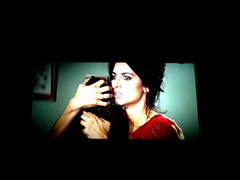
1. Watching Volver, at midnight, with the whole theatre to ourselves, meant we could put our feet up on the row in front without kicking the backs of people's heads and chatter all the way through with such inane comments like "Eeeee. Pedro Almodovar is so humsup" (even though he's professedly gay) and "If Raimunda's mom is a ghost, why can't she just appear in Madrid instead of being stuck in a car boot?", and also, "Is Sole a very bad actress or is she just meant to portray awkwardness?" and then, towards the end of the show, "Eh. Why is there a man in white standing behind us?"

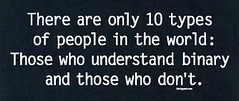
2. Completely cool geek t-shirt spotted after service. Ultimate was ultimately scuttled by rain, but some painting, baking (edible) cookies to use up soon-to-expire stuff and giving the old piano ivories a bit of a run wasn't half bad. Thank God for pottering.

3. Finally. A dry evening! Not time enough, though, for a Singapore Biathlon pitch. Time, however, collapsed and compressed, for a half-hour run round the Singapore Botanic Gardens before dinner. Nifty Nike Frees, fresh air, fecundity of flora and fauna, Lesser Whistling Ducks ducking. The next evening: underwater hockey scuttled by thunder and lightning. Sub-aqua ice hockey soon perhaps? Singapore Ironman 70.3 Triathlon in September 2007. Pwnage.

4. At the Gingers': crowding round some good curry, tandoori and prata and tossing about really bad jokes:
"Would you prefer prata or naan?"
"Ah, the naan that begot Joshua?"
"..."
"You know, Joshua - son of Nunn?"
"........"
We had a listen to a scrap of their impressive collection of John Piper's sermons and a good chat about his Christian Hedonism.

*Off-the-cuff Stuff*

Even without toe-dipping into discussions about classical philosophical definitions of the term "hedonism", it appears slightly worrying that Piper has built his whole ministry around this idea of Christian Hedonism.

The gist of Mr. Piper's argument seems to be:
Premise I: Obligation of a human is to seek one's own pleasure.
Premise II: The greatest pleasure is to be found in God.
Conclusion: Therefore, obligation of a human is to find pleasure in God.

While the conclusion may seem biblical:
1. Syllogisms can sometimes be used invalidly, eg:
Premise I: God is love.
Premise II: Love is blind.
Premise III: Stevie Wonder is blind.
Conclusion: Therefore, Stevie Wonder is God.

2. In Piper's case, the fundamental premise itself is fallacious: the primary obligation of a human is not the seeking of our own pleasure or the fulfilment of our desires. It is to seek God and his pleasures and desires.

3. Just because God has designed us to find greatest pleasure and satisfaction in the worship of him does not mean that we should conflate the two. Our motivation for worshipping God is not to the end of gaining self-centred pleasure but for God himself: because of who he is, his all-encompassing power, authority, compassion, mercy and love etc. Our pleasure is not God; only God is God.

Labels: , , ,

Tuesday, December 26, 2006

Christmas Week and The Babe In The Manger

Purple Wrapper
Sticky messes (as opposed to sticky date toffee puddings and strawberry messes) are: leaving little lavender ribbon-wrapped packages of toffees on the laptop in the car on a grandly sunny Christmas morn in Singapore.
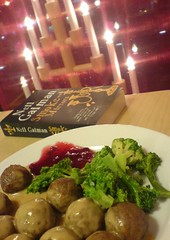
Christmas Lightup Meatballs
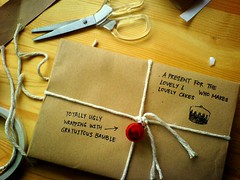
Christmas on Mondays means that celebrations start, properly, assiduously, like Letitia Baldridge's star student with set pearls, a week prior, with many roasted turkeys stuffed with all manner of stuffing and cranberry sauce and gravy, chardonnay, many carvings of roast beef and lamb and dollops of mint sauce, pinot noir, meatballs and meeting up with old friends, pasta and passing presents, logcakes and lolling about, laughing, natgeog preaching involving little plastic trees and reindeer and half-eaten logcakes, chocolate fondues and champagne, cheesecakes, fruit tarts, Christmas letters with updates on weddings, funerals, engagements, elopements, births and same-old same-olds, mincepies, botrytis semillion and brown paper packages tied up with string, pine trees and baubles, fruitcake, rescuing toddlers from pine trees and baubles and flashing fairy lights, gravlax and gathering around pianos and singing spoofing carols till hapless pianists are blinded by tears and helpless giggling...(at one of the houses, there was also something about a Christian workout video but no one probed too far)
L's Pressie Kid at Christmas Tree
...so on Christmas eve, the best place to be is with good friends at the nice-and-quiet (until it came upon the midnight clear, those glorious sparklers of old, and screaming and bending near the earth to spray each other with cans of streamers (until cellphones beep with festive greetings to all)) of km8...

...so on Christmas morning, there is crawling out of bed to put out Christmas presents and rescuing the newly-anointed laptop, and then there is crawling back under the covers before a round of parties and carolling later and then more piano/guitar karaoke (complete with nationalistic songs and a mock fly-past) until it is past midnight and the hostess calls time.
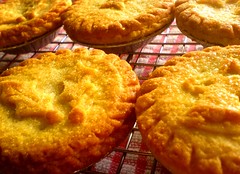
Mincepies
...ah but later, there is a fresh pot of tea, mincepies and brandy butter, and the unwrapping of a little pile of presents and sinking into the heftiest: Neil Gaiman's "The Absolute Sandman, Volume 1".

As the onion said to the tomato after the tomato was run over by a truck, so I said to sleep,"Catch-up! Catch-up!"

The Babe in the Manger
Christians know that Christmas isn't just a festive holiday or a season (in Asia, I suppose, the season is monsoon). Regardless of Desmond Morris' "Christmas Traditions" and the historicity (as the carollers at the back of the pack were discussing) of the date of Jesus' birth, Christmas is really about who the babe in the manger was.

If he was yet another cute kid born in underprivileged circumstances, bullied by the heartless bourgeois class, the world easily sympathises. If this was the beginnings of power or genius, the world loves stories of a humble person's rise to greatness.

But the truth is neither so romantic nor sentimental. We cannot just smile benignly, make coo-ing noises and move on. The babe in the manger is no less than God incarnate.
He, through whom time was made, was made in time; and He, older by eternity that the world itself, was younger in age than many of His servants in the world; He, who made man, was made man; He was given existence by a mother whom He brought into existence; He was carried in hands which He formed; He nursed at breasts which He filled; He cried like a babe in the manger in speechless infancy - this Word without which human eloquence is speechless! (Augustine of Hippo, Sermon on Christmas)
The babe is fully God and fully man, and the fully God bit is a scary thing for a sinful world.

It used to be a tradition in our house that once a year, on Christmas Day, because the walls were like cardboard in England, I who lived in the garret would throw open the windows and turn up the volume on Handel's "Messiah". People were offended. Not by the noise, but by the message. What terrible things to say on this joyous occasion! For Handel's "Messiah" isn't all Hallelujah Chorus: the libretto gives us a great Bible overview, from the promises of God through the prophets of old, to the fulfilment of prophecy, to the death and resurrection of Jesus.

We cannot separate the babe in the manger from Jesus who rebuked the Pharisees; who made a whip out of cords and drove all from the temple area, both sheep and cattle and scattered the coins of the money changers and overturned their tables (John 2:15); who cursed the fig tree; who claimed that he alone was the Way, the Truth, the Life and no one could be saved except through him; who died bloodied on the cross and rose again from the dead in 3 days; who now sits at the right hand of the Father, ready to judge the world (Acts 2:33, 1 Peter 4:5); who is portrayed in Revelation 19 as the avenger of God's wrath, with eyes like blazing fire and robes dipped in blood. Out of his mouth comes a sharp sword with which to strike down the nations.
...who may abide the day of His coming, and who shall stand when He appeareth? For He is like a refiner's fire. (Malachi 3:2)
Jesus' birth is to be greeted with both rejoicing and fear. It is the birth of a saviour who will save us from the penalty of our sins and it is also the birth of he who will judge the guilty world.

So why do you celebrate Christmas, oh you who do not yet live under the rule of Christ? Do you not know that your rebellion has already marked you for death? Fear the babe in the manger, tremble at the incarnation of God made man, for his birth (and death and resurrection) means that the world is one step closer to the day when all will be judged, both living and dead, great and small: those who repented of their rebellion against God and trusted in Jesus and his death and resurrection to save them, to everlasting life; and those who had not, to everlasting death where there will be terrible weeping and gnashing of teeth.

If all peoples everywhere could truly celebrate Christmas, and there is much we should do to so assist them...

Labels: , ,