Monday, March 16, 2009

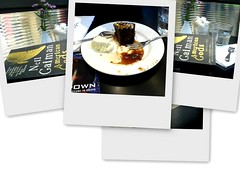
Askinosie Chocolate, Absolute Sandman Volume 4, Satan's Devices
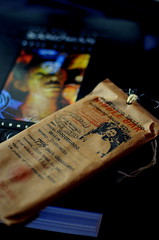
Askinosie Soconusco Nibbler Bar + Crunchy Cocoa Nibs, Neil Gaiman's The Absolute Sandman Volume 4
Some people are particular about the pedigree of their chocolate, others are antsy about the art in their favourite graphic epics, but a man is rarely sticky about the sins he commits. If there were such a man, he would be reviled at least as an extremist tragically burdened by too sensitive a conscience.

To trick man into writing off rebellion against God so flippantly must be Satan's oldest trick. While our deliberate disobedience is no one's fault but our own, the Devil is ever at hand to help us fulfil our sinful potential (see eg. Genesis 3, Ephesians 6:11, 2 Timothy 2:26).

Whatever sin the heart of man is most prone to, that the devil will help forward. If David is proud of his people, Satan will provoke him to number them, that he may be prouder (2 Samuel 24). If Peter is slavishly fearful, Satan will encourage him to rebuke and deny Christ to save his own skin (Matthew 16:22, 26, 69-75). If Ahab's prophets are given to flattery, the devil will straightaway become a lying spirit in the mouths of four hundred of them and they shall flatter Ahab to his ruin (1 Kings 22) etc

Satan has several devices to deceive, entangle and undo the souls of men:
Device 1: To present the bait and hide the hook
To present the golden cup and hide the poison; to present the sweet, the pleasure, and the profit that may flow in upon the soul by yielding to sin, and by hiding from the soul the wrath and misery that will certainly follow the committing of sin. By this device he took our first parents: "And the serpent said to the woman, You shall not surely die: for God knows that in the day you eat of it, your eyes shall be opened and you will be as gods, knowing good and evil (Genesis 3:4-5). Your eyes shall be opened and you shall be like gods! here is the bait, the sweet, the pleasure, the profit. Oh, but he hides the hook - the shame, the wrath and the loss that would certainly follow!

Device 2: By painting sin with virtue's colours
Satan knows that if he should present sin in its own nature and dress, the soul would rather fly from it than yield to it; and therefore he presents it to us, not in its own proper colours, but painted and gilded over with the name and show of virtue, that we may the more easily be overcome by it, and take the more pleasure in committing of it. Pride, he presents to the soul under the name and notion of neatness and cleanliness, and covetousness to be but good husbandry; and drunkenness to be good fellowship, and riotousness under the name and notion of liberality, and wantonness as a trick of youth.

Device 3: By extenuating and lessening of sin
Ah! says Satan, it is but a little pride, a little worldliness, a little uncleaniness, a little drunkenness etc. As Lot said of Zoar,"It is but a little one, and my soul shall live" (Genesis 19:20). Alas! says Satan, it is but a very little sin that you stick so at. You may commit it without any danger to your soul.

Device 4: By presenting to the soul the best men's sins, and by hiding from the soul their virtues and repentance
By setting before the soul the adultery of David, the pride of Hezekiah, the impatience of Job, the drunkenness of Noah, the blasphemy of Peter etc, and by hiding from the soul the tears, the sighs, the groans, the meltings, the humblings, and the repentings of these precious souls.

Device 5: To present God to the soul as one made up all of mercy
Oh! says Satan, you need not make such a matter of sin, you need not be so fearful of sin, not so unwilling to sin; for God is a God of mercy, a God full of mercy, a God that delights in mercy, a God that is ready to show mercy, a God that is never weary of showing mercy, a God more prone to pardon his people than to punish his people; and therefore he will not take advantage against the soul; and why then says Satan, should you make such a matter of sin?

Device 6: By persuading the soul that the work of repentance is an easy work and that therefore the soul need not make such a matter of sin
Why! Suppose you do sin, says Satan, it is no such difficult thing to return, and confess, and be sorrowful, and beg pardon, and cry,"Lord, have mercy upon me!" and if you do this, God will cut the score and pardon your sins and save your souls.

Device 7: By making the soul bold to venture upon the occasions of sin
Says Satan, you may walk by the harlot's door though you won't go into the harlot's bed; you may sit and sup with the drunkard though you won't be drunk with him; you may look upon Jezebel's beauty and you may play and toy with Delilah though you do not commit wickedness with the one or the other.

Device 8: By representing to the soul the outward mercies that vain men enjoy and the outward miseries that they are freed from while they have walked in the ways of sin
Says Satan, do you see, O soul, the many mercies that such and such enjoy, that walk in those very ways that your soul startles even to think of, and the many crosses that they are delivered from, even such as makes other men, that say they dare not walk in such ways, to spend their days in sighing, weeping, groaning and mourning? And therefore, says Satan, if you are to be freed from the dark night of adversity and enjoy the sunshine of prosperity, you must walk in their ways.

Device 9: By presenting to the soul the crosses, losses, reproaches, sorrows and sufferings that daily attend those that walk in the ways of holiness
Says Satan, do you not see that there are none in the world that are so vexed, afflicted and tossed, as those that walk more circumspectly and holily than their neighbours? They are a byword at home and a reproach abroad; their miseries come in upon them like Job's messengers, one upon the neck of another, and there is no end of their sorrows and troubles. Therefore, says Satan, you had better walk in ways that are less troublesome, and less afflicted, though they are more sinful; for who but a madman would spend his days in sorrow, vexation and affliction when it may be prevented by walking in the ways that I set before you?

Device 10: By working them to be frequent in comparing themselves and their ways with those that are reputed or reported to be worse than themselves
By this device, the devil drew the proud pharisee to bless himself in a cursed condition,"God I thank you that I am not as other men are, extortioners, unjust, adulterers, or even as this publican (Luke 18:11)". Why, says Satan, you swear but pretty oaths, as "by your faith and troth" but such and such swear by wounds and blood; you are now and then a little wanton but such and such do daily defile and pollute themselves by actual uncleanness and filthiness; you deceive and overreach your neighbours in things that are but as toys and trifles but such and such deceive and overreach others in things of greatest concernment, even to their ruin and undoings; you do be sit and chat and sip with the drunkard but such and such sit and drink and are drunk with the drunkard; you are only a little proud in heart and habit, in looks and words.

Device 11: By polluting and defiling the souls and judgements of men with such dangerous errors, that do in their proper tendency tend to carry the souls of men to all looseness and wickedness, as woeful experience abundantly evidences
Ah, how many are there filled with these and suchlike Christ-dishonouring and soul-undoing opinions eg, that ordinances are poor, low, carnal things that should not only be lived above but without also; that the Scriptures are full of fallacies and uncertainties, and not to be heeded unless they agree with us; that is is a poor low thing, if not idolatry too, to worship God in a mediator, such man or person as Jesus Christ, but that all is an allegory, and it signifies nothing but light and love, and such good frames born in men; that there is no God nor devil, heaven nor hell, but what is within us; that there is no sin in the saints, they are under no law but that of the Spirit, which is all freedom; that sin and grace are equally good, and agress to his will... with a hundred other horrid opinions, which has caused wickedness to breaking as a flood among us.

Device 12: To choose wicked company, to keep wicked society
And oh! the horried impieties and wickedness that Satan has drawn men to sin, by moving them to sit and associate themselves with vain persons.

See Thomas Brooks, Precious Remedies Against Satan's Devices, for useful suggested remedies to these cunning devices. (Brooks, in his dedicatory note, calls himself a "Watchman", which naturally brings to mind the question "Who watches the Watchmen?" (check out The New Frontiersman), which can in turn be answered: a fair number people. We did a fortnight ago before stumbling home at 3am.)

Of God, it might be said: Your voice was is the soundtrack of my summer.

Askinosie Chocolate
Crim defense attorney done good. Then again, he was never one of those bad greed-enabling corporate lawyer types. The choc-o-lot number on each bar allows purchasers to track its genesis.


Labels: , ,

Friday, February 06, 2009

Stories, the Tongues That Tell Them and James 3:1-12

Saturday Night Vegetarian Pizza
Saturday night pizzas and sparkling rosés. A cake in oven* after the pizzas.

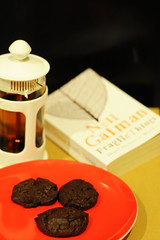
Nothing Says Home Like Mis-shapen Chocolate Cookies, A Cafetière of Earl Grey and a Neil Gaiman
Then chocolate chip biscuits and earl greys. And we were telling stories of stories by telling the stories. Because the best way to describe a story is to tell it.

What a wonderful thing to be a real teller of stories, to entertain refugees from the Black Death or pilgrims on that butt-sore donkey ride to and from Canterbury, to give stories as payment for a tankard of ale, a hot bowl of stew and a kip in a soft bed in a wayside inn, to construct inviting worlds for weary labourers to step into for just a while and forget their sweaty bodies, to use cliffhangers for the postponement of one's own death.

The magic of a good yarn can't really be broken down into its component parts by scholars - oh, here we observe the progression of character, and there, a plot device used to create a point of divergence. Legends, folk tales and fairy tales, myths pay little heed to set literary technique. But everyone knows a good tale when they hear one: the storyteller starts to speak, the tourniquet is tight and the needle is in the vein, then the tourniquet is off and the plunger is in and soon they scarcely notice the world around them fade, replaced by a cosmos of fairies in forests and monsters guarding untold treasures and heros saving worlds and sailing off to adventures in foreign lands.

Some stories are this-world factoids woven with impossible hopes and aspirations. Other stories are dreams articulated. But perhaps, still other stories create the very things they tell of. And perhaps certain other stories are the only permanent things in the world.

Well, God's stories for sure.

Though puny fragile, his creatures know too the longevity of the vibration of their little vocal chords. The stories we tell our children existed in various forms long before ground on which our houses are built was populated and will exist long after any traces of us or our homes can be found. So with an eye to posterity, "historical" accounts have always been commissioned by the victors of bloody skirmishes to commemorate their bravery and divine birth, and by stark contrast, the scumminess of the losers. And so Qin Shi Huang, arriving on the scene to find the stories not quite in his favour, burnt books and buried scholars. But words are not so easily silenced.

It is an amazing thing to consider the power of words, those symbols of thoughts and, when strung together in a language known to at least 2 people, modes of communication. And truly, stories are communicable. Quite innocently, you catch them and are infected by them. They peek out in dreams and nightmares and are subtly stitched into the lining of real life. "I have a dream," says one man and changes the course of entire nations and cultures. Even after the original ones have grown old and died. After all, it was the serpent's five words "You shall not surely die" that changed the path of the entire human race.

Jesus affirmed the permanence of our words, even the throw-away careless ones. They will be remembered and kept in store until the end of this world. Then we will be either justified or condemned by them (Matthew 12:36-37).

This would not worry us if we were navel-gazers, more intent in getting our navels to a "higher rung" in the church hierarchy as teachers or pastors or elders or deacons, liking the sound of our own voices and that people to shush each other to listen to the half-considered notions that spring from our mouths (James 3:1a). But it should.

If even the careless word is judged, then what more the deliberate oratorical sermons or pastoral pronouncements that emerge from our lips that will be heard and will affect tens, or hundreds or thousands**? If we consider that we are all sinful (James 3:2) and that the tongue is the part of the body most induced to sin (James 3:3-8), then surely we ought to have the appropriate safeguards in place before bringing it out for a wriggle, especially in front of a microphone. How careful we must be if the main tool of our job is the part most prone to terrible failure! What a dangerous thing it is to be a teacher!

Sailing and Smoking
Useless live figurehead having a morning fag at the bow


The tongue seems a fairly small organ, roughened up with papillae and taste buds, bashfully tucked away in the oral cavity. But like the bit in the mouth of a horse (James 3:3) or the small rudder on a large ship (James 3:4), that saliva-coated muscle is able to direct great things.

So if we were mature ("perfect" cf James 1:4), we could do great things with our tongues. But alas, our tongues are usually uncontrolled and fulfil their potential for great destruction, much to the delight of the source of all this, the devil (James 3:6). The horrible twisted evil little thing stains and ruins our whole life and destroys those of others too (James 3:6). So whilst humankind can domesticate large predators, it is helpless to control that very thing that resides in our mouths (James 3:7). So the tongue remains wild, restless, full of deadly poison. And we all know how weeks and months and years are sometimes preoccupied with dealing with the fail-out from a sentence or two (James 3:8). The devil isn't in parseltongue, it's in those few rather normally false, biting, slanderous words.

But it's not as if the tongue itself is the evil that resides within us so that if we shear off our tongues, we will be free from the control of our sinful nature and the world. Our tongues are only barometers of our spiritual condition. James looks at outside for evidence of inside. It is our real attitudes and thoughts that are vocalised by the tongue and it is these that corrupt the whole person.

"...it is not what goes into the mouth that defiles a person, but what comes out of the mouth; this defiles a person," said Jesus,"what comes out of the mouth proceeds from the heart, and this defiles a person. For out of the heart come evil thoughts, murder, adultery, sexual immorality, theft, false witness, slander. These are what defile a person" (Matthew 12:11, 18-20, 33-37)

We rail against skimpily dressed women and the rampant and cheap sex prostituted by the mass media, but the tongue is the most unvalued temptation and possibly the most socially destructive instrument of sin. Possibly, the more entrenched we are within a church community, the more people accept without question what we say because of our position or longevity within a social circle, the greater our temptation to sin in this way. In our jealousy or selfish ambition or self-seeking, we destroy reputations on a whim, we tear down rather than build up, we incite disharmony and rebellion, we manipulate, we encourage gossip and slander, all usually under the cover of sharing our concern for God or the church or others. Far too many a post-service snigger or flippant fellowship meal or rash email/sms/chat has spawned untold grief and destruction of lives.

If we claim to have taken hold of the truth and received the Spirit which is able to change us to be more like Christ, then this state of affairs is sick and as utterly unnatural as salty tepid water in our Evian spring water bottled at source or stinky durians growing in our delicate heirloom tomato patch.

And if we hear a brother or sister fall into one of the many traps that litter this area, we must be quick to yank them away. There is nothing like a cabal of shared gossip to build community and togetherness. But this is not the foundation on which Christ's body is to be built. The danger of losing friends, who might perceive one's lack of eagerness to partake of the information exchange as a betrayal of their friendship, is real. But the fire of hell is real too.

Dick Lucas, James 3:1-12
Christopher Chia, James 3:1-12
Desiring God 2008 National Conference had the tongue and words as its theme. Free downloads. As with everything else, use with discretion.

PS:

This is not the worst of it but surely we are all too savvy about this very common inconsistency. Courtesy of Desiring God Ministries.

Saturday Night Chocolate Cake for Sunday Lunch
*Neil Gaiman likens stories to cakes - "Sometimes the cake won't rise, no matter what you do, and every now and again the cake tastes better than you ever could have dreamed it would". This was true of a boca negra, which'd tasted far better when improperly baked, glooped out and a little burnt, than properly baked and characterless.

**"Ministers are noteworthy of their calling. All preachers are vulnerable to the charge of hypocrisy. In fact, the more faithful preachers are to the Word of God in their preaching, the more liable they are to the charge of hypocrisy. Why? Because the more faithful people are to the Word of God, the higher the message is that they will preach. The higher the message, the further they will be from obeying it themselves." R.C. Sproul

***Neil Gaiman reading The Graveyard Book for which he won the Newbery.


James

Labels: , , , ,

Sunday, April 06, 2008

Operation Leftover Easter Stuff: Reconstructed Deconstructed Lemon Meringue Cream Tart, and 2 Samuel 1 - 4

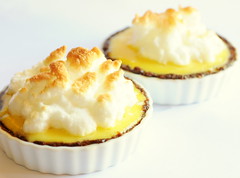
Lemon Cream Tart with Meringue-ish Top
Leftover flour, butter, eggs, lemon and cocoa powder from Easter = Reconstructed Deconstructed Lemon Meringue-ish Cream Tart

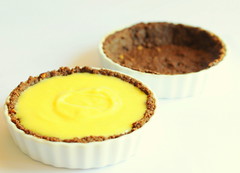
Lemon Cream Tart
Ugly tart shell was made from on-offer Digestive biscuits crushed with 55% Equatoriale dark Valrhona cocoa powder. (The kitchen being pestle-challenged, the butt-end of a vodka bottle had to be put to work for the crush-fest.) Wanted the chunky crunchy texture of a deconstructed tart shell for a more interesting mouthfeel than Mr. Crushed-Like-Fine-Breadcrumbs and Boring. Also wanted a bootylicious bitter chocolate biscuit partner that'd walk beside the lemon cream, not one of those sweet pastry shells two mincing steps behind with its head lowered.

The principle behind the lemon cream, ie. adding the butter only at the end, came from Pierre Hermé[1]. Unfortunately, being also extremely challenged in the weighing-machine and measuring-cup departments, I probably ended up in some distant grove from Monsieur Pierre's lemon heaven. Nevertheless, this lemon cream was sublimely smooth and lip-smackingly rich, yet light enough for the afternoon heat. And as a plus, it engendered no Proustian link to washing-up liquid, viz Mama Lemon.

To top it off, a snowy cumulus cloud of meringue. Wanted something much less dense than the normal meringue usually scraped off a LMT. Envisioned a progression/procession of taste and texture: a thin covering of sticky sweetness perched atop an ethereal cloud that would collapse in the mouth into tangy citron cream, all undergrid by a crumbly bitter chocolate biscuit base; sort of like a culinary interpretation of the cross-section of our atmosphere et earth.

A whole lot of fun.

Those with more experience in these endeavours may scoff, but to strangers to the kitchen like me (this being the my maiden manufacture of the constituents of la tarte au citron meringuée), even the thickening of the lemon cream and the stiffening of the meringue were things of wonder akin to standing at the edge of the Grand Canyon and surveying its vast magnificence.

I was amazed that the scent of lemons resided in their zest (had to google "zest" to see what it meant because, as it was pointed out later, I had been deprived of the benefits of a cable TV education - surely the newest frontier in class discrimination).
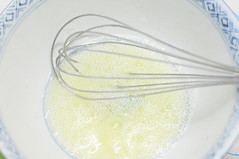
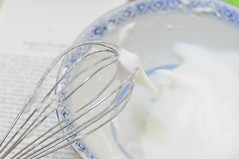
Egg White Just Out of Its Shell + a whipping = Egg White After Being Whipped
I was agog to observe a puny egg white slowly transform into white peaks several times its original volume and stiff enough to withstand being squished and piped through a bag (and also to clog up the kitchen sink) through mere elbow grease.

Well blowtorch me over but God, your world is awesomely wonderful and yummy indeed.

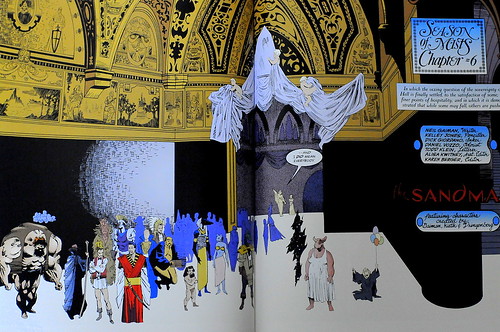
Neil Gaiman's "Season of Mists" - sovereignty of Hell finally settled
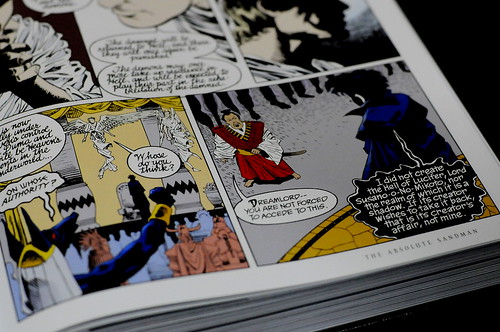
In Neil Gaiman's Sandman: Season of Mists, Lucifer closes down Hell and gives Morpheus the keys. Morpheus is promptly beset by a beauty parade of gods from the pantheon of human imagination all wanting that choice bit of real estate[2]. The gods dreamed up by humans are a motley crew, yet it is easy to see how each of them could have been conceived by the homo sapien mind. As we work through the book of 2 Samuel though, it becomes increasingly clear that the God of the Bible cannot have been dreamed up by insecure persons as a handy psychological crutch.

2 Samuel 1 starts with a dusty Amalekite bounding up to David with what he supposes is good news for David: Saul, the until-recently-incumbent king is dead - I mercy-killed him with my own hand. What's more, I stripped the corpse of his symbols of office and brought you the royal bling (the crown and the armlet, *nod nod wink wink*) for your use.

Instead of rewarding the little liar (see 1 Samuel 31 for what really happened to Saul), David has him executed. It is difficult to understand why. David had been anointed as king a long time ago when he was just a wee lad (1 Samuel 16:1-13) and God had already rejected Saul as king. We would expect God to have instructed David to toss Saul out of the way. Instead, even when Saul set out to kill David, the narrator notes approvingly that David resisted the temptation to return the favour even though he could have invoked a plea of self-defence and even in circumstances could very well have been interpreted as the Lord obviously giving Saul into David's hand (eg. in the cave in 1 Samuel 24 and by Saul's bed in 1 Samuel 26). David's reason for refusing to kill Saul in both instances and his execution of the Amalekite is the same: a healthy appreciation of God's sovereignty and a healthy fear of his judgement - Saul was and still continued to be God's chosen king. It was for God to deal with him as He pleased. No mere man would be able to destroy God's anointed and hope himself to live.

The amount of detail interfering with the rags to riches story of David's rise to kingship not only suggests that 2 Samuel is a true account of history but also that David isn't really the main character in the narrative. The distinct lack of inherent charisma in David would give his fan club very little to go on. (Still, they appear to have managed to wring something out.) David is neither touted as manly nor decisive. My DG girls tsk-ed at David's constant consultation of God in 2 Samuel 2 - didn't David have a backbone? Didn't David have his own brain? As un-macho as being the proud owner of a Hello Kitty pencilcase. To save the day, a marketing department would have spun David's dependence on God into a model of wonderous piety, to be forever pictured on his knees, his heavenward-gaze illuminated by a single shaft of sunlight in a darkened room. But the matter-of-fact text is bereft of superlatives.

Then in 2 Samuel 4, an unfortunate repetition of events. Rechab and Baanah mercenarily attempt to gain favour with David by off-ing Ishbosheth, the pretender to David's throne. They present David with his head as dogs might present their masters with a dead rat, expecting praise and a pat on their own heads. What's more, they invoke God's name, claiming to have been agents of his vengence (2 Samuel 4:8).

David might have sighed when he said:
when one told me, 'Behold, Saul is dead,' and thought he was bringing good news, I seized him and killed him at Ziklag, which was the reward I gave him for his news. How much more, when wicked men have killed a righteous man in his own house on his bed, shall I not now require his blood at your hand and destroy you from the earth?"
And David had the mercenaries executed and their limbless bodies hung on public display by the pool where people would come to draw water every day. One would expect this sort of thing as perhaps a warning against usurpers or a Achilles-Hector type gory trophy of victory over enemies. Scarcely the thing to do to allies unless your goal was not your own position of power but God's justice.

There is much personal glory in courageous and creative jihads and satisfying piety in finding enlightenment in the om of nothingness. But if this strange dearth of inspirational self-improvement tips suggests the authenticity of the account, then the God we are dealing with isn't just a Mother Nature-style creator who makes pretty and sometimes edible things but also a divine being much concerned with his creatures living their individual lives according to his rule.

________________________________________

[1] If he were dead, he would be turning in his grave. But he is not, for there are reports that he is wandering around somewhere in Singapore for the World Gourmet Summit.

[2] The issue was finally settled by the Creator, who having created everything, also created Hell and the realm of which it is a shadow.
Neil Gaiman's "Season of Mists" - Creator created Hell therefore has sovereignty over it

PS: For people actually in possession of weighing machines and measuring cups, here's a reproduction of Pierre Hermé's lemon cream recipe as recorded in English by Dorie Greenspan in Baking - From My Home To Yours and promulgated by Global Gourmet:
1 cup sugar
Finely grated zest of 3 lemons
4 large eggs
1/2 cup fresh lemon juice (from 4-5 lemons)
2 sticks plus 5 tablespoons (10-1/2 ounces)
unsalted butter, cut into tablespoon-size
pieces, at room temperature

Getting Ready: Have an instant-read thermometer, a strainer and a blender (first choice) or food processor at hand. Bring a few inches of water to a simmer in a saucepan.

Put the sugar and zest in a large heatproof bowl that can be set over the pan of simmering water. Off the heat, rub the sugar and zest together between your fingers until the sugar is moist, grainy and very aromatic. Whisk in the eggs, followed by the lemon juice.

Set the bowl over the pan, and start stirring with the whisk as soon as the mixture feels tepid to the touch. Cook the lemon cream until it reaches 180 degrees F. As you whisk—you must whisk constantly to keep the eggs from scrambling—you'll see that the cream will start out light and foamy, then the bubbles will get bigger, and then, as it gets closer to 180 degrees F, it will start to thicken and the whisk will leave tracks. Heads up at this point—the tracks mean the cream is almost ready. Don't stop whisking or checking the temperature, and have patience—depending on how much heat you're giving the cream, getting to temp can take as long as 10 minutes.

As soon as it reaches 180 degrees F, remove the cream from the heat and strain it into the container of the blender (or food processor); discard the zest. Let the cream stand, stirring occasionally, until it cools to 140 degrees F, about 10 minutes.

Turn the blender to high (or turn on the processor) and, with the machine going, add the butter about 5 pieces at a time. Scrape down the sides of the container as needed as you incorporate the butter. Once the butter is in, keep the machine going—to get the perfect light, airy texture of lemon-cream dreams, you must continue to blend the cream for another 3 minutes. If your machine protests and gets a bit too hot, work in 1-minute intervals, giving the machine a little rest between beats.

Pour the cream into a container, press a piece of plastic wrap against the surface to create an airtight seal and refrigerate for at least 4 hours or overnight. (The cream will keep in the fridge for 4 days and, or tightly sealed, in the freezer for up to 2 months; thaw it overnight in the refrigerator.)
__________________________________

Labels: , ,

Monday, April 23, 2007

The Casino Royale Game

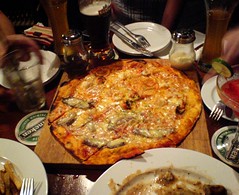
Pizza and Beer at Timbre
Friday night was normal enough, catching up and chowing down with some ex-DG peeps at Timbre and listening to Timmy's stand-in bop through next generation's easy listening menu of Green Day, Coldplay, Maroon 5 and a song dedicated to a Vivian (whom it must have been painful to smooch), "Lips of an Angle (sic)".

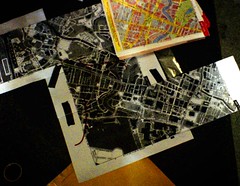
1700 hours Saturday evening to 1230 hours Sunday, however, the applicants for double-0 agent status were legging it around Singapore in the Casino Royale Game induction programme.

Team Wagon
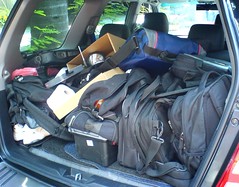
Our team wagon was decently-equipped with 5 laptops, 1 M1 wireless broadband router for a bouncy wifi bubble, 1 extension cord for juice-sharing, 4 phone cameras, a pair of walkie-talkies, 1 GPS kit, 5 bottles of water, 2 toolboxes, a bunch of bananas, a roll of toilet paper, a diving torch for boinking sharks on the nose (if necessary), killer wasabe seaweed snacks and a terry-cloth elephant named Ganesh (who spent the first hour warming the bananas and was thereafter relegated to the boot).

Tummies ruled the day with enquiries about dinner before The Game commenced and the driver needing to be fed every 4 hours (and the rest needing resupplying at various other times):
1800 (before solving 1st clue): McDonald's, Bras Basah for burgers.

1850 (2nd pitstop): stocked up on bao, pancakes and currypuffs.

2030 (working on 4th clue): a round of drinks at McDonald's, Liang Court.

2235 (5th pitstop): Applicant M had 5 groundnuts. (Actually meant to be a sort of penalty.)

Couples/Singles Clue and Kopitiam Coma
0020 (working on 7th clue): we were truly foiled by food. A mini-wok of fried chilli chicken rice, a huge plate of carrot cake, another plate of oyster omelette and several plates of dim sum later, we all succumbed to a 2-hour food-induced coma.

Changi Airport Clue
The Changi Airport Run-around


0520 (9th clue): backseat folk nibbled on a string of jelly beans that constituted the 9th clue.

0800 (working on clue 12): teas, milos, pratas and wanton noodles at Seah Im.

0900 (working on clue 13): canned drinks at Science Hub.

Welcome Mat at SIS HQ
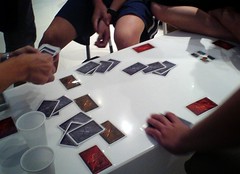
1130 (end point): there were snacks at the MI6 Secret Intelligence Service Headquarters at Oglivy Centre but we were too zonked to eat much. Wound down by attempting to play Saboteur.
Saboteur at SIS HQ
(All timings very approximate.)

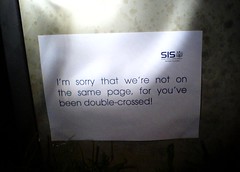
Double-crossed and In the DarkPolite Double-crosser
In the end, we were rather gobsmacked to have won the game. Better still, even though most of the other Games awarded only bragging rights to winners, we got an S$80 voucher for Brewerkz. Neat.

Many thanks to:
  • our ignorance (or our blatant lack of attention at the intro briefing) that asking for help was permitted, we saved on penalty points for hint-whoring;
  • the technologically souped-up wagon;
  • the frontseat "20 is space in ASCII" meta-cryptographer Google-king;
  • the driver, the back window of whose wagon we had to frequently scrape our faces off, whose constant practice in bad jokes came in useful and who appeared to sporadically download the collective consciousness of Game Control ("Suntec Skygarden!", "UE Square!", "Reflections at Bukit Chandu!");
  • the teamleader for sharp eyes, working knowledge of many things and loads of enthusiasm;
  • the other backseater who was ace in Japanese hieroglyphics and pop culture jingles; and
  • the combined general knowledge pool.
(I was good only for brute force attacks and hacking. In a most literal way.)

Loads of thanks to Agents X, M (whom we discovered was male (and probably heterosexual) and therefore, had not wished to bond with us the previous night), O, T, J and Q, the Stanford chaps who'd planned this inaugural Game in Singapore and who'd stayed cheerful (but hungry) through the night at SIS HQ and not drunk at Long Bar, Raffles Hotel. Especially loved the Dove Soap and X-ray clues but most of all, the dead cool CD containing interactive software. (Let us not make mention of laws of the land that were tickled in the process.)

Fairly decent overnighter fun that has spawned some ideas for youth camp wide games (toned down of course, without them ASCII hexadecimal things).

Semper OccultusTill next time!

PS: Game Control's post-game blog here - game stats, meta-clue solution and clue debriefs.

(In other news, while trying not to fall asleep at work today, was hauled up by The Boss. Fortunately, it wasn't a ticking-off for skiving but a nod of the head and a pay raise. Phew. Just about enough for the desperately-needed haircut. The hair, like Neil Gaiman's mop, looks like it's getting ready to escape from my head and go hunting for weasels.)

Labels: , ,

Tuesday, December 26, 2006

Christmas Week and The Babe In The Manger

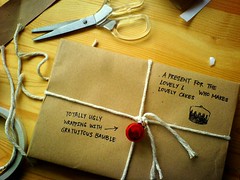
Purple Wrapper
Sticky messes (as opposed to sticky date toffee puddings and strawberry messes) are: leaving little lavender ribbon-wrapped packages of toffees on the laptop in the car on a grandly sunny Christmas morn in Singapore.
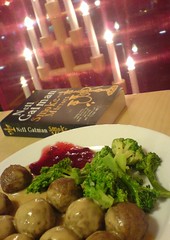
Christmas Lightup Meatballs
Christmas on Mondays means that celebrations start, properly, assiduously, like Letitia Baldridge's star student with set pearls, a week prior, with many roasted turkeys stuffed with all manner of stuffing and cranberry sauce and gravy, chardonnay, many carvings of roast beef and lamb and dollops of mint sauce, pinot noir, meatballs and meeting up with old friends, pasta and passing presents, logcakes and lolling about, laughing, natgeog preaching involving little plastic trees and reindeer and half-eaten logcakes, chocolate fondues and champagne, cheesecakes, fruit tarts, Christmas letters with updates on weddings, funerals, engagements, elopements, births and same-old same-olds, mincepies, botrytis semillion and brown paper packages tied up with string, pine trees and baubles, fruitcake, rescuing toddlers from pine trees and baubles and flashing fairy lights, gravlax and gathering around pianos and singing spoofing carols till hapless pianists are blinded by tears and helpless giggling...(at one of the houses, there was also something about a Christian workout video but no one probed too far)
L's Pressie Kid at Christmas Tree
...so on Christmas eve, the best place to be is with good friends at the nice-and-quiet (until it came upon the midnight clear, those glorious sparklers of old, and screaming and bending near the earth to spray each other with cans of streamers (until cellphones beep with festive greetings to all)) of km8...

...so on Christmas morning, there is crawling out of bed to put out Christmas presents and rescuing the newly-anointed laptop, and then there is crawling back under the covers before a round of parties and carolling later and then more piano/guitar karaoke (complete with nationalistic songs and a mock fly-past) until it is past midnight and the hostess calls time.
Mincepies
...ah but later, there is a fresh pot of tea, mincepies and brandy butter, and the unwrapping of a little pile of presents and sinking into the heftiest: Neil Gaiman's "The Absolute Sandman, Volume 1".

As the onion said to the tomato after the tomato was run over by a truck, so I said to sleep,"Catch-up! Catch-up!"

The Babe in the Manger
Christians know that Christmas isn't just a festive holiday or a season (in Asia, I suppose, the season is monsoon). Regardless of Desmond Morris' "Christmas Traditions" and the historicity (as the carollers at the back of the pack were discussing) of the date of Jesus' birth, Christmas is really about who the babe in the manger was.

If he was yet another cute kid born in underprivileged circumstances, bullied by the heartless bourgeois class, the world easily sympathises. If this was the beginnings of power or genius, the world loves stories of a humble person's rise to greatness.

But the truth is neither so romantic nor sentimental. We cannot just smile benignly, make coo-ing noises and move on. The babe in the manger is no less than God incarnate.
He, through whom time was made, was made in time; and He, older by eternity that the world itself, was younger in age than many of His servants in the world; He, who made man, was made man; He was given existence by a mother whom He brought into existence; He was carried in hands which He formed; He nursed at breasts which He filled; He cried like a babe in the manger in speechless infancy - this Word without which human eloquence is speechless! (Augustine of Hippo, Sermon on Christmas)
The babe is fully God and fully man, and the fully God bit is a scary thing for a sinful world.

It used to be a tradition in our house that once a year, on Christmas Day, because the walls were like cardboard in England, I who lived in the garret would throw open the windows and turn up the volume on Handel's "Messiah". People were offended. Not by the noise, but by the message. What terrible things to say on this joyous occasion! For Handel's "Messiah" isn't all Hallelujah Chorus: the libretto gives us a great Bible overview, from the promises of God through the prophets of old, to the fulfilment of prophecy, to the death and resurrection of Jesus.

We cannot separate the babe in the manger from Jesus who rebuked the Pharisees; who made a whip out of cords and drove all from the temple area, both sheep and cattle and scattered the coins of the money changers and overturned their tables (John 2:15); who cursed the fig tree; who claimed that he alone was the Way, the Truth, the Life and no one could be saved except through him; who died bloodied on the cross and rose again from the dead in 3 days; who now sits at the right hand of the Father, ready to judge the world (Acts 2:33, 1 Peter 4:5); who is portrayed in Revelation 19 as the avenger of God's wrath, with eyes like blazing fire and robes dipped in blood. Out of his mouth comes a sharp sword with which to strike down the nations.
...who may abide the day of His coming, and who shall stand when He appeareth? For He is like a refiner's fire. (Malachi 3:2)
Jesus' birth is to be greeted with both rejoicing and fear. It is the birth of a saviour who will save us from the penalty of our sins and it is also the birth of he who will judge the guilty world.

So why do you celebrate Christmas, oh you who do not yet live under the rule of Christ? Do you not know that your rebellion has already marked you for death? Fear the babe in the manger, tremble at the incarnation of God made man, for his birth (and death and resurrection) means that the world is one step closer to the day when all will be judged, both living and dead, great and small: those who repented of their rebellion against God and trusted in Jesus and his death and resurrection to save them, to everlasting life; and those who had not, to everlasting death where there will be terrible weeping and gnashing of teeth.

If all peoples everywhere could truly celebrate Christmas, and there is much we should do to so assist them...

Labels: , ,

Tuesday, June 20, 2006

Gigs, Neil Gaiman, Pseudo-Postmodernism, Meaninglessness and Apologetics

Right. Now that there's been time to do abit of housekeeping, what with the ARPC church camp and youth camp, here's a post from a month ago (21 May 2006):

A smörgåsbord of gig offerings last night:
Unplucked
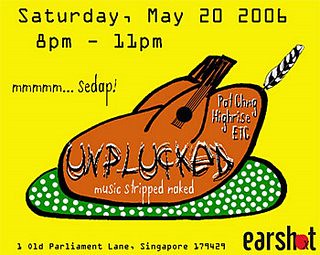
Unplucked featuring Pat Chng, highrise and ETC at Earshot Cafe and Nat's naked fowl with a feather in her butt,
Open Stage
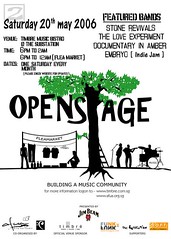
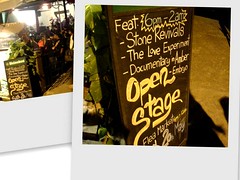
Openstage 2 showcasing Jim Beam girls in white cowboy hats, Documentary in Amber, Love Experiment and The Stoned Revivals at Timbre,
Gas Haus Jamwerkz Opening
a rock bash for the Jamwerkz Opening at Gashaus and some sweltering kiddy moshing at IJ Studios, Gordon Industrial Building. So some thoughtful prioritising had to be done.
Open Stage 2
Then later...early in the cool dark morning, when the screech of cicadas had taken over from the wail of electric basses, we were seated in a line along the curb, spotlit by incandescent street lamps, doing coin tricks to prove we could still walk in a straight line thankyouofficer, peeling wet labels off empty Hoegaardens and setting them alight with snippy Zippos, talking about how it felt to hear some part of your life immortalised in someone's songs and about setting up record labels even as Cafe Cosmo was set to run her farewell lap in the coming week.
Curbside
Then still later, when heady perfume of night flowers had grown faint in the tentative light and there was an expectant hush as the world gathered itself up for the new day ahead, I was restless and anxious to get back to my postmodernist readings for the seminar next month.

So after some quick shuteye and Chris' sermon at the ARPC service at Kuo Chuan Secondary, we found ourselves tucked away in a nice quiet corner after lunch, with Neil Gaiman between us.
Gaiman and Pudding
Neil Gaiman's a particularly pleasant introduction to popular postmodern literature. Before Magic The Gathering and the advent of teenage acne, my childhood weekends were spent among the shelves of Comics Mart in Serene Centre, surreptitiously (because I lacked the years and the dollars to purchase them) reading "Black Orchid" and "The Sandman" and marvelling at Dave McKean's fab cover and divider graphic art that were certainly not the usual stuff of primary-coloured DC Comics. (Without the enlightening benefit of the internet then, I also assumed that I was Neil Gaiman's only fan. This assumption was put to bed, authoritatively, by the snaking queues at his book signings in Singapore last year.)

Gaiman's fruitcake mix of the mundane and the fantastical, giggly horror, mystical deception, blatant mystery, nonchalant murder, unconscious magic, screwball comedy, karaoke death songs, romance, maggot-hacking ghosts, divine dysfunction, cuddly scary birds, ancient grudges and alcoholic gods makes for a fine Sunday afternoon book, entertaining understated British humour and strong characterisation baked in a cheeky winking postmodernist vehicle not too clever for its own good, the sort to have with a spot of tea and some pudding. James Joyce, who'd earlier attempted something similar in "Finnegan's Wake" wouldn't hold a candle to Gaiman's entertaining (though not very tight) weaving together of the mythologies across different generations and cultures: European, Asian and Islamic, Blake, Dante, Shakespeare, Milton...

Gaiman's Theology
Named as one of the ten greatest living postmodernist writers (the others presumably dead from sincerely carrying out their postmodernist belief to its logical end), Gaiman's theology, seen especially in the Sandman books and "American Gods" (and less so in "Anansi Boys"), is that gods are created by people. The family of "gods" in the Sandman books are called The Endless. They are seven siblings: Destiny, Death, Dream, Destruction, Desire, Despair, and Delirium (whose name used to be Delight). They are The Endless because they are states of human consciousness itself, and cannot cease to exist until thought itself ceases to exist.

And as Voltaire said of God,"Si Dieu n'existait pas, il faudrait l'inventer (If he did not exist, it would have been necessary to invent him)", so Gaiman says that humans need gods and dream up gods, be they Allah or Jesus or Krishna, not so much to worship or sacrifice to, but to dream up some sense to our lives, to enable us to believe that in the mundanity and chaos of daily existence there is, after all, meaning and an end point. Storytelling and religion are, after all, the same thing.
There are only two worlds -- your world, which is the real world, and other worlds, the fantasy. Worlds like this are worlds of the human imagination: their reality, or lack of reality, is not important. What is important is that they are there. These worlds provide an alternative. Provide an escape. Provide a threat. Provide a dream, and power; provide refuge, and pain. They give your world meaning. They do not exist; and thus they are all that matters. Do you understand? (Titania in "The Books of Magic", Neil Gaiman)
This was exactly my theology when I was 12 and wrote much embarrassingly arrogant juvenile poetry sneering at the organised religions of the world (fortunately, the Ministry of Education subsequently banned their publication so we have no official records of these past follies).

Meaninglessness
If God doesn't exist, then there is no objective revealer of objective truth or reality. If there is no objective truth or reality, then there is no right or wrong. William Golding said,"If God is dead; if man is the highest; good and evil are decided by majority vote", but he would be wrong. Certainly, it is a remarkably fetching (not to say, convenient) proposition to entertain that I am the centre of anything and the arbiter of all reality. Certainly, one can explain this democratic valuation as some sort of social contract.

But if it is true that there is no true or false, no right and wrong, and by logical extension, we are unable to know anything (even ourselves). Taking a majority vote on value or morality would be like calling a poll to decide on a superstition. If truth or reality is unknowable, then we must admit that there is no inherent value to anything, even life, and (as I said to adults as a snotty kid) we are cowardly fools that mask our terrible meaninglessness with fanciful bedtime stories dressed in religious clothing. We ought to play the man and stop hiding in our little fictional worlds.

But we don't, do we? We don't rape babies, we don't eat each other's eyeballs for breakfast, we don't walk off the roof of tall buildings to attempt to get over to the next. We think the weak should be protected from abuse, we campaign for justice (whatever that may be), we feel deeply about the death of human beings, we all adhere to some form of perceived reality and assumed values.

While it would easy to (1) argue from common experience that we do not live out to the logical end the alleged truth of relativism; and (2) point out that the belief that relativism is true is itself is a logical fallacy, and bridge-building as these may be, I have a sneaking suspicion that their value as biblical apologetic methodology is highly unsatisfactory.

Akan datang.Lousy Evangelistic Tools for Answering Postmodernists and Others

Labels:

Tuesday, July 05, 2005

Neil Gaiman and Book Signings


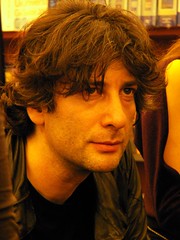
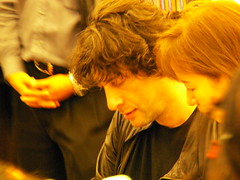
Neil Gaiman in Singapore. Not Death. Looks a bit like Dream of the Endless. Or...dare i say it...David Schwimmer...

*promptly gets beaten up by a dozen Goth chicks*

Book signings.

Why do authors do book signings?

Literary agents recommend it as a good way to market one's books and build up one's fan base. Seasoned book signers, it is said, would know how to work the crowd to create social interaction between themselves and their audience and also between the people waiting in line to get their books signed. Who knows? They might get together and start another fan club. The publicity posters, the announcements in the bookshop, the popping camera flashes, the snaking queue and the media reviews enhance the author's profile, visibility and brand, generate interest and might induce curious onlookers to pick up a book or two, thereby increasing sales (and royalties). Gaiman says that he isn't in it to make money.
I do them because it's good to go and meet people, and because, while exhausting, they're also more or less fun, and because it makes a change from sitting in a room and making things up. And it makes numbers into people, which I like.
Why do people go to book signings then?

Some want to be recognised and acknowledged by the author as his fans. They want to connect with him and own a bit of him (even if it is his swiggle). Some are curious about what the author looks like, how he gets his ideas and why he expressed them in this particular way. The more mercenary go to book signings to increase the value of their books after the author's death.

It's interesting that although many of the people that Project Timothy bring in are good and even popular authors in their own right, none of them have ever done a book signing. Suggest to an evangelical that he get his copy of Graeme Goldsworthy or Vaughan Roberts signed, and he'd stare at you with horror and (after checking your temperature) offer to do Two Ways to Live with you again.

I sometimes give books and CDs as utilitarian presents. Don't scribble well wishes in them so people can re-gift or sell the stuff if they want to, but many girlies get offended: "it's not personal like that" some say, "we have nothing to remember you by". And if I become a famous preacher or writer, others say, they would be able to pull out the gift, show it to their grandchildren and say they knew me from way before. Of course if I ended up a mass murderer or infamous hacker or virus programmer [this almost happened recently when i accidentally left my executable virus experiments lying around at home], they'd shake their head and warn the kiddies not to follow in my murky footsteps.

If one of us does manage to string together some words or produce a CD that people would actually be willing to pay hard-earned money for, and someone asked us to autograph their book or CD, what should we do?

Should we scoff at their "immaturity", rebuke them for putting us mere humans on a pedestal and subsequently turn this shocking behaviour into a sermon illustration?

I guess firstly, we shouldn't judge their motives before talking to them.

Secondly, while talking to them, Phillip Jensen's account of a wedding-ring blessing incident is instructional in thinking about the confluence of the love for God, love for right theology and love for people:
PJ was telling a young pastor that a visiting couple had approached him before a service and asked him to bless their wedding ring.

"Surely you didn't agree!" gulped the young pastor at this superstitious travesty.

"Surely I did", murmured PJ. He met the couple after the service, sat them down at the back of the church hall and asked about their marriage. They talked and laughed about and gave thanks for the joys and prayed about the problems. He told them the gospel and of God's great and wonderful design for marriage.

Did he ever bless the wedding ring? Like PJ's middle name, that awaits further revelation.

But the point is this: if the gospel is true and God's words recorded in Scripture are true, then truth isn't just confined to formal meetings like bible studies or services or to strict legalities where we require every one to jump through our Pharisaic hoops. The truth about God, about right theology and about love for others goes out to meet people where they are. And when it meets them, it cares for them gently and genuinely.

Labels: ,

Sunday, July 03, 2005

Visiting Death

Visited Death again recently…in a dusty childhood collection of Neil Gaiman's The Sandman. Gaiman portrays death anthropomorphically as a hot Goth chick with a silver ankh around her neck, an agreeable practical perky elder-sisterish personality and an eccentric collection of floppy hats. She is kindly, encouraging and loving to those whom she goes out to greet.

The anthropomorphism of death in all cultures throughout the history of mankind is rarely questioned. The ancient Greeks had Thanatos (reincarnated as Thanos in the Marvel comics universe; a comely young lady wearing a diaphanous purple robe), the Roman copycats had Mors and the cat-worshipping Egyptians, Anubis. The Hindus have Yama. Popular Western culture personifies death as the Grim Reaper, an intimidating skeleton wearing a black hooded cloak and carrying a scythe.

Terry Prachett's parody of the Grim Reaper is a curious seven-footer who is intrigued by humans and attempts to live like them: he has a horse named Binky who is a normal living horse (originally, Death tried the more traditional skeletal horse, but it kept falling apart; and a flaming horse, but it kept burning down the stables), he lives in an upper-middle class house (although he has no need of one), has a bedroom (although he doesn't need to sleep) and doesn't realise that pipes have to be hollow. he loves curry (although he doesn't need to eat). He doesn't like chess though, because he cannot remember "how the little horse-shaped ones move" (a cheeky allusion to The Seventh Seal, where Death has a Swedish accent and plays chess with a medieval knight).

The Death who stopped politely for Emily Dickinson is a genteel citizen; the very figure of a gentleman taking a lady for a carriage (one that "swings low" perhaps?) ride.

What do we think of death?

Do we attempt to downplay our fear of it by constructing a fictional welcoming Goth chick or an ally of humanity and an efficient but maligned worker just performing a public service (and who is replaced by a combine harvester when he goes on holiday)?

But we are right to fear death, no matter how 'natural' and certain it is. For there will be a time when we will all lie in a coffin, cold and still. A fly will alight on our nose and no one will flick it away. Perhaps we may not even make it to the obituary page. Maybe no one will come to our wake. Tall or short, fat, buff or rake-thin, rich or poor, head-turningly good-looking or scream-worthily ugly, we will be burned or buried (or if we were caught in a terrorist blast, have our DNA spread over a 1m radius). Possibly we will be mourned for, for a while and then soon forgotten. Our hopes and dreams will be burned or buried with us, and our writings and works which we held precious thrown out with the garbage. Our graffiti on school walls will be painted over and the foundations and trust-funds we established dissipated to nothingness. Our blood-line will die out. And there is nothing we can do about it.

We want to control our lives:
  • our education by studying hard and having good examination strategies;
  • our career by proper presentation at job interviews, impressing the boss and doing the right things to beef up the CV;
  • our family by marrying the right person and having proper marriage and parenting skills and techniques;
  • our money by savvy investing and prudent wealth management; and
  • even our colleagues and friends by politicking, emotional blackmail and psychological horseplay.
Yet, we cannot plan for death; we cannot control when we die (suicide excepted but even then, there are always those bunglers who don't quite make it out of life).

I've heard cancer patients die unwillingly, braying loudly like mad donkeys, struggling to keep breathing and keep living. Others describe the painful gasping for breath and flailing of arms as some are dragged towards death, their eyes wide with fear and terror of the unknown.

As a young child, I was sickly and in and out of hospitals. One strong memory I have is of lying on an operating table, sleepy but conscious of my surroundings. The surgeon switches off the operating lights and my parents hover just within sight. The surgeon is talking to my parents. I try to call out to them but my mouth won't open and no sound comes out. The surgeon's voice is thick and muffled but I make out that he is telling them that there is nothing more he can do, he is sorry. What is he talking about? I'm alive and fine! I try to protest with my arms. Nothing moves. I try kicking. My feet are still. I can't even blink. They move away and out of sight. I sink back into oblivion.

Would death be like that, I've always wondered: the lonely separation from the ones we know and love, the impenetrable wall between the living and the dead; friendless, still, stiff; 'wrecked, solitary and alone'?

Who can accompany us as we take our last breath? We may have an adoring crowd around our bed as we die, but not even our closest friend holding our fading hand will be able go with us. We leave the life we've lived and the world we knew and the people we've treasured and travel the journey alone. It is our rightful penalty for sin (Genesis 3, Romans 5).

But death is not the end and death is certainly not the most frightening thing to ever happen to us. There will come a day when all the dead from all the ages past, present and to come will rise again. Great and small, they will all stand before the throne of God and he will judge them according to what they had done while they lived (Revelation 20:12). Words cannot describe how much more terrible than death that day will be for those who do not know God, for they remain his enemies and will be condemned to everlasting death.

Yet for those who knew God and acknowledged his kingship while in the flesh, that day will be a most glorious day. From then on, the dwelling of God will be with them. They will be his people, and God himself will be with them and be their God. He will wipe every tear from their eyes. There will be no more death or mourning or crying or pain (Revelation 21:3-4).

With that certain hope and future, as we who believe take our last breath, we can say, not with silly bravado but with solid confidence,
"Where, O death, is your victory?
Where, O death, is your sting?" (1 Corinthians 15:55)
For in the sacrifice of our Lord Jesus Christ on the cross in place of our sins, death has been swallowed up in victory (1 Corinthians 15:54).

Labels: ,