Monday, March 16, 2009

Askinosie Chocolate, Absolute Sandman Volume 4, Satan's Devices
Askinosie Soconusco Nibbler Bar + Crunchy Cocoa Nibs, Neil Gaiman's The Absolute Sandman Volume 4
Some people are particular about the pedigree of their chocolate, others are antsy about the art in their favourite graphic epics, but a man is rarely sticky about the sins he commits. If there were such a man, he would be reviled at least as an extremist tragically burdened by too sensitive a conscience.

To trick man into writing off rebellion against God so flippantly must be Satan's oldest trick. While our deliberate disobedience is no one's fault but our own, the Devil is ever at hand to help us fulfil our sinful potential (see eg. Genesis 3, Ephesians 6:11, 2 Timothy 2:26).

Whatever sin the heart of man is most prone to, that the devil will help forward. If David is proud of his people, Satan will provoke him to number them, that he may be prouder (2 Samuel 24). If Peter is slavishly fearful, Satan will encourage him to rebuke and deny Christ to save his own skin (Matthew 16:22, 26, 69-75). If Ahab's prophets are given to flattery, the devil will straightaway become a lying spirit in the mouths of four hundred of them and they shall flatter Ahab to his ruin (1 Kings 22) etc

Satan has several devices to deceive, entangle and undo the souls of men:
Device 1: To present the bait and hide the hook
To present the golden cup and hide the poison; to present the sweet, the pleasure, and the profit that may flow in upon the soul by yielding to sin, and by hiding from the soul the wrath and misery that will certainly follow the committing of sin. By this device he took our first parents: "And the serpent said to the woman, You shall not surely die: for God knows that in the day you eat of it, your eyes shall be opened and you will be as gods, knowing good and evil (Genesis 3:4-5). Your eyes shall be opened and you shall be like gods! here is the bait, the sweet, the pleasure, the profit. Oh, but he hides the hook - the shame, the wrath and the loss that would certainly follow!

Device 2: By painting sin with virtue's colours
Satan knows that if he should present sin in its own nature and dress, the soul would rather fly from it than yield to it; and therefore he presents it to us, not in its own proper colours, but painted and gilded over with the name and show of virtue, that we may the more easily be overcome by it, and take the more pleasure in committing of it. Pride, he presents to the soul under the name and notion of neatness and cleanliness, and covetousness to be but good husbandry; and drunkenness to be good fellowship, and riotousness under the name and notion of liberality, and wantonness as a trick of youth.

Device 3: By extenuating and lessening of sin
Ah! says Satan, it is but a little pride, a little worldliness, a little uncleaniness, a little drunkenness etc. As Lot said of Zoar,"It is but a little one, and my soul shall live" (Genesis 19:20). Alas! says Satan, it is but a very little sin that you stick so at. You may commit it without any danger to your soul.

Device 4: By presenting to the soul the best men's sins, and by hiding from the soul their virtues and repentance
By setting before the soul the adultery of David, the pride of Hezekiah, the impatience of Job, the drunkenness of Noah, the blasphemy of Peter etc, and by hiding from the soul the tears, the sighs, the groans, the meltings, the humblings, and the repentings of these precious souls.

Device 5: To present God to the soul as one made up all of mercy
Oh! says Satan, you need not make such a matter of sin, you need not be so fearful of sin, not so unwilling to sin; for God is a God of mercy, a God full of mercy, a God that delights in mercy, a God that is ready to show mercy, a God that is never weary of showing mercy, a God more prone to pardon his people than to punish his people; and therefore he will not take advantage against the soul; and why then says Satan, should you make such a matter of sin?

Device 6: By persuading the soul that the work of repentance is an easy work and that therefore the soul need not make such a matter of sin
Why! Suppose you do sin, says Satan, it is no such difficult thing to return, and confess, and be sorrowful, and beg pardon, and cry,"Lord, have mercy upon me!" and if you do this, God will cut the score and pardon your sins and save your souls.

Device 7: By making the soul bold to venture upon the occasions of sin
Says Satan, you may walk by the harlot's door though you won't go into the harlot's bed; you may sit and sup with the drunkard though you won't be drunk with him; you may look upon Jezebel's beauty and you may play and toy with Delilah though you do not commit wickedness with the one or the other.

Device 8: By representing to the soul the outward mercies that vain men enjoy and the outward miseries that they are freed from while they have walked in the ways of sin
Says Satan, do you see, O soul, the many mercies that such and such enjoy, that walk in those very ways that your soul startles even to think of, and the many crosses that they are delivered from, even such as makes other men, that say they dare not walk in such ways, to spend their days in sighing, weeping, groaning and mourning? And therefore, says Satan, if you are to be freed from the dark night of adversity and enjoy the sunshine of prosperity, you must walk in their ways.

Device 9: By presenting to the soul the crosses, losses, reproaches, sorrows and sufferings that daily attend those that walk in the ways of holiness
Says Satan, do you not see that there are none in the world that are so vexed, afflicted and tossed, as those that walk more circumspectly and holily than their neighbours? They are a byword at home and a reproach abroad; their miseries come in upon them like Job's messengers, one upon the neck of another, and there is no end of their sorrows and troubles. Therefore, says Satan, you had better walk in ways that are less troublesome, and less afflicted, though they are more sinful; for who but a madman would spend his days in sorrow, vexation and affliction when it may be prevented by walking in the ways that I set before you?

Device 10: By working them to be frequent in comparing themselves and their ways with those that are reputed or reported to be worse than themselves
By this device, the devil drew the proud pharisee to bless himself in a cursed condition,"God I thank you that I am not as other men are, extortioners, unjust, adulterers, or even as this publican (Luke 18:11)". Why, says Satan, you swear but pretty oaths, as "by your faith and troth" but such and such swear by wounds and blood; you are now and then a little wanton but such and such do daily defile and pollute themselves by actual uncleanness and filthiness; you deceive and overreach your neighbours in things that are but as toys and trifles but such and such deceive and overreach others in things of greatest concernment, even to their ruin and undoings; you do be sit and chat and sip with the drunkard but such and such sit and drink and are drunk with the drunkard; you are only a little proud in heart and habit, in looks and words.

Device 11: By polluting and defiling the souls and judgements of men with such dangerous errors, that do in their proper tendency tend to carry the souls of men to all looseness and wickedness, as woeful experience abundantly evidences
Ah, how many are there filled with these and suchlike Christ-dishonouring and soul-undoing opinions eg, that ordinances are poor, low, carnal things that should not only be lived above but without also; that the Scriptures are full of fallacies and uncertainties, and not to be heeded unless they agree with us; that is is a poor low thing, if not idolatry too, to worship God in a mediator, such man or person as Jesus Christ, but that all is an allegory, and it signifies nothing but light and love, and such good frames born in men; that there is no God nor devil, heaven nor hell, but what is within us; that there is no sin in the saints, they are under no law but that of the Spirit, which is all freedom; that sin and grace are equally good, and agress to his will... with a hundred other horrid opinions, which has caused wickedness to breaking as a flood among us.

Device 12: To choose wicked company, to keep wicked society
And oh! the horried impieties and wickedness that Satan has drawn men to sin, by moving them to sit and associate themselves with vain persons.

See Thomas Brooks, Precious Remedies Against Satan's Devices, for useful suggested remedies to these cunning devices. (Brooks, in his dedicatory note, calls himself a "Watchman", which naturally brings to mind the question "Who watches the Watchmen?" (check out The New Frontiersman), which can in turn be answered: a fair number people. We did a fortnight ago before stumbling home at 3am.)

Of God, it might be said: Your voice was is the soundtrack of my summer.

Askinosie Chocolate
Crim defense attorney done good. Then again, he was never one of those bad greed-enabling corporate lawyer types. The choc-o-lot number on each bar allows purchasers to track its genesis.


Labels: , ,

Saturday, March 14, 2009

Celebratory Meeting-Ups, Lenten Fasting and the Spirit

It was obvious with

Double Bay, Raffles City, Singapore
the repeated trips to Double Bay, Raffles City, for good fresh seafood with different folk,

Yummy Homecooked
the yummy homecooked braised pork dinners (with sharing and praying for dessert),

Vodka Dinner
the homemade vodka cocktails, chicken liver pate, smoked salmon dip, "stonkingly-expensive" fig balsamic vinegar salad, ham pasta dinners (with hangover-inducing vodka jelly and Seventh Heaven's lovely coconut ice-cream and an unseeming amount of cable telly for dessert),

Ocean Seafood Fish Head Curry - steaming hot and very shiok on a rainy day
the catching up over steaming hot (or so it was on arrival but had become merely tepid when the B arrived half an hour later, having gotten very lost attempting to ford crocodile-infested rivers) fish head curry on rainy afternoons,

The otherwise occupied customers at Brotzeit did not notice the rapture of the empty beer bottles occuring just beside them.Good friends, good food, good beer. Brotzeit German Bier Bar.
the sharing of good German nosh and beer at Brotzeit in honour of someone passing through and then a brief but good catch-up chat on the way home,

7atenine Singapore
the sampling of passable dishes at 7atenine but with good company,

Macarons!
the generosity of friends (macarons! with lychee ganache! and hazelnut! and chocolate! with earl grey!),

Three-Cheese Poppyseed Cheesecakelets with and without Vodka-soaked Raisins
and the dairy fridge-clearing (cream cheese cottage cheese sour cream poppyseed cheesecake-lets with vodka-soaked raisins), that the traditional Lenten fasting was not a visitor to this household.
2 For day after day they seek me out;
they seem eager to know my ways,
as if they were a nation that does what is right
and has not forsaken the commands of its God.
They ask me for just decisions
and seem eager for God to come near them.

3 'Why have we fasted,' they say,
'and you have not seen it?
Why have we humbled ourselves,
and you have not noticed?'
"Yet on the day of your fasting, you do as you please
and exploit all your workers.

4 Your fasting ends in quarreling and strife,
and in striking each other with wicked fists.
You cannot fast as you do today
and expect your voice to be heard on high.

5 Is this the kind of fast I have chosen,
only a day for a man to humble himself?
Is it only for bowing one's head like a reed
and for lying on sackcloth and ashes?
Is that what you call a fast,
a day acceptable to the LORD ?

6 "Is not this the kind of fasting I have chosen:
to loose the chains of injustice
and untie the cords of the yoke,
to set the oppressed free
and break every yoke?

7 Is it not to share your food with the hungry
and to provide the poor wanderer with shelter—
when you see the naked, to clothe him,
and not to turn away from your own flesh and blood? (Isaiah 58:2-7)
As meaningless and boring (no fat, no meat, no alcohol, no treats? Oatmeal porridge and grilled unagi for brekkie again?) Lenten fasting per se might be, a daily log of our repenting of sins committed would be a far faster-acting irritant: O Lord, I'm sorry I did this. O Lord, I'm sorry, won't do it again. O Lord, oops I did it again...and that other thing I said I didn't know was a sin? I did that again too.

Yet there is much value to this somewhat impotent struggle against sin.

A majority of humans want to live rightly. Our definition what is "right" is either something that we have already attained or something we will attain in the future through effort. Only Christianity tells us from the outset that the standard of "right"-ness is perfection, God's definition of perfection at that (for he alone created the world and therefore alone defines right and wrong), and that we can't attain it no matter how hard we try, how severe our fasting, even if we give our whole lives for it.

It is an unusual thing that happens in the Christian believer when he first believes - he is at the same time both stricken with guilt and grief at his sin and despair at his inability to escape the accompanying judgement, and also bursting with celebratory joy at the salvic grace of an infinitely loving and merciful God who gave his Son that we might escape his judgement. This duality accompanies us through our lives as Christians as we struggle against our distrust and disobedience of God and his laws and is, in fact, evidence of our continuing to stand under cover of Christ's blood.

And it is the Spirit who works in us to accomplish this (far more useful than, say, inducing people to speak in unintelligible tongues, quack like ducks, fall over and scuff the church carpet). We cannot make any progress towards right living, however miniscule, without him:

(1) The Spirit alone clearly and fully convinces the heart of the evil and guilt and danger of the corruption, lust, or sin to be mortified. Without this conviction, or whilst it is so faint that the heart can wrestle with it or digest it, there will be no thorough work made. An unbelieving heart (as in part we have all such) will shift with any consideration, until it be overpowered by clear and evident convictions. Now this is the proper work of the Spirit: "He convinces of sin," John 16:8; he alone can do it. If men's rational considerations, with the preaching of the letter, were able to convince them of sin, we should, it may be, see more convictions than we do. There comes by the preaching of the word an apprehension upon the understandings of men that they are sinners, that such and such things are sins, that themselves are guilty of them; but this light is not powerful, nor does it lay hold on the practical principles of the soul, so as to conform the mind and will to them, to produce effects suitable to such an apprehension. And therefore it is that wise and knowing men, destitute of the Spirit, do not think those things to be sins at all wherein the chief movings and actings of lust do consist. It is the Spirit alone that can do, that does, this work to the purpose. And this is the first thing that the Spirit does in order to the mortification of any lust whatever, -- it convinces the soul of all the evil of it, cuts off all its pleas, discovers all its deceits, stops all its evasions, answers its pretences, makes the soul own its abomination, and lie down under the sense of it. Unless this be done all that follows is in vain.

(2) The Spirit alone reveals to us the fullness of Christ for our relief; which is the consideration that keeps the heart from false ways and from despairing despondency, 1 Corinthians 2:8.

(3) The Spirit alone establishes the heart in expectation of relief from Christ; which is the great sovereign means of mortification, 2 Corinthians 1:21.

(4) The Spirit alone brings the cross of Christ into our hearts with its sin-killing power; for by the Spirit are we baptised into the death of Christ.

(5) The Spirit is the author and finisher of our sanctification; gives new supplies and influences of grace for holiness and sanctification, when the contrary principle is weakened and abated, Ephesians 3:16-18.

(6) In all the soul's addresses to God in this condition, it has support from the Spirit. Whence is the power, life, and vigour of prayer? whence its efficacy to prevail with God? Is it not from the Spirit? He is the "Spirit of supplications" promised to them "who look on him whom they have pierced," Zechariah 12:10, enabling them "to pray with sighs and groans that cannot be uttered," Romans 8:26. This is confessed to be the great medium or way of faith's prevailing with God. Thus Paul dealt with his temptation, whatever it were: "I besought the Lord that it might depart from me." (John Owen, The Mortification of Sin)
ALMIGHTY and everlasting God, who hatest nothing that thou hast made, and dost forgive the sins of all them that are penitent: Create and make in us new and contrite hearts, that we worthily lamenting our sins, and acknowledging our wretchedness, may obtain of thee, the God of all mercy, perfect remission and forgiveness; through Jesus Christ our Lord. Amen. (The Collect, The First Day of Lent Commonly Called Ash Wednesday, The Book of Common Prayer)

ALMIGHTY God, who sees that we have no power of ourselves to help ourselves: Keep us both outwardly in our bodies, and inwardly in our souls; that we may be defended from all adversities which may happen to the body, and from all evil thoughts which may assault and hurt the soul; through Jesus Christ our Lord. Amen.
(The Collect, Second Sunday in Lent, The Book of Common Prayer)
Then will come the Day when every man will be judged for what he has done in the flesh. At that time and in that glorious and dreadful day, all our praying and fasting behind closed doors, all our works done for the audience of One, all our puny seemingly futile pounding against the strong brick wall that is sin will not save us, but will stand as testimony that Christ has saved us, and that we will pass into a new world where our rebelliousness will trouble us no longer.

I Long For The Day
I long for the day when faith sees its goal,
When the things now unseen will be seen.
The day when my Saviour comes for his bride,
Whom his blood has washed spotlessly clean.
(Bryon Smith)

Double Bay Australian Dining and Bar
252 North Bridge Road
#01-22 Raffles City Shopping Centre
Tel: 6334 6530

Seventh Heaven
No. 10 Raeburn Park
#01-24/25/26
Singapore 08702
Tel: 6227 7787

Brotzeit
252 North Bridge Road
#01-17 Raffles City Shopping Centre
Singapore 179103
Tel: 6883 1534

Labels: , , ,

Friday, March 06, 2009

Things Cross-Processed: Photos of Le Gâteau de Zoé and Sins

Messing around with recette du chef Pierre Jancou, proprietaire du restaurant Racines à Paris, parue dans Elle à table:

Gâteau de Zoé - cocoa nibs!
6 œufs
300g de chocolat noir
120g de beurre demi-sel
1 expresso très fort
80g de sucre en poudre
cocoa nibs (merci Monsieur David Lebovitz!)

Préchauffez le four à 200°C.
Faites fondre le beurre avec le chocolat et le petit café très serré.
Séparez les jaunes d’œufs des blancs.
Battez les jaunes et le sucre jusqu’à obtenir un mélange homogène.
Battez les blancs en neige bien ferme.
Incorporez le mélange jaunes-sucre et les blancs en neige, mélangez puis ajoutez délicatement.
Incorporez le mélange chocolat.
Versez le tout dans un moule à manqué beurré et fariné.
Parsemer le cocoa nibs.
Enfournez et faites cuire 15 minutes.
Sortez le gâteau du four, le cœur doit être coulant.

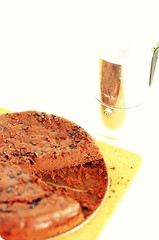
Gâteau de Zoé Schadenfreude: a sad cake makes many people happy
A "cross-processed" image of le Gâteau de Zoé. Le cœur doit être coulant - not, because of an unborn child. Still,what Schadenfreude - the sad cake made many people happy, except the sad ones who were unhappy with bittersweet endings.

Sins, when cross-processed (that is, through the cross of Christ), are both paid for and still in need of mortification.
The mortification of a lust consists of three things:
(1) An habitual weakening of it.
Every lust is a depraved habit or disposition, continually inclining the heart to evil. Thence is that description of him who has no lust truly mortified, Gen 6:5, "Every imagination of the thoughts of his heart is only evil continually." He is always under the power of a strong bent and inclination to sin. And the reason why a natural man is not always perpetually in the pursuit of some one lust, night and day, is because he has many to serve, every one crying to be satisfied; thence he is carried on with great variety, but still in general he lies towards the satisfaction of self.

The lust or distemper whose mortification is desired may not always be stirring up imaginations, thoughts, and contrivances but we should consider it to be a strong, deeply-rooted, habitual inclination and bent of will and affections. Hence, men are said to have their "hearts set upon evil," the bend of their spirits lies towards it, to make "provision, for the flesh." And a sinful, depraved habit, as in many other things, so in this, differs from all natural or moral habits whatever: for whereas they incline the soul gently and suitably to itself, sinful habits impel with violence and impetuousness; whence lusts are said to fight or wage "war against the soul," 1 Pet. 2:11, -- to rebel or rise up in war with that conduct and opposition which is usual therein, Rom. 7:23, -- to lead captive, or effectually captivating upon success in battle, -- all works of great violence and impetuousness.

I might manifest fully, from that description we have of it, Rom. 7, how it will darken the mind, extinguish convictions, dethrone reason, interrupt the power and influence of any considerations that may be brought to hamper it, and break through all into a flame. But this is not my present business. Now, the first thing in mortification is the weakening of this habit of sin or lust, that it shall not, with that violence, earnestness, frequency, rise up, conceive, tumultuate, provoke, entice, disquiet, as naturally it is apt to do, James 1:14-15.

I shall desire to give one caution or rule by the way, and it is this: Though every lust does in its own nature equally, universally, incline and impel to sin, yet this must be granted with these two limitations:

[1] One lust, or a lust in one man, may receive many accidental improvements, heightenings, and strengthenings, which may give it life, power, and vigour, exceedingly above what another lust has, or the same lust (that is, of the same kind and nature) in another man. When a lust falls in with the natural constitutions and temper, with a suitable course of life, with occasions, or when Satan has got a fit handle to it to manage it, as he has a thousand ways so to do, that lust grows violent and impetuous above the others, or more than the same lust in another man; then the steams of it darken the mind so, that though a man knows the same things as formerly, yet they have no power nor influence on the will, but corrupt affections and passions are set by it at liberty.

But especially, lust gets strength by temptation. When a suitable temptation falls in with a lust, it gives it a new life, vigour, power violence, and rage, which it seemed not before to have or to be capable of. Instances to this purpose might be multiplied; but it is the design of some part of another treatise to evince this observation.

[2] Some lusts are far more sensible and discernible in their violent actings than others. Paul puts a difference between uncleanness and all other sins: 1 Cor. 6:18, "Flee fornication. Every sin that a man does is outside the body; but he that commits fornication sins against his own body." Hence, the motions of that sin are more sensible, more discernible than of others; when perhaps the love of the world, or the like, is in a person no less habitually predominant than that, yet it makes not so great a combustion in the whole man.

And on this account some men may go in their own thoughts and in the eyes of the world for mortified men, who yet have in them no less predominancy of lust than those who cry out with astonishment upon the account of its perplexing tumultuatings, yea, than those who have by the power of it been hurried into scandalous sins; only their lusts are in and about things which raise not such a tumult in the soul, about which they are exercised with a calmer frame of spirit, the very fabric of nature being not so nearly concerned in them as in some other.
I say, then, that the first thing in mortification is the weakening of this habit, that it shall not impel and tumultuate as formerly; that it shall not entice and draw aside; that it shall not disquiet and perplex the killing of its life, vigour, promptness, and readiness to be stirring. This is called "crucifying the flesh with the lusts thereof," Gal. 5:24; that is, taking away its blood and spirits that give it strength and power, -- the wasting of the body of death "day by day," 2 Cor. 4:16.

As a man nailed to the cross; he first struggles, and strives, and cries out with great strength and might, but, as his blood and spirits waste, his strivings are faint and seldom, his cries low and hoarse, scarce to be heard; -- when a man first sets on a lust or distemper, to deal with it, it struggles with great violence to break loose; it cries with earnestness and impatience to be satisfied and relieved; but when by mortification the blood and spirits of it are let out, it moves seldom and faintly, cries sparingly, and is scarce heard in the heart; it may have sometimes a dying pang, that makes an appearance of great vigour and strength, but it is quickly over, especially if it be kept from considerable success. This the apostle describes, as in the whole chapter, so especially, Rom. 6:6.

"Sin," says he, "is crucified; it is fastened to the cross." To what end? "That the body of death may be destroyed," the power of sin weakened and abolished by little and little, that "henceforth we should not serve sin;" that is, that sin might not incline, impel us with such efficacy as to make us servants to it, as it has done heretofore. And this is spoken not only with respect to carnal and sensual affections, or desires of worldly things, -- not only in respect of the lust of the flesh, the lust of the eyes, and the pride of life, -- but also as to the flesh, that is, in the mind and will, in that opposition to God which is in us by nature. Of what nature soever the troubling distemper be, by what ways soever it makes itself out, either by impelling to evil or hindering from that which is good, the rule is the same; and unless this be done effectually, all after-contention will not compass the end aimed at. A man may beat down the bitter fruit from a evil tree until he is weary; whilst the root abides in strength and vigour, the beating down of the present fruit will not hinder it from bringing forth more. This is the folly of some men; then set themselves with all earnestness and diligence against the appearing eruption of lust, but, leaving the principle and root untouched, perhaps unsearched out, they make but little or no progress in this work of mortification.

(2) In constant fighting and contending against sin
To be able always to be laying load on sin is no small degree of mortification. When sin is strong and vigorous, the soul is scarce able to make any head against it; it sighs, and groans, and mourns, and is troubled, as David speaks of himself, but seldom has sin in the pursuit. David complains that his sin had "taken fast hold upon him, that he could not look up," Ps. 40:12. How little, then, was he able to fight against it! Now, sundry things are required unto and comprised in this fighting against sin:

[1] To know that a man has such an enemy to deal withal, to take notice of it, to consider it as an enemy indeed, and one that is to be destroyed by all means possible, is required hereunto. As I said before, the contest is vigorous and hazardous, -- it is about the things of eternity. When, therefore, men have slight and transient thoughts of their lusts, it is no great sign that they are mortified, or that they are in a way for their mortification. This is every man's "knowing the plague of his own heart," 1 Kings 8:38, without which no other work can be done. It is to be feared that very many have little knowledge of the main enemy that they carry about with them in their bosoms. This makes them ready to justify themselves, and to be impatient of reproof or admonition, not knowing that they are in any danger, 2 Chron. 16:10.

[2] To labour to be acquainted with the ways, wiles, methods, advantages, and occasions of its success, is the beginning of this warfare. So do men deal with enemies. They inquire out their counsels and designs, ponder their ends, consider how and by what means they have formerly prevailed, that they may be prevented. In this consists the greatest skill in conduct. Take this away, and all waging of war, wherein is the greatest improvement of human wisdom and industry, would be brutish. So do they deal with lust who mortify it indeed. Not only when it is actually vexing, enticing, and seducing, but in their retirements they consider, "This is our enemy; this is his way and progress, these are his advantages, thus hath he prevailed, and thus he will do, if not prevented." So David, "My sin is ever before me," Ps. 51:3. And, indeed, one of the choicest and most eminent parts of practically spiritual wisdom consists in finding out the subtleties, policies, and depths of any indwelling sin; to consider and know wherein its greatest strength lies, -- what advantage it uses to make of occasions, opportunities, temptations, -- what are its pleas, pretences, reasonings, -- what its stratagems, colours, excuses; to set the wisdom of the Spirit against the craft of the old man; to trace this serpent in all its turnings and windings; to be able to say, at its most secret and (to a common frame of heart) imperceptible actings, "This is your old way and course; I know what you aim at;" -- and so to be always in readiness is a good part of our warfare.

[3] To load it daily with all the things which shall after be mentioned, that are grievous, killing, and destructive to it, is the height of this contest. Such a one never thinks his lust dead because it is quiet, but labours still to give it new wounds, new blows every day. So the apostle, Col. 3:5.

Now, whilst the soul is in this condition, whilst it is thus dealing, it is certainly uppermost; sin is under the sword and dying.

(3.) In success
Frequent success against any lust is another part and evidence of mortification. By success I understand not a mere disappointment of sin, that is be not brought forth nor accomplished, but a victory over it, and pursuit of it to a complete conquest. For instance, when the heart finds sin at any time at work, seducing, forming imaginations to make provision for the flesh, to fulfill that lusts thereof, it instantly apprehends sin, and brings it to the law of God and love of Christ, condemns it, follows it with execution to the uttermost.

Now, I say, when a man comes to this state and condition, that lust is weakened in the root and principle, that its motions and actions are fewer and weaker than formerly, so that they are not able to hinder his duty nor interrupt his peace, -- when he can, in a quiet, sedate frame of spirit, find out and fight against sin, and have success against it, -- then sin is mortified in some considerable measure, and, notwithstanding all its opposition, a man may have peace with God all his days.

(John Owen, The Mortification of Sins In Particular Described from The Mortification of Sins)
Gâteau de Zoé - does not look good naked
But how can the repentant sinner even commence this mortification of sin? Akan datang.


Gabriel Fauré, Cantique de Jean Racine (Choir of St John's College Cambridge)
Dissipe le sommeil d'une âme languissante,
Qui la conduit à l'oubli de tes lois!

Labels: , , , ,

Tuesday, March 03, 2009

Fat Shrove Pancake Mardi Gras Tuesday and How Not To Mortify Sins

Rough Cottage Cheese "Pancakes" with Lemon and Strawberries for Breakfast
Cottage Cheese "Pancakes"
85g cottage cheese
1.5 large eggs
23.5g unbleached all-purpose flour
28.5g unsalted butter melted

A week ago, it was Mardi Gras, Fat Tuesday, Pancake Day, Shrove Tuesday, the day before the 40-day season of Lent during which Christians in the Dark Ages would pray, do penance for their sins, give money to the poor and fast or otherwise deny themselves of nice things in preparation for the celebration of Jesus' resurrection and in hope that by so doing some absolution of their sins might be achieved. Somewhat like the Hindu Thaipusam.

Semla, IKEA, Singapore
Semla, IKEA


According to wiki tradition, enterprising economical housewives devised pancakes, semla and donut-like treats for Shrove Tuesday to finish up the fat and eggs in the pantry which would otherwise have gone to waste during the Lenten abstinence.

Other than paving the way for Dunkin' Donuts and Krispy Kreme (and also Lenten austerity) all year round, the Reformation demonstrated that if one actually thought to read the Bible, or even one book of it (like James), one would understand that prayer was an unceasing necessity if one believed in a God, the absolution of sins wholly the work of Christ, the denial of things of the world a 24-7 job and sins something to be put to death (mortified) every day of one's life. And the last of this does not mean self-flagellation in the sitting room, scratching at a scratchy cassock, or tearing up on thorny underpants. The mortification of sins is far more painful. And the single-minded commitment to God that undergirds it does not think to have one last hedonistic fling in Batam before slouching into church the next day for the themed wedding.

Here's John Owen, in the Mortification of Sins*, on how not to mortify sins:
Suppose a man to be a true believer, and yet finds in himself a powerful indwelling sin, leading him captive to the law of it, consuming his heart with trouble, perplexing his thoughts, weakening his soul as to duties of communion with God, disquieting him as to peace, and perhaps defiling his conscience, and exposing him to hardening through the deceitfulness of sin, -- what shall he do? what course shall he take and insist on for the mortification of this sin, lust, distemper, or corruption, to such a degree as that, though it be not utterly destroyed, yet, in his contest with it, he may be enabled to keep up power, strength, and peace in communion with God?

...

I. 1. (1.) To mortify a sin is not utterly to kill, root it out, and destroy it, that it should have no more hold at all nor residence in our hearts. It is true this is that which is aimed at; but this is not in this life to be accomplished. There is no man that truly sets himself to mortify any sin, but he aims at, intends, desires its utter destruction, that it should leave neither root nor fruit in the heart or life. He would so kill it that it should never move nor stir any more, cry or call, seduce or tempt, to eternity. Its not-being is the thing aimed at. Now, though doubtless there may, by the Spirit and grace of Christ, a wonderful success and eminency of victory against any sin be attained, so that a man may have almost constant triumph over it, yet an utter killing and destruction of it, that it should not be, is not in this life to be expected. This Paul assures us of, Phil. 3:12, "Not as though I had already attained, either were already perfect." He was a choice saint, a pattern for believers, who, in faith and love, and all the fruits of the Spirit, had not his fellow in the world, and non that account ascribes perfection to himself in comparison of others, verse 15; yet he had not "attained," he was not "perfect," but was "following after:" still a vile body he had, and we have, that must be changed by the great power of Christ at last, verse 21. This we would have; but God sees it best for us that we should be complete in nothing in ourselves, that in all things we must be "complete in Christ;" which is best for us, Col. 2:10.

(2.) I think I need not say it is not the dissimulation of a sin. When a man on some outward respects forsakes the practice of any sin, men perhaps may look on him as a changed man. God knows that to his former iniquity he has added cursed hypocrisy, and is got in a safer path to hell than he was in before. He has got another heart than he had, that is more cunning; not a new heart, that is more holy.

(3.) The mortification of sin consists not in the improvement of a quiet, sedate nature. Some men have an advantage by their natural constitution so far as that they are not exposed to such violence of unruly passions and tumultuous affections as many others are. Let now these men cultivate and improve their natural frame and temper by discipline, consideration, and prudence, and they may seem to themselves and others very mortified men, when perhaps, their hearts are a standing sink of all abominations. Some men are never so much troubled all their lives, perhaps, with anger and passion, nor as troubled as others are almost every day; and yet the latter has done more to the mortification of the sin than the former. Let not such persons weigh up their mortification by such things since their natural temper does not tempt them to sin in that way. Let them examine themselves for self-denial, unbelief, envy, or some such spiritual sin, and they will have a better view of themselves.

(4.) A sin is not mortified when it is only diverted. Simon Magus for a season left his sorceries; but his covetousness and ambition, that set him on work, remained still, and would have been acting another way. Therefore Peter tells him, "I perceive you are in the gall of bitterness;" -- "Notwithstanding the profession you have made, notwithstanding your relinquishment of your sorceries, your lust is as powerful as ever in thee; the same lust, only the streams of it are diverted. It now exerts and puts forth itself another way, but it is the old gall of bitterness still." A man may be sensible of a lust, set himself against the eruptions of it, take care that it shall not break forth as it has done, but in the meantime suffer the same corrupted habit to vent itself some other way; as he who heals and skins a running sore thinks himself cured, but in the meantime his flesh festers by the corruption of the same humour, and breaks out in another place. And this diversion, with the alterations that attend it, often befalls men on accounts wholly foreign to grace: change of the course of life that a man was in, of relations, interests, designs, may effect it; yes, the very alterations in men's constitutions, occasioned by a natural progress in the course of their lives, may produce such changed as these. Men older in age do not usually persist in the pursuit of youthful lusts, although they have never mortified any one of them. And the same is the case of bartering of lusts, and leaving the service of one that a man may serve another. He that changes pride for worldliness, sensuality for Pharisaism, vanity in himself to the contempt of others, let him not think that he has mortified the sin that he seems to have left. He has changed his master, but is a servant still.

(5.) Occasional conquests of sin do not amount to a mortifying of it. There are two occasions or seasons wherein a man who is contending with any sin may seem to himself to have mortified it:

[1.] When it has had some sad eruption, to the disturbance of his peace, terror of his conscience, dread of scandal, and evident provocation of God. This awakens and stirs up all that is in the man, and amazes him, fills him with abhorrency of sin, and himself for it; sends him to God, makes him cry out as for life, to abhor his lust as hell, and to set himself against it. The whole man, spiritual and natural, being now awaked, sin shrinks in its head, appears not, but lies as dead before him: as when one that has drawn nigh to an army in the night, and has killed a principal person, -- instantly the guards awake, men are roused up, and strict inquiry is made after the enemy, who, in the meantime, until the noise and tumult be over, hides himself, or lies like one that is dead, yet with firm resolution to do the like mischief again upon the like opportunity. Upon the sin among the Corinthians, see how they muster up themselves for the surprisal and destruction of it, 2 Cor. 7:11. So it is in a person when a breach has been made upon his conscience, quiet, perhaps credit, by his lust, in some eruption of actual sin; -- carefulness, indignation, desire, fear, revenge, are all set on work about it and against it, and lust is quiet for a season, being run down before them; but when the hurry is over and the inquest past, the thief appears again alive, and is as busy as ever at his work.

[2.] In a time of some judgement, calamity, or pressing affliction; the heart is then taken up with thoughts and contrivances of flying from the present troubles, fears, and dangers. This, as a convinced person concludes, is to be done only by relinquishment of sin, which gains peace with God. It is the anger of God in every affliction that galls a convinced person. To be quit of this, men resolve at such times against their sins. Sin shall never more have any place in them; they will never again give up themselves to the service of it. Accordingly, sin is quiet, stirs not, seems to be mortified; not, indeed, that it has received any one wound, but merely because the soul has possessed its faculties, whereby it should exert itself, with thoughts inconsistent with the motions thereof; which, when they are laid aside, sin returns again to its former life and vigour. So they, Ps. 78:32-37, are a full instance and description of this frame of spirit whereof I speak: "For all this they sinned still, and believed not for his wondrous works. Therefore their days did he consume in vanity, and their years in trouble. When he slew them, then they sought him: and they returned and inquired early after God. And they remembered that God was their rock, and the high God their redeemer. Nevertheless they did flatter him with their mouth, and they lied to him with their tongues. For their heart was not right with him, neither were they steadfast in his covenant." I no way doubt but that when they sought, and returned, and inquired early after God, they did it with full purpose of heart as to the relinquishment of their sins; it is expressed in the word "returned." To turn or return to the Lord is by a relinquishment of sin. This they did "early," -- with earnestness and diligence; but yet their sin was unmortified for all this, verses 36,37. And this is the state of many humiliations in the days of affliction, and a great deceit in the hearts of believers themselves lies oftentimes herein.

These and many other ways there are whereby poor souls deceive themselves, and suppose they have mortified their lusts, when they live and are mighty, and on every occasion break forth, to their disturbance and disquietness.
So how can sin be mortified then? Akan datang.

Poladroid! Cottage Cheese "Pancakes" with Lemon and Strawberries for Breakfast

*edited slightly. Sorry Uncle John.

Labels: ,

Saturday, February 28, 2009

John Owen on Why the Flesh Must Be Mortified (and a bit of cheese on the side)

We bid a sad farewell to James (the epistle of). Much straightforward practical wisdom there and much to think about and work out in our lives. Now that manybooks are visible at a glance, have been reunited with the Puritans. They don't profess to be the complete word of God but there's much biblical truth in their writing. A good follow-on from James.

Gouda Fermier, Brie de Meux, Dried Apricots, Dried Figs, Dried Raisins, Rye crispbread knäckebröd, Carr's cheese melts
Here's John Owen on Why the Flesh Must Be Mortified* from The Mortification of Sin. Good stuff. Well worth a bunch of friends, accompanied by low GI nibbles (as if there will be any appetite after Owen's punches to the solar plexus), settling in for a mass read:

So Paul challenges the Colossian believers in Colossians 3:5, "Mortify therefore your members which are upon the earth." To whom does he speak? To those who were "risen with Christ" (3:1); those who were "dead" with him (3:3); those whose life Christ was, and who should "appear with him in glory" (3:4).

Do you mortify**? Do you make mortification your daily work? You must always be at it while you live; cease not a day from this work; always be killing sin or it will be killing you.

Your position of being dead with Christ, your new life with him, will not excuse you from this work. And our Saviour tells us how his Father deals with every branch in him that bears fruit, every true and living branch. "He prunes it, that it may bring forth more fruit," John 15:2. He prunes it and that not for a day or two, but while it is a branch in this world. And the apostle tells you what was his practice, 1 Corinthians 9:27, "I discipline my body and keep it under control" "I do it," says he, "daily; it is the work of my life: I omit it not; this is my business." And if this were the work and business of Paul, who was so incomparably exalted in grace, revelations, enjoyments, privileges, consolations, above the ordinary measure of believers, where may we possibly be exempt from this work and duty*** while we are still in this world?

There are 6 reasons why we need to be at this important work:

1. Indwelling sin always abides while we are in this world; therefore it is always to be mortified.
Some vain, foolish, and ignorant men think they can perfectly keep the commands of God, and attain perfection in this life, and be wholly and perfectly dead to sin. It is more than probable that the men of those abominations never knew what belonged to the keeping of any one of God's commands, and are so much below perfection, that they never attained to a perfection of parts in obedience or universal obedience in sincerity. And, therefore, many in our days who have talked of perfection have been wiser, and have affirmed it to consist in knowing no difference between good and evil. Not that they are perfect in the things we call good, but that all is alike to them, and the height of wickedness is their perfection. Others who have found out a new way to it, by denying original, indwelling sin, and tempering the spirituality of the law of God unto men's carnal hearts, as they have sufficiently discovered themselves to be ignorant of the life of Christ and the power of it in believers, so they have invented a new righteousness that the gospel knows not of, being vainly puffed up by their fleshly minds.

For us, who dare not be wise above what is written, nor boast by other men's conjectures of what God has not done for us, we say that indwelling sin lives in us, in some measure and degree, while we are in this world. We dare not speak as "though we had already attained, or were already perfect," Philippians 3:12. Our "inward man is to be renewed day by day" while we live, 2 Corinthians 4:16; and according to the renovations of the new are the breaches and decays of the old. While we are here we "know but in part," 1 Cor. 13:12, having a remaining darkness to be gradually removed by our "growth in the knowledge of our Lord Jesus Christ," 2 Peter 3:18; and "the flesh lusts against the Spirit, so that we cannot do the things that we would," Galatians 5:17; and are therefore defective in our obedience as well as in our light, 1 John 1:8. We have a "body of death," Romans 7:24; from whence we are not delivered but by the death of our bodies, Philippians 3:21. Now, it being our duty to mortify, to be killing of sin while it is in us, we must be at work. He that is appointed to kill an enemy, if he quits before the other ceases living, does only half his work, Galatians 6:9; Hebrews 12:1; 2 Corinthians 7:1.

2. Sin not only still abides in us, but is still acting, still labouring to bring forth the deeds of the flesh.
When sin lets us alone we may let sin alone; but as sin is never less quiet than when it seems to be most quiet, and its waters are for the most part deep when they are still, so ought our contrivances against it to be vigorous at all times and in all conditions, even where there is least suspicion. Sin not only abides in us, but "the law of the members is still rebelling against the law of the mind," Romans 7:23; and "the spirit that dwells in us lusts to envy," James 4:5. It is always in continual work; "the flesh lusts against the Spirit," Galatians 5:17; lust is still tempting and conceiving sin, James 1:14; in every moral action it is always either inclining to evil, or hindering from that which is good, or disframing the spirit from communion with God. It inclines to evil. "The evil which I would not, that I do," says Paul, Romans 7:19. Why is that? Why, "Because in me (that is, in my flesh) dwells no good thing." And it hinders from good: "The good that I would do, that I do not," verse 19;-- "Upon the same account, either I do it not, or not as I should; all my holy things being defiled by this sin." "The flesh lusts against the Spirit, so that you cannot do the things that you would," Galatians 5:17. And it unframes our spirit, and is called "The sin that so grievous complaints that the apostle makes of it, Romans 7. So that sin is always acting, always conceiving, always seducing and tempting. Who can say that he had ever any thing to do with God or for God, that indwelling sin had not a hand in the corrupting of what he did? And this trade will it drive more or less all our days.

If, then, sin will be always acting, if we be not always mortifying, we are lost creatures. He that stands still and suffers his enemies to double blows upon him without resistance, will undoubtedly be conquered in the issue. If sin is subtle, watchful, strong, and always at work in the business of killing our souls, and we are slothful, negligent, foolish, in bringing about the ruin of sin, can we expect a favourable outcome? There is not a day but sin foils or is foiled, prevails or is prevailed on; and it will be so while we live in this world.

The saints know there is no safety against sin but only that to be found in a constant warfare.

3. Sin will not only be striving, acting, rebelling, troubling, disquieting, but if let alone, if not continually mortified, it will bring forth great, cursed, scandalous, soul-destroying sins.
Paul tells us what the works and fruits of sin are, Galatians 5:19-21, "The acts of the sinful nature are obvious: sexual immorality, impurity and debauchery; idolatry and witchcraft; hatred, discord, jealousy, fits of rage, selfish ambition, dissensions, factions and envy; drunkenness, orgies, and the like." You know what sin did in David and many others. Sin aims always at the utmost; every time it rises up to tempt or entice, might it have its own course, it would go out to the utmost sin in that kind. Every unclean thought or glance would be adultery if it could; every covetous desire would be oppression, every thought of unbelief would be atheism, might it grow to its head.

Sin may not be heard speaking a scandalous word in man's hearts, it may not seem to be provoking him to any great scandal; but yet every rise of lust, it is taking its course, and will soon come to the height of villainy: it is like the grave, it is never satisfied.

And herein lies the deceitfulness of sin, by which it prevails in hardening the hearts of men and so bring them to their ruin, Hebrews 3:13. It is modest in its first motions and proposals, but having once got footing in the heart by them, it constantly makes advances and presses on further. The advancement of sin makes the soul take little notice of how much it has already fallen away from God. The soul is ndifferent to sin and is hardened as sin continues to grow. And sin still presses forward because it has no bounds but the utter relinquishment of God and opposition to him; that it proceeds towards its height by degrees, making good the ground it has gotten by hardness, is not from its nature, but its deceitfulness.

Now nothing can prevent this but mortification; that withers the root and strikes at the head of sin every hour, so that whatever it aims at it is crossed in. There is not the best saint in the world but, if he should give over this duty, would fall into as many cursed sins as ever any did of his kind.

4. This is one main reason why the Spirit and the new nature is given to us, that we may have a principle within whereby to oppose sin and lust.
"The flesh lusts against the Spirit." Well! and what then? Why, "The Spirit also lusts against the flesh," Galatians 5:17. There is a propensity in the Spirit, or spiritual new nature, to be acting against the flesh, as well as in the flesh to be acting against the Spirit: so 2 Peter 1:4,5. It is our participation in the divine nature that gives us an escape from the pollutions that are in the world through lust; and, Romans 7:23, there is a law of the mind, as well as a law of the members.

Now this is, first, the most unjust and unreasonable thing in the world, when two combatants are engaged, to bind one and keep him up from doing his utmost, and to leave the other at liberty to wound him at his pleasure; and, secondly, the foolishest thing in the world to bind him who fights for our eternal condition, and to let him alone who seeks and violently attempts our everlasting ruin. The contest is for our lives and souls. Not to be daily employing the Spirit and new nature for the mortifying of sin, is to neglect that excellent succour which God has given us against our greatest enemy. If we neglect to make use of what we have received, God may justly hold his hand from giving us more. His graces, as well as his gifts, are bestowed on us to use, exercise, and trade with. Not to be daily mortifying sin, is to sin against the goodness, kindness, wisdom, grace, and love of God, who has furnished us with a principle of doing it.

5. Negligence in this duty casts the soul into a perfect contrary condition to that which the apostle affirms was his, 2 Corinthians 4:16, "Though our outward man perishes, yet the inward man is renewed day by day."
Neglience in the duty of mortification ensures that the inward man perishes, and the outward man is renewed day by day. Exercise and success are the two main cherishers of grace in the heart; when it is suffered to lie still, it withers and decays: the things of it are ready to die, Revelations 3:2; and sin gets ground towards the hardening of the heart, Hebrews 3:13. By the omission of the duty of mortification, grace withers, lust flourishes, and the frame of the heart grows worse and worse. And the Lord knows what desperate and fearful issues it has had with many. Where sin, through the neglect of mortification, gets a considerable victory, it breaks the bones of the soul, Psalm 31:10, and makes a man weak, sick, and ready to die, Psalm 38:3-5, so that he cannot look up, Psalm 60:12, Isaiah 33:24. And when poor creatures will take blow by blow, wound after wound, foil after foil, and never rouse up themselves to a vigorous opposition, can they expect any thing but to be hardened through the deceitfulness of sin, and that their souls should bleed to death? 2 John 8. Indeed, it is a sad thing to consider the fearful issues of this neglect, which lie under our eyes every day. Do we not see those, whom we knew humble, melting, broken-hearted Christians, tender and fearful to offend, zealous for God and all his ways, his Sabbaths and ordinances, grown, through neglect of watching unto this duty, earthly, carnal, cold, wrathful, complying with the men of the world and things of the world, to the scandal of religion and the fearful temptation of them that know them?

True evangelical mortification is all but lost between a rigid, stubborn frame of spirit, which is for the most part earthly, legal, censorious, partial, consistent with wrath, envy, malice, pride, on the one hand, and pretences of liberty, grace, and I know not what, on the other.

6. It is our duty to be "perfecting holiness in the fear of God," 2 Corinthians 7:1; to be "growing in grace" every day, 1 Peter 2:3, 2 Peter 3:18; to be "renewing our inward man day by day," 2 Corinthians 4:16.
Now, this cannot be done without the daily mortifying of sin. Sin sets its strength against every act of holiness, and against every degree we grow to. Let not that man think he makes any progress in holiness who walks not over the bellies of his lusts. He who does not kill sin in his way takes no steps towards his journey's end. He who finds no opposition from it, and who sets not himself in every particular to its mortification, is at peace with it, not dying to it.

This, then, is the first general principle of our ensuing discourse: Notwithstanding the meritorious mortification, if I may so speak, of all and every sin the cross of Christ; notwithstanding the real foundation of universal mortification laid in our first conversion, by conviction of sin, humiliation for sin, and the implantation of a new principle opposite to it and destructive of it; yet sin does so remain, so act and work in the best of believers, while they live in this world, that the constant daily mortification of it is all their days incumbent on them. Before I proceed to the consideration of the next principle, I cannot but by the way complain of many professors of these days, who, instead of bringing forth such great and evident fruits of mortification as are expected, scarce bear any leaves of it. There is, indeed, a broad light fallen upon the men of this generation, and together with many spiritual gifts communicated, which, with some other considerations, have wonderfully enlarged the bounds of professors and profession****; both they and it are exceedingly multiplied and increased. Hence there is a noise of religion and religious duties in every corner, preaching in abundance, and that not in an empty, light, trivial, and vain manner, as formerly, but to a good proportion of a spiritual gift, so that if you will measure the number of believers by light, gifts, and profession, the church may have cause to say, "Who hath born me all these?" But now if you will take the measure of them by this great discriminating grace of Christians, perhaps you will find their number not so multiplied. Where almost is that professor who owes his conversion to these days of light, and so talks and professes at such a rate of spirituality as few in former days were, in any measure, acquainted with (I will not judge them, but perhaps boasting what the Lord has done in them), that does not give evidence of a miserably unmortified heart? If vain spending of time, idleness, unprofitableness in men's places, envy, strife, variance, emulations, wrath, pride, worldliness, selfishness, 1 Corinthians 1, be badges of Christians, we have them on us and amongst us in abundance. And if it be so with them who have much light, and which, we hope, is saving, what shall we say of some who would be accounted religious and yet despise the gospel light, and for the duty we have in hand, know no more of it but what consists in men's denying themselves sometimes in outward enjoyments, which is one of the outmost branches of it, which they will seldom practice? The good Lord send out a spirit of mortification to cure our distempers, or we are in a sad condition!

There are two evils which certainly attend every unmortified professor - the first, in himself; the other, in respect of others:
1. In himself. Let him pretend what he will, he has slight thoughts of sin; at least, of sins of daily infirmity. The root of an unmortified course is the digestion of sin without bitterness in the heart. When a man imagines he has such apprehension of grace and mercy as to be able, without bitterness, to swallow and digest daily sins, that man is at the very brink of turning the grace of God into lasciviousness, and being hardened by the deceitfulness of sin. Neither is there a greater evidence of a false and rotten heart in the world than to drive such a trade. To use the blood of Christ, which is given to cleanse us, 1 John 1:7, Titus 2:14; the exaltation of Christ, which is to give us repentance, Acts 5:31; the doctrine of grace, which teaches us to deny all ungodliness, Titus 2:11,12 to countenance sin, is a rebellion that in the issue will break the bones.

At this door have gone out from us most of the professors that have apostatised in the days wherein we live. For a while they were most of them under convictions; these kept them to their duties, and brought them to profession; so they "escaped the pollutions that are in the world, through the knowledge of our Lord Jesus Christ," 2 Peter 2:20: but having got an acquaintance with the doctrine of the gospel, and being weary of duty, for which they had no true desire, they began to allow themselves to neglect these things because of the doctrine of grace. Now, when once this evil had laid hold of them, they speedily tumbled into perdition.

2. To others. Unmortified professors have an evil influence on others in two ways:
(1.) It hardens them, by persuading them that they are in as good condition as the best professors whenever they see that their want of mortification does not concern them. These unmortified professors have a zeal for religion; but it is accompanied with want of forbearance and universal righteousness. They deny prodigality, but with worldliness; they separate from the world, but live wholly to themselves, taking no care to exercise loving-kindness in the earth; or they talk spiritually, and live vainly; mention communion with God, and are every way conformed to the world; boasting of forgiveness of sin, and never forgiving others. And with such considerations do poor creatures harden their hearts in their unregeneracy.

(2.) They deceive them, in making them believe that if they can come up to their standard of "holiness" it shall be well with them; and so it grows an easy thing to have the great temptation of repute in religion to wrestle withal, when they may go far beyond them as to what appears in them, and yet come short of eternal life.

*taken from Christian Classics Ethereal Library. Have tried to update the language a bit and have abridged the work slightly.

**mortify = putting a living thing to death, to take away all of its strength, vigour and power so that it cannot act, or exert, or put forth any proper actings of its own. Indwelling sin is compared to a person, a living person, called "the old man", with his faculties, and properties, his wisdom, craft, subtlety and strength. The "old man" is utterly mortified and slain by the cross of Christ. He is said to be "crucified with Christ" (Romans 6:6) and ourselves to be dead with him (v8). This takes place in regeneration. The work of the Holy Spirit, who is planted in our hearts, also opposes the lusts of the flesh (Galatians 5:17). This whole work is done by degrees, and is to be carried on towards perfection all of our days. (from John Owen, Introduction to The Mortification of Sin, as abridged and made easy to read by Richard Rushing)

***duty = "If by the Spirit you put to death the deeds of the body, you will live" (Romans 8:13)
"the body" = "the flesh" = indwelling sin

****professors - those who profess to have faith in Christ, not those worrying about their tenure
profession - profession of faith, not the career that is cast in jeopardy by this creditcrunchglobalfinancialcrisis

Labels: , ,