Wednesday, January 13, 2010

Fast (But Satisfying) Food (1 Thessalonians 1)

Paul and Silvanus (Silas) had served up some very good food indeed (the bread of life) in Thessalonica for three Sabbaths before they were forced to leave by jealous Jews (Acts 17:1-9).

Afraid that the Thessalonians might have gone on to ruin their lives with poisonous junk, they sent Timothy to check in on them and encourage them to keep feeding on the good stuff (1 Thessalonians 2:17-3:10).
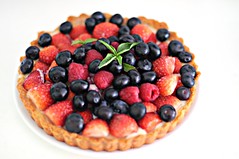
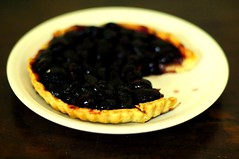
Fruit Tart
Fruity

Paul, Silas and Tim were now writing to provide (further) assurance that they did really have the gospel of God and were on track.
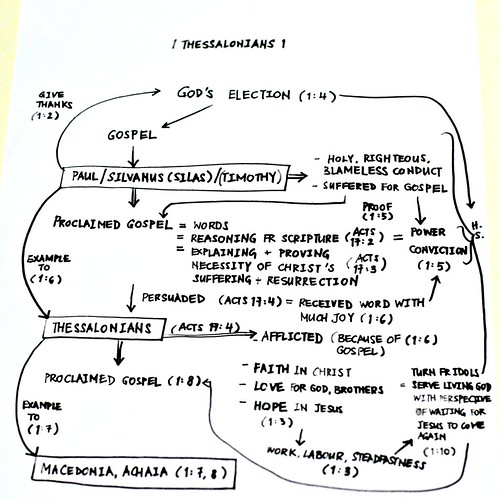
1 Thessalonians 1

The gospel of Paul/Silas/Timothy/God had objective content. The Thessalonians had neither been persuaded by Paul/Silas' eloquence nor their cutting illustrations nor confident speech. Rather, they had been convinced (1) by proof from scripture (Acts 17:2-3) that Jesus was the Christ who had to suffer and rise from the dead; (2) by proof from the lives of Paul/Silas/Timothy (1 Thessalonians 1:5) that they were really convinced about their message - suffering for the proclamation of the gospel and leading holy, righteous and blamesless lives (Acts, 1 Thessalonians).

The Thessalonians then came to trust in objective realities: they had faith that Jesus was the Son of God, that he died on cross as an atoning sacrifice for sins, that he was raised from dead and that he would come to save them from God's coming wrath (1 Thessalonians 1:10). Knowing the love of God (1 Thessalonians 1:4), they loved others (1 Thessalonians 3:12, 4:9-10). They had a sure and certain hope of the future when God's Son would come from heaven and deliver them from the wrath to come.

Therefore, there was two-fold (or perhaps just one-fold) proof that they were alright by God: (1) that they were intellectually persuaded and had accepted the gospel; and (2) evidence that they had really accepted the gospel was that their lives had been changed and shaped by these doctrines (their faith worked, their love laboured and their hope was steadfast) because they had come into a relationship with God who was now their Father (1 Thessalonians 1:3). So the three letterwriters observe that the gospel had come to them not only in words but, as evidence that they had been chosen by God in power, in the Holy Spirit and in full conviction and so they received it with joy.
Tower of Double Chocolate Cookies - Remember Babel
Remembering Babel

If this is so, then:
- one cannot claim to be on a "mission trip" or be serving God if one is merely building houses in a developing country or being hospitable to all and patient to the longwinded and, by common consensus, irritating. These were certainly not the things Paul/Silas/Tim/the Thessies were concerned about and persecuted for. If it is the word (1 Thessalonians 1:5,6,8), and the work of the Holy Spirit (1 Thessalonians 1:5,6) through that word (and the choice of God ultimately), that transforms lives, then any work of God must include the proclaiming of the good news. After all, this was also why Jesus came to earth (Mark 1). And after all, this shows that one's own life has been transformed so to the service of the living and true God who wants all to be saved and not perish.

- while there is a place for bridge-building to, eg. the yet-unnamed post-cyberspace generations, it is the pure gospel that must be preached, not adulterated in the desperate but baseless hope that leaving out sin or Jesus might make "Christianity" much more attractive to unsubscribers. The God who is to be worshipped must be proclaimed in his full justice and glory so that he can be worshipped, and in so doing show that the preacher does actually worship this God. His Spirit will work in those who are his.

- we know we are alright by God and really believe the gospel not because we are in the right (Bible-believing) church or that the church leadership demonstrates their approval of us by appointing us to positions in the church hierarchy or because our friends so assure us, but by the proof in our lives that we have turned from idols to serve the living God, with love for all, while clinging steadily to the hope of Jesus' coming.

- elders, pastors, overseers, leaders and the like who have to account for their flock and who see their sheep wandering off cliffs and taking candy from wolves, need, themselves not to lose sight of the way God has designed lives to be turned back and transformed - by the Spirit, through the word - in both the sheep's lives and their own. Therefore, better music with emotional song leaders, a more persuasive and/or emotive preaching style, church-wide programmes for unity, love and service, a push to missions, more rules on what should or should not be done, accountability groups, topical comments on the latest scandal or political hot potato etc will, of themselves and despite the best of intentions, never bring anyone into a living relationship with God because they point to man rather than God. Better to be preoccupied with God and concentrate on teaching faithfully from the Bible the Christ to be worshipped (or rather, not to obfuscate God's word in proclaiming what God says about the his own glory) and praying, and also (and simultaneously by so doing) demonstrating the conviction of one's faith in one's life, setting the example of living according to the center of one's faith, love and hope. The gospel must first convict the undershepherds before they can so speak and so live in a way that, with the power of the Holy Spirit, generate conviction in the sheep.

********************

Fruit tart recipe from Keiko Ishida's Okashi.
Double chocolate cookie recipe from Donna Hay.
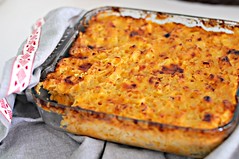
Animal Pasta! Mac & Cheese (or rather Animal Pasta & Cheese!)
Blood sugar high and failure to make much sense not completely attributable to Mark Bittman's macaroni animal pasta and cheese recipe (accidentally left for too long while Rabbids invaded the Phone).

Labels: , , , ,

Sunday, October 18, 2009

And the Missing Link is Jesus (Matthew 5:17-20)

It would have been clear to Jesus' Jewish audience that the characteristics of members of the kingdom of heaven (= the real disciples of Jesus = Christians) and their relationship with the world (Matthew 5:3-16) was not unlike what they had been taught through the ages by God's prophets and written down in the Law and the Prophets. Viral meme word associations would have hit a chord in their (sub)consciousness, like "zipbra preens", "duck genes" and "boomz" to a Singaporean.

Snuffleupagus and the Laws of the Land

But the elephant in the room on that mountaintop might have had its trunk in a knot trying to fit Jesus' teaching into the Old Testament Hebrew worldview: how did the dots all join up? Was Jesus teaching a new thing and ought he then be stoned for heresy? No, said Jesus,
Do not think I have come to abolish the Law or the Prophets; I have not come to abolish them but to fulfil them. For truly, I say to you, until heaven and earth pass away, not an iota, not a dot, will pass from the Law until all is accomplished. Therefore whoever relaxes one of the least of these commandments and teaches others to do the same will be called least in the kingdom of heaven, but whoever does them and teaches them will be called great in the kingdom of heaven. For I tell you, unless your righteousness exceeds that of the scribes and Pharisees, you will never enter the kingdom of heaven." (Matthew 5:17-20)
This pushes off an astonishing teaching section on the connection between this seemingly new revelation and God's revelation through the centuries, and ends with Matthew 7:11 - "this is the Law and the Prophets".

Ok, cool. So it was clear that all the preceding commandments and teachings still stood. They were God's words afterall and one wouldn't expect revisionism from an all-powerful all-knowing God. And if these were still in effect, then entry into the kingdom of heaven would be by obedience to these words.

The scribes and the Pharisees apparently were well aware of this and were fastidious OCD keepers of the commandments...or well, the commandments were a bit vague you see so they put in a clarification here and a neatly packed some others and put them in colour-coded boxes within reaching distance filed by aleph-a-bet. It would be easy to fall in the pharisiacal did-God-really-say trap of concluding that it wouldn't be too difficult to top the righteousness of the Pharisees - after all they were all law no love nasty smug legalistic moralistic bullies with simpering voices who deserved their comeuppance. But the standard, Jesus emphasised, in case anyone was thinking otherwise, was far higher - "...be perfect, as your heavenly Father is perfect" (Matthew 5:48). Not an iota or a dot was to pass from the Law, and no part of the commandments was to be relaxed.

At this point, the elephant on the mountain might have fainted clean away, causing massive environmental damage by tsunami on the other side of the earth. Real, unwatered-down perfection? Impossible!

And just how impossible? From Jesus' six examples of how the Law and the Prophets had indeed not been diluted but were far more Extra Strength Man Sized than the wimpy righteousness promulgated by the Pharisees (see Matthew 5:21-48), infinitely impossible. The terrible overwhelming sinfulness of sin. This dreadful realisation would have driven anyone, screaming OMGOMG, to the poverty of spirit that characterises the person in Matthew 5:3 to whom is promised the kingdom of heaven.

No wait.

Are there two ways of entering the kingdom of heaven? Why have those contrite failures been promised the kingdom earlier in the Sermon (Matthew 5:3)? But doesn't the need for perfection strictly preclude any other backdoor (contrition) route? The ridiculousness of anything short of perfection managing to see God would be like singing the scary fat man song Rocka My Soul in the Bosom of Abraham in rounds in the crisp mountain air making everything alright in the world and with God.

Ah, the missing link is
...
...
...
wait for it
...
...
...
wait for it
...
...
...
Jesus!

Strawberry Tart with Valrhona Ganache
Unable to Follow Even Simple Tart-making Instructions Person is Obviously Needing Jesus

The rest of the Bible then explains how Jesus' death allows grossly imperfect people to enter into a relationship God. Huge and mind-boggling. Theological terms like substitutionary atonement, penal substitution, imputed righteousness, propitiation, expiation all go some way to attempting to explain this and obviously a paragraph can't do it justice. But regardless, this was the good news Jesus was to preach to the poor (Matthew 5:3 cf Matthew 11:5, Isaiah 61:1), that he had come to enable the scum of the earth to meet the perfect maker of heaven and earth. So Jesus fulfilled the Law and the Prophets (Matthew 5:17) not only by keeping them perfectly in the fullness of their meaning, but also by being the one to whom they had been pointing (qv Matthew 1:22, 3:15, 4:1-12, 4:14, 11:12-15). Therefore obeying the Law and the Prophets would necessarily require acknowledgement of Jesus as saviour and obedience to his words which, far from abolishing them, bring out the real significance of the Law and the Prophets. So some aspects of the law, eg. the ceremonies, priests, temple and sacrifices, no longer existed in their Old Testament form because the person to whom they had been pointing had arrived and the event/problem to which they had been anticipating was fulfilled/accomplished by Jesus.

If Jesus has fulfilled the Law and the Prophets, if all has been paid for already, does that mean we don't have to bother with them or with working on our righteousness?

To think so would be to fall into the same hole, on top of the bodies of the Pharisees and scribes littering the bottom. Such a view assumes that the commandments and instructions are but mechanical means of entry into heaven, so once these have been satisfied they can be tossed into the junkheap. It's just as erroneous to see these words as mere commandments to be kept so that God will give us a little pat on the head for being such an obedient boy/girl when we see him. Nor are they to be co-opted by those who love certainty and rules to live by as the perfect moral complement to their rigorous self-improvement, healthy mind and body regime. Nor are they in the first instance (though it is one of their purposes, see Romans 7) the evangelistic instrument by which God bats us out so we will be contrite in heart and poor in spirit. Just as the Law and the Prophets were first given to Israel when they became God's people and he became their God, Jesus' commandments are meant to teach us who have come to know God the character of God embedded therein and how to live in direct, living, true relationship with this God. The focus is on the living person of God not the letter of the law (and the inevitable pharisaical sub-laws, regulations and guidelines that trail not far behind).

And besides, if we are Christians who think the kingdom of heaven is ours, are we not then people who also hunger and thirst after righteousness (Matthew 5:6) surpassing that of the Pharisees and scribes (Matthew 5:20), and who are pure in heart and seek after God (Matthew 5:8)? If we treat the law lightly and teach others to do the same (Matthew 5:19), we demonstrate that we aren't what we say we are.


A Trundle Through Sermon on the Mount
Earth Moves Under Feet, Kingdom Comes (Matthew 5-7)
This is the Sound of Inevitability (Matthew 5:1-6)
Breeding - We Hazs It (Matthew 5:7-12)
Coffee, Salt and Light, and the Essence and Use of the Christian (Matthew 5:13-16)
And the Missing Link is Jesus (Matthew 5:17-20)
Perfect Laws for Perfect Relationships (Matthew 5:21-48)
Cakes for Kierkegaard and Sermon on the Mount as Existentialist Answer Perhaps (Matthew 6:1-18)

Labels: , , ,

Thursday, January 22, 2009

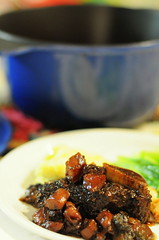
Braised Short-Ribs of Dead Cow, Creamless Strawberry Pav, 44th POTUS' Inauguration and James 2:1-13

Childhood fantasies are funny things, and in their own way, naive and selfishly insular.

Braised Beef Short Ribs
For children barred from eating any sort of red meat, fascination with the smell and texture of the cooked flesh of dead cows.

Creamless Strawberry Pavlova
For children for whom sugar (refined, or of the fresh cherry or strawberry sucrose variety) could only be obtained by sneaking sugar packets from restaurants and eating the white stuff surreptitiously in a corner hidden by piles of yellow National Geographic magazines, dreams of the desserts and edible delights that were the bricks and motar of the witch's house in Hansel und Gretel.

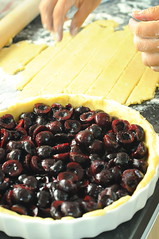
Possibly the Ugliest Cherry Tart on Flickr
Two nights ago, we stayed up, cherry tart in hand, to watch the inauguration of the 44th President of the United States of America. Chief Justice John Roberts flubbed Barack Hussein Obama's swearing-in, but the cool-headed dude went on to give a speech pitched at the oratory (and history) books. He painted a sweeping vision for Americans, united as one; a vision that encompassed not just that part of the continental mass separating the Pacific from the Atlantic but also one that would radiate throughout the world.

The seemingly grander fantasies of grown men.

"Now, there are some who question the scale of our ambitions...," said Obama because if nothing he is skilled enough to anticipate and address audience response,"their memories are short. For they have forgotten what this country has already done..." The basis of his confidence in the vision of Americans working together for a common purpose is their glorious history and their forefathers who "struggled and sacrificed and worked till their hands were raw so that we might live a better life. [Who] saw America as bigger than the sum of our individual ambitions; greater than all the differences of birth or wealth or faction" and of whose legacy they were keepers.

(Arguably however, the past does not necessarily inform the future, especially for neo-nazis and regulars at KKK meetings who would see no reason to perpetuate the "mistakes" of America's history. Though citizens of the land, they will have no part in any "common purpose".)

"My brothers!" James calls out (James 2:1) in a tone of familiarity not unlike that invoked by the 44th POTUS. But James is claiming more than a common humanity or a common citizenship. For on those bases, we give to charity and help little old ladies cross roads. But not all of us all of the time. Because sin has entered into the world, sometimes monies are spent on frivolous luxuries and little old ladies are honked at and knocked down.

And the scale of James' stated ambition, the vision of a church not split by partiality or discrimination, is not based on the great and glorious history of Israel, heavily varnished by sweeping rhetoric. Scripture is more realistic than that. It recognises the innate sinfulness of men and women everywhere of all races and positions and creeds. There can be no multi-racial un-class-conscious society in any deep meaningful way except in the real brotherhood that is united by faith in the blood of our Lord Jesus Christ (James 2:1).

Making Cherry Pie
Jesus: as American as cherry pie? After all, a distinctive characteristic of Jesus was that he showed no partiality, supping and dining with sinners and tax collectors and consorting with prostitutes while the rabbis tsked and tutted outside. This presented an excellent opportunity for enemies to try to trip him up. Oh, an equal opportunist are you? Friend of the poor and the rich same-same? Then you must not think anything of that chap Caesar and surely you're telling us to ignore him and his Roman colonialist pan-handling as well? (Mark 12:14-17)

But in a manner not too popular with modern Americans, Jesus and later Paul failed to encourage us to consider ourselves equal in all respects with everyone else. They emphasised the need to give due honour where such honour was due: to the governing authorities instituted by God, even though they might not have been Christian, slaves were to obey their masters, respect was to be given to those senior in years. Age and authority merit from us a reasonable and courteous respect. We are not told to respect nothing.

Furthermore, even the most outwardly egalitarian of humans will make judgements on peoples and situations as part of daily life. And without the guiding hand of the Bible, we inevitably respect the wrong things. Judging people by the magnitude of their wealth in particular is a common folly in democratic capitalist societies. To treat wealth as meaningless is intellectual imbecility - the markets have evolved so that it is money that pays for food, shelter, nealthcare, transportation, and arguably, civilisation. The patently non-materialists too cannot avoid the inadvertent snobbery of giving uncalled-for preferential treatment to the allegedly disadvantaged, like the black politican who was interviewed as saying that the antidote to a corrupt senator who happened to be white was to put a black man in that office. The favouritism of the coloured skin.

And again, netizens often enjoy seeing the rich get punished both for their crimes as well as for their wealth in courts of law. But the Bible has always been refreshingly clear in stating that there be no discrimination in judgement - no partiality to the poor, nor deference to the great (Leviticus 19:15, Deuteronomy 1:17).

It is inevitable that if we do not take the Bible as truth, then we take on the standards of the world as truth. But if we profess to accept God's word and claim we have faith in him, then why how can we hear but not do (James 1:22-25)? How can we still play favourites within the church family (James 2:2-7)?

So we may not suck up to the politican during service with sycophantic motives towards his riches and influence and usefulness, but if we think that preaching in a savage reservation is greater than preaching to the owners of luxury yachts, or that the Chief of Defence Force volunteering as door-greeter is more humbled and thus more godly than the roadsweeper performing the same task, then perhaps we have subscribed to the half-truth that communism thrived on - the favouritism of farmers and dismissive and harsh treatment of the educated and well-off.

Obama's political vehicle of government through mutual love and respect has been well-received. God is love? Even those opposed to Christianity have no problem with this statement. But they do not understand that because God is the Creator, God alone defines what love is, not us. And it's not about warm waffles and fuzzy hugs. God's specs of this thing called love can be found in his laws and commandments. Only if we obey his laws and commandments can we be making some headway in loving others properly. Hence, the outcry from certain communities over what they perceive to be outdated "conservative" Christian distaste over their way of life, and the accusations of the unlovingness of these Christians are unfounded. The protestors do not truly understand what love is.


If we turn the spotlight on just one facet of God's love, what glimmers forth here is love as lack of favouritism (Romans 2:11). If we claim to show love to some people and not to others, then our actions cannot have come from true love, divine love. The all-encompassing law of loving neighbour is not a relaxation of the law of obedience of the 10 commandments because they were so darned hard to keep but an explanation of their depth and the consequent scope of human obligations. So the 10 commandments were in fact, only examples of what it meant to love one's neighbour. We cannot claim to have kept to the spirit of the law (by our own interpretation) if we did not even obey the explicit details of what it means to keep the law.

And if the royal law, the law of liberty, is a direct reflection of the character of God, then we cannot call some details important and others not (James 2:10-13). We cannot divide them into venial sins and mortal sins. This guards us against the deceitfulness and self-righteousness of taking refuge in our disobedience by stressing our obedience to other bits.

James does not merely administer a friendly slap on the wrist here. He puts out a dire warning: discriminate and die. For if you show partiality, you break the law of loving neighbour and sin and shall be convicted as transgressors (James 2:9). And the sentence for such law-breaking is death (James 1:15), because it demonstrates that despite your profession of allegiance to Christ, you worship the king of this world, not God; you are an enemy of state, of the kingdom that will triumph in the end.

We who are the firstfruits of God's creatures (James 1:18) have no excuse: we know God, we are not ignorant of his laws (because not only has God revealed to us his statutes time and again in the Bible, we also have the implanted word (James 1:21)) nor of the need to obey them, nor do we lack the ability to do what is required of us through the Spirit (Galatians 5:16-26).
James

Labels: , , , , ,

Thursday, May 01, 2008

Inevitabilities, Boat Asia, Strawberries, 五月天 (wuyuetian, MayDay)'s 回到地球表面 (Down To Earth) Concert and 2 Samuel 12

A crazy week filled with inevitabilities.

Boat Asia 2008 at Marina@Keppel Bay, Keppel Island, Singapore
It was inevitable that the gloriously hot weekend was just the thing for Boat Asia 2008 at Marina@Keppel Bay on Keppel Island. There were jetskis and sailboats for sale, and floating platoons to put together like real life Lego, and yachts to clamber onto for joyrides and also houseboats to dream of living and navigating the world in.

Marina@Keppel Bay, Keppel Island, Singapore
Out of the heat, in the air-conditioned confines of TCC, we sat and chatted till the lights came on and some of the boat crew sounded their foghorns, untied big bunches of balloons and let the wind carry them up into the darkness.

Le Fraisier
It was also inevitable that the heat made it impossible to eat much, so fruits were the order of the day. Because strawberries were cheap in the fresh produce section, there was an attempt at Le Fraisier, but really, that was far too precious.

TGIF Breakfast Faux-Trifle
Much better was just heaping them in a bowl with leftover vanilla sponge and natural Greek yoghurt and drizzling some manuka honey over the lot.

Fresh Strawberries and Greek Yoghurt

And even better just kosong: strawberries and yoghurt and nothing else.

(When some friends rolled into town from half-way across the world though, we managed (for their sake, of course) a bit of chilli crab and cereal crayfish (the receipt said "clay fish"). After, durians were hunted down.)

Ashin and Monster
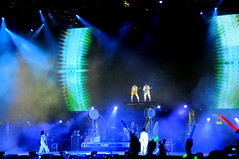
Again, it was inevitable that we would not have had been able to enjoy completely 五月天 (wuyuetian, MayDay)'s 回到地球表面 (Down To Earth) (新加坡第一站 hor) Concert at the Singapore Indoor Stadium, however novel the concept of Chinese pop music concert-going, however free the tickets, however better the sound system than the one at Singapore Expo Max Pavilion,

DSC_6205.JPG
however innovative the stage,

Monster
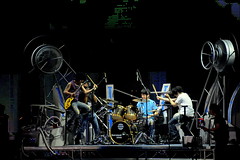
however wonderful the guitar antics of Monster (here with pink bear standing by),

Guanyou/Ming
however crazy the drumming of Guanyou/Ming (here with unwelcome helpers),

DSC_6271.JPG
however communist and equal-opportunity the UFO-like skybridge,

Raptuous Audience
however raptuously the crowd greeted the proximity of band members,

DSC_6297.JPG
drummer Guanyou/Ming and bassist Masa
however cheeky the banter that put paid the innocence of candles on birthday cakes,

"O""V"
however "high" the audience and however companionable the neighbours. A function, no doubt, of the fact that no amount of earnest emotion set to catchy music can guarantee the future and the understanding that all good things are but a pale low-quality imitation of the great party-to-come (see Revelation).

Setlist/Song list (mostly thanks to the fans at mdmd.net forum):
Ashin hamming it up for the camera
lead singer Ashin hamming it up for the camera
五月天 回到地球表面
The stage was covered with a ceiling-to-floor white sheet. 4 "armed" men rappelled down from the ceiling wearing gas masks. Continuation of video from their last concert 離開地球表面.
1. 抓狂 - MV, Singapore concert
2. 香水 - MV
3. 叫我第一名
4. 為愛而生 - MV, Singapore concert
5. 一千個世紀 - MV, Singapore concert
6. 雌雄同體 - MV, Singapore concert
7. 愛情萬歲 - MV, Singapore concert
8. 離開地球表面 - MV
9. 生命有一種絕對 - MV
10. 孫悟空 (每個人各唱一小段) - MV, Singapore concert
11. 小太陽 (「回到地球表面」演唱會主題曲) - MV, Singapore concert
12. 九號球+離家出走 - MV, Singapore concert
13. 闖 - MV, Singapore concert
14. 生活 + 疯狂世界 - MV, MV, Singapore concert
15. 垃圾車 + 生日快樂 (瑪莎慶生 Masa's birthday) - MV, Singapore concert
16. 愛情的模樣 - MV, Singapore concert
17. 最重要的小事 (阿信彈吉他) - MV, Singapore concert
18. 我又初戀了 - MV
19. 戀愛ING - MV, Singapore concert
20. 溫柔 - MV, Singapore concert
21. 洋蔥 - Singapore concert
22. 軋車 - MV
23. 溫柔 (還你自由版)
24. 倔強 - MV (the sinner's song, said the B)
25. 人生海海 - MV, Singapore concert

Encore
UFO-like Skybridge Does An Encore
Second descent of UFO-like skybridge

Encore
26. 天使 - MV, Singapore concert

Ashin
27. 知足 - MV, Singapore concert (I waited the whole concert for this, said the C)

Ashin
28. 離開地球表面 電音版
then they threw their sweat-drenched towels into the audience. One man's bio-hazard, another's prized possession.

And it was also inevitable that, living in the community of believers, there would be the shared pain of the suffering of fellow brothers and sisters: young mothers diagnosed with third stage breast cancer, sudden deaths of loved ones in swimming pools, the tearing apart of families in the bid to make new ones, disillusionment with the manifestation of God's kingdom on earth, the lust for gossip and the injustice of the manipulation and lies so rife within Christ's body.

2 Samuel 12-13
is one of those passages in the Bible ripe with the complexity of reality that couldn't have been dreamt up by the human mind.

At the end of 2 Samuel 11, David seemed very much in control. He'd taken and gotten what he'd wanted and the cover-up of his adultery with Bathsheba and murder of her husband Uriah appeared flawless. But we are told at the end of 2 Samuel 11 that what the thing David had done displeased the Lord. And we know that several centuries before, Moses had already warned that one could be sure that one's sin would find one out (Numbers 32:23). Whereas 2 Samuel 11 is all about David sending people out to do his bidding, 2 Samuel 12 opens with the LORD sending Nathan to David. It was God who was in control and despite David's erstwhile relationship with God, he'd incomprehensibly forgotten that he would have God to answer to.

David's strong reaction to Nathan's story (2 Samuel 12:1-7a) demonstrated that David was not incognisant of right and wrong, but merely deliberately blind to his own sin. "The man must die" he said of the rich man in the story, thereby accusing and condemning himself. "You are that man," said Nathan. And God was as livid and outraged at what David had done as David was indignant at the rich man in Nathan's story.

It wasn't just that David had broken some laws and destroyed the lives of people, he was that he had despised the LORD himself (2 Samuel 12:9). When we breach God's laws, it isn't just about socio-economic-political consequences; when we sin, we show utter contempt for God, the law-maker/giver.

David acknowledged that he had indeed sinned against the LORD (2 Samuel 12:13). This was a great change from his predecessor, Saul, who had a whole slew of excuses for disobedience ("you didn't come on time, what was I to do" etc). David didn't bring forth defences nor character witnesses to attest to his general generosity and the good he had done for his people, instead, we see in Psalm 51 the plain confession of his sinfulness. David knew that that had not been a one-off, a moment of weakness, a temporary aboration, a sorry-won't-happen-again incident. He had been sinful from birth and would forever be inclined to spit on the living God. He was a born adulterer and born murderer. He admitted that he deserved punishment.

Yet, immediately, David received gratuitous forgiveness. "The LORD has put away your sin," said Nathan, "you shall not die" (2 Samuel 12:13). But this was not the slap on the wrist given to smug perpetrators that cause grieving members of victims' families to attack them outside the courtroom with foldable umbrellas. Nevertheless, and this was a big nevertheless, despite David not getting the death sentence he deserved, his son would die (2 Samuel 12:14). And there would always be the perpetual reek of death in David's family (2 Samuel 12:10). And there would always be the dreadful agonising tyranny of evil on his loved ones (2 Samuel 12:11).

(Several centuries later, in the New Testamental times, Jesus would explain that suffering was not always caused by sin. The man born blind and the people killed by the falling tower of Silom did not suffer because of their sin and rebellion. But other times, suffering and difficulties are the consequences of our sin and we must bear the responsibility for that - the illegitimate child, being made a paraplegic from drinking and driving, the broken relationships caused by gossip and slander etc. But in David's case, the cause of his suffering was quite certainly his past sins. Because God said so.)

So sure enough, the child took sick. David lay on the ground all night pleading with God to spare his son. He refused to get up and took no food. His grief freaked out his aides. (2 Samuel 12:15b-17) They figured him for a suicide risk and when the kid in fact died, they didn't know how to break the news. They needn't have worried. When David heard that his son had died, David got up, had a bath, put on clean clothes, slapped on some Old Spice and worshipped God. Then he went home and had a good meal (2 Samuel 12:20), possibly while his servants stood gaping. David explained: he'd thought that perhaps, just perhaps, God's word through Nathan wasn't his last word and plus he knew that he could rely on God's graciousness to let the child live if he wished. But, in a way that did not impinge on his graciousness, God's judgement through his prophet had been his last word on the matter and David accepted and trusted God on this (2 Samuel 12:22).

2 Samuel 12 ended with a note of hope - God gave David victory over the Ammonites in battle and David begot a son with Bathsheba whom the LORD loved.

There are certain inevitabilities we can be sure of in this 疯狂世界:

The Initiative of Grace
God is the one in control. He takes the initiative and seeks sinners to bring them to repentance. (Sinners, inevitably don't seek after the real God, no matter how they might claim to be looking for him.)

The Severity of Grace
"T'was grace that taught my heart to fear". Grace reveals and exposes and brings people to repentance so that they might be saved. The only heart that God can accept is a broken and contrite heart so therefore, in his love and his grace, he must break us so that we can see the death sentence which we are facing because of our rebellion against him, and turn to him for mercy.

The Miracle of Grace
Grace gives totally free forgiveness. But the consequences remain with us. The rest of David's life is grim: David's baby son dies even before he can be named; David's other son Amnon rapes his daughter and Amnon's half-sister Tamar (2 Samuel 13); David's yet other son Absalom murders Amnon for what he did, then leads a rebellion against his father; David's other other son Solomon eyed the crown while David was still alive etc.

And though the sinner has to deal with the consequences of his sin, he does not pay for them through his suffering. The fact is, he can never do enough to pay for even a quark of his sin because the wages of sin is death. What is free for sinners is costly to God because it cost him his only son who died on the cross in our place so that we will not have to face eternal death.

Dale Ralph Davis, 2 Samuel
Jonathan Fletcher, Grace Abounding

_________________________________________

Labels: , , , , , ,

Friday, April 11, 2008

The Return of Sunshine and the Return of the Ark in 2 Samuel 6

She beckoned through the ceiling-high windows, flaunting her freedom, vaulting through luminous leaves, sparkling off the azure sea (the really real simulacra of cheesy literary adjectives). But we were inside the board room, haunted by the spectre of inter-governmental meetings, gathered round the enormous whiteboard, adding structure upon structure to an already complicated deal.

Then at last it was over. And I ran like a beggar's dog into the last light of the day.

Sunset at Siloso Beach, Sentosa, Singapore
Finally, the fresh salty taste of sea air and warm soft sand between the toes, frisbee pick-up on Siloso Beach and spectacular dives into the foamy water. And the very fetching silhouettes of oil tankers and refineries on the horizon.

Sunset at Siloso Beach, Sentosa, Singapore
Later, we lay on deck chairs at Coastes, cocooned against the cold breeze with hot fat chips and alot of garlic mayo, cheese-splurting hotdog sausages and a goodly rack of ribs. In front of us, kids dug huge holes and buried each other in the sand, then ran about screaming in excitement at the fireworks.

(We shall not speak in further detail of the Ah Beng-blue xenon dancing lights of a certain skateboard.)

Frisbee at KovanFrisbee at Seletar
The sunshine and blue skies lasted through the weekend, good for lazing around in vast grassy fields then for more frisbee, whooping at the silky beauty of flight trajectories until the cicadas awoke and it was time for sunburnt noses to head home.

Blueberry and Strawberry Galette Bound for Oven Hell
As hot day melted into sweltering hot day later in the new week, it was difficult to keep from lolling about in ice-cold pools with only ice-blended juices and cut fruits by the cold truckload for sustenance. But I needed to carbo load for the upcoming race, and puff pastry seemed the lightest and most minimalistic way of getting some carbo delivery, so a blueberry and strawberry galette it was.

Absolut Vodka bottle as rolling pin
In the appliance-challenged kitchen, the good old Absolut vodka bottle had to be enlisted for rolling-pin service and it discharged its duties faithfully. Unfortunately, there isn't an "After" photo of the galette because I was too engrossed with 2 Samuel 6.

Chapter 6 records the story of the return of the Ark of the Lord to the centre of Israelite life.

The Ark of God was sitting around in Abinadab's house on a hill in Baale-judah (2 Samuel 6:2, also known as Kiriath-Jearim (1 Samuel 7:1)). It had been lost to the Philistines in the, erm, battle against the Philistines (1 Samuel 4).

The Ark wasn't merely a mouldy old piece of antique furniture. It was constructed at the specific instruction of God (Exodus 25:10-21) as a symbol of his presence with Israel (Numbers 10:35-36). David called it God's footstool, a reminder of God's kingship and rule (1 Chronicles 28:2). It was sprinkled with the blood of sin-offering, a reminder of man's guilt against God and inability to approach him without mediation (Leviticus 16:14-15). The Ark also contained the stone tablets on which were inscribed the word of God (Exodus 25:16,21; Deuteronomy 10:1-5), a reminder that the substance of God is informed by his word.

There are no magical objects in the Bible with inherent magical powers. The Ark wasn't worshipped as an idol but was instead a physical demonstration of the difficulty sinful man faced in relating to a holy God. The word "difficulty" suggests a possibility of relationship, no matter how remote; perhaps "impossibility" would be more accurate. Sinful man could not (and still cannot) expect to approach a holy God and live. The Philistines discovered their terrible error in presuming otherwise: the men who did not die were struck with tumours (1 Samuel 5). Being terribly logical folk, they were not completely certain that the God of Israel was behind all this until their little experiment in kiasu-ism proved it to be so.

But lest anyone think that the holiness of God was a problem for only the non-Israelites, even the rejoicing men of Beth-shemesh were struck dead when they looked upon the Ark (1 Samuel 6:19-20). And again at the start of 2 Samuel 6, when David decided to bring the Ark to his city, in the midst of great revelry and singing and dancing, the oxen carrying the Ark stumble and the unfortunate Uzziah reached out to steady it. He was struck dead instantly (2 Samuel 6:7).

David was incensed (2 Samuel 6:8). As are we. Why so legalistic, God? Why so finicky? These people weren't against you; they were for you, they were rejoicing at your presence.

Then David was afraid (2 Samuel 6:9). The reality, whether we like it or not, is that we have a deluded sense of reality. We refuse to understand that no guilty party can draw near to a holy God without death, the rightful punishment for sin, intervening. We cannot deal with God on our own terms. The reality is that God'd explained this reality to the Israelites but they didn't think it worthy of notice.

It was so as to keep them alive that God had warned them not to look at the Ark nor touch it, but to have Levites carry it on their shoulders with poles slotted through rings on the Ark itself (Numbers 4:15, 17-20; Numbers 7:9; 1 Chronicles 15:15). God's instructions on the subject were not the arbitrary shrubbery preferences of the Knights Who Till Recently Said "Ni" in Monty Python and the Holy Grail; they were real warnings about a real danger.

Why so arbitrary? Why only one way to God through Jesus? Why have such a strict God who hasn't kept up with our tolerant open-minded era?

Because, says the Bible, that's the way things are. Take it or leave it, that's reality. I'm just warnin' ya. In fact, I'm pleading with you to take this warning seriously: God was, and still is, dangerous (1 Corinthians 11:30-31; Hebrews 10:26-31). God has remained consistent throughout the Old Testamental and New Testamental times and still remains so: remember Ananias and Sapphira (Acts 5:1-11). Ignore him, choose not to believe in him, approach him lightly, at your own risk.

Coastes
50 Siloso Beach Walk
Sentosa

__________________________________

Labels: , , , ,

Tuesday, October 09, 2007

Cheese, Music, Marriage, and God and the Church

Long-standing love affairs.

As the blame-passing scab-picking garden-variety of psychotherapy will have you know, the seeds of dysfunction were sowed in childhood, with the thin foil and red tabs of The Laughing Cow. By 13, cheese was so much part of my life, so spinach to Popeye, that "Je mange du fromage avec du pain" was de rigueur in any self-description. The hardcore hard-rind stuff came mostly in England, home to the Wensleydale-chomping Wallace and with him, a whole nation of nibblers who must have, through centuries of communal nibbling (and thousands of cups of tea), created the Cheddar Gorge. Countryside-living was inevitably dairy-related: a shortcut to a particular pub for weekly smoky chats on philosophy meant sneaking through a muddy paddock, running if chased by the resident bull. Sunny summer days meant cows, expressing their great satisfaction with the sweet grass, interrupting lectures. And there was always a crumb of curdled and fermented milk to be had about town. Cheese, like good farmhouse artisanal mould, was unhindered in its blue-green veining through the creamy curds of my life: one summer, lost in a storm on Ben Nevis, it was a little package of Scottish mature cheddar and highland oatcakes that (as they often say in British stories about adventures of sorts) kept my spirits up. And back in Singapore, Monsieur Gérard Poulard's early incursions suggested that a long-term stay here might just have the right kind of stink about it after all.

Jones the Grocer, Singapore
Two fromageries opened in Singapore in the last few months: a little walk-in cupboard at Jones the Grocer's and another simply called La Fromagerie along Mohamed Sultan. ("Chi-chi cheese-shopping" someone sniffed. But unlike some overpriced frivolities (I'm talkin' about you, S$20 Persian candy floss), much cheese is honest-to-goodness stuff, like hot crusty bread and cold beer. Plus, since Ramadan's just over, dried figs and dates, with which Muslims usually break their fast, still abound. The possibilities (BVM surprise guest-appearance on grilled cheese sandwich excepted)!) But they are only a small whiff of the great heaven that is Neal's Yard Dairy, stockist of 200 cheeses piled high to the sky, exuding promises of casomorphine opiates.

Cheese for supper
Perhaps, I said to someone, cheese is my raisin cake. Or perhaps strawberries are my raisin cake. But I came to strawberries later in life than cheese. You are going all postmodern on me, he said. I am going to leave you now, very quietly, and shut the door behind me. And I will make no sudden movements. I might even throw you some Babybel once I am safely outside.

Wang Jian playing in the cello section of the SSO
Or perhaps, music is my raisin cake, came the realisation, as Wang Jian sawed through the third movement of Elgar's Cello Concerto in E Minor. An indiscriminate love that knows no bounds: Gregorian plainchant, polyphonic counterpointy Baroque, coquettish Classical, OTT opera, hep-hoppin' jazz, moshpit metal, eccentric 80s, SNAG soft-rock, blingbling hiphop, college indie, bouncy Bollywood, cheesy Chinese...I love them all from the bottom of my pencilcase. I can live without cheese and strawberries, but if I never hear even soppy songs with my ears again, I promise you that I shall never breathe again, breathe again, that I shall never breathe again.

Soppy songs. It is the season for weddings again.

Floating on the top of the breaking curl that was the series on Hosea, boosted by the talks imported by kind friends from this year's London's Men's Convention (fetchingly titled "liars, evil brutes, lazy gluttons"?), weddings have never looked more beautiful.

Weddings: the smile of sunshine, the white satin train of the bride's gown, the fragrance of bouquets, the smell of cologne and new suits, the back-patting, the teary farewells, the walk-in, the giving-away of the bride, the cameras, the sermon on love, the solemnisation, what God has brought together let no man put asunder, the unveiling, the kiss, the signing of the marriage register, the hand-in-hand walk-out as husband and wife, the thrown rice and popped confetti, the photos for the family album, the hearty hugs and grinned best wishes, the happy whispers of how great the new couple look together.

But. Far more than the entertainment value afforded by the perfect execution of meticulous plans and aesthetically-pleasing couples set in dreamily-romantic mis-en-scenes, the tear-inducing heart-bursting beauty of weddings lies in that of which they are but mere shadows: God and his people, Christ and the church.

The tender love exhibited by the wedding couple that makes the rheumy hearts of many an old aunt flutter is but a puny birthday candle to the great hot furnace that is God's love for his people and Christ's love for the church.

We think that a wedding is one of the most lovely, most romantic things in the world. But, step right up step right up! Ladies and gentlemen, boys and girls, Plato might have said had he known, you have all been obsessed with mere shadows! What's that? A heart full of love you say, sir? Filled your days with endless wonder did he eh, lady? Well! You haven't seen anything yet.
Wedding Hockneyised
The story, good folk, the real story is that of the divine husband and his adulterous wife; a wife so stupid, so greedy, so lewd, that even though married to the perfect husband, she abandoned him to strut her stuff openly before lascivious male eyes. Lacking even the remnant of decorum of whores, who allow themselves to be approached by customers, in a frenzy of desperate lust, she pursued her would-be lovers.

So Hosea indicted Israel, who'd chased after the Baals in crazed delusion that they had been responsible for her prosperity and abundance. What inexcusable stupidity. She, of all people, ought to have been familiar with her true husband. Centuries of Israelite history, written down in God's word and repeated by prophet after prophet, should have taught her that God alone was her creator and her sustainer. No one apart from him was able to give and take away life and all the trappings of existence.

Through Hosea, Yahweh contrasted her thirst for spiritual adultery, for the Baals, with her treatment of him:"But me she forgot." She had courted their favour and adorned herself for mute idols, but neglected and slighted her real benefactor and true lover.

The LORD swore that her betrayal of his love would not succeed. Israel's misuse of God's gifts to her would prompt him to withdraw them. At the time of the harvest, the crop and wine would fail. Her vines and fig-trees would be laid barren. Her people would starve and die.

But God did not intend to send Israel away as a bad job, or win custody of the children and then look for a much better mother for them. Instead, amazingly, he wished to allure rotten old Israel once more, to rekindle the romance they'd enjoyed in their honeymoon years, to draw her back into union with himself. The image was not just of renewal or renovation of the old marriage but a completely new betrothal, with Israel starting out again as a fresh-faced virgin bride. And unlike the complete mess of the old marriage, the new marriage would last forever, secured by steadfast love and mutual faithfulness. And it'd be God who would impart to Israel the qualities that will ensure a marriage for all eternity.

The institution of marriage is not a convenient metaphor co-opted to describe the relationship between God and his people. Rather, God instituted marriage for the very purpose of demonstrating to dimwitted humans some faint shadow of the mindblowing relationship Christ would have with his church (Ephesians 5:32).

So human marriage is not a useless Victorian social construct to be thrown out with yesterday's kitschy fridge magnets but an institution weaved into our human fabric to be a meaningful display of the love relationship between Christ and his body. We preserve marriages not because of shared family values nor so that the children won't grow up splashing out money on psychiatrists' couches nor so as to give Dr James Dobson a point of pontification, as if marriages were valuable in and of themselves; we preserve marriages because Creator made them so that when a man and a woman come together in matrimony, they do, by his design and in a way we cannot fully comprehend, truly become one flesh.

And if God designed marriage, then he alone knows how best they are meant to work. And they work best in imitation of Christ's loving relationship with the church (Ephesians 5).

Extremely elegant equations. Our math teacher (who ever-despaired of us brutally hacking our way to the correct answer) would have applauded.

Yet if our relationship with God is not an armslength schoolteacher-badstudent one, but one even more intimate than a marriage, then raisin cakes are no laughing matter. Sins, trivial though they seem, aren't just about cheekily breaking a window and running away or copying someone else's homework; they are about having our lives and our decisions revolve around things other than the one whom they should rightfully revolve around: God, in place of God; they are acts of adultery, they constitute the vomitous betrayal of a relationship, the cuckolding of the perfect husband, the tearing away at an entity that has since been constituted organically as one flesh.

Whoredom, Raymond C Ortlund Jr
Marriage: Sex in the Service of God, Christopher Ash

Jones the Grocer
Dempsey Hill
Block 9 Dempsey Road #01-12

La Fromagerie
5 Mohamed Sultan Road
Singapore 239014
Tel: 6732 6269

Labels: , , , , , ,

Thursday, August 09, 2007

Collectors, Consumers, Conclusion

Rockin' 'bout town:
Morton's
a celebratory dinner at Morton's where the menu means a waitress, well-seasoned with American gregariousness, pushes up a trolley laden with cellophaned pink cuts of beef and exalts their meaty virtues in an enthusiastic show-and-tell;

Chat Masala, Greenwood
good Indian at Chat Masala where the fish briyani is so good and the ginger lassi is so good-strange and where we were so merry and laughed so loud, the packed restaurant was shocked into sudden silence;

Banana Energy for Basketball
a 3-on-3 basketball tournament where my on-court puke-iness in the finals reduced us to a silver medal, with my profusely burbled apologies;

Festival of Praise, Singapore
Festival of Praise a Don Moen and Delirious? concert saved from herd-instinct vacuity by the study of Hosea that very arvo;

Wild Oats, Emily Hill
sweet punnets of strawberries headed for fates surely involving variations on the theme of strawberry cheesecake because one night - a martini glass of deconstructed strawberry cheesecake at Wild Rocket and then after, because there is never ever enough strawberry cheesecake, a shot of cocktail (featuring coconut cream liquor) made to taste of strawberry cheesecake at Wild Oats. (Wild Oats which sits on the Emily Hill compound that previously inspired many latenight ghost stories during those halcyon NAFA days of artistic disrepair. Wild Oats which shall now be known for its obstinate waiters who huff at 3 separate tables,"We're a bar! We don't serve coffee!" and refuse to bring any over from its sister restaurant, a spitting distance away.);

Prata Brunch, Jalan Kayu
a pleasant morning in Seletar Camp where there was once carolling at Christmas: spacious living for humans in hammocks and smiling dogs and happy bunnies, languid swings hanging from the strong arms of great shady trees, pretty red letterboxes, yellow hibiscus bushes, purple morning glories draped lazily over backgates, and brunch at Jalan Kayu after. Tomorrow night, there will, God-willing, be salsa dancing (because "there is no way you are backing out of this") at 10pm (because "people don't go there that early unless dressed in loud hawaiian shirts trying to look cool and blend in" and because I don't actually own a Hawaiian shirt).

Great company and good food for the most part. Expansive generous talk. No weedy industry fare, no sour sweaty gossip, no bland frivolity, no inflated insincerity. Solid, meaty, satisfying conversation: encouraging each other in the truth, in how we make our decisions with God as our priority no matter how heart-wrenching and painful, in how we stand firm in what is right regardless of how stupid and foolish it seems to the world.

Ding Tai Fung, Junction 8
And a story: someone's sister passed away 2 years ago. Space constraints recently required that her room be cleared to make way for a living person. Stashed in her cupboard: the full collection of Hello Kitty plushes carefully collected for months from McDonalds and limited edition t-shirts still in their wrappers and never worn. How she must have queued and planned and bought countless McDonald meals to make up her collection. How she must have invested time and energy in procuring and folding and bagging the t-shirts. I know they must have meant something to her, said the Clearer of the Room, but there is no space. I have no choice. I will bin them all.

Our collections are, for the most part, no longer about the vulgar conspicious consumption of the 1980s; they are, we think smugly, about beauty and taste, about an appreciation of the finer things in life. We collect many things: cars, watches, guitars, wine, handbags; gems to pad our CVs; brownie points with the right bosses for a nice bonus or promotion; friends to stave off loneliness and boost our social standing; networks and contacts that might prove valuable in the future; comfortable investment portfolios; high scores on games; greatly cherished experiences from another time and another place when we'd really really lived...

But the finality of death makes stark the utter unimportance, the puerile pettiness, of it all.

Amongst many other corrective behavioural therapies, anger management and marriage counselling advocate that taking a long-term view of events allows a person to live the here-and-now more reasonably, none of that sticking the cheese knife into someone and appearing, handcuffed in a wild-eyed photo, in the next day's gleeful New Paper. Driver cut into your lane without signalling? Toothpaste left uncapped despite constant pleas not to neglect the cap? STOP. THINK: how will this matter in 1 month, 1 year, 5 or 10 years' time?

Since our event horizon is a bit longer than a decade and slightly wider than this world, then the relevant points of reference for our acquisitiveness, our reaction to situations, our fondling idolatry of things and people and experiences, must surely be that of eternity and the massive massive kingdom of God.

I am constantly amazed how often I forget this fact. Though, what with a partially redeemed mind and heart in this now-but-not yet, such forgetfulness should come as no surprise. Sometimes, the rejection of God by his children does not happen at the end of an Al Qaeda gun barrel but amidst great peace and safety, where the jolly comfort of "friends" mask their cunning deceitfulness. And I suppose I don't quite say this enough, but thank God and thank you all you true friends who keep reminding me, who keep forcing me to avert my gaze from my own navel, to look up and out into the grand and glorious scheme of things revealed to us by our Creator and our Final Judge.

Tomorrow morning, I shall blush at such sentimentality and my unwieldy sentences and grammar mistakes. But in the light of eternity and God's kingdom, I guess I'll manage!

Labels: ,

Thursday, May 17, 2007

Ingmar Bergman's Wild Strawberries

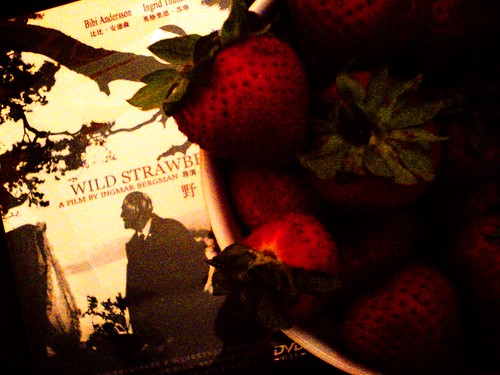
Wild Strawberries and Organic Strawberries
For reasons not always to do with Strawberry Shortcake, males are uncommonly fond of strawberries. So a 1kg haul of macho-yumminess it was, for hand-churned strawberry ice-cream slathered with thick sticky strawberry ice-cream sauce and also for heaping in a great bowl and having very cold and very sweet while lying about watching Ingmar Bergman's Wild Strawberries (Smultronstället, 1957). Eating strawberries in the dark - the petulant Sei Shōnagon would have been disconcerted.

Beyond the vast mound of sweet juiciness, in full monochrome glory, there is the Professor, an old distinguished doctor making a journey to his hometown of Lund to receive an honorary doctorate for his life's work. His 400-mile car journey is parallelled by an interior journey of self-discovery because, you know, it is afterall an arthouse film (go, genre of road movies!).

And what self-respecting self-discovery arrives without a fistful of dreams enroute? So we get an early dream sequence that is all Expressionistic - clocks with no hands, balloony men who fall over and burst and spill dark liquid on the tarmac, and doppelgängers in coffins who (hey, what fun is it lying around all day in a coffin) reach out and grab their shuddering twin. Later dream sequences are Freudian - full of parental-approval-seeking and psychoanalytical childhood scenes that (literally) hold mirrors to the doctor's current state.
The general public adores the Professor. They think he has old-world charm. They think him kind. They think he is the best doctor in the world.

But, hullo, arthouse movie not Disney animation! So, obviously he ain't all white-toothy and benevolent.

What is the doctor really like? So's we can be sure to get his characterisation spot-on, Bergman names the good Professor "Isak Borg" ("ice fortress" in Swedish). His own daughter-in-law cheerfully describes him as utterly ruthless, selfish and cold as a corpse. And later, his own *ahem* unconscious accuses him of callousness, selfishness and ruthlessness.

Ingrid, the daughter-in-law, notices how this coldness runs in the family: Borg's ancient mom is "cold and forbidding as death" and his son, her husband Evald, "cold and dying".

Pre-filmtime, Ingrid left Evald to stay with Borg because of a dispute over her pregnancy. She wishes to keep the child but Evald is horrified at the thought of bringing a child into the world. He thinks it absurd to do so, having been an "unwanted child in a hellish marriage". He hates his life and wishes to be "dead, stone dead" and not feel anymore pain. Frigidity as a reaction to pain.

His father is no different. Although the good doctor states proudly at the start of the film that his withdrawal from human relations was a conscious decision made when he realised that "in our relations with other people, we mainly discuss and evaluate their character and behaviour", although he thinks he is in control of his own life and that he is an entirely self-made man, we see as the film goes on that just as Evald's horror at child-bearing is founded on his childhood pain, so Borg's coldness stems from the pain of being rejected by his beautiful childhood sweetheart and cuckolded by his wife.

Borg's dreams tell him that however distinguished a doctor he has been, he has been incompetent in living his own life. His first duty as a doctor should have been to ask for forgiveness. It is not the forgiveness of those he has hurt by his coldness that he should seek but the forgiveness of self.

If the movie had been a clarion-call for ice-melting, the fuzzy-wuzzies and touchy-feely-ness, it would have been the cooties. But Bergman isn't quite so binary and reductivist.

What Borg must learn is that his coldness is neither right nor wrong. Therefore, no forgiveness from others is called for. His guilt lies in feeling guilty for who he is. He needs to be able to look into the mirror without flinching, to honestly acknowledge the pain in his past, and forgive himself for feeling guilty for living as he needed to live. He needs to accept the person he is and how he became that person.

So Bergman's main thrust is akin to Borg's answer to the disputing young men (one - a modern man of science who only believes in himself and his own biological death, and the other - a would-be minister) as to whether science or God, rationalism or religion, was right:
Where is the friend I seek everywhere?
Dawn is the time of loneliness and care.
When twilight comes I am still yearning
Though my heart is burning, burning.
I see His trace of glory and power
In an ear of grain and the fragrance of a flower
In every sign and breath of air
His love is there.
(Neither, nor. How very Mary Midgley. But, later!)

Once, someone spoke of how it is a symptom of our sinfulness that we do not truly know ourselves, how we persist in thinking what nice, moral people we are, how we grow so used to our masks and become so skilled at this self-subterfuge that we are quite certain that we are good people; that we couldn't possibly be bad.

Perhaps a further symptom of our sinfulness is how we respond when we do, infact, see ourselves in full decomposing goriness and breath in the full stench of our callousness, ruthlessness, selfishness, greed, lasciviousness and hypocrisy. Do we grasp at that which we have no right to by attempting to forgive ourselves, however illusory the reconciliation? Or do we seek real forgiveness from the one whose laws and design we have actually transgressed and whose person we have offended to our eternal detriment?

Labels: ,