Sunday, September 13, 2009

All That Jazz and God Transforming Sinful Natures

In another life, it might be nice to use some random postgraduate degree as an excuse to research a thesis on food blogs as carriers of cultural memes, with food as universal language, hunger and greed as international drivers, recipes as socially-transmitted information. Unfortunately for those lovely ladies slogging away in cavernous kitchens in the Middle Ages, the lack of the internets then and the lack of readily available plucked and washed swans in the supermarkets now means my collection of Medieval recipes shall languish sadly in their hotel rooms like craggy-faced Bill Murrays on the set of Lost In Translation.

Chocolate and Hazelnut Cake
So for the present, chocolate hazelnut cake as sappy nostalgia commodified into the product of flour, eggs, cocoa and heat; as bourgeois-aspirational Anglo-centric fetishistic faux-domesticgoddess/Stepfordwife-ness; as handy reference to the "original" Nigella Lawson Torta alla Gianduia, itself is a dessert that references other desserts and on and on until drowned out by liberal socialist types protesting the tyranny of the meta-dessert (or as Zizek might mumble through his chocolate and hazelnut-stained teeth, the Dessert of the Real).

Beo Crescent Teochew Porridge
In yet another life, the thesis would be about music as a barometer of societal values wherein freewheeling jazz was first subversion of object-oriented composition by oppressed minorities, but is now signification of modern/post-modern respectability, hegemony synonymous with the institutionalisation of improvisation, the entrenchment of laissez-faire composition. (With the great Dianne Reeves, however, jazz was secondary to The Voice. And what a fantastic concert at the Esplanade Concert Hall, well-supported by a tight band consisting of Peter Martin on piano, Reginald Veal on bass, Terreon Gully on drums. Much mirth at the gospelised lyrics. By the end of the second encore, the audience was engorged with two solid hours of mesmerising musicianship. Some discussion later about gospel as cultural heritage.)

Bunnahabhain Islay Single Malt Scotch Whisky
Oh yes, and in another, research would be on the symbiotic relationship of food and music as culture and so, taken as an interdisciplinary whole, as rhetoric and symbols of particular worldviews and thus their effect, exported, on foreign cultures.

But there aren't many alternate lives in which to spread these ironically inherently meaningless thesis-misses togged in obfuscating semiotics; there's one life now to deal with, then death and judgement.

Making Espresso from Segafreddo's Classic Espresso Ground Coffee in a Bialetti Venus
Of some help in the important desert-of-the-real stuff in this one life might be the self-improvement section-ly titled You Can Change by Tim Chester I helped a friend purchase. A flip-through while waiting for a morning espresso yielded some interesting pull-togethers of Scripture, inter alia:

Introduction and Chapter 1: What would you like to change?
In addition to the Vaughan Roberts-style run-through of being created in God's image, how that image was broken because of humanity's rejection of God, and how humans are re-created in God's image, sinful behaviour was set out not just in the passé terms of lust, pornography addiction, adultery and alcoholism, but also in terms of the constant worrier, the grumbling of respectable Christian servants and the insecurity of "good-value" diligent well-taught blokes.

Chapter 2: Why would you like to change?
An important point missed out by most books on the subject. Anyone who has tried to work at changing themselves will know that motives are always mixed. Perhaps we want to change so God will be impressed with us and save us or bless us in some way by giving us health, a job, a spouse, a child etc. Or perhaps we want people to be impressed - to fit in or win approval, to show that we are godly or spiritual. Or we might want to feel good about ourselves and boost our self-esteem by claiming that our former sins are comfortably behind us.

Chapter 5: What truths do you need to turn to?
Behind every sin and negative emotion is a lie. Sinful acts always have their origin in some form of unbelief. People are given over to sinful desires because "they exchanged the truth of God for a lie" (Romans 1:24-25). Recognising that behind every sin is a lie not only gives us a radical view of sin, it also points us to the road out of sinful behaviour and emotions - that road is trust in God:
1. God is great - so we don't have to be in control.
2. God is glorious - so we don't have to fear others.
3. God is good - so we don't have to look elsewhere.
4. God is gracious - so we don't have to prove ourselves.

Chapter 9: How can we support one another in changing?
God is in the business of change and he's placed us in a community of change. Individual sin impedes the growth of the community as a whole. It stops us from growing together as the body of Christ. Even our private, secret sins affect the community. But the Christian community is the best context for change because it's the context God has given. Therefore the church is a better place for change than a therapy group, a counsellor's office or a retreat centre. God has equipped each of us with a gift so that we can contribute to the community as a whole. Together, we grow towards maturity by speaking the truth in love to each other; by confessing, being accountable, encouraging and rebuking each other; by being honest, open and transparent about our struggles so that we rejoice to be in a messy community of broken people but a community of grace. Sadly, many Christian relationships and friendships are less about sanctification and preparing for judgement and more talismans against loneliness and low self-esteem, support groups and social clubs, and gossip exchanges. How can we make our Christian friendships more heaven-oriented as God intended?

Not really meant to be a summary of the book, but a scratch-and-sniff to say that it seems like one that might repay some reading, with a Berean mind and Bible at hand of course.

Labels: , , ,

Tuesday, July 03, 2007

Rani Singam and the Half Past Late Organ Trio

Rani Singam at Barstop, Devonshire Road
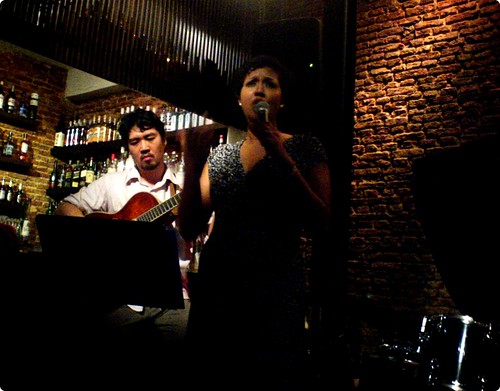
Bar Stop on Tuesdays. Schnapps, margaritas, beers on tap, 30-year whiskeys. A jazz chanteuse sings into a night of lacquered black and burnished gold. Her voice is tawny port. It is good to sip it, to let out the held breath of constant travel and savour thoughts of a week of consecutive days in the same bed, of fully unpacking the luggage, of purchasing perishables from the grocers, of making appointments without caveats, to bask in the glow of friendship.

There are friends air-kissing, friends back-slapping, friends swapping tips and updates, friends swooning at the front table, friends matchmaking, friends not sneaking out the backdoor, friends pressed into singing two songs in the second set, friends yelling yeh! yeh!, friends leaning on each other, friends with permed hair, friends laughing at friends with permed hair.

Scatting and cajoling, bantering and ribbing, sweating and bopping, fuelled by Smart Alex the barman, Rani Singam and the Half Past Late Organ Trio swing the final set to a heppin' hot end: Chok Kerong on organ, Andrew Lim on guitar and Darren Moore on drums, everybody! Thank you and good night!

Why, asks Kerong wandering up to our table, coiling the wires to his little red organ round his elbow and back up to his hand, are you guys still here?

More chatter and the dredging of glasses.

Outside, the midnight air is cool and sweet for a walk with friends.

Bar Stop
6 Devonshire Road
Singapore 239844
Tel: +65 6735 6614

Labels: ,

Thursday, May 31, 2007

Doing the Accounts

Scotch and the Bills
I fly again on Sunday to another harrowing week of negotiations in Saigon, so it was good today to have some quiet time with God. And as the grey rumbled forth and the wind rattled roof tiles and the rain beat against windows, alone-time also for a snifter of whiskey for sorting out finances and bills while folks hepped it up on digJazz, Jazz Corner, WBGO and jazzfm.

Good to discover, belatedly, the bank account looking fairly healthy, thanks to a decent-ish bonus. Am grateful that this means financial support for the evangelistic parties and ministry events planned for the rest of the year can be given without too much worried balancing of books.

Two things I ask of you, O LORD;
do not refuse me before I die:

Keep falsehood and lies far from me;
give me neither poverty nor riches,
but give me only my daily bread.

Otherwise, I may have too much and disown you
and say,"Who is the LORD?"
Or I may become poor and steal,
and so dishonour the name of my God.
(Proverbs 30:7-9)

Labels: , , ,

Tuesday, November 14, 2006

Existentialism: Exit Stage Left, Hotly Pursued By A Lobster (Boiled and Slathered with Butter. The lobster, that is.)

The nights (and days even) this last week were cold and dark and cold, bitter wind howling through the eaves, roof creaking under the heavy drumming of the rain, thunder rumbling grumbling nearby.
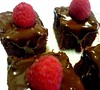
1kg Slab of Chocolate Horsing Around with Chocolate, a Hot Oven and Some Raspberries
So we took a break from wanting to throttle a really rather garrulous apostle and writing a talk to horse around messily with a 1 kg slab of chocolate, a hot oven and the last bits of a punnet of raspberries.
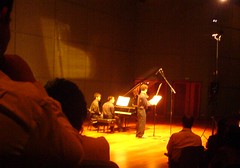
Ang Shao-wen and Lim Yan's Charity Recital
Late in the week, family friends were doing their own horsing around (an intense programme of Beethoven's "Kreutzer" and Prokofiev's "Sonata No.2 in D Major", with a pretty Paganini Cantabile and Wieniawski's showpiece "Scherzo-Tarantella" thrown in for good measure), on their own instruments of choice, for a good cause. After strings were spectacularly broken and manicured hands were wrung and big taitai hair was bobbed about, there were 5 ovations and a cheeky section of the audience demanding an encore.

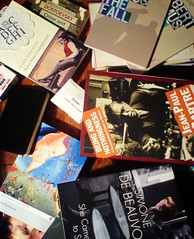
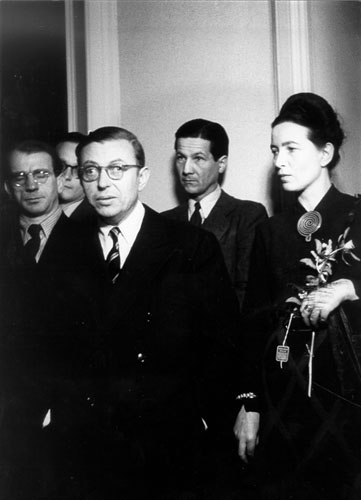
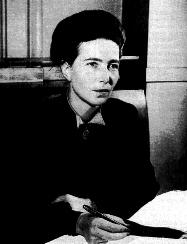
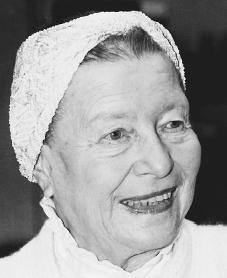
Existentialist ReadingsLater still, thanks to someone's generosity and a timetable swept clear by the rain, there was the drapping of bodies over cushy armchairs and picking up where we'd left off in our distant past, bridging that gap between the cold harsh plateau where Arthur Schopenhauer and Friedrich Nietzsche were encamped, and the psychedelic drug-addled bivouac of Jack Kerouac, Allen Ginsberg and William S Burrough. After much girding of loins (the loins, that is, of the lamb that was in the stew - with splashes of red wine), there was settling into the stacks of Søren Kierkegaard and Martin Heidegger tottering beckoningly on the table. And in the wee hours of the morning, when the storm had exhausted itself into a tired sullen patter, we moved onto the sea of Jean-Paul Sartre (also garrulous), Simone de Beauvoir, Albert Camus (well, if Dubya can...), Maurice Merleau-Ponty and Fyodor Dostoevsky spread across the floor. Balanced precariously on one pile was a healthy snifter of single malt whisky, neat, for mouthwash, because existentialists leave behind a nauseating blandness in the oral cavities.

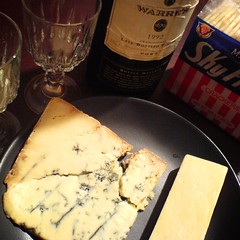
Cheese and PortIn between readings, there was some cheese and port for fortification (pun fully intended). And, because of Sartre's smoky underground St.-Germain-des-Prés dancehalls and "Le jazz, c’est comme les bananes, ça se mange sur place" ("Jazz is like a banana. It has to be consumed on the spot."), there was very bad jitterbugging to Charlie Parker, Dizzy Gillespie, John Coltrane, Benny Goodman and Miles Davies. Then bhangra-ing and slowdancing to Nouvelle Vague. Then also, because it is only by making decisions that we become significant, there was hilarious pretendingtobeinthethroesofunrequitedlove singing along to Maurice Chevalier, Edith Piaf, Jacques Brel and Yves Montand.

But if making decisions to please only ourselves and instant gratification are the only things that give us value in life, then we would be very sad gits indeed. No wonder Sartre and Beauvoir spent a good bit of their lives hepped up on caffeine, drugs and whisky (well, Sartre more than Beauvoir: late in life, he was haunted by the delusion that he was being stalked by a giant lobster).

(The story about reading existentialists is this: that just like how it is by living abroad for a period that one understands more distinctly what it is to be a born and bred Singaporean, so it is by touring (touring only hor, correctives welcome!) foreign worldviews that one sees more clearly, by contrast, contradiction and negation, what it means to be Christian.)

Lots of things need more thinking about than there was time for, just me 2¢:
Rude First Intro
I first knew of Simone de Beauvoir, in the most unlikely of ways, as the woman who denied A.J. Liebling (famed, amongst other things, for his Rabelaisian appetite and memorable gastronomic descriptions of Parisian meals, a journalist of a golden generation) a pleasant dinner at Mme. G.'s. Mme. G's, according to Liebling had been "more than a place to eat, although one ate superbly there...Madame was a bosomy woman - voluble, tawny, with a big nose and lank black hair - who made one think of a Saracen...Her conversation was a chronicle of letters and the theater" ("Between Meals"). Returning to Mme. G's some months later, Liebling was distraught to find that the original restaurant had been replaced by poor pretenders to the throne. Upon enquiry, he confirmed that Mme. G., ill, had sold the lease and the good will and had definitely retired.
"What is the matter with her?" I asked in a tone appropriate to fatal disease.
"I think it was trying to read Simone de Beauvoir," he said. "A syncope."
(A.J. Liebling, "Between Meals")
Nihilism
Understandably, those historically categorised as existentialists do not seem to have agreed to a definition of existentialism amongst themselves. If we go with Sartre, whose name is unremittingly linked to the philosophy, existentialism is "the attempt to draw all the consequences from a position of consistent atheism".

Assume as Nietzsche's soundbyte goes, "God is dead" and matter is all there is and we live in a closed universe, then humans are the only conscious beings. But we have no way of knowing that it is true that matter is all there is or that we live in a closed universe; we have no way of knowing what is reality. Then, there is also no such thing as right or wrong, moral or immoral, and everything is meaningless. Life and death are meaningless. Suicide is a mere act amongst many other acts like ordering food in a restaurant or writing a note. There is no value, significance, dignity or worth in anything. The examined life is not worth living. Complete nihilism.

Atheistic Existentialism
However, very few people can continue to subscribe to nihilism and live. Enter stage right: the atheistic existentialists. James Sire elucidates his understanding of the basic beliefs of atheistic existentialists and how they attempt to save themselves from the dark void of nihilism, from a universe devoid of any meaning:
  1. The cosmos is composed solely of matter, but to human beings reality appears in two forms - subjective and objective. The objective world is the world of material, of inexorable law, of cause and effect, of chronology, of flux, of mechanism. Human beings know of the external, objective world by virtue of careful observation, recording, hypothesizing, checking hypotheses by experiment and ever refining theories and proving guesses about the lay of the cosmos we live in. The subjective world is the world of the mind, of consciousness, of awareness, of freedom, of stability. Because, Sartre says, "the effect of all materialism is to treat all men, including the one philosophising, as objects, that is, as an ensemble of determined reactions in no way distinguished from the ensemble of qualities and phenomena which constitute a table or a chair or a stone" ("Existentialism") and yet, the one philosophising is self-conscious and self-aware (unlike the unconsciousness of the machinery of the universe), so self-conscious and self-aware beings are to find their value and meaning and significance in the subjective world. Our significance is not dependent on the facts of the material objective world over which we have no control, but on the consciousness of the subjective world over which we have complete control.
  2. For human beings alone, existence precedes essence; people make themselves who they are. "If God does not exist, there is at least one being in whom existence precedes essence, a being who exists before he can be defined by any concept and...this being is man. First of all, man exists, turns up, appears on the scene, and, only afterwards, defines himself" (Sartre, "Existentialism"). Remember the distinction drawn between the objective and the subjective worlds. The objective world is a world of essences - everything comes bearing its nature: salt is salt, trees are tree, ants are ant. Only human beings are not human before they make themselves to be so. Each of us makes himself to be human by what we do with our self-consciousness and our self-determinacy. "At first [man] is nothing. Only afterwards will he be something, and he himself will have made him what he will be" (Sartre, "Existentialism").
  3. It follows from proposition 2 that each person is totally free as regards their nature and destiny. Each of us is uncoerced, radically capable of doing anything imaginable with our subjectivity. We can think, will, imagine, dream, project visions, consider, ponder, invent. Each of us is king in our own subjective world.
  4. However, the highly wrought and tightly organised objective world stands over against human beings and appears absurd. To us subjective beings, the facticity, the hard coldness, of the objective world seems alien. As we make ourselves to be by fashioning our subjective world, we see the objective world as absurd: it does not fit us. Our dreams and visions, our desires, all our inner world of value runs smack up against a universe that is impervious to our wishes. The toughest fact to transcend is the ultimate absurdity - death. We are free only as long as we are alive. When we die, each of us is just an object among other objects.
  5. In full recognition of and against the absurdity of the objective world, the authentic person must revolt and create value. Because nothing is of value in the objective world in which we become conscious, we are free to choose our meanings and our significance. We are "condemned to be free", but in this freedom, while we are conscious, we can create value for ourselves and affirm our own worth. Our objective should be to live an "authentic" existence by keeping ever aware of the absurdity of the cosmos but rebelling against that absurdity by creating meaning in life. "The meaning of a man's life consists in proving to himself every minute that he is a man and not a piano key" (Fyodor Dostoevsky, "Notes From Underground"). A good action, therefore, is a consciously chosen action. "To choose to be this or that is to affirm at the same time the value of what we choose, because we can never choose evil. We always choose the good" (Sartre, "Existentialism"). So the good is whatever a person chooses; the good is part of subjectivity, it is not measured by a standard outside the individual's consciousness.
Though I knew not existentialism by name, I was greatly attracted to it, for a short while, as a kid. Thanks, amongst other things, to a S$5 copy of "Thus Spake Zarathustra" (unearthed in a secondhand bookshop in Holland Village while hiding from wrath of the school principal) and its logical consequences, I was very early on appraised of the nihilistic notion that life was meaningless and therefore not worth living. However, while systematically thinking about the suicide option and methodically researching various methods of committing it, I came upon Rollo May, an existential psychologist. Having already wandered through various psychological texts by the end of primary school and having thought rather poorly of the likes of Sigmund Freud and Carl Jung, Rollo May came as the proverbial breath of fresh air because, to my puny nub of grey matter, his theories considered situations that identified with my perception of reality and offered solutions that majored neither in self-help superficiality nor wayout weirdity. (He also disagreed somewhat with Freud and itching ears like these things.) Yes, he said, the lack of absolutes in the world does necessarily cause uncertainty and despair. Yes, there is evil in everyone. But we find our value in having the courage to move forward inspite of our despair, in taking responsibility for our anxiety. We are to live a radical, passionate, authentic existence - life without passion and risk and commitment is phony. (See, for example, Albert Camus' "The Myth of Sisyphus")

Problems With Existentialism
Enamoured as I was for, maybe, 2 months, it was distasteful to live life purposefully when, infact, in reality, there was no purpose to be found. That was phony. It smacked of both the blinkered positive-thinking and pearlywhite dentalwork of American motivational speakers and the ineffectual intellectual games one plays to mess with the minds of school discipline masters. (Kierkgaard's prescription of a "leap of faith" in face of the absurd, posited by many a vocational religious, seemed no better. Pascal's wager seemed a common-sensical enough way to proceed, but the question in this pluralistic society would be: which God or gods? Sartre simply condemned all these practices as "bad faith", and they are rather cowardly self-delusions.)

Solipsism
Also, various practical problems are associated with the universal subjectivity of ultimate worth (other than the issue of whether existentialism itself is subject to subjectivity). What follows on from subjectivity is solipsism, the affirmation that each person alone is the determiner of values and there are thus as many centers of value as there are persons in the cosmos at any one time.

Sartre countered this objection by insisting that every person in meeting other persons encounters a recognisable center of subjectivity. So others like us must be involved in making meaning for themselves. We are all in this absurd world together and our actions affect each other in such a way that "nothing can be good for us without being good for all" (Sartre, "Existentialism"). Moreover, as I act and think and effect my subjectivity, I am engaged in a social activity:"I am creating a certain image of a man of my own choosing. In choosing myself, I choose man" (Sartre, "Existentialism"). People living authentic lives create value not only for themselves, but for others too (Sire, "The Universe Next Door").

Ethics
In a Sartrean universe, the definitions of "good" and "evil" are turned on their heads. Good means the creation of value by choosing. Evil, then is not-choosing; it is passivity, living by the direction of others, being blown around by one's society, not recognising the absurdity of the universe.

Sartre assumes the existence of some standard of morality, even if such morality is on his terms. But his philosophical structure disallows him from having any basis or foundation for such a morality.

This does not explain our universal innate sense of right and wrong, of fairness and justice, of the value of another human life. If goodness is authenticity and authenticity is being true to one's own conscience, integrity, spirit, or character, despite external pressures to the contrary, then I choose whatever pleases me and me alone. But my choice may not be the desired choice of others though in my choosing I choose for others. Therefore, the Nazis, were praiseworthily authentic when they systematically ferreted out and killed Jewish men, women and children; therefore, the Khmer Rouge were doing "good" in wiping out 1.7 - 3 million of their own people.

Even in matters not directly related to life and death, Beauvoir's characters experience the painful consequences of the choices of another - they are taut, nervy, watchful, frantic, manic, depressive and lonely. The lack of values or morals means that no one can be trusted because everyone acts purely for their own pleasure and comfort. Everyone lies to each other. Their husbands while assuring them of transparency and honesty were not, in fact, faithful and, even when their wives were understanding of their dalliances, the husbands did not deign to tell the truth about their affairs. The wives are left yearning for relational stability, significance, value and certainty of the future. (Beauvoir's answer to this seems to be that they too should inflict themselves on others in similar ways.)

The truth is that we live life predicated on the unconscious tenet that there is an objective standard external to ourselves and that standard necessarily shapes the proper actions and relationships between subjects.

(Also, the mere methods by which Sartre conveys his thoughts on existentialism - essays, novels, plays, lectures, suggest a deterministic world where there are rules about communication and language. How self-stultifying.)

Greatness of Nihilism and Existentialism
The greatness of nihilism, though, is that it courageously and clearly presents the implications of a world without God. It honestly acknowledges that people do actually live as though God is non-existent or dead. No faffing about, no hiding behind pretty intellectual theories. The basic truth about man and his condition in a world without God is that life is meaningless and bleak. And what is interesting about existentialism is that underlying all the variations on a theme is the concept that man is somehow estranged from his essential nature.

But existentialism as salvation from nihilism is, to put it mildly and politely, both externally and internally incoherent and practically untenable.

Exit Stage Left

Ultimately, Sartre's pour-soi philosophy seems more a lifetime's work of justifying his rebellious urge, intellectual posturing and selfish self-indulgence than vice versa. The diaries, letters and autobiographies of Sartre and Beauvoir show that in real life, they sought to attain their worth not from their own choices or being true to that which was internal and within them, but to the external pleasures and affirmation that those choices afforded - young lovers to stave off the fear of mortality, aging and death, attention and approval from others. Beauvoir said of one of her lovers, Claude Lanzmann, 17 years her junior, that above all, he gave her "freedom from [her] age" (note, not freedom from oppressive societal values etc). Despair and depression ensued when the result of their choices was not as they desired, and drugs and alcohol were abused to rid them of this ennui, this meaningless void in themselves and the hollow emptiness they saw at the heart of all things.

Existentialists lived, communicated, felt and made decisions according to certain values that were not the direct outworking of their philosophy. Even if atheistic existentialists say they are more moral or ethical than theists, by their own stated beliefs, they have no claim on any system of morality or ethics. Arguably, this does not necessarily prove that there is a higher moral order or a higher being; social contract, Darwanian social theory, utilitarianism or one's pick-and-mix of sociological-ethical theories might be able to explain perceived social codes without resorting to the presence of a god.

But...

...while it may not be a terribly intellectually-sexy observation, if human beings do actually live according to certain epistemologies even if they cannot theoretically prove the truth of such epistemologies, then whatever the niceties and fetching intricacies of these epistemologies, they cannot practically hold water unless they assume that however absurd the objective world, it cannot be ignored. For if you think the world is illusory or that you can out-think the law of gravity, and you step off the top of a tall building, you can be sure that you'll end up a sorry splat on the pavement below.

And of all the competing worldviews, the Christian one contains an eminently viable epistemology based on historical facts. It is deliciously coherent both externally and internally. Christians are given a strong foundation for ultimate knowledge, meaning, love, hope, truth, joy, and assurance for the future. But it is not mere cowardly "bad faith" or wishful thinking or living on Cloud Cuckoo Land, it is based on objective facts, the same facts that we depend upon throughout our daily lives. Fierce!

...

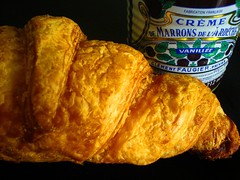
In the morning, the air was fresh. The Planetshakers were "Arise"-ing (for the textured, layered sound; definitely not for the existential saturated-self lyrics) and Jack Johnson's "In Between Dreams" was discovered in between the pages of a book where someone at some point in spacetime had co-opted it as a bookmark. There was basking in the sunshine, birds in the azure sky, croissants and a tin of crème de marrons chestnut spread each (yay, Clement Faugier!) and strong coffee.
Croissant and Crème de Marrons
Jabba the Hutt exits stage right

Righto. So much for me 2¢. Now that that's been pensieved, back to writing that elusive talk.

PS: One is immensely tempted to pun "the wall-eyed Sartre", but that, even to the existentialist, would be cruel.

Labels: , , , , ,

Tuesday, June 07, 2005

Jazz and That Woman in Proverbs 31

As we sat listening to yet another skinny chinese girl with rebonded hair, a singlet and jeans and limbs like sticks looking particularly unhappy singing jazz, we wondered: What's a good jazz voice?

Beauty is in the eye of the beholder, we are told. And I'm personally fond of jazz voices that can be described with cheesily as:
black-velvet, rich vintage port, individual, smoky and unique, husky with life experience, mysterious, private yet honest, confidently inventive, stately sirloin with oak-aged burgundy, creative, talent tinged with sadness, sultry presence, soaring and energetic, beautiful real pain, heart-melting, mesmerizing, smoothly-drawn cigars, mellow layered malt, solid and reliable, creamy and silky smooth, earthy woody tangy spicy
SL informed me that my idea of a beautiful jazz voice isn't particularly shared by most people in Singapore.

The idea of beauty seems more consensual at weddings. A beautiful woman and a beautiful wife, many a speechgiver has never failed to point out, exudes the qualities of that woman described by Proverbs 31.

Suffice to say that a good jazz voice isn't part of the package.

In any case, a closer look (now that we're reading great chunks of Proverbs) suggests that that woman in Proverbs 31 isn't not so much a checklist of good/beautiful wifely qualities as the very picture of the wise person that has been described in the rest of Proverbs. Here is a visual display of someone who has attained all the goals of wisdom set out in Proverbs 1:2-6 and so, the purpose of the authors in writing Proverbs. In her, all the major attributes of wisdom come together in one person, illustrating what it means to be wise and live wisely.

She is utterly trustworthy (v11) and an eager worker (vv13-14). She is generous and compassionate (v20) and a master of her tongue (v26). She lives for others, and as she does so, she herself is blessed (vv28-31).

If we are not to be the fool who will end his sorry days in terrible disaster, we are to be like the wise wife of Proverbs 31, whatever our gender.

And what's her secret?

It's that which the author(s) of Proverbs have already whispered loudly in our ears: she is a woman who fears the LORD (v30).

Labels:

Thursday, March 17, 2005

Side Effects of Being Christian

On one of our weekly late night jazz drives, someone noted that one of the side benefits of being Christian and learning to lead bible studies is the translatability to the workplace of the social and intellectual skills learnt: presenting information in a clear but faithful manner, always backed up with evidence, and dealing with antagonistic people calmly and with dignity and love. I think this works as well for people who do not lead but learn to read the bible for themselves and to love their DG mates.

Would it be complete misrepresentation to put out an ad for courses in presentation and EQ and then teach eager students the gospel? Many a missionary has gone into a "closed country" as an English teacher and taught English from the bible.

Noticed another side effect this week. Faced with an "important" board meeting and a bible study on the same day, realised that I lack the same fear of the higher echelons of the corporate food chain as many others and seem to be have been shielded from the nervous, too-loud laughter at jokes of the powers-that-be and the scurrying around and hasty promises of acquiring the moon and the stars. I can speak to the richest man in Singapore as to an equal, without bowing or scraping.

An idea for a course in self-confidence? Perhaps. Self-confidence that can only come not from any power of positive-thinking and self-valuation of myself in grand Rollo May style, but with knowing and being known by the Creator and having a relationship with One who is above all powers and authorities. This, surely, is freedom indeed.

Labels: