Tuesday, April 13, 2010

Quest for Immortality: EPIC FAIL (Ecclesiastes 1:1-15)

The words of the Preacher, the son of David, king in Jerusalem.
Vanity of vanities, says the Preacher,
vanity of vanities! All is vanity.
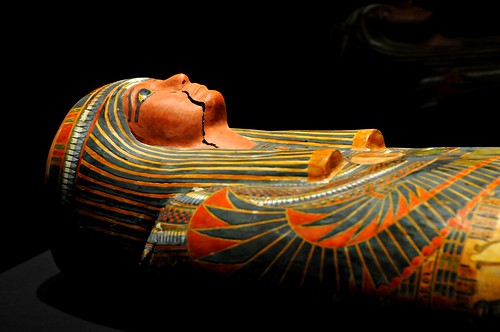
Mummy of Pe-de-ese in cartonnage cover
Mummy of Pe-de-ese in cartonnage cover.
"里面有人" - museum staff
"Pe-de-ese, doorkeeper of the temple of Amun, died when he was 35 to 50 years old. X-rays reveal Harris Lines on the shin bone. These form in bones during the early stages of life - when the bones were still growing - and are caused by stress, disease or poor nutrition. This indicates that as a child, Pe-de-ese must have faced some hardship."
What does man gain by all the toil
at which he toils under the sun?
A generation goes, and a generation comes,
but the earth remains forever.
The sun rises, and the sun goes down,
and hastens to the place where it rises.
The wind blows to the south
and goes around to the north;
around and around goes the wind,
and on its circuits the wind returns.
All streams run to the sea,
but the sea is not full;
to the place where the streams flow,
there they flow again.
The same sun that beat down on the weathered backs of the Egyptians constructing the pyramids now causes eye-straining glare off our computer screens. No one knows the names of those whose sweat stained the stone blocks any more than anyone will remember the cubicled worker bees who make up an economic edifice.
Man comes and tills the field and lies beneath,
And after many a summer dies the swan.*
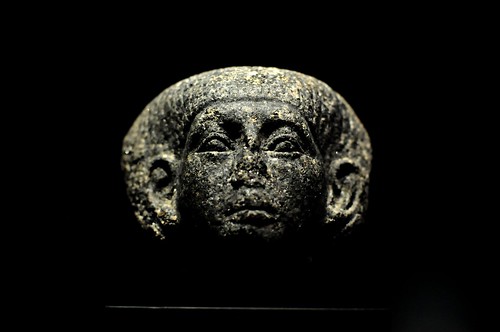
Male Statue Head
"This sculpted head is probably of King Am[...] as the features are reminiscent of images of him in the style of the time. The extensive damage to the lower parts of the wig that the head had been subsequently used as a grinding stone for a manual mill."

A man's life is here today and gone tomorrow, a vapour in the wind. All his hopes and dreams, and work and achievements, and his personality and relationships, condensed into the few years of his existence means nothing in the long history of the world. You and I, we are of no significance in the grand scheme of things.

And even the things that greatly outlast human generations seem without direction or purpose. There is only endless repetition. The tedious days and months and seasons and cycles never produce anything new.

In spite of the constant activity, nothing is of lasting significance in and of themselves; there is no purpose in anything. What's the point of living? Let's stop all the dishonesty about making your life count and living well.
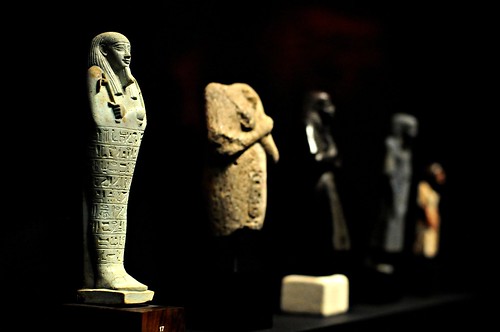
Shabtis
"In ancient Egypt, a labour system existed for important communal projects such as maintaining the irrigation systems that controlled the Nile flood. It was imagined that such a system might also exist in the afterlife. This could be avoided by having small mummy-shaped figurines of the deceased known as shabti, which would magically perform work on behalf of their owner. They were made of stone, wood, faience, pottery or bronze, and were a regular feature of tomb equipment from the Middle Kingdom (2123-1650 BCE) to the Ptolemaic period (332-30 BCE)." Fast forward a few centuries and you'll find skea building customised paper houses, pets and servants for Taoists to burn for their dead.
All things are full of weariness;
a man cannot utter it;
the eye is not satisfied with seeing,
nor the ear filled with hearing.
What has been is what will be,
and what has been done is what will be done,
and there is nothing new under the sun.
Is there a thing of which it is said,
"See, this is new"?
It has been already
in the ages before us.
There is no remembrance of former things,
nor will there be any remembrance
of later things yet to be
among those who come after. (Ecclesiastes 1:1-11)
History teachers tell us that those who do not know history are doomed to repeat it. But the people who intone such motivational spiel might not, themselves, have really studied human history. All revolutions and "radical!" "original!" ideas and movements have been thought of before and are but part of the cycle of human exertion. Nothing really changes; nothing is new.

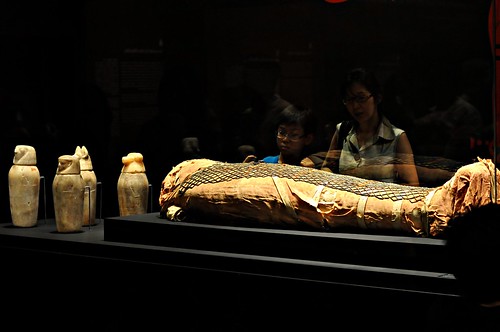
Mummy of Nekhet-iset-aru and canopic jars
"里面有人" - same museum staff


The human experience for both Christian and non-Christian is the same. Our existence is prima facie fleeting, absurd, valueless, pointless, meaningless. Nothing lasts. And we are unable to change anything; we are unable to escape from these endless cycles until death releases us from this weariness. The existentialists (in all their dreary variations on the same theme) may have been right. And anyone who says otherwise is selling something.

The Teacher - Preacher has left no stone unturned in searching for significance in life. His research paper is the Book of Ecclesiastes and his conclusion is:
I have seen everything that is done under the sun, and behold, all is vanity and a striving after wind. (Ecclesiastes 1:14)
In his great wisdom, the Qoheleth sees that this futility and inscrutability, this unhappy business of searching but not finding and of wanting meaning and purpose but experiencing only endless meaningless repetition and of yearning but never being satisfied by anything done under the sun, has been ordained by God himself (Ecclesiastes 1:12-13).
What is crooked cannot be made straight,
and what is lacking cannot be counted. (Ecclesiastes 1:15)
Who can unravel what God has twisted? How can a finite being understand the infinite? Everything in this present age, in this world, is vapour. Yet there is Someone who stands outside this absurdity who has ordained this emptiness...


Ecclesiastes
Easter Everyday
Quest for Immortality: EPIC FAIL (Ecclesiastes 1:1-15)
Life is Vapour, Therefore Enjoy Life (Ecclesiastes 2:1-3:15)
Life is Far Worse than an iPhone Game, Therefore Harvest the Day! (Ecclesiastes 3:16-5:7)
Rawa Island and Godly Contentment (Ecclesiastes 5:8 - 6:9)
Fallen Frangipani, Really Wise Living (Ecclesiastes 6:10-7:29)

************

Quest for Immortality Exhibition, National Museum of Singapore

*from Lord Alfred Tennyson's Tithonus. Tithonus, having been granted immortality by a goddess was doomed to live for eternity with the effects of sin, in a fallen degenerating body.
Bust of a goddess
Death to him would have been, in fact, a welcome relief.

Labels: , ,

Tuesday, November 14, 2006

Existentialism: Exit Stage Left, Hotly Pursued By A Lobster (Boiled and Slathered with Butter. The lobster, that is.)

The nights (and days even) this last week were cold and dark and cold, bitter wind howling through the eaves, roof creaking under the heavy drumming of the rain, thunder rumbling grumbling nearby.
1kg Slab of Chocolate Horsing Around with Chocolate, a Hot Oven and Some Raspberries
So we took a break from wanting to throttle a really rather garrulous apostle and writing a talk to horse around messily with a 1 kg slab of chocolate, a hot oven and the last bits of a punnet of raspberries.
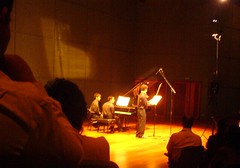
Ang Shao-wen and Lim Yan's Charity Recital
Late in the week, family friends were doing their own horsing around (an intense programme of Beethoven's "Kreutzer" and Prokofiev's "Sonata No.2 in D Major", with a pretty Paganini Cantabile and Wieniawski's showpiece "Scherzo-Tarantella" thrown in for good measure), on their own instruments of choice, for a good cause. After strings were spectacularly broken and manicured hands were wrung and big taitai hair was bobbed about, there were 5 ovations and a cheeky section of the audience demanding an encore.

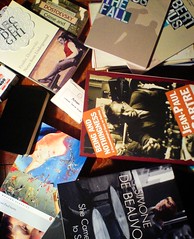
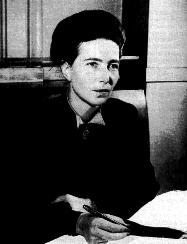
Existentialist ReadingsLater still, thanks to someone's generosity and a timetable swept clear by the rain, there was the drapping of bodies over cushy armchairs and picking up where we'd left off in our distant past, bridging that gap between the cold harsh plateau where Arthur Schopenhauer and Friedrich Nietzsche were encamped, and the psychedelic drug-addled bivouac of Jack Kerouac, Allen Ginsberg and William S Burrough. After much girding of loins (the loins, that is, of the lamb that was in the stew - with splashes of red wine), there was settling into the stacks of Søren Kierkegaard and Martin Heidegger tottering beckoningly on the table. And in the wee hours of the morning, when the storm had exhausted itself into a tired sullen patter, we moved onto the sea of Jean-Paul Sartre (also garrulous), Simone de Beauvoir, Albert Camus (well, if Dubya can...), Maurice Merleau-Ponty and Fyodor Dostoevsky spread across the floor. Balanced precariously on one pile was a healthy snifter of single malt whisky, neat, for mouthwash, because existentialists leave behind a nauseating blandness in the oral cavities.

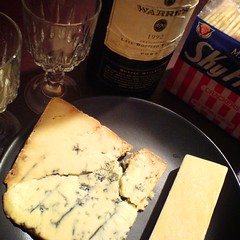
Cheese and PortIn between readings, there was some cheese and port for fortification (pun fully intended). And, because of Sartre's smoky underground St.-Germain-des-Prés dancehalls and "Le jazz, c’est comme les bananes, ça se mange sur place" ("Jazz is like a banana. It has to be consumed on the spot."), there was very bad jitterbugging to Charlie Parker, Dizzy Gillespie, John Coltrane, Benny Goodman and Miles Davies. Then bhangra-ing and slowdancing to Nouvelle Vague. Then also, because it is only by making decisions that we become significant, there was hilarious pretendingtobeinthethroesofunrequitedlove singing along to Maurice Chevalier, Edith Piaf, Jacques Brel and Yves Montand.

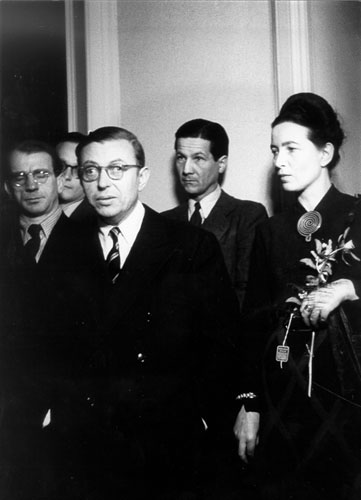
But if making decisions to please only ourselves and instant gratification are the only things that give us value in life, then we would be very sad gits indeed. No wonder Sartre and Beauvoir spent a good bit of their lives hepped up on caffeine, drugs and whisky (well, Sartre more than Beauvoir: late in life, he was haunted by the delusion that he was being stalked by a giant lobster).

(The story about reading existentialists is this: that just like how it is by living abroad for a period that one understands more distinctly what it is to be a born and bred Singaporean, so it is by touring (touring only hor, correctives welcome!) foreign worldviews that one sees more clearly, by contrast, contradiction and negation, what it means to be Christian.)

Lots of things need more thinking about than there was time for, just me 2¢:
Rude First Intro
I first knew of Simone de Beauvoir, in the most unlikely of ways, as the woman who denied A.J. Liebling (famed, amongst other things, for his Rabelaisian appetite and memorable gastronomic descriptions of Parisian meals, a journalist of a golden generation) a pleasant dinner at Mme. G.'s. Mme. G's, according to Liebling had been "more than a place to eat, although one ate superbly there...Madame was a bosomy woman - voluble, tawny, with a big nose and lank black hair - who made one think of a Saracen...Her conversation was a chronicle of letters and the theater" ("Between Meals"). Returning to Mme. G's some months later, Liebling was distraught to find that the original restaurant had been replaced by poor pretenders to the throne. Upon enquiry, he confirmed that Mme. G., ill, had sold the lease and the good will and had definitely retired.
"What is the matter with her?" I asked in a tone appropriate to fatal disease.
"I think it was trying to read Simone de Beauvoir," he said. "A syncope."
(A.J. Liebling, "Between Meals")
Nihilism
Understandably, those historically categorised as existentialists do not seem to have agreed to a definition of existentialism amongst themselves. If we go with Sartre, whose name is unremittingly linked to the philosophy, existentialism is "the attempt to draw all the consequences from a position of consistent atheism".

Assume as Nietzsche's soundbyte goes, "God is dead" and matter is all there is and we live in a closed universe, then humans are the only conscious beings. But we have no way of knowing that it is true that matter is all there is or that we live in a closed universe; we have no way of knowing what is reality. Then, there is also no such thing as right or wrong, moral or immoral, and everything is meaningless. Life and death are meaningless. Suicide is a mere act amongst many other acts like ordering food in a restaurant or writing a note. There is no value, significance, dignity or worth in anything. The examined life is not worth living. Complete nihilism.

Atheistic Existentialism
However, very few people can continue to subscribe to nihilism and live. Enter stage right: the atheistic existentialists. James Sire elucidates his understanding of the basic beliefs of atheistic existentialists and how they attempt to save themselves from the dark void of nihilism, from a universe devoid of any meaning:
  1. The cosmos is composed solely of matter, but to human beings reality appears in two forms - subjective and objective. The objective world is the world of material, of inexorable law, of cause and effect, of chronology, of flux, of mechanism. Human beings know of the external, objective world by virtue of careful observation, recording, hypothesizing, checking hypotheses by experiment and ever refining theories and proving guesses about the lay of the cosmos we live in. The subjective world is the world of the mind, of consciousness, of awareness, of freedom, of stability. Because, Sartre says, "the effect of all materialism is to treat all men, including the one philosophising, as objects, that is, as an ensemble of determined reactions in no way distinguished from the ensemble of qualities and phenomena which constitute a table or a chair or a stone" ("Existentialism") and yet, the one philosophising is self-conscious and self-aware (unlike the unconsciousness of the machinery of the universe), so self-conscious and self-aware beings are to find their value and meaning and significance in the subjective world. Our significance is not dependent on the facts of the material objective world over which we have no control, but on the consciousness of the subjective world over which we have complete control.
  2. For human beings alone, existence precedes essence; people make themselves who they are. "If God does not exist, there is at least one being in whom existence precedes essence, a being who exists before he can be defined by any concept and...this being is man. First of all, man exists, turns up, appears on the scene, and, only afterwards, defines himself" (Sartre, "Existentialism"). Remember the distinction drawn between the objective and the subjective worlds. The objective world is a world of essences - everything comes bearing its nature: salt is salt, trees are tree, ants are ant. Only human beings are not human before they make themselves to be so. Each of us makes himself to be human by what we do with our self-consciousness and our self-determinacy. "At first [man] is nothing. Only afterwards will he be something, and he himself will have made him what he will be" (Sartre, "Existentialism").
  3. It follows from proposition 2 that each person is totally free as regards their nature and destiny. Each of us is uncoerced, radically capable of doing anything imaginable with our subjectivity. We can think, will, imagine, dream, project visions, consider, ponder, invent. Each of us is king in our own subjective world.
  4. However, the highly wrought and tightly organised objective world stands over against human beings and appears absurd. To us subjective beings, the facticity, the hard coldness, of the objective world seems alien. As we make ourselves to be by fashioning our subjective world, we see the objective world as absurd: it does not fit us. Our dreams and visions, our desires, all our inner world of value runs smack up against a universe that is impervious to our wishes. The toughest fact to transcend is the ultimate absurdity - death. We are free only as long as we are alive. When we die, each of us is just an object among other objects.
  5. In full recognition of and against the absurdity of the objective world, the authentic person must revolt and create value. Because nothing is of value in the objective world in which we become conscious, we are free to choose our meanings and our significance. We are "condemned to be free", but in this freedom, while we are conscious, we can create value for ourselves and affirm our own worth. Our objective should be to live an "authentic" existence by keeping ever aware of the absurdity of the cosmos but rebelling against that absurdity by creating meaning in life. "The meaning of a man's life consists in proving to himself every minute that he is a man and not a piano key" (Fyodor Dostoevsky, "Notes From Underground"). A good action, therefore, is a consciously chosen action. "To choose to be this or that is to affirm at the same time the value of what we choose, because we can never choose evil. We always choose the good" (Sartre, "Existentialism"). So the good is whatever a person chooses; the good is part of subjectivity, it is not measured by a standard outside the individual's consciousness.
Though I knew not existentialism by name, I was greatly attracted to it, for a short while, as a kid. Thanks, amongst other things, to a S$5 copy of "Thus Spake Zarathustra" (unearthed in a secondhand bookshop in Holland Village while hiding from wrath of the school principal) and its logical consequences, I was very early on appraised of the nihilistic notion that life was meaningless and therefore not worth living. However, while systematically thinking about the suicide option and methodically researching various methods of committing it, I came upon Rollo May, an existential psychologist. Having already wandered through various psychological texts by the end of primary school and having thought rather poorly of the likes of Sigmund Freud and Carl Jung, Rollo May came as the proverbial breath of fresh air because, to my puny nub of grey matter, his theories considered situations that identified with my perception of reality and offered solutions that majored neither in self-help superficiality nor wayout weirdity. (He also disagreed somewhat with Freud and itching ears like these things.) Yes, he said, the lack of absolutes in the world does necessarily cause uncertainty and despair. Yes, there is evil in everyone. But we find our value in having the courage to move forward inspite of our despair, in taking responsibility for our anxiety. We are to live a radical, passionate, authentic existence - life without passion and risk and commitment is phony. (See, for example, Albert Camus' "The Myth of Sisyphus")

Problems With Existentialism
Enamoured as I was for, maybe, 2 months, it was distasteful to live life purposefully when, infact, in reality, there was no purpose to be found. That was phony. It smacked of both the blinkered positive-thinking and pearlywhite dentalwork of American motivational speakers and the ineffectual intellectual games one plays to mess with the minds of school discipline masters. (Kierkgaard's prescription of a "leap of faith" in face of the absurd, posited by many a vocational religious, seemed no better. Pascal's wager seemed a common-sensical enough way to proceed, but the question in this pluralistic society would be: which God or gods? Sartre simply condemned all these practices as "bad faith", and they are rather cowardly self-delusions.)

Solipsism
Also, various practical problems are associated with the universal subjectivity of ultimate worth (other than the issue of whether existentialism itself is subject to subjectivity). What follows on from subjectivity is solipsism, the affirmation that each person alone is the determiner of values and there are thus as many centers of value as there are persons in the cosmos at any one time.

Sartre countered this objection by insisting that every person in meeting other persons encounters a recognisable center of subjectivity. So others like us must be involved in making meaning for themselves. We are all in this absurd world together and our actions affect each other in such a way that "nothing can be good for us without being good for all" (Sartre, "Existentialism"). Moreover, as I act and think and effect my subjectivity, I am engaged in a social activity:"I am creating a certain image of a man of my own choosing. In choosing myself, I choose man" (Sartre, "Existentialism"). People living authentic lives create value not only for themselves, but for others too (Sire, "The Universe Next Door").

Ethics
In a Sartrean universe, the definitions of "good" and "evil" are turned on their heads. Good means the creation of value by choosing. Evil, then is not-choosing; it is passivity, living by the direction of others, being blown around by one's society, not recognising the absurdity of the universe.

Sartre assumes the existence of some standard of morality, even if such morality is on his terms. But his philosophical structure disallows him from having any basis or foundation for such a morality.

This does not explain our universal innate sense of right and wrong, of fairness and justice, of the value of another human life. If goodness is authenticity and authenticity is being true to one's own conscience, integrity, spirit, or character, despite external pressures to the contrary, then I choose whatever pleases me and me alone. But my choice may not be the desired choice of others though in my choosing I choose for others. Therefore, the Nazis, were praiseworthily authentic when they systematically ferreted out and killed Jewish men, women and children; therefore, the Khmer Rouge were doing "good" in wiping out 1.7 - 3 million of their own people.

Even in matters not directly related to life and death, Beauvoir's characters experience the painful consequences of the choices of another - they are taut, nervy, watchful, frantic, manic, depressive and lonely. The lack of values or morals means that no one can be trusted because everyone acts purely for their own pleasure and comfort. Everyone lies to each other. Their husbands while assuring them of transparency and honesty were not, in fact, faithful and, even when their wives were understanding of their dalliances, the husbands did not deign to tell the truth about their affairs. The wives are left yearning for relational stability, significance, value and certainty of the future. (Beauvoir's answer to this seems to be that they too should inflict themselves on others in similar ways.)

The truth is that we live life predicated on the unconscious tenet that there is an objective standard external to ourselves and that standard necessarily shapes the proper actions and relationships between subjects.

(Also, the mere methods by which Sartre conveys his thoughts on existentialism - essays, novels, plays, lectures, suggest a deterministic world where there are rules about communication and language. How self-stultifying.)

Greatness of Nihilism and Existentialism
The greatness of nihilism, though, is that it courageously and clearly presents the implications of a world without God. It honestly acknowledges that people do actually live as though God is non-existent or dead. No faffing about, no hiding behind pretty intellectual theories. The basic truth about man and his condition in a world without God is that life is meaningless and bleak. And what is interesting about existentialism is that underlying all the variations on a theme is the concept that man is somehow estranged from his essential nature.

But existentialism as salvation from nihilism is, to put it mildly and politely, both externally and internally incoherent and practically untenable.

Exit Stage Left

Ultimately, Sartre's pour-soi philosophy seems more a lifetime's work of justifying his rebellious urge, intellectual posturing and selfish self-indulgence than vice versa. The diaries, letters and autobiographies of Sartre and Beauvoir show that in real life, they sought to attain their worth not from their own choices or being true to that which was internal and within them, but to the external pleasures and affirmation that those choices afforded - young lovers to stave off the fear of mortality, aging and death, attention and approval from others. Beauvoir said of one of her lovers, Claude Lanzmann, 17 years her junior, that above all, he gave her "freedom from [her] age" (note, not freedom from oppressive societal values etc). Despair and depression ensued when the result of their choices was not as they desired, and drugs and alcohol were abused to rid them of this ennui, this meaningless void in themselves and the hollow emptiness they saw at the heart of all things.

Existentialists lived, communicated, felt and made decisions according to certain values that were not the direct outworking of their philosophy. Even if atheistic existentialists say they are more moral or ethical than theists, by their own stated beliefs, they have no claim on any system of morality or ethics. Arguably, this does not necessarily prove that there is a higher moral order or a higher being; social contract, Darwanian social theory, utilitarianism or one's pick-and-mix of sociological-ethical theories might be able to explain perceived social codes without resorting to the presence of a god.

But...

...while it may not be a terribly intellectually-sexy observation, if human beings do actually live according to certain epistemologies even if they cannot theoretically prove the truth of such epistemologies, then whatever the niceties and fetching intricacies of these epistemologies, they cannot practically hold water unless they assume that however absurd the objective world, it cannot be ignored. For if you think the world is illusory or that you can out-think the law of gravity, and you step off the top of a tall building, you can be sure that you'll end up a sorry splat on the pavement below.

And of all the competing worldviews, the Christian one contains an eminently viable epistemology based on historical facts. It is deliciously coherent both externally and internally. Christians are given a strong foundation for ultimate knowledge, meaning, love, hope, truth, joy, and assurance for the future. But it is not mere cowardly "bad faith" or wishful thinking or living on Cloud Cuckoo Land, it is based on objective facts, the same facts that we depend upon throughout our daily lives. Fierce!

...

In the morning, the air was fresh. The Planetshakers were "Arise"-ing (for the textured, layered sound; definitely not for the existential saturated-self lyrics) and Jack Johnson's "In Between Dreams" was discovered in between the pages of a book where someone at some point in spacetime had co-opted it as a bookmark. There was basking in the sunshine, birds in the azure sky, croissants and a tin of crème de marrons chestnut spread each (yay, Clement Faugier!) and strong coffee.
Croissant and Crème de Marrons
Jabba the Hutt exits stage right

Righto. So much for me 2¢. Now that that's been pensieved, back to writing that elusive talk.

PS: One is immensely tempted to pun "the wall-eyed Sartre", but that, even to the existentialist, would be cruel.

Labels: , , , , ,

Monday, August 14, 2006

Three Days Of Reading Haruki Murakami

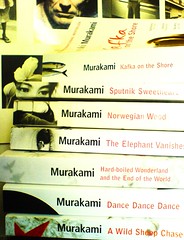
Not having the benefit of frequent London transportation strikes unlike some, we made do with the National Day holiday and the recent weekend to get stuck into a certain much-feted author. Besides, Borders was selling 3 Haruki Murakamis for the price of 2. Would have preferred the ones with John Gall's cover art. But a discounted book is a discounted book.

[Sidenote 1: Yes, I'm very left in the dust behind the Murakami fan-wagon. ;-). Aiyah. Haven't read much fiction since secondary school.]

Murakami and the Red Dot Traffic Building
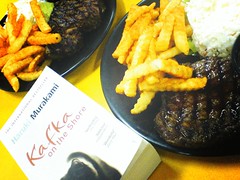
[Sidenote 2: The Red Dot Traffic Building houses a nice quiet Pacific Coffee Company outlet with cushy red plush armchairs, leather sofas and Vietnamese paper lamps that is highly conducive for long-term Murakami reading.]

3 Days of Murakami
On a blasphemously quick read of many of his books within 3 days, the catchy universality of Murakami, it seems, stems less from his Western cultural references than his realistic portrayal of urban malaise in many works ("A Wild Sheep Chase", "Dance Dance Dance", "Hardboiled Wonderland and the End of the World", "Norwegian Wood", perhaps "The Wind-Up Bird Chronicle", maybe "South of the Border, West of the Sun", "Sputnik Sweetheart" and "Kafka On The Shore"). Quite a few of his male protagonists are passionless loners, unaffected by their wives' betrayals (if any). They are alienated from their families. They are individualistic outsiders, disengaged from community and self-sufficient: able to cook, clean and iron their own clothes. They are disconnected from the girls they sleep with, having sex without emotion or guilt. They had no interest in grades at school. They intentionally avoid the Japanese culture of joining a company and clawing their way up the career ladder. They may be unemployed because they find no interest in work, or, to survive, they may "shovel cultural snow", doing the lowly, thoughtless, thankless tasks that need to be done in society. They keep their heads down. Life to them is pointless and meaningless. They are aimless and irresolute. They have no special talents. We never know their true names nor the names of some of the women that disappear "like smoke" on them. They are suffused with the bittersweet smell of loss. In a Philip Marlowe-ish way, there is a sense that even though they may be unaware of it, their emptiness and cynicism, their thick psychological shells, their chain-smoking coffee-glupping and hard drinking, their distractions of music/food/books, are defensive reactions to some dark past, some unnamed pain. The narrator of "Sputnik Sweetheart" says:
(I) draw an invisible boundary between myself and other people. No matter who I was dealing with. I maintained a set distance, carefully monitoring the person's attitude so that they wouldn't get any closer.
Into this banal mundanity is frequently introduced the fantastical: hard-boiled Raymond Chandler and Dashiell Hammett, suburban Raymond Carver with a sort of dreamscape that is very different from the humour of Neil Gaiman or the horror of Franz Kafka but somewhat similar to the permeable Shinto worlds of Hayao Miyazaki (and we like Miyazaki). Kazuo Ishigoro calls it a "deadpan, surreal-verging-on-absurdist comic tone, a willingness to bend the edges of reality in stories set in an otherwise mundane setting". There is a pinch of film noir and David Lynch and a grain of Thomas Pynchon. There is a dash of the metaphoricalism of Richard Brautigan and determinism of Kurt Vonnegut - the characters do not control their own lives (express Sophoclean prophecy as in "Kafka On The Shore" or otherwise), passive recipients of what life deals them. Stylistically, "Hardboiled Wonderland" resembles Philip K Dick, of whom I'm fond, Lewis Carroll and fantasy of the David Eddings garden variety. Some of "The Elephant Vanishes" is more Raymond Carver short stories-ish but lacks its minimalism. Bits of "The Wind-Up Bird Chronicle" are quite Giovanni Boccaccio and Ernest Hemingway simultaneously. In "Kafka On The Shore" Murakami suggests the packed knowledge of Jorge Luis Borges, my all-time top ten favourite fiction writer (yes, should lay off the Nick Hornby) and expressly quotes Borges in "Hardboiled Wonderland" (so Murakami can't be half bad?).

But being neither a besotted fan, a studious student of literature nor a contemptuous literary critic, what was of interest to me wasn't Murakami's writing style nor the fresh tactile perkiness of his descriptions nor his characterisation nor his plot layout nor primarily, his observation of modern consumerist societies, nor the metaphors of subterranean spaces, shadows and telephones nor, err, that obsession with beautiful female ears, but the conflicts in the stories and their resolution. If the common problem with the protagonists is that they are emotionless and so less than 100% human, struggling to live in a chaotic unknowable world, then we expect that it is through their encounters with enigmatic vanishing women and their own fantastical experiences that they remember their pasts, rediscover their sense of self and humanness, and figure out how to get connected again, to work their way out of the labyrinth.

Are the fantastical aspects of the characters' experiences real? Or are they tales they tell themselves, parallel worlds, splintered psyches, doppelgängers, that they create, to sort out their present? Are they journeys of self-exploration that take place in states of consciousness? Are they Heinrich Zimmer-Joseph Campbell type mythologies that provide the individuals the roadmaps to navigate the complex modern world? "The best way to think about reality," declares the narrator of "The Wind-Up Bird Chronicle", is "to get as far away from it as possible".

And what comes of all this thinking about reality? The words "reconnect" and "rediscover" imply solutions that are neat, tyingupoflooseends, satisfying. But with Murakami, there are no fully-flowered bildungsroman conclusions. The most the characters learn is how human beings must survive on their own, how they must cope with their hollowness, their distance from others, in this meaningless world as they hurtle, silently, stoically, towards certain death and oblivion. There is no going back. The best they can do is to accept things they cannot understand and leave them that way, keep dancing, keep spinning, in the here-and-now, to survive in this hostile world where there are neither safe havens nor stable relationships. The idea is almost Taoist (that is, the original Taoism, not the animistic one commonly practised in South-East Asia).

Christian novelists should have in their hands a fair better answer to this pomo existentialism and alienation of self that besets the modern society, more satisfying than advocating the flimsy merging of the Jungian conscious and unconscious worlds or forced engagement with a valueless purposeless universe. But if a Christian wrote such a beautifully-worded novel, would it be globally panned by the literary critics for being unspeakably, well, regressive?

As a kid, I read fiction voraciously, hoping to find in stories the meaning to non-fictive life. Now that I have the truth about real life, these stories yield 2 layers of fiction: the first being the fictive narrative itself and the second, the message behind that narrative, the ontology of that fictional world. Hmmm..it'll be interesting to do a prose piece on that. Very Russian-dolls-like.

Kafka On The Shore
*************

Some other Murakami short stories may be accessed online:
"The Folklore of Our Times"
"Hunting Knife"

The typeface for the "Kafka On The Shore" hardcover is apparently Electra (hurhurhur).

Is it just me or does the black cat on the paperback cover of "Kafka On The Shore" look like Jiji in Hayao Miyazaki's "Kiki's Delivery Service"?

Labels: ,