Thursday, May 31, 2007

Doing the Accounts

Scotch and the Bills
I fly again on Sunday to another harrowing week of negotiations in Saigon, so it was good today to have some quiet time with God. And as the grey rumbled forth and the wind rattled roof tiles and the rain beat against windows, alone-time also for a snifter of whiskey for sorting out finances and bills while folks hepped it up on digJazz, Jazz Corner, WBGO and jazzfm.

Good to discover, belatedly, the bank account looking fairly healthy, thanks to a decent-ish bonus. Am grateful that this means financial support for the evangelistic parties and ministry events planned for the rest of the year can be given without too much worried balancing of books.

Two things I ask of you, O LORD;
do not refuse me before I die:

Keep falsehood and lies far from me;
give me neither poverty nor riches,
but give me only my daily bread.

Otherwise, I may have too much and disown you
and say,"Who is the LORD?"
Or I may become poor and steal,
and so dishonour the name of my God.
(Proverbs 30:7-9)

Labels: , , ,

Friday, November 17, 2006

Colleague's Retirement Plans

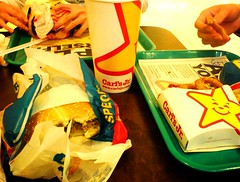
Lunch at Carls' Jr
Over lunch, a colleague related his retirement plans: Where is good money to be found? Not in the volatile stock market nor in commodity or derivative trading nor the rental off prime real estate. The good money is to be found in the pockets of the superstitious and this is how he will get his paws on some of that stuff:
  1. buy a plot of land and build a temple
  2. engage the services of a popular monk (like the one who rappelled down Suntec City) to head the temple
  3. install a grotty (cheap) but ginormous Buddha statue, the grottier (cheaper), the better, for authenticity
  4. provide the usual temple-y services including divination by lots (and at the back of each lot, the Chinese mainlander who wrote the whole Buddhist canon on a grain of rice shall inscribe exclusion clauses to protect the temple from liability)
  5. draw the crowds by procuring that someone win the lottery with numbers chosen from divination in the temple
  6. sell gold-leaf to the pious to plaster the statue with and so earn karma points
  7. (And he smiled a beautific smile and spread his arms wide to indicate the riches of the world for the taking.)

  8. scrape the gold-leaf off the Buddha for resale at the same absorbitant prices
  9. start a funeral business and gloriously overcharge the bereaved for prayers, rituals and, even, entry into heaven!
  10. charge a yearly rate for the upkeep of the tablets (polishing, dusting, not accidentally stepping on the said tablets etc)
When he'd done telling us his nefarious plan, he threw back his head and laughed loudly. HAHAHAHAHAHA. One minute later, he was still laughing, alone and as loudly, like the evil corrupt man in a kung-fu movie, dressed in black clothes to match the blackness of his heart.

In the far corner, an old man looked at us with watery eyes, and shook his head, slowly.

Labels:

Friday, July 28, 2006

Christianity: A High Risk Investment

MacchiatoMacchiatoMacchiato
We undo our cufflinks and roll up our shirt sleeves and buy each other triple macchiatos. We speak in acronyms. We talk of ROIs and ROEs and ROCs and ROAs and EBITAs and EPSes. We inscribe complex paths for billion-dollar cashflows on the back of paper napkins. We exchange essential market gossip and discuss investment strategy. We broker deals and shake hands.

Business, even high-profile cross-border multi-gazillion-dollar business, seems a bit of a game; some Friday night entertainment over biscuits and hot tea. We laugh, we teasingly chide, we take risks for the fun of it and at the end of the night, we pack up, thank the host, help to wash up and go home to real life.

But back in real life, we have on our portfolio what appears to be a devastatingly high risk investment called Christianity. Contrary to prudent financial planning advice, we have invested everything we ever had in it: our whole life henceforth, all our decisions, our heart, our mind, our will, our money, our time, our hopes. These are assets we cannot afford to lose. And once spent thus, they are gone forever, never to be replenished or replaced. Also contrary to the rudimentary principle of portfolio diversification, we have put all our eggs in one basket, one God, one way of interpreting reality. Even worse, Christianity is a buy-and-hold-until-death investment. If we sell at any time, we lose all our investment immediately. Meanwhile, there is no visible asset appreciation and no palpable way of calculating returns.

So we live in the fear that one day, one terrible day, we might suddenly realise that we have been blinded by illusion and wishful thinking, that "we have lingered in the chambers of the sea/by sea-girls wreathed with seaweed red and brown" but "human voices wake us, and we drown". So we want to cut our losses as early as possible. We want to hedge our risk. We want to have a bird in hand than an infinite number in a bush. Why not have our little pleasures in the here-and-now? Why not limit our risks by reaping our little rewards (the praise of men or otherwise) immediately, rather than hold out for an unknown future?

But although Christianity seems to be high-risk now, it is also a sure-win investment. First, the returns are more than we can ever imagine, for "the kingdom of heaven is like treasure hidden in a field, which a man found and covered up. Then in his joy he goes and sells all that he has and buys that field. Again, the kingdom of heaven is like a merchant in search of fine pearls, who, on finding one pearl of great value, went and sold all that he had and bought it" (Matthew 13:44-46).

This is important for non-investors as well because the kingdom of heaven is also "like a net that was thrown into the sea and gathered fish of every kind. When it was full, men drew it ashore and sat down and sorted the good into containers but threw away the bad. So it will be at the close of the age. The angels will come out and separate the evil from the righteous and throw them into the fiery furnace. In that place there will be weeping and gnashing of teeth" (Matthew 13:47-50).

Not only are the promised returns out-of-this-world (literally), but we also know that the promisor has always displayed the type of covenantal faithfulness and graciousness that gives us reason to believe that he will always be true to his word. (See, like, the whole Bible. Most recently for ARPCians, 1 Samuel 9-10.)

Labels:

Friday, October 21, 2005

The Bull Run 2005

During lunch hour, some accountants spotted a Starbucks employee dispensing coffee from a metal canister that looked unappetisingly like the container of insecticide that the ubiquitous NEA guys had been totting about the island this dengue season. But our hardy accountants, being practical and not at all adverse to free items, went through several cups of the stuff.

Payback came after markets closed and they realised that their tummies though trained on long late nights and endless cups of caffeine could not cope with the non-airconditioned environment of the Padang where we gathered for this year's Bull Run, the corporate charity fun run in office wear organised by the lovely people at SGX (the Singapore Exchange).

So they took handfuls of antacids and ruminated about the accountability of spending by charities.

Good fun was also to be had at the expense of the corporate governance people who, similarly unused to the heat, were wearing thick T-shirts of dubious breathability. They were promptly (and gleefully) accused of not being transparent.

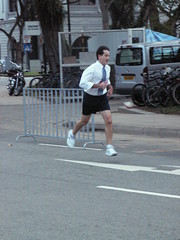
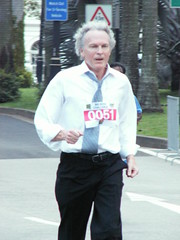
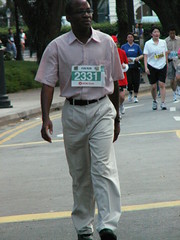
The following photographs are similarly of dubious quality due to the heat, the battle with mozzies and the excessive build up of lactic acid (and not, I stress, not the free Veuve Clicquot):

Chris Flagnagen (Credit Suisse)


What the desk-bound really wear under the table:


Genuine cubicle dwellers:

Traders clearing adrenaline from their system:

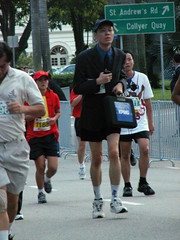
Tall, pale, thin, wearing shorts and cap with shirt, tie and jacket...must be an experienced accountant...:

Tanned, decent-sized, running with a flag...must be the new recruits:


If you've always been too busy to get to know your colleague:


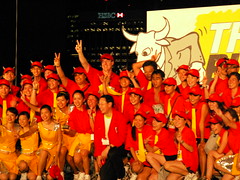
Remember the evil-looking-bull-with-ridiculously-coloured-toupee? These guys were carrying his head in a bedsheet!

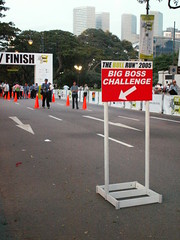
Naturally, the Big Bosses get their own lane:


Then on with the party on the Padang!


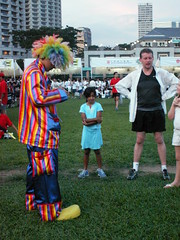
Boastful fire-eaters, gaudy stilt-walkers and eager clowns mingled with the crowds. But those city kids are difficult to please:


Cute Chaoyang kids dancing:

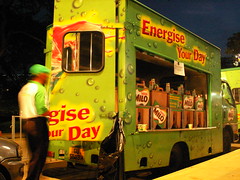
Free Milo:

free gourmet coffee:

and free Tiger beers and cartons of Veuve Clicquot champagne:


Games of chance:


The management relay with briefcases as batons:

While Merrill's red devils red bulls collected their Best Dressed contest prize:

KPMG cleared out and disappeared back to the office to do more work:

Massively great fun for all and S$2.3 million was raised for various charities. But people wondered if all the money paid out for use of the venue and for publicity and general entertainment (and the goodie bags and the rest of the free stuff) could not have been better spent by giving it to the named charities instead.

How much better stewards of money would Christians be even if we were organising fund-raising for "church" purposes? And how much more cheerful givers of money would we be without having to be distracted by "fun" events while someone attempts to pry the dough from our cold dead hands?

Labels: ,

Thursday, August 25, 2005

Bugis, NAFA and Materialism

Everytime I meet certain clients at Bugis, several long hours are spent trying to inculcate me into the scintillating world of Mammon and the great happiness (vaguely defined by well-appointed houses in several countries, fancy cars, the perks of platinum cards, valets and maids, flying in a Michelin-starred chef of your choice to cook dinner, a private jet for a weekend in Paris or a shopping trip in New York, a fleet of yachts, an island or two...) that success would hand me on a silver platter.

After tactfully avoiding offers to buy me lunch/dinner, I either escape to the Sony shop downstairs for a run on their display-set PSP or take a long walk around the environs to clear my head of visions of grandeur.

On one side of Bugis Junction, there are the colourful, pungent, crowded restaurants lining Liang Seah and Tan Quee Lan streets filled with backpackers, mat rockers, fagging indie folk and zombified office workers.

On the other side of Bugis Junction, past the boring ubiquitous facade of the usual fast food restaurants are dark sweaty alleyways misty with cheap cigarette smoke squashed with shops offering better than the usual pasar malam clothes, jostling among secondhand mobiles, international calling cards, S$7 CDs, S$5 sunglasses, drinks mixed in huge plastic tubs, Hakka abacus beads, kueh tutu steamers, and cheap watches.

On the second storey, a more Harajuku-meets-Far East Plaza's Level One/The Heeren's The Annex/Bugis Junction's Edge counts amongst its tenants a sex shop with a very bored proprietor, a tattoo studio and a cafe that sells large palm-sized cookies.

Inevitably, I end up at the familiar grounds of the old campus of the Nanyang Academy of Fine Arts. Unlike the cold new monstrosities campuses, the old one sounded and smelt just right: wet clay drying as you entered the side door, silhouettes of unfinished sculptures in dark corners, a central courtyard filled with strains of strings or muffled piano from improperly-closed studio doors. Classrooms had the comfortably lived-in smell of generations of wet watercolour paint and freshly-ground 墨水. Water-coolers were sometimes clogged with paintbrush hair and algae. The ancient lift was cranky and tempermental and sometimes made us *very* late for someone's debut recital.

The thing about not selling out to Mammon or material success is that it's not a particularly Christian virtue. It was a code of honour concept at my alma mater that one didn't do art for *shocked and insulted expression* money. "This piece was commissioned!" they'd whisper with some venom at the exhibition. "He takes in too many students..." some would sniff darkly at the mention of a particular practitioner. Art for art's sake was ideal. Sacrifice and suffering for one's art was noble, untainted by the vulgar material considerations.

So is there a difference between a Christian's view and an artist's view of materialism?

Yes!

The Christian thinks that materialism is good. :-)

*******

See also an article by Phillip Jensen reproduced below:
This present age: Our struggle not to covet
Originally published in Briefing #280 (January 2002)

As for the rich in this present age, charge them not to be haughty, nor to set their hopes on the uncertainty of riches, but on God, who richly provides us with everything to enjoy. They are to do good, to be rich in good works, to be generous and ready to share, thus storing up treasure for themselves as a good foundation for the future, so that they may take hold of that which is truly life (1 Tim 6:17-19).

Money. We’re to enjoy it, but not to love it. There is nothing wrong with being rich, but wealth is a great snare. We are to receive all good things with thanksgiving, but at the same time build up our riches in heaven. It seems that a right attitude towards wealth is a constant balancing act between extremes, and there is no one level of wealth which is ideal; being rich may lead to self-satisfaction, being poor might make you resentful. How on earth are we to know whether we have the right, Christian attitude towards money?

The passage above from 1 Timothy 6 is a good place to start talking about riches, for here we have encapsulated the great blessings and the great dangers of wealth. Wealth does tempt us to be haughty. Wealth means other people will serve us; and it is very natural to become arrogant towards others when you know they’ll do whatever you want. Wealth generates confidence, for it seems as if you will always be safe. Banks, insurance agencies and financial management companies all tell us the same thing: wealth is the way to make the future secure, so you can have peace of mind as well as comfort now.

In fact wealth does not give security, for it can disappear overnight, as survivors of stock market crashes can testify. All wealth, whether inherited or earned, is a gift. The family into which you were born, the economy, the time in history—all these are a gift from God. At this time in history, to be born into an Australian family means the possibility of a wealth not even dreamed of by most Afghan families.

But wealth is not wrong; God provides it to be enjoyed. This is part of using wealth well—as is being generous and using wealth to store up treasures in heaven. The last point is crucial: whether we are rich or poor materially, our real wealth is spiritual. That is the wealth we should value; that is the wealth on which we should judge ourselves. That is the wealth that matters. And in having this attitude towards money, Christians are at odds with the atheistic world, and also with other religions.

Material realism but not materialism
The secular world is materialistic. It believes philosophically that this life and this physical universe is all there is; and so it is not surprising that it preaches a doctrine of amassing material wealth. What else is there? There is no other ultimate justification, no other reward, nothing else worth having. The best we can have is material comfort, so we might as well devote everything towards that end.

It is an entirely self-centred view, and for that reason it is terribly anti-social. Westerners care about the country’s economy only because it affects their own wealth. Other people’s interests might be addressed to the extent that together we can all create more wealth for ourselves; but other people do not really matter. There is a story circulating that some American business people, on seeing the planes crash into the World Trade Centre, reached for their telephones to sell shares. Whether or not this is true, the sad thing is we can well believe it could be true. We can easily imagine people whose immediate attitude to disaster is to think of how it affects their money. We can easily imagine it, because we could do it, too.

Christianity is not the only religion to oppose this self-centred materialism, but it does it in an unusual way. Buddhism and the philosophies of Hinduism, for instance, are anti-materialist both philosophically as well as practically. Their doctrines teach that this physical world is not just passing, it is essentially an illusion—an evil illusion. Reality is found when the illusion of material existence can be overcome. This is done through denial, through asceticism and meditation. The physical world must be rejected entirely.

Christians, however, believe in creation. The material world is good, because God created it to be good. It is the doctrine of demons to reject the material world, to live in asceticism and denial of the generous gifts God gives us. Material things are good. Stereos and big houses and harbour views are good. Large salaries are good. It is better to be rich than poor, it is better to have food and clothes and beautiful things than to be without them. Poverty is not a godly state and money is not the root of all evil—although the non-Christian world generally thinks that we preach that.

No, the love of money is the root of all evil. You cannot serve both money and God. In serving God, however, money is a great thing to have. It is useful to consider the advice given to the exiles in Babylon, in Jeremiah 29:1-9. Build houses and live in them, God told them. Plant gardens and eat their produce, marry and have families. Even more, seek the welfare of the city and pray to the Lord on its behalf, for in its welfare you will find your welfare.

We are in exile, in the spiritual Babylon while we wait to get into the Promised Land, our spiritual Jerusalem. We should never forget Jerusalem; but while we are here, we should go about the business of living. The exiles in Babylon were tempted in two directions: to undermine Babylon as the enemy, or to enjoy living there so much they forgot Jerusalem. God told them to do neither. We have exactly the same two temptations: denial of this world or denial of the next. Well, in theory we do. Most middle-class Western Christians are in no danger of asceticism. Our danger is all the other way.

Paul tells us, in Philippians 4:11-13, that he has learned the secret of facing both plenty and hunger. With the power of God, he has learned to overcome the temptations of both. He has learned not to covet, which is the real evil at the heart of both riches and poverty. He has learned not to envy his neighbour, not to live in enmity with others who might have more. He has learned by the power of God to be content. How might we learn the same thing? How can we beware of the greed in our hearts?

The rule is simple: don’t covet—but the material circumstances that go with coveting can be anything from billionaire-hood to utter poverty. Just about any action, from buying a lolly to selling a mansion can be done in a greedy manner—or a godly one. It is up to us to examine our own hearts. But there are things that, at least, should make us pause and do some reexamination. I have noticed recently a few clarion-call indicators which we should take as a signal that materialism may have moved in quietly and taken hold. The first issue, gambling, is one on which most Christians probably agree; after that we will get to the touchier ones—children’s education and minister’s salaries.

Gambling
The basic rule for Christians is, no gambling. This is not because there is anything inherently bad about games of chance—but then, the essence of gambling is not chance, but covetousness. Gambling is wanting something for nothing. It’s wanting something that you don’t have, that you want to take from someone else without paying for it. It almost inevitably involves taking somebody else’s money. It doesn’t feel like it, when the organizing body orchestrates the money exchange; but the money you win from a lottery, or a bet, or a marketing competition effectively comes from the other people who also want the prize. If none of you were so covetous, there would be no prize.

But what about sport? What about winning a trophy? What about investing on the stock market? There are a thousand different applications of gambling, some of which seem quite innocent. What about when a company offers you a free food processor if you ring up and leave your address? They’re going to give it away anyway! In all these things, the evil is covetousness. If you need a food processor, go and buy one. God is quite capable of providing you with a food processor. He can give you the money, or provide a Christian friend who will give you one. By participating in the "competition", you are encouraging the system whereby people are motivated by their greed to read a company’s advertising. Greed is the evil.

Of course, some activities can be practised without gambling. You can invest in the stock market in order to support a certain company that produces goods that help society. Or you can gamble on the stock market, investing without caring what the business is as long as it will increase your money. You can go and watch horseracing if you happen to like watching horses run. You can even play a game with yourself or a friend to see who can guess which horse will win. That is still different to betting on a horse. No doubt every reader can think now of an exception to these claims. It is the attitude of the heart that creates a gamble; the odds are irrelevant.

Schooling
How to divide your church in one easy lesson: preach on whether you should send your children to private or public schools.

Recent debate on schooling in New South Wales has produced some interesting definitions regarding the difference between public and private schooling. The private school, it is said, is the place where you bond. It’s a close, protected environment where children make strong relationships with the other children, who will most likely be from similar backgrounds. Parents send children there because they want the child to bond with that group, for intellectual, cultural, religious or social reasons.

Public schools, on the other hand, force children to bridge. Because the other children could be from any background or socio-economic group, children have to learn how to relate to different kinds of people. They must be able to build bridges across social gaps and form friendships with those from different backgrounds.

Of course it is not as clear-cut as that. Private schooling may involve some necessary bridging. Public schools generally draw children from one suburb, which in itself will involve a similar socio-economic background. A small public school in a country town may comprise children of more diverse backgrounds—although, of course, they will all have in common being country children. A school experience where real bridging with a totally different social group takes place is very rare.

Christian parents want to protect their children (as do almost all parents). They are also prepared to make sacrifices for the sake of their children. Parents also generally want their child to have a quality education, which is achieved most often in schools with small classes and many resources—private schools. These may be good reasons to send children to a private school. The question for parents is—are they actually the reasons that motivate you?

For as well as any such noble motivations as described above, private schools will also set your child on the upwardly mobile track to economic success. The other children they bond with will be the future high earners, so your child is likely to be up there with them. It is the private schools that give the high TERs, the entry into the good universities which lead to the profitable careers. In short, private schooling for children can very easily be a Christianised way of loving money. It may be for your children instead of yourself, but it’s still a form of materialism.

It is not good for a country to have all its education controlled by the state. The freedom of choice in education is a necessary part of freedom of life. But we must not let our children’s education become a way to indulge in love of money. There are so many ways in which a good cause like this—children and their education—can be twisted by our covetous hearts. For many people, private schooling is prohibitively expensive, so parents sacrifice home time for work in order to afford the schooling. But education is ultimately a parent’s responsibility, and it requires relating to the children. Parents can make themselves so busy providing for their children that they have no time to know their children. Is private schooling really worth that?

Of course we want to provide good things for our children. It may be time, however, for some to pause and take stock. What are we buying for our children? What do they actually need? Love of money can appear anywhere, even in our love for our children.

Clergy salaries
Another issue which can fall prey to materialistic thinking is how much we should pay someone to minister the gospel.

Consider a minister in a poor suburb. Everyone in the suburb lives in three-bedroom fibro houses. The minister wants to fit in with his people. The church organization he works for, however, has a standard policy for ministry salaries and housing. So they build him a brick rectory—the only brick house in the suburb—and pay him about five times what his neighbour earns. His congregation just can’t relate to him. They’re jealous of his wealth and feel uncomfortable being entertained in his house.

Consider the minister a few suburbs away, in a very wealthy area. He’s paid the same salary, but in this suburb it gives him a house a quarter the size of his neighbours. When he entertains people, they can’t believe how shabby the carpet is. He makes his decisions according to bus timetables. He never goes to the same restaurants, plays or concerts that his congregation members do. His congregation simply cannot relate to the way he thinks. He seems to be a walking insult to them all the time, not someone whose message might be listened to.

We must be able to reach people. In impoverished areas you simply cannot maintain nice middle-class standards and still do your ministry well. Missionary societies have known this for years—missionaries to impoverished areas are generally prepared for the fact they will probably have to reduce their standard of living. But ministers in Sydney, for example, still get their big brick houses in the ‘fibro’ suburbs. On the other hand, gospel ministry can be just as damaged by insisting on poverty in a rich suburb as it can by living in luxury in a poor suburb.

How do we live by the gospel with greedy hearts in this fallen world? Only by the power of God. We must work at learning the art of contentment. We must learn to live amongst riches without being seduced by the love of money, and in poverty without resentment. Some ministers will earn more than others will, even more so as our society becomes more diverse economically. What every minister should earn, however, is as much as he needs to live. Then all are equal whatever the suburb.

In the end, the salary is not what creates a problem of greed amongst clergy; sinful hearts create greed. We do not want a situation that haunts some areas of the United States, where ministers angle for rich ministries in order to grow rich. Neither do we want an equality of pay so rigidly enforced that no one has what he or she needs. Ministers must always beware of the love of money. Do not covet more than you need. We have been given immeasurable riches in the kingdom of God. Be satisfied with them.

© 2004 Matthias Media. All Rights Reserved.

Labels: , ,

Monday, July 25, 2005

Buying Cars and Stumbling Others

We've spent the last few weeks helping someone search for a car. This morning, she sent out this email:
Yo guys.
Thanks for helping me in this car search thingie. Really appreciate it.

Had to think about loads of stuff while contemplating whether to purchase a car:
Q: Is this a good stewardship of money?
Q: Do I really need a car?
Q: How can the car be used to serve others?
Q: What car would be the best use of God's money for which I would have to give an accounting on the last day?

It just occurred to me that another factor to think about is that I live within a community of believers, a church. Therefore the purchase of a car not only affects me but also affects others within the local family of Christ. In purchasing a car, I should not stumble anyone. A pretty car or perceived-to-be luxurious car might cause others to lust after it and covet it even if price-wise, it costs less than a soul-less new Jap/Korean car.

You might know me well enough to know how much I appreciate (perhaps demand) beauty in objects: classic leather-strapped Rolexes, soft-calf Bally leather, the exact shade of black on Prada goods... I think I can say in good conscience that my love for the beauty in these things is intrinsic and not tied to any praise or admiration I may garner for being the owner of these items.

Similarly, the look and sound of a Beetle or the classy curves of a classic BMW or Merc or Aston Martin...

But even though any of these may actually be a better use of money than the purchase of a new Jap/Korean (with the welcome addition of some character), I guess there is the danger that they might cause brothers and sisters to stumble. Therefore, I have decided to look for the ugliest, most uncovetable working used car possible [Q: Does this work for husbands as well? ;-p].

Of course there is the 3-strand reason for why we sin: the world, Satan and our flesh. So people might still covet my ugly car but the least I can do is show my love for my church family by not putting stumbling blocks in places where I know some people might trip over.

Please hold me to this.

[PS: It scares me that I teared as I made this decision. In all conscious memory, I've never ever considered any car other than a classic. It's almost like giving away apart of something entrenched within me, some cherished dream. But what is that compared to the invaluable godliness of others. Yet, it's scary to realise how much I still treasure things of this world...]
Postscript: after the car was acquired, she had this to say:
A car was necessary because I continue to reside in ulus-ville and waste loads of time (and other people's time) attempting to get to civilisation and meet others. A car would mean weekend, beforework and afterwork time can be used more efficiently for ministry and errands, rather than waiting for a taxi/bus/lift out of the house.

Am quite sad to have to stop taking lifts because the enforced proximity that is a function of lift-taking has helped to nurture many a friendship and provided the enjoyment of not just a few fellowships discussing God's words and works. Never mind. Now, I shall be another provider of enforced proximity for friendship and fellowship.

:-)

Labels: ,

Saturday, May 07, 2005

Gourmet Cellar, Christie's and Losing Out in Life

Gourmet Cellar @ Watten Rise

chilled chillified baby octopus, sliced tomatoes

tender lamb medallions wrapped with potato
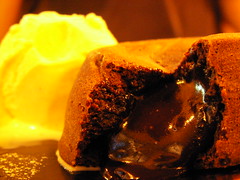
molten chocolate cake with vanilla ice-cream

Gourmet ah-beng waiters smelling of Marlbolo.

Gourmet mamak shop complete with industrial shelves, dreary fluorescent tubes and baby cockroaches.

Gourmet goes the heartlanders? The people have sung and it is the song of gourmet food.

Talking about proletariats, I sauntered into a Christie's jewellery and watches pre-auction viewing today in T-shirt, shorts and slippers. Met a wealthy lady there who was trying on some of the bling-bling auction pieces. In the short polite conversation that ensued, she basically bade me to enjoy the viewing because I would never have the money to buy them for myself. The person assisting her repeated what was said and sniggered loudly. Men in Armani suits turned from their own antique watch-shopping to look at us.

Instinctively, I recoiled from the jibe and, like any good Singaporean who has watched one TCS drama too many, wanted to resolve to work hard and show everyone how successful and powerful and wealthy I could be. You will see my face in the Tatler and my name in the Time's list of 100 Most Influential People in the World and weep, my friends.

But something rang false.

These instincts somehow addressed concerns which I had long since ceased to be concerned about: success; power; wealthy; the friends, service, comfort, honour and respect that all these could buy.

Some years ago, the path was open for me to follow in the well-heeled footsteps of my former bosses to the pages of society rags. I chose the other path for a simple reason: coming to know God as God, the most powerful person in the entire universe, turned my world around and changed my value system. If God was real, and his word in the Bible was real, then it would be mentally unsound to live as if none of this was real; it would be madness to live as if success and power and wealth and the friends, service, comfort, honour and respect that all these could buy was really what life was all about.

Reality is constructed by God. He tells us that life is really about is him, his Son, his plan for the world and his people. It would be insane to chase after illusions when real and eternal value was to be found in the gospel, in the salvation of people, in my relationship with God and with his people.

So I chose a job that would pay so so so much less and really not the sort of occupation to put me on the fast-track to ambassadorship. But it gave me time to spend with God, praying and reading his word in the Bible, and the time and energy to talk to people about the gospel and fellowship with God's family.

It was then that I realised what the fear (eg. 1 Peter 3:6) of living out the Christian life, living as strangers and aliens in this world, could be: it is the kiasu fear that by living rightly, we deprive ourselves of something, we miss out on what life has to offer, we short-change ourselves and basically lose out to other people.

Was I really missing out?

It was really (and continues to be) a choice between a dud investment and a sure-win investment.

Why put all my money on a dud investment which would not only give zero interest but also gobble up my principal, leaving me without a cent when there was a wonderful investment with not only a guarantee on the principal but a sure return infinite times of the principal?

My mind happily settled, went for some plebian health food:
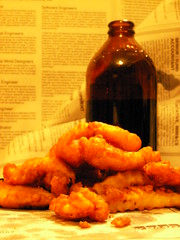
beer-battered fish and fat hot chips anointed with salt and vinegar; and

[To protect the sensibilities of the delicate, this photo shall not be shown.]

fried mars bars.


Labels: ,

Monday, April 18, 2005

The Christian, Casinos and Gambling

Some months ago, we were having a casual chat with the CFO of a listed conglomerate on the Singapore government's proposal to build casinos (oops, "integrated resorts") in Singapore. He thought it made good economic sense "but of course we've got to deal with those Christians".

Did God really say…?
Most Christians have long taken the stand that gambling is a detestable evil, a hideous sin. But none can locate any bit of Scripture that expresses this view. Indeed, the Bible gives no direct prohibition on gambling. Nowhere does it say,"And the LORD sayeth unto them,"Thou shalt not gamble or leprosy shall come upon thy fingers; yea, even upon thy pinkies".

In fact, there are passages that, superficially, appear to give some support for gambling, for example, the casting of lots – the main activity of chance in the Bible:
  • the casting of lots and the use of Urim and Thummim;
  • the casting of lots to choose the goat to be sacrificed on the Day of Atonement;and
  • the casting of lots to determine the allocation of temple duties for the priests.
We hear of a God who knows how lots fall, and Proverbs 16:33 explains:"The lot is cast into the lap, but its every decision is from the Lord". Therefore the purpose of the casting of lots (for example, in Lev. 16:8; 1 Chron. 24:5, 31, 25:8, 26:13, Proverbs 18:18, Luke 1:9, Acts 1:26) was to discern the will of God on an issue (hot potato! A discussion for another day I suspect!). No money was involved in these. Elsewhere, the enemies of God's people also cast lots.

So arguments about "lots" (or apparent activities of chance) can go either way: on the one hand, the Bible seems to leave room for doing it (for example, to discern God's will); but on the other hand it is almost always the enemies of God who use it for material gain.

What is gambling?
Andrew Cameron and Tracy Gordon suggest that all forms of gambling incorporate a system of redistributing wealth that embodies winners and losers. In the practice of casting lots, unlike gambling, there was no redistribution of wealth according to chance and there were no winners and losers. In gambling, money or wealth is willingly taken from one or many and given to another or to a few. There is always at least one loser, and in the case of lotteries or lotto there are many losers.

Is it just a game?
When does a game become gambling? Game theorist Roger Caillois says that games are corrupted when the very real boundary of imagination that defines their terrain and structure is violated. Gambling, he says, is always the murder of a game, because gambling violates the God-created playfulness of the game world, and enslaves fun in the straitjacket of money.

We can watch the way reality changes before our eyes when we stop betting for monopoly money (where the game is constrained) and start to bet with real money (because money acts as a conduit between the game world and the real world).

So is the problem with gambling the money involved?
Phillip Jensen writes:"Money. We're to enjoy it, but not to love it. There is nothing wrong with being rich, but wealth is a great snare. We are to receive all good things with thanksgiving, but at the same time build up our riches in heaven. It seems that a right attitude towards wealth is a constant balancing act between extremes, and there is no one level of wealth which is ideal; being rich may lead to self-satisfaction, being poor might make you resentful. How on earth are we to know whether we have the right, Christian attitude towards money?

"As for the rich in this present age, charge them not to be haughty, nor to set their hopes on the uncertainty of riches, but on God, who richly provides us with everything to enjoy. They are to do good, to be rich in good works, to be generous and ready to share, thus storing up treasure for themselves as a good foundation for the future, so that they may take hold of that which is truly life" (1 Tim 6:17-19).

The passage above from 1 Timothy 6 is a good place to start talking about riches, for here we have encapsulated the great blessings and the great dangers of wealth. Wealth does tempt us to be haughty. Wealth means other people will serve us; and it is very natural to become arrogant towards others when you know they'll do whatever you want. Wealth generates confidence, for it seems as if you will always be safe. Banks, insurance agencies and financial management companies all tell us the same thing: wealth is the way to make the future secure, so you can have peace of mind as well as comfort now.

In fact wealth does not give security, for it can disappear overnight, as survivors of stock market crashes can testify. All wealth, whether inherited or earned, is a gift. The family into which you were born, the economy, the time in history—all these are a gift from God. At this time in history, to be born into an Australian family means the possibility of a wealth not even dreamed of by most Afghan families.

But wealth is not wrong; God provides it to be enjoyed. This is part of using wealth well—as is being generous and using wealth to store up treasures in heaven. The last point is crucial: whether we are rich or poor materially, our real wealth is spiritual. That is the wealth we should value; that is the wealth on which we should judge ourselves. That is the wealth that matters. And in having this attitude towards money, Christians are at odds with the atheistic world, and also with other religions.

Material realism but not materialism
The secular world is materialistic. It believes philosophically that this life and this physical universe is all there is; and so it is not surprising that it preaches a doctrine of amassing material wealth. What else is there? There is no other ultimate justification, no other reward, nothing else worth having. The best we can have is material comfort, so we might as well devote everything towards that end.

It is an entirely self-centred view, and for that reason it is terribly anti-social. Westerners care about the country's economy only because it affects their own wealth. Other people's interests might be addressed to the extent that together we can all create more wealth for ourselves; but other people do not really matter. There is a story circulating that some American business people, on seeing the planes crash into the World Trade Centre, reached for their telephones to sell shares. Whether or not this is true, the sad thing is we can well believe it could be true. We can easily imagine people whose immediate attitude to disaster is to think of how it affects their money. We can easily imagine it, because we could do it, too.

Christianity is not the only religion to oppose this self-centred materialism, but it does it in an unusual way. Buddhism and the philosophies of Hinduism, for instance, are anti-materialist both philosophically as well as practically. Their doctrines teach that this physical world is not just passing, it is essentially an illusion—an evil illusion. Reality is found when the illusion of material existence can be overcome. This is done through denial, through asceticism and meditation. The physical world must be rejected entirely.

Christians, however, believe in creation. The material world is good, because God created it to be good. It is the doctrine of demons to reject the material world, to live in asceticism and denial of the generous gifts God gives us. Material things are good. Stereos and big houses and harbour views are good. Large salaries are good. It is better to be rich than poor, it is better to have food and clothes and beautiful things than to be without them. Poverty is not a godly state and money is not the root of all evil—although the non-Christian world generally thinks that we preach that.

No, the love of money is the root of all evil. You cannot serve both money and God. In serving God, however, money is a great thing to have. It is useful to consider the advice given to the exiles in Babylon, in Jeremiah 29:1-9. Build houses and live in them, God told them. Plant gardens and eat their produce, marry and have families. Even more, seek the welfare of the city and pray to the Lord on its behalf, for in its welfare you will find your welfare.

We are in exile, in the spiritual Babylon while we wait to get into the Promised Land, our spiritual Jerusalem. We should never forget Jerusalem; but while we are here, we should go about the business of living. The exiles in Babylon were tempted in two directions: to undermine Babylon as the enemy, or to enjoy living there so much they forgot Jerusalem. God told them to do neither. We have exactly the same two temptations: denial of this world or denial of the next. Well, in theory we do. Most middle-class Western Christians are in no danger of asceticism. Our danger is all the other way.

Paul tells us, in Philippians 4:11-13, that he has learned the secret of facing both plenty and hunger. With the power of God, he has learned to overcome the temptations of both. He has learned not to covet, which is the real evil at the heart of both riches and poverty. He has learned not to envy his neighbour, not to live in enmity with others who might have more. He has learned by the power of God to be content. How might we learn the same thing? How can we beware of the greed in our hearts?

The rule is simple: don't covet—but the material circumstances that go with coveting can be anything from billionaire-hood to utter poverty. Just about any action, from buying a lolly to selling a mansion can be done in a greedy manner—or a godly one. It is up to us to examine our own hearts."

What's the deal with gambling then?
Covetousness
Phillip continues,"The basic rule for Christians is, no gambling. This is not because there is anything inherently bad about games of chance—but then, the essence of gambling is not chance, but covetousness. Gambling is wanting something for nothing. It's wanting something that you don't have, that you want to take from someone else without paying for it. It almost inevitably involves taking somebody else's money. It doesn't feel like it, when the organising body orchestrates the money exchange; but the money you win from a lottery, or a bet, or a marketing competition effectively comes from the other people who also want the prize. If none of you were so covetous, there would be no prize.

But what about sport? What about winning a trophy? What about investing on the stock market? There are a thousand different applications of gambling, some of which seem quite innocent. What about when a company offers you a free food processor if you ring up and leave your address? They're going to give it away anyway! In all these things, the evil is covetousness. If you need a food processor, go and buy one. God is quite capable of providing you with a food processor. He can give you the money, or provide a Christian friend who will give you one. By participating in the "competition", you are encouraging the system whereby people are motivated by their greed to read a company's advertising. Greed is the evil.

Of course, some activities can be practised without gambling. You can invest in the stock market in order to support a certain company that produces goods that help society. Or you can gamble on the stock market, investing without caring what the business is as long as it will increase your money. You can go and watch horseracing if you happen to like watching horses run. You can even play a game with yourself or a friend to see who can guess which horse will win. That is still different to betting on a horse. No doubt every reader can think now of an exception to these claims. It is the attitude of the heart that creates a gamble; the odds are irrelevant."

Love
Covetousness is at odds with God's command to love our neighbours (Matt 22:39, Mk 12:31). Love in the Bible is a commitment to do good to others. For example: the fruit of the Spirit is love (Gal 5:22). Love should bear the burdens of others (Gal 6:2). Love is to good to all people (Gal 6:10). Love is sacrificial (John 15:13). It counts the other greater than oneself.

As observed above, all forms of gambling incorporate a system of redistributing wealth that embodies winners and losers. Money or wealth is willingly taken from one or many and given to another or to a few. There is always at least one loser, and in the case of lotteries or lotto there are many losers.

Love, being the commitment to the good of others is completely opposed to the idea of taking from some, the losers, be they few or many, wealth for which they worked, without any substantial return. The loss devalues the work of the loser.

Some may argue that the money paid out by the loser bought him/her an opportunity for greater wealth. But this opportunity for greater wealth only comes at a cost to others.

Again, others may argue that losers are paying for a moment of excitement and entertainment, and that excitement and entertainment are legitimate needs in life. But what are the participants excited about and where is the entertainment found? Is it not in the possibility of gaining wealth at a cost to others? The other-person-centredness of love baulks at this selfish practice. The impetus of this argument is greatly increased by studies that show a large percentage of gamblers are poor—the winners are taking money that many of the losers cannot afford.

What would or could motivate a person to participate in a system that indiscriminately redistributes wealth? With the exception of charitable raffles or lucky draws (discussed later), the only real motive would be the desire to be a winner — to gain wealth for self at the expense of others. The motive for gambling can never be the good of those in need. Gambling is motivated by covetousness, and covetousness is a condemning display of selfishness.

Stewardship
The concept of stewardship is threaded throughout the text of Scripture. The Bible does not have a strong concept of ownership. According to the Scriptures people really do not own anything: "The earth is the Lord's and the fullness thereof" (Ps 24:1). Everything comes from God as a gift and is to be administered faithfully on his behalf. Fidelity in this case means using God's gifts to fulfil his purposes. As we have seen above, his will is that we love one another. And love does what is good for others even if it necessitates some sacrifice.

From a stewardship perspective, gambling as a method of redistributing wealth has a number of problems. Buying an opportunity for greater wealth through gambling is not good stewardship. The chance of winning varies across the different forms, but it is always low. The best one can hope for is a 50% chance in a game of cards with only two players. In most popular forms of gambling, such as lotteries and lotto, the chances of winning are extremely small.

If it is thought that gambling may be a way of giving to others in need, then it is not effective, since gambling distributes the wealth indiscriminately. It is far from certain that the poor and needy will receive the contributions of others and it would be poor stewardship to give to those who already have much. Good stewardship requires that we use our wealth in accordance with God's will and purposes.

Gambling also wastes money. Few gamblers ever make a profit. Most, over a lifetime and proportionate to their incomes, make enormous losses. Better to throw a dollar in the gutter than to place it on a bet. At least that way you will not be troubled and thrilled by the prospect of it turning into a million dollars and thereby be tempted to throw another dollar after it.

Self-control
Gambling undermines self-control. It is addictive. Many are drawn to the concept of getting something for nothing, thinking that somehow they will be able to beat the odds and come out on top. For some, the lure of the promise (which generally goes unfulfilled) becomes all-consuming, so that gambling becomes an emotional problem with fatal consequences. It creates a craving for more gambling. Many lose their possessions, professions, families and freedom through compulsive gambling and the crimes they commit to feed their habits. Just ask Chia Teck Leng.

Work to eat
Many Christian books on gambling include an argument against gambling based on the biblical notion of work. There it is argued that work is a moral duty for those who are able to perform it, and it is maintained that wealth and prosperity are fundamentally created by work, hence the commandment "six days you shall labour" (Exod 20:9; 34:21). Slothfulness or laziness is condemned (Prov 19:15; Eccl 10:18). This Old Testament perspective on work is continued in the New. Paul, for example, gave the Thessalonians this rule: if a man will not work he shall not eat (2 Thess 3:10). The idle are to be warned to settle down and earn the bread they eat (1 Thess 5:14; 2 Thess 3:11-12; cf Eph 4:28). Since work sustains the capacity to help those in need, it becomes a duty for those who love their neighbour.

Love is sacrificial and is willing to bear the cost of helping others. The cost will be paid in terms of wealth that is usually secured by work.

Despite all this, as a reason to condemn gambling, the argument is too strong for its own good. It would prevent the giving of gifts and the receiving of inheritances—both of these practices are given legitimacy by the Scriptures and endorsed by common sense.

Having said that, the nature of the wealth distribution achieved by gambling certainly could encourage an attitude of laziness and an unwillingness to work. However, it is more likely to appeal to those who are already lazy, rather than make them lazy, and the fact that gambling appeals to the lazy is not enough to declare it immoral. Many good things might appeal to those who wish to avoid work, for example, living on state welfare or the charity of others. Those who are lazy may use gambling to avoid work; work, however, cannot be the place at which an argument against gambling is secured.

As a system of redistribution of wealth, however, gambling is parasitical. It cannot exist by itself. It feeds off and grows on an economic system based on work. The Bible is right to encourage people to be engaged in productive effort. Gambling has the capacity to rob this work of value for many of those who participate in the practice.

What about local raffles or lucky draws?
Many of us who condemn the appearance of casinos on Singapore soil happily participate in lucky draws in shopping malls or by deliberately purchasing products we don't need or buying raffle tickets for charity or donating to the National Kidney Foundation or some other charity for the chance of winning a car or a condominium or an iPod. Do we take a consequentialist approach and argue that some forms of gambling are not harmful and are therefore not wrong? Do we say that the charity tickets are cheap or that the products which we need to purchase in order to participate in the lucky draw are of minimal cost to us? Do we excuse ourselves saying we buy them in order to help a section of the community and do good works?

In the case of lucky draws for charity, our motivation may be other-person-centred and therefore honourable. The economic consequences for us as an individual may be minimal and there is a good outcome for the charity.

However, this argument could be one of "the end justifying the means". That is, it argues that a good outcome makes an action or practice acceptable. But this principle is not convincing.

Hill suggests that we can see that the principle is false if we take an extreme case rather than look at a trivial case like buying lucky draw tickets for charity. If the government of Australia murdered Australia's richest citizen and distributed his billions to the poor or to any other good cause, this would not make his murder acceptable. The outcome does not justify this particular murder or the practice of murder in general. Murder is intrinsically wrong. Even a very good outcome does not justify the act of murder. The principle that the end justifies the means is false. If this is so, and gambling is wrong for the reasons outlined above, then the outcome of local raffles, even though it is good, does not justify the practice. We ought to avoid practices that are intrinsically wrong even if they have a good outcome (see Rom 6:1). This is especially so in cases where the practice leaves the motivation of the participants unclear. It will not be clear to us nor to others whether we are buying charity lucky draw tickets to help a good cause or because we might win something.

Testimony
Hill also suggests that if non-Christians see Christians gambling, even in small ways, they may think the practice is condoned in general. Some years ago this point was rammed home to a delegation from the Christian church in Victoria who approached the then Premier and objected to the building of a new casino. It is reported that the Premier pointed out that the churches were full of raffles and bingo. He accused them of hypocrisy.

Other ways to raise money for good causes ought to be found — ways such as auctions or donations.

Godless
Ultimately, gambling violates the very purposes for which we were made to live. It encourages not just the lack of love for neighbour, but also the distrust of God. Pagans obsess about wealth because they don't know nor trust God (cf. Luke 16:13). The sad reality of their greed and covetousness is their desperate sense of despair about their own survival, in their world without a loving and trustworthy God. Yet the very definition of a Christian is his trust in a loving and good God who is able and is willing to provide and protect (Luke 12:13-34).

Gambling also encourages the wrong perspective on life: it strongly suggests and implies that satisfaction and happiness in life is to be found in the jackpot or the prize money, things that will pass away and not God, the Creator nor the eternal things.

Responding to gambling
A church should never raise money for its new building or for missionaries by even "light gambling" (eg. lucky draw tickets, bingo). In raising money for charity, a Christian should feel very free to say, with a gentle smile,"no thanks, I don't gamble — here's a donation". If the event is a small, fun office sweep, the Christian should be free to participate if it really is just a game. But if it starts to "overheat", with a bigger pool and with people obviously fretting about the stakes, the Christian might do well to say "no thanks—this doesn't feel like fun to me any more".

How do we respond to a government that advocates gambling? Rulers exist to do right and wrong for a people on behalf of God. Encouraging gambling is against their godly mandate. Yet we are commanded by God to give them the respect that is due to them because God has appointed them. But we can and should also make our views (and so God's views) known to them in a godly manner through the proper lawful channels.

In the Singapore context, whether gambling will be the sole focus of Intergrated Resorts is something that has to be seen. The plans so far suggest that casinos will form only a small part of the Intergrated Resorts.

In any case, in casting our votes in any upcoming elections however, we should not vote myopically and emotionally but consider wisely the ability of the competing parties to maintain the stability and peace we now enjoy in our country, so that we will be able to continue God's work of proclaiming and preaching the gospel without harrassment or fear of persecution.

Some bits rojak-ed from:
"Chasing Fantasies" by Andrew Lansdown
"This Present Age: Our Struggle Not to Covet" by Phillip Jensen
"Should the Stewards Object?" by Michael Hill
"Is Gambling All That Wrong?" by Andrew Cameron and Tracy Gordon. The following statement is included in this post in accordance with the terms of use of this paper: "A briefing paper by Andrew Cameron and Tracy Gordon of the Social Issues Executive, Anglican Diocese of Sydney. To access this free weekly briefing, send your email address to tracy.gordon@moore.edu.au or visit http://www.sydneyanglicans.net/socialissues."

"Taming the Casino Dragon" by Chia Teck Leng, once the second biggest casino gambler in the world, now serving 42 years' imprisonment for various crimes committed to feed his gambling addiction.

Labels: ,