Friday, May 30, 2008

Pomegranates, Pomegranate Ice-Cream and Psalms
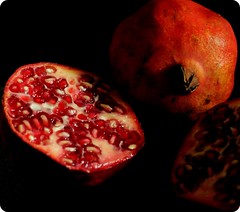
Pomegranate Cross-section
Until recently, she'd flitted only in the peripheral vision of our experience, mysterious and vague.

A friend from Dubai was back for a visit so we sat around into the early hours of the morning catching up and reminiscing about old times. At first, when we were wet behind the ears and new to the Middle East, we'd been amused to find pomegranate arils garnishing every single dish. I'd distinguished myself by poking them around and saying,"Red ruby ah?" They didn't add much in the way of flavour to anything. So I'd been surprised that anyone would have believed that Persephone sold her freedom for four pomegranate seeds in Hades.

In any case, when a mound of Iranian pomegranates winked at me at NTUC, I took a couple home and made pomegranate ice-cream*.

No-churn Pomegranate Ice-cream
This is Nigella Lawson's (even-a-monkey-with-half-a-brain-could-do-it) no-churn pomegranate ice-cream recipe.
Ingredients
2 pomegranates
1 lime
175g icing sugar
500ml double cream

Preparation
  1. Juice the pomegranates and the lime and strain the juices into a bowl.
  2. Add the icing sugar and whisk to dissolve.
  3. Whisk in the double cream and keep whisking until soft peaks form in the pale pink cream.
  4. Spoon and smooth the ice cream into the airtight container of your choice and freeze for at least 4 hours, or overnight.
  5. Scatter with some pomegranate seeds before you eat it.
Obviously this monkey possesses less than half a brain since I didn't even have the patience to follow the recipe. Anyhoo, the ice-cream was fairly creamy and, in vast quantities that popped in your mouth like juicy salmon roe, the pomegranate arils were cold and sweet. Next time, might try reducing the pomegranate juice over fire to achieve a more intensely pomegranatey ice-cream.

Love the whole pomegranate look: the shape and colour somehow conspire to give the fruit the air of a relic from medieval times. But several thousand years before that, the LORD was already telling Moses to decorate the hem of his priestly robes with the fruit (Exodus 28:33-34). And even without Tim Gunn's fashion tips, these were good enough for ministering before God. (Actually, if Tim Gunn'd heard God's instructions on the priestly garments, he would have said,"That's a lot of look!" But even though divine taste might flunk out of Project Runway, guess who'll win in the end?) Later on, Solomon had pomegranate latticework done in bronze in the great temple dedicated to the LORD (1 Kings 7:18, 20, 42; 2 Chronicles 3:16; 2 Chronicles 4:13). When they rebuilt the temple centuries later, they did not neglect this detail (Jeremiah 52:22 - 23).

Like the vine and the fig, the pomegranate appears to be some sort of reminder to the agricultural Jews of God's divine provision and sustenance. I think.

Half-gnawed leftovers from our recent 2 Samuel studies include discussions on reading the Old Testament in light of the New Testament. The usual Sunday school/ARPC/Project Timothy/evangelical way insists that the answer is "Jesus". But what is the link? And how does one arrive at that certain conclusion?

Still much to think through but for consideration, Michael Reeves (via Dave Bish) handling the Psalms:
Mike Reeves - Psalm 1
Mike Reeves - Psalm 51

PS: In other news, I wish to record the utter shock of being told, at a wedding rehearsal in a Methodist church, that the wedding photographers were not to get up on the carpeted stage area that the pastor alternately termed "the altar" and "the holy place". "Free church people", he said, did not respect this. In order not to jeopardise the chances of the couple finally getting married, I desisted from pointing out that God was very capable of causing to suddenly fail to exist photographers (or errant OT temple priests) trespassing on holy ground, and that the flower arrangement in the "holy place" had wilted quite badly and started to decompose. Maybe I should have suggested a comely clutch of pomegranates.

*Says Robert L. Wolke in What Einstein Told His Cook 2:
"Does eating ice cream in hot weather cool you off?...The answer...is in fact, no. After all, we are warm-blooded creatures with thermostats set at 37 degrees celcius, and eating something cold cannot change that. Our cooling mechanism is purely a surface phenomenon: the evaporation of perspiration from our skins, assisted, when we're lucky, by a breeze that hastens the process. Putting ice cream into one's mouth serves only to cool the mouth. you'd do much better by smearing the ice cream all over your body."

Labels: ,

Wednesday, July 11, 2007

More Birthday Stuff, Lord Of The Rings, Psalms And Songs for Sleepy Sunny Sunday Picnics

It has come to be that, more than a month after this year's birthday, the celebrations show every sign of stretching their sparkly festive fingers to Christmas (this year). Birthdays in themselves seem nothing little more than annual milestones towards death, but they're always good excuses to party and parties are always good for fellowship, friendship and reunion allsorts.

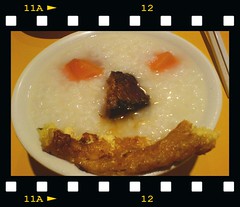
Taiwanese Porridge
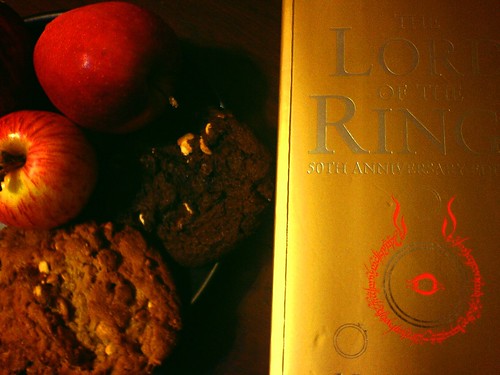
Anyway, breathers between the festivities are for light fare and, from a dip in the tub of unopened presents, J.R.R. Tolkien's Lord of the Rings in shiny gold clothes.

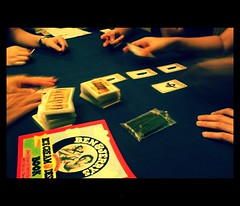
Council of Cardgamers
A few nights ago, I was torn between summons to a council of card gamers and rescuing the fair folk of the Company from frozen-framed eternity: poor Gandalf and Pippin mid-gallop towards Minas Tirith, and Frodo and Sam mid-trudge to Mordor, with Gollum not far behind.

Card gaming was a good choice: homemade ice-cream, a sheriff suicidally killing off her deputies, endless laughing at "can you turn on your rubber duckies so I can play with them?" asked seriously and politely, then, while shuffling for Saboteur, real life intervening with an unexpected call, an emergency pray-together demonstrating of the reality of dependence on God and tangible fellowship.

Games and real life. Myth and truth.

Tolkien was of the view that all myths of the world are a mixture of truth and error - truth because they are written by those made by and for God and error because they were written by those alienated from God. But there is one true myth, a true accounting of truth: the Bible.
Lord of the Rings and Nibbles
Even if LOTR isn't Christian allegory, the song bits appear faint echoes of the Book of Psalms: the beauty of the descriptive poetry, then the frustration of having to guess at the music that might have accompanied the verses, as trying to see through a brick wall. Oh, the psalmist tries to help of course: "to the tune of The Death of the Son" he says of Psalm 9, "to the tune of The Doe of the Morning" for Psalm 22, "to the tune of Lilies" for Psalm 45 etc. But the Top 40 hits of the ancient Hebrews have been lost in the intervening millennia.

Still, melodies misplaced don't taint the meat of the Psalms. And very tasty meat it is too.

Mike Reeves hosts an express gravy train through the stuff for a sampler: Understanding The Psalms.

The Psalms, misused, are unfortunately brilliant for insipid navel-gazing. It is often said how much they reflect a good range of human emotions, a well-stocked aural Hallmark shop (maybe someecards might work better?). But if we think that is all the Psalms are about, we're really missing out on the big show.

The Books of Psalms are not goody bags of Bible sweeties. We don't just open up the Psalms when we're feeling a bit nibbly and grab one to enjoy on its own. They are not just King David's songs on random shuffle, but more like Handel's Messiah: the story of Jesus put together intelligently and set to music, different pieces of text and music working together to tell a story.

Just as Moses gave Israel the 5 Books of the Law, so David gave Israel the 5 Books of the Psalms, as if they were a commentary on Moses' 5 Books of the Law.

The root word in Hebrew for "psalms" can either mean "to praise" or "to be foolish". So the Psalms, like the other wisdom books, are about wisdom and folly. These are the options set before us: to praise the LORD or to be a fool, the fool being the idiot who says in his heart,"There is no God". The judgement on them is that they are corrupt, their deeds are vile; there is no one who does good (Psalm 14:1).

If the 5 Books of the Law correspond to the 5 Books of the Psalms, Book 1 of the Psalms, comprising Psalms 1 - 41, corresponds to the Book of Genesis. Psalms 1 - 4 end with the evening and in Psalm 5, it is morning again, recalling the day-night-day cycle of Genesis 1. Psalm 8 too sounds like in Eden at the end of Genesis 1.

But the Psalms not only commentate on the Books of the Law but also prophesy the future: what God has willed to happen, what Jesus is going to do. Psalm 16 for example, as is explained in Acts 2, is not about King David, but a direct prophesy about Christ. And Jesus quotes Psalm 22 on the cross,"My God, my God, why have you forsaken me?". The fulfilment of Psalm 22:18, the dividing of clothing and the casting of lots for them, is described in the Gospel narratives. What happens after his death? Psalm 23 speaks of the LORD, the shepherd, who comforts the one who goes through valley of death and finally returns to the house of the LORD forever. Psalm 24 speaks of one ascending the hill of the LORD. Who is the one ascending? The LORD himself. Trinitarian tidbits.

On the cross, Jesus quotes Psalm 22:1 and Psalm 31:5. He was very probably using these 2 verses as bookends, to make his hearers think of everything between those 2 verses. He was declaring what would happen in the future even while he hung on the cross. Psalm 22:1, he is in pain but Psalm 22:23, 27 there is great praise of God. Even while he is on the cross, Jesus was saying that he would be triumphant. He wanted us to see that he knew what will happen: he knew that was not the end. His calling on the Lord was justified.

Book 2 consists of Psalm 42 - 72, dealing with liberation and escaping from slavery, very much like the Book of Exodus.

We see in this book many songs of the sons of Korah. Korah's claim to fame is a whole chapter of his misdeeds in Numbers 16 where he rebelled against God and was neatly, together with all his people and household and goods, swallowed up by the earth. But we know from Numbers 26 that the line of Korah did not die out. The sons of Korah, who should have been in the grave with their father, still lived. They are, to us, a picture of a redeemed people who do not deserve life but yet, by the grace and mercy of God, have life. From the Psalms, we see that the sons of Korah were always surrounded by trouble, but still they get really joyful. The climax, it seems, is in Psalm 49: why should I fear in times of trouble? For God will ransom my soul from the power of the grave (Psalm 49:15).

Book 2 ends with Psalm 72, a great psalm all about the remnant people and the coming of the king.

Book 3 consists of Psalms 73 - 89 and corresponds with the Book of Leviticus. These psalms were written by Levites and mostly concern priestly issues: the temple and sacrifices. Asaph's name pops up quite a bit in this book (see, eg. Psalm 74). The chap was Levite from the Korah-ite clan and a director of the singers who served in the house of the LORD. He is also described as a prophet in 2 Chronicles 29:30, because the Psalms are not just praise but also prophesy. The last Psalm in this book, Psalm 89, ends with the death of God's own chosen one (Psalm 89:45). All the levitical stuff and sacrificial stuff leads up to this: the death of messiah.

Book 4 (Psalms 90 - 106) corresponds with the Book of Numbers. Loads of desert scenery here. Psalm 90 is a prayer request of Moses. Psalm 91 is what Satan quotes to Jesus where? In the wilderness, the desert. But while Israel was faithless in the wilderness, Jesus the true king was faithful in desert; he doesn't trust Satan in the least. Psalm 106 is basically the story of the Exodus. It ends in great prayer: save us. O LORD our God and gather us from the nations that we may give thanks to your holy name.

Lastly, Book 5 (Psalms 107 - 150) corresponds with the Book of Deuteronomy. It is all about living by God's word. Deuteronomy opens with the Israelites about to enter God's land, so in parallel, Psalm 107 gives thanks that the people of God have been gathered (107:3). The prayer of Psalm 106 has been answered.

Psalm 120:5 is a tale of woe: a man in distress, living in exile not in Israel. This is rubbish, he says, I want to be in Israel. no more pagan land for me. Let's go to Jerusalem. And he starts travelling knowing that the Lord will protect him on his journey (Psalm 121). In Psalm 122:2, we see that he's gotten to Jerusalem from exile and proceeds to praise the wonder of Jerusalem rapturously. He now lifts his eyes to the holy place and starts thinking about building temple of the Lord (Psalm 132). And what more, the Messiah himself is going to go and join them in Jerusalem. Extremely cool. And Jerusalem will be their resting place forever.

It's really nice to get to the end of LOTR when the Ring is destroyed and there is peace for all peoples (and also in-jokes about Sharkey's End). It is similarly nice to wait with bated breath for the last instalment of J.K. Rowling's Harry Potter series coming to good bookstores near us from 12.01am on 21st July 2007, which most are sure will end with the defeat of Voldemort, the epitome of evil, and peace for all the wizarding world. For us non-literary-critic plebs who do not begrudge their popularity, these books, while they last, let us walk in other worlds and enjoy the ultimate triumph of good over evil. But when the final page has been turned and the final word has been read, and there is a sigh of satisfaction and a goodly stretch, the book is closed, goes back onto the shelf, and we go back to real life.

Keeping it real is so much more totally awesome. But in reality, we are not, neither by default nor nonchalant effort as we like to assume, on the side of the good and ultimately victorious. And if reality is about the ultimate triumph of the good God and God's people and about the destruction of evil, of those who do not acknowledge the lordship of God and do not repent of their rebellion against him, then happy endings will come only to those who choose to be wise, who choose to rely on Jesus for their salvation, who choose to be blessed:
Blessed is the man
who walks not in the counsel of the wicked,
nor stands in the way of sinners,
nor sits in the seat of scoffers;
but his delight is in the law of the LORD,
and on his law he meditates day and night.

He is like a tree
planted by streams of water
that yields its fruit in its season,
and its leaf does not wither.
In all that he does, he prospers.
The wicked are not so,
but are like chaff that the wind drives away.

Therefore the wicked will not stand in the judgment,
nor sinners in the congregation of the righteous;
for the LORD knows the way of the righteous,
but the way of the wicked will perish. (Psalm 1)
If we acknowledge God as our master and trust only in Christ's blood to save us, there will be no more despairing winter, only the joy of a spring and summer to come far more marvellous than the marvellous summer of the Shire with its wonderful sunshine and delicious rain and air of richness and growth, far more yearned for than white shores and beyond them a far green country under a swift sunrise. There, we shall see our Master face-to-face and dwell in his house forever.

(For now, only a pale shadow of that great summer holiday: merely the Sunday sun. Blue sky. Butterflies. Green lawn. Shady trees. Picnic basket. Red checked mat. Cold lemonade. Sandwiches. Crisps. Lemon meringue pie. Sweet cherries. Noshing, reading, sleeping. Dreaming together. Rockin' bop-abouts for the drive home.

Harry Nilsson, She Sang Hymns Out of Tune
Marbles, I Love The Summer Days
Ted Leo & The Pharmacists, The Gold Finch and The Red Oak Tree
Yoko Kanno, Dreams In A Pie
4 bonjour's parties, Satellite
Cibelle, Green Grass
Angel Tech, Slow Toy Piano
The Veils, Under The Folding Branches
The Red River, The Birds And The Boats (Hitchcock's birds?)
Julian Carax - Under The Sun (Frenchie under ze sun.)
Toy, Rabbit Pushing Mower (Too much sun means monsieur sees bunnies doing the gardening.)
Belle & Sebestian, I Know Where The Summer Goes (Cos all that sugar will give you diabetes.)
Feeder, Seven Days In The Sun (Rockit home!)
The Positions, Summer Nights (Summer in Singapore? Whatever. Clap and duetit!)

Jack Johnson? He's not here. He's out surfing, getting angsty and drinking coconut juice.

Nice but only a pale shadow.)

Labels: , , , , ,

Tuesday, May 02, 2006

Roy Clements, Persevering and Psalm 51

The May Day weekend was overcommitted and variously double-booked. Had to forcibly carve out some time out to prep Psalm 51 for this week's study. (Then, I lost track of the hours in the quietness of Tea Chapter and almost missed a family dinner, to the ire of those members who'd been reminding me, for several days prior to the event, NotToBeLate.)
Tea and Psalm 51
One of the commentaries on Psalm 51 handed out during CLOBS showed a certain astuteness and insightfulness into the workings of the sinful human psyche. It was a great shock to discover that the author was none other than Roy Clements. And someone actually cried.

Prior to 1999, Roy Clements was a wonderfully influential preacher and teacher of the Bible. His ministry was international. He was a popular apologist and brought many people to saving faith in Christ. Thousands who'd never heard him speak were encouraged by the books he wrote. In 1999, he resigned from Eden Baptist Church, Cambridge. He told his wife that he had been in a relationship with a younger man, his research assistant, for several years. Then he left her and their children and went to live with his partner.

Recalls Gary Benfold:
I sat enraptured as the preacher completed his series on 2 Timothy. "Guard the gospel" he'd called the series, and it was the first expository preaching I had ever heard. I was so thrilled at the power of the Word that I began to hope that, one day, I too might be able to give my life to preaching. I remember so well as the preacher reached 4.7 ("I have fought a good fight; I have finished my course; I have kept the faith" - we all used the AV in those days), he stepped back from the makeshift pulpit, looked around the room and said:"When you're old, infirm and living in a rest-home and the students from the local Christian Union come to visit you, make sure you will be able to take their firm young hand in your frail old hand and fix their bright young eyes with your rheumy old eyes and say: "I have fought the fight; I have finished the race; there is laid up for me a crown of righteousness"."

There were times - many times - in those early days of my Christian pilgrimage when those words held me and brought me back to the road. I owe so much to that weekend's preaching; even now I'm profoundly moved as I recall it. It was more than 25 years ago; the preacher was Roy Clements, and it recently became public knowledge that he has left his wife for another man.
Even before I was Christian, I noticed that it was not the norm for professed Christians to stay in a right relationship with God. The years saw fervent ex-classmates who used to speak of nothing but God and salvation exchanging their beliefs for intimate relationships with non-Christian partners (of the same and opposite sexes) or the bitterness of being childless or the numbing comfort of a stable career, family and leadership positions in their local churches befitting their seniority.

In their time, some had been fearless and bold evangelists, clear about sin and salvation. Others had been amazing prayer warriors of unwavering faith, unafraid to depend on God for everything. The sort who were committed to finishing what they'd begun, who'd do their own homework and hand it in on time too. I the easily-bored introvert with the short-attention span specialising in copying homework, disrupting classes, and later, mumbly, somewhat inarticulate public prayers wondered how I could possibly make it through to my 77th birthday (assuming the statistical life expectancy for Singapore) if they didn't even manage to last the better part of a decade.

Well, Psalm 51 tells us we ain't gonna make it happen. For it's not just that all humans commit little sins, cheeky acts of rebellion against God, but that we are inherently sickeningly sinful, rotting and corrupted to the core of our very being, so that even when we were nothing but a bunch of cells clinging to our mothers' wombs we were already at war with God (Psalm 51:5). If we looked honestly at ourselves, past the strawmen-excuses of lousy genetics, stress and lack of proper upbringing, we come face-to-face with the terribly ugly person we would be ashamed to acknowledge as a distant uncle thrice removed, not to say our actual selves.

If we looked clearly at our own corrupt selves and then at God's face, holy, pure and true, we know that he will be absolutely right to condemn us to hell.

The shadows of this terrible condition beset us even after we come into a right relationship with God. Because we remain in this flesh. O wretched man that I am! Who will deliver me from this body of death? moaned Paul the apostle (Romans 7:24). Thanks be to God that it is the initiative of God himself who in his infinite compassion and undeserved mercy called us to be his children and also gave us his Holy Spirit to indwell in us so creating in us a new heart, a new being that was not in existence before, a being that is actually capable of doing the will of the Father, who will also preserve us.

When I think about the groups of Christians I hang with: the leaders at CLOBS, the little prayer couples and triplets, the DGs, the one-on-one studies, the evangelistic-events, sports, games or food fellowships...I wonder how many of us current enthusiasts for the gospel will still stand in God in 10, 20, 50 years' time. 50 years is a long time, longer than we've been on this earth. How will we persevere?

Fortunately, it will be the same way we started, not (ultimately) by our own effort or our own work but depending the lovingkindness, the steadfast love, the covenantal faithfulness of the God who first called us, who accepts our useless broken and contrite hearts, trusting that he who knew us before we knew him will finish the good work he first began in us.

So John Chapman is fond of saying that the first 50 (the number keeps increasing) years are the hardest. So someone quoted David Jackman as saying that we must keep the communication channels open with those who seem to have fallen away because he has seen God turn the hearts of some back to him after 40 years.

And what can I do, O God of my salvation? My tongue will sing aloud of your righteousness (Psalm 51:14). O Lord, open my lips, and my mouth will declare your praise (Psalm 51:15). And with Jeremy Camp I sing: Wonderful, so wonderful is your unfailing love. No heart in this world will fully know how glorious, how beautiful you are. Beautiful one, my soul must sing (mp3). And it is impossible to keep this good news to myself, so I will teach transgressors your ways, and sinners will return to you (Psalm 51:13).

Labels: ,