Sunday, October 25, 2009

Perfect Laws for Perfect Relationships (Matthew 5:21-48)

Green Tea Frap and Good Snacks on Sunny Sunday Afternoon
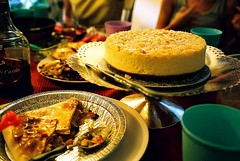
Green Tea Cream Frap, Hazelnut Latte and a few Good Snacks. Taken with an iphone and messed with on Mill Color.

Starbucks has overtaken McDonalds as the new mugging (as in hogging a table and swotting, not the thing that happens in a dark lonely alley with a knife) hotspot, with a smellscape of coffee instead of french fry grease and a soundscape of easy jazz* instead of the hyperness of Rick Dee's Top 40s. At least one macbook and an iphone adorn each table.

Mugging up God's word is hard work, especially with the sort of warped feeble minds we sinful people have rattling in our skulls. But after having sweatily grasped it, our equally corrupt and flabby hearts have great difficulty living out what we know. The Pharisees and the scribes who made a living from studying Scripture got their knickers all in a twist in the end, what more us 21st century information junkies - our constant plugged-in-ness to Facebook, Twitter, RSS feeds to favourite blogs and sites while simultaneously watching cable news, sitcoms and movies and listening to podcasts, fresh hot new songs or curated playlists and playing online games, necessarily means we skim and will/can hardly linger for a hard look and anything more than a taste and sniff before being whisked off to new things by the fast-moving knowledge conveyor belt ("128,540 updates since you started reading this sentence").

Matthew 5:17-20 took a bit of working through (What was the connection between Jesus and the Old Testament? In what ways did he fulfil the Law and the Prophets?) but we got that sorted. Matthew 5:20 ("For I tell you, unless your righteousness exceeds that of the scribes and Pharisees, you will never enter the kingdom of heaven.") sat a bit uncomfortably but could have been explained by our partaking of Jesus' perfect obedience to the law. As could "You therefore must be perfect, as your heavenly Father is perfect." (Matthew 5:48).

We could just as happily, with a quick sigh of relief, dismiss the teachings on murder, adultery, divorce, oaths, retaliation and loving neighbours (Matthew 5:21-48), as mere aspirations not principles to be worked on; or perhaps think, surely God could not have meant that and domesticate what Jesus said so as to bring his teaching within range of our accomplishment.

Or if we are uncreative enough to take Jesus' words as-is, then we strive hard to pass Christ's strict examination, flagellating ourselves literally and/or metaphorically to make ourselves better Christians; or we sink under the weight of the impossibility of perfection.

While this last might lead to the poverty of spirit commended by Jesus (Matthew 5:3), the poor who are promised the kingdom of heaven (William Taylor of St. Helen's Bishopsgate gives a good exposition of this aspect of Matthew 5:17-48 here), there is nothing in the Sermon on the Mount that any of what Jesus is commanding cannot be fulfilled by his disciples. In fact, he fully expects his disciples to obey them:
"whoever relaxes one of the least of these commandments and teaches others to do the same will be called least in the kingdom of heaven, but whoever does them and teaches them will be called great in the kingdom of heaven." (Matthew 5:19)

"Everyone then who hears these words of mine and does them will be like a wise man who built his house on the rock." (Matthew 7:24)
The Law will not pass away even in the least bit (Matthew 5:18) because we are told by the rest of Scripture that it does several things: (i) it expresses the character of God and thus his will for man's life; (ii) it demonstrates, by man's failure to keep it, the character of man and therefore his need of God's salvation; and (iii) it teaches us the character of salvation. (i) and (iii) are eternal, while (ii) will continue until everything is accomplished and all things are made new.

So Jesus fulfils the law by, inter alia, (i) filling out the height, breadth, width and depth of the Law and thus the character of God; (ii) by so doing in Matthew 5:21-48, challenges the hollowness of the self-righteousness (if any) of his audience; and (iii) teaches them how to live when they have been saved and become sons of God.

As a son of God, the Christian, that person bankrupt of spirit and mourning over sin hungering and thirsting for righteousness (Matthew 5:3-6), is a desperate drooling canine straining at his leash in the cage of his sinfulness, nose squashed against the bars, sniffing the yummy scent of righteousness in the air but unable to get at it. If someone came along and unlocked the cage and took off the leash, would he not make a frantic mad dash for the righteousness he was going crazy for? If we are so completely crazy for God and knowing him and his will for our lives, would we not, once we are given the chance, rush to, bask in the glorious beauty of his created order, gulp down his words and live according to them? The Law is the wonderful enveloping fragrance of salvation.

It is common to say that Matthew 5:21-48 reminds us to obeys the heart of the law and not just the letter. Living authentically as such would inevitably render us salty and useful, and spotlights for the glory of God (Matthew 5:13-16). But even non-Christians would tsk at a pharisaical fulfilment of merely conforming with the letter of the law, and even much maligned secular legal systems and lawyers endorse equitable principles concerning the "spirit of the law". This encompasses something more: our relationship to the Father in heaven as his sons and our need both to accept our innate character and to work at imitating him (Matthew 5:48). It is like the new husband who is told that he must show his love by remembering his wife's birthday with flowers. He dutifully sends a bouquet along to her workplace every year and, even though he has not been told to do so, brings her out for a nice dinner that night, and her colleagues commend her on her loving spouse. But if he is prone to letting doors slam in her face after he'd passed through or to ignoring her frankly tediously boring daily updates about the home and the children, the existence of the relationship and his character as husband and father would be in question. Merely value-adding to existing legislation just isn't enough; relationships with God and man and the character of God our father which is to be our character as sons of God cannot be adequately and fully legislated or defined.

We are not left alone to figure out these relationships or to build up a holy perfect character though. The blood of Jesus has been spilled for us and the Spirit has been given to us, by which and whom only we can be and are comforted and satisfied (Matthew 5:4,6), to help us follow the guide given to us in the written word.

Still, we are told to knuckle down and work at these relationships because we are continue to live in the now-but-not-yet, confused and confunded by our still-sinful beings: truth-seeking trips are derailed by the murder of fellow journeymen, flagrant abuse of even grace and truth (truth without charity being intolerant and persecuting; grace without truth being weak and untrustworthy in judgement (Joshua Swartz)) carrying on unchecked, so some are too eager to condemn without due evidence, whilst others are too eager to overlook evidence of sin and soothe confessions of obedience failure with false comfort, and still others argue bitterly over which represents a true and accurate picture/interpretation of a given situation...etc etc

Spinach and Emmental Cheese Sausages Pizza, Sunset Level 1 Buffalo Wings, Carmen Chardonnay 2006, Harry Potter
Tough enough perhaps to make one deny the truth of Christianity and the existence of God? Discussing the attractiveness of Harry Potter, we realised that the Bible and the Christian life had everything Harry Potter had and more: Good and Evil? Yes. Bildungsroman of protagonists? Somewhat. Blood, gore, death, difficulties, persecution requiring stout-heartedness, strong-headedness as regards what is good and true and loyalty at the risk of one's life? Yes in truck loads. Love? Actually and massively. Good ending? Definitely. Our problem is that we are somewhere in Book 3 and though we've been told how Book 7 ends, we don't quite believe it sometimes.
So I find it to be a law that when I want to do right, evil lies close at hand. For I delight in the law of God, in my inner being, but I see in my members another law waging war against the law of my mind and making me captive to the law of sin that dwells in my members. Wretched man that I am! Who will deliver me from this body of death? Thanks be to God through Jesus Christ our Lord! So then, I myself serve the law of God with my mind, but with my flesh I serve the law of sin. (Romans 7:21-25)

Therefore, having this ministry by the mercy of God, we do not lose heart. But we have renounced disgraceful, underhanded ways. We refuse to practice cunning or to tamper with God’s word, but by the open statement of the truth we would commend ourselves to everyone’s conscience in the sight of God. And even if our gospel is veiled, it is veiled only to those who are perishing. In their case the god of this world has blinded the minds of the unbelievers, to keep them from seeing the light of the gospel of the glory of Christ, who is the image of God. For what we proclaim is not ourselves, but Jesus Christ as Lord, with ourselves as your servants for Jesus’ sake. For God, who said,"Let light shine out of darkness," has shone in our hearts to give the light of the knowledge of the glory of God in the face of Jesus Christ.

But we have this treasure in jars of clay, to show that the surpassing power belongs to God and not to us. We are afflicted in every way, but not crushed; perplexed, but not driven to despair; persecuted, but not forsaken; struck down, but not destroyed; always carrying in the body the death of Jesus, so that the life of Jesus may also be manifested in our bodies. For we who live are always being given over to death for Jesus’ sake, so that the life of Jesus also may be manifested in our mortal flesh. So death is at work in us, but life in you.

Since we have the same spirit of faith according to what has been written,"I believed, and so I spoke," we also believe, and so we also speak, knowing that he who raised the Lord Jesus will raise us also with Jesus and bring us with you into his presence. For it is all for your sake, so that as grace extends to more and more people it may increase thanksgiving, to the glory of God.

So we do not lose heart. Though our outer self is wasting away, our inner self is being renewed day by day. For this light momentary affliction is preparing for us an eternal weight of glory beyond all comparison, as we look not to the things that are seen but to the things that are unseen. For the things that are seen are transient, but the things that are unseen are eternal. (2 Corinthians 4)

A Trundle Through Sermon on the Mount
Earth Moves Under Feet, Kingdom Comes (Matthew 5-7)
This is the Sound of Inevitability (Matthew 5:1-6)
Breeding - We Hazs It (Matthew 5:7-12)
Coffee, Salt and Light, and the Essence and Use of the Christian (Matthew 5:13-16)
And the Missing Link is Jesus (Matthew 5:17-20)
Perfect Laws for Perfect Relationships (Matthew 5:21-48)
Cakes for Kierkegaard and Sermon on the Mount as Existentialist Answer Perhaps (Matthew 6:1-18)

*They've just switched to what sounds like Glenn Gould's deliberate tinkling of Bach's Goldberg Variations...followed closely by...horrors, La Paloma!

This post is brought to you by:

Burger Shack
Burger Shack Original Burger, Burger Shack
far too many instances of frustratingly cold burgers and cold fries from Burger Shack by Island Creamery
559 Bukit Timah Road
#01-01 King's Arcade

Fat Boy's - The Burger Bar
slightly more decent burgers from Fatboy's - The Burger Bar, 187 Upper Thomson Road

once upon a milk shake
sadly overpriced milkshakes from the cute once upon a milk shake
32 Maxwell Road
#01-08 Maxwell Chambers (fka The White House)
Tanjong Pagar
Singapore 069115

Labels: , ,

Wednesday, October 07, 2009

This Is The Sound of Inevitability (Matthew 5:1-6)

Foray into Sermon on the Mount looked to be fairly epic. Adequate fortification was necessary.

Café Hacienda L.A. Burger
L.A. Burgers at Café Hacienda, Dempsey

The Handburger, Raffles City The Handburger, Raffles City
The Handburger, Raffles City Blue Cheese Beef Burger, The Handburger
The Handburger at Raffles City. Interior thanks to Plystudio. Dry-pattied blue cheese beef burger no thanks to kitchen dude.

During Main Course
A well-lubricated good dinner on pretty Klaus Haapaniemi plates. Now if only the tastebuds had returned in time for the occasion.

Human culture has been built great epic stories. The most exciting sort feature long journeys into far-flung little-known lands by quaint systems of transportation, muscley heroes with big personalities (all set up for a hubris-catharsis moment, or if un-muscley, weak and unimpressive then all set for journey-as-bildungsroman). If Jason had sobbingly declined Pelias' offer of the throne citing lack of ability and abject incompetence, The Argonautica (if written containing Jason's monumental list of personal defects) would have been the laughing stock of the Ancient Greeks. Whether bundled with willing or reluctant heroes, the quests completed at each pitstop in a packaged expedition has been a sure hit for all peoples of all ages. Like scaling the highest mountain or exploring the darkest depths of the sea, we love celebrating the human spirit - the affirmation that humans can prevail, overcome and conquer all difficulties and enemies as long as they put their minds and wills to it. Less nobly, prime content for macho boasts at drinking parties and a money-churner on the inspirational/motivational talk circuit. So the Crusaders rode out to heathen places for land and glory, and returned with citrus fruits, bags of sugar and a future cameo in Dan Brown's bestsellers.

But Jesus said that the people blessed by God are very different kettle of fish altogether. (The 9 "blesseds"/"Beatitudes" are often regarded as Jesus' rules for successfully happy living, which is about as logical and realistic an interpretation as pinning the tail on the donkey in a physical vacuum. "According to experts", the Greek makarios translated to the English "blessed" has in its family tree the name he makaria, given to the island of Cyprus which was apparently so bountiful and beautiful that all who lived on in were completely satisfied and had no interest in the outside world because nothing could be better than that heaven on earth. A blessed person is to be congratulated on his state for he has everything supremely desirable. That person is to be honoured and affirmed in his state. He is approved. More importantly and specifically in context then, blessedness in the Old Testament (via the Septuagint) is the condition of a man who has been approved by God and having God's grace and favour, has been given the gift of salvation (eg. Psalm 32:1-2).)
Blessed are the poor in spirit, for theirs is the kingdom of heaven.
Blessed are those who mourn, for they shall be comforted.
Blessed are the meek, for they shall inherit the earth.
Blessed are those who hunger and thirst for righteousness, for they shall be satisfied.
Blessed are the merciful, for they shall receive mercy.
Blessed are the pure in heart, for they shall see God.
Blessed are the peacemakers, for they shall be called sons of God.
Blessed are those who are persecuted for righteousness’ sake, for theirs is the kingdom of heaven.
Blessed are you when others revile you and persecute you and utter all kinds of evil against you false on my account. Rejoice and be glad, for your reward is great in heaven, for so they persecuted the prophets who were before you. (Matthew 5:3-12)
Exclusive Membership
Familiar words often misused. In the context of the coming of King Jesus and the inauguration of his kingdom (Matthew 1-9), the blessed are those who will be subjects in his kingdom, that is, Christians, the ones who will suffer because of Jesus (Matthew 5:11). Matthew 5:3 and 5:10 also bracket together the intervening verses, suggesting that the blessed person described in the entire passage is one and the same - one whom God has promised the kingdom of heaven. Therefore:
1. All Christians are meant to manifest these characteristics, not just the "holier" or "godlier" ones.

2. No one who is not Christian will be able boast of any of these characteristics, however nice they might be. One cannot say "So-and-so does not claim to be Christian, never reads the Bible nor prays nor submits to God. But, you know, he's so nice and polite and patient and never says a harsh word and is so encouraging, I think he's more of a Christian than many people who warm a church pew."
Matthew 5:3-10 is a description of the Christian: this is the sort of man he is. Matthew 5:11-12 then shows us the character of the Christian as proved by the reaction of the world to him: because he is the sort of man he is, the world reacts this way to him. Matthew 5:13-16 is an account of the relationship of the Christian to the world: God's purpose for and so the function of the Christian in society and in the world.

Commencement and Term of Membership
Matthew 5:3 and 5:10 are the only verses in the "beatitudes" where blessedness is expressed in the present tense. As the disciples were blessed then with the kingdom Jesus was inaugurating, so the Christian is blessed now with membership of the kingdom inaugurated by Christ. But the kingdom in full glory and so membership with all its privileges is not yet (see future tense in 5:4-9).

Description of the Character of Members
What sort of man gains membership? Well, the man who is "poor in spirit" (Matthew 5:3), who is fully aware that he absolutely, irrevocably, uncontroversially fails the meet the criteria for membership. The man who knows all too well that his righteousness cannot exceed that of the Pharisees ("unless your righteousness exceeds that of the scribes and Pharisees, you will never enter the kingdom of heaven (Matthew 5:20)). There is a tremendous awareness of his nothingness before God. There is a complete absence of pride, self-assurance and self-reliance. He puts no confidence in his theological education and training, his position in life, whatever talents has been given to him, nor the chuminess of his natural temperament to stand him in good stead before God. And because Christ had not come to abolish the Old Testament but to fulfil it, none of this is new. Already, God'd spoken through Isaiah saying:
this is the one to whom I will look:
he who is humble and contrite in spirit
and trembles at my word. (Isaiah 66:2)
And quite inevitably, as the man is confronted with God and his holiness, sees where he himself as he is, he cannot help but mourn (Matthew 5:4). Every night, running through his day, he considers what he has done and said and thought and behaved with respect to others and finds that he has done things he ought not to have done and harboured thoughts and ideas and feelings most foul, and is smitten with grief and sorrow that he was ever capable of such deeds and thoughts, and mourns. And like Jesus himself who wept over the city of Jerusalem, the Christian too mourns over the moral messes, the unhappiness, the suffering of the whole of mankind. God too had spoken in the past of the blessedness of those who mourn for their sin and the sin of others:
The Spirit of the Lord GOD is upon me,
because the LORD has anointed me...
to grant to those who mourn in Zion—
to give them a beautiful headdress instead of ashes,
the oil of gladness instead of mourning,
the garment of praise instead of a faint spirit;
that they may be called oaks of righteousness,
the planting of the LORD, that he may be glorified. (Isaiah 61:3)

This was written to God's people when they were in exile under the judgement of God.
And just as inevitably, having seen his own utter nothingness and helplessness face to face with the demands of the law of God, having mourned his sin and inner evil, the man cannot then relate to another person in any other way than in meekness (Matthew 5:5). This meekness is not a natural temperament like how some dogs are nice and friendly and easy to get on with and others are plain irritable and love nothing more than getting their little sharp teeth around a stray finger. This meekness is born of a clear-eyed assessment of where he stands before God and in the world and so, like Moses (the meekest man on earth (Numbers 12:3)), the meek man does not demand his rights, his position, his privileges, his possessions or his status in life. He does not bother protecting himself or going on the defensive because he does not see anything worth protecting or defending. He does not pity himself or explain away his own sin saying,"You are having a hard time. You didn't really mean to do/think that. God will understand." or "If only these people had caught me in a good mood, they would know how godly I really am.". He is not more concerned about justifying himself and his actions; instead, he trusts God (Zephaniah 3:12) and busies himself edifying his brother. And meekness is not an optional extra to the Christian life. God'd said previously, opposite of meekness is wickedness:
A little while, and the wicked will be no more;
though you look for them, they will not be found.

But the meek will inherit the land
and enjoy great peace. (Psalm 37:10-11)
And still inevitably, this leads the Christian to hunger and thirst for righteousness (Matthew 5:6). He has seen his sorry estate and now yearns desperately for a solution. He moans and regrets and hates it all and cries in great anguish for deliverance from his own evilness that prevents him from living in right relationship with God. He wants nothing more in his life than to walk in fellowship with Him. Already, the Psalmist characterised this deepest, most universal human need thus:
Some wandered in desert wastes,
finding no way to a city to dwell in;
hungry and thirsty,
their soul fainted within them.
Then they cried to the LORD in their trouble,
and he delivered them from their distress.
He led them by a straight way
till they reached a city to dwell in.
Let them thank the LORD for his steadfast love,
for his wondrous works to the children of man!
For he satisfies the longing soul,
and the hungry soul he fills with good things. (Psalm 107:4-9)
and
As the deer pants for streams of water,
so my soul pants for you, O God.

My soul thirsts for God, for the living God.
When can I go and meet with God? (Psalm 42:1-2)
Benefits of Membership
And the most wonderful and delicious thing is that Jesus wasn't merely describing the poor, downcast, desperate, sobbing members of his kingdom, far better yet, he brought them the good news that all God had promised to people such as these would soon be fulfilled: those far too aware that their presence will befoul the kingdom of God would be welcomed into it (Matthew 5:3), those mourning over their diseased hearts would be comforted (Matthew 5:4), those who truly see themselves as they are so that nothing anyone can say about them can be too bad will inherit the earth (Matthew 5:5), and those who yearn to be right with God again would have their thirst and hunger more than satisfied (Matthew 5:6)!

This was amazing news - unspeakable incomprehensible grace to the undeserved and mercy to the utterly hopeless and helpless. What a God this was: what a generous deliverer and saviour. But how could this be? How could perfection be sullied by imperfection? How could corrupt immoral incompetent imbeciles be put in charge of the world? Jesus did not explain how this would come to pass at that point. It would have been too much to comprehend. But we know now that the magnanimity and greatness of God did not end there. The king himself died so that all this could be fulfilled. Perhaps this too was inevitable given the awesomeness and complete goodness of God.

Enough to make the lame leap and dance for joy and the mute sing (cf Isaiah 35:6). Literally. There is no one like our God.


Unfortunately, in the here-and-now, physical tummy-wise, the burgers have been long digested. To be continued In šāʾ Allāh IFTLW...

PS. William Taylor explains this much better of course: The Good, The Bad... from the series, Revolution Not Resolution.


A Trundle Through Sermon on the Mount
Earth Moves Under Feet, Kingdom Comes (Matthew 5-7)
This is the Sound of Inevitability (Matthew 5:1-6)
Breeding - We Hazs It (Matthew 5:7-12)
Coffee, Salt and Light, and the Essence and Use of the Christian (Matthew 5:13-16)
And the Missing Link is Jesus (Matthew 5:17-20)
Perfect Laws for Perfect Relationships (Matthew 5:21-48)
Cakes for Kierkegaard and Sermon on the Mount as Existentialist Answer Perhaps (Matthew 6:1-18)

*********************

Studies in the Sermon on the Mount, D. Martyn Lloyd-Jones
Jesus' Sermon on the Mount, D.A. Carson

Café Hacienda

Blk 13 Dempsey Road, #01-07
Tel: +65 6476 2922

The Handburger
Raffles City Shopping Centre, B1-77/78

Labels: , , ,

Sunday, June 07, 2009

Anniversaries of Birth-Days

Hello, my name is Sick Like Dog. Which is how I came to be stuck in a hot little room with a dead chick, Kami Sakura. Easy pickings for a weekend dinner.

Blurry Nekkid Chick
Said chook felt faint at the prospect of something somewhat indelicate being done to her with a lemon.

1 chicken
salt
pepper
butter
olive oil
lemon

1. Give chook a rinse.
2. Pat dry, paying special attention to her under-wing area.
3. Massage with butter.
4. Anoint with olive oil.
5. Season with salt and pepper inside and out.
[At this point, she will ignore your offer of chardonnay.]
6. Roast at 220°C for 1h.
7. Deglaze pan with residual chardonnay.

Roast Sakura Chicken
Very Dead and Also Resting.


Leftover Roast Chicken Shredded Sitting on Thick Toast and Grilled Cheese and Topped with Lingonberry Jam and Fried Sage Leaves
My name is Pukka, I live on the second floor.

And enough to shred and make a sandwich of good thick bread, slightly melted "cave-aged" gruyère, lingonberry jam and fried sage leaves.

After superinfecting the office, managed to recover somewhat in time for the boss and colleagues poking their heads round the piles of paper with a cake (and the injunction not to blow out the candles for fear of infecting the uninfected - a heavy reference book snapped close suddenly did the job as well);

Brotzeit, Vivocity
a satisfying lunch with colleagues at Brotzeit, satisfying someone's sauerkraut cravings, discussing parenting styles;

Ajisen, Vivocity
an old friend popping down for lunch at Ajisen, chatter about missionaries and OMF, old preachers and male leadership in churches;

Longevity Buns
surprise longevity buns during a very tasty work dinner at East Ocean Teochew Restaurant where the off-menu food was fantastic and remarks were continually made about my relative youth amongst the two tables;

Candles on Japanese Honey Cake
the mish-mash hilarity of too many journos and ex-journos in the same room brimming with stories of the gross and grotesque and something about mystery shoppers and food reviewers,
Another Cake
washed down with much alcohol, salty Sakura tea, and fortified with three different types of cakes;

Whisky, Tea and Macarons
good shabu-shabu buffet at En Dining, Crown Centre. Well-marbled sliced beef, good beef capaccio, yummy grilled beef cubes, sashimi salad, bittergourd with egg and spam. The yakitori was ok. But the chicken dishes were either made from poor quality chicken or overcooked. An interestingly milky sake not on the menu. Later, the smoochee was traumatised, but the smoocher was quite proud of himself. Still later, the 12 year Bowmore would have gone down even better after a ski trip, while lounging before a roaring fire in a snow-covered chalet. Godstuff gossip;

Beng Hiang
favourite Teochew-Hokkien ngor hiang and hei cho, fish maw soup, stodgy dark noodles (and not so favourite roast chicken) at Beng Hiang;

P.S. Cafe, Palais
long overdue catch-up nosh at Nirai Kanai then dessert at P.S. Cafe, Palais;

Sunshin Burger: 200g patty, bacon, melted cheese, portobello mushroom. With Flying Dog's Doggie Style Classic Pale Ale
and of course, what would celebrations be without a juicy patty of dead cow, with bacon, melted cheese and portobello mushroom. Behold a burger so thick you'd have to dislocate your lower jaw eating it. Washed down with Flying Dog's Doggie Style Classic Pale Ale.

While sms greetings clogging up the inbox, cards in the mail, presents tied up with silk ribbons and good food with good friends and much more slated in the weeks to come are all nice things, I have never really gone in for the celebrating of birthdays. Too me-centred. And I hadn't even asked to be born, so not much of an achievement there.

However, listening to William Taylor of St. Helen's Bishopsgate on a series on Discipleship with Distinction: the Book of Daniel has made me repent of this. In Daniel, we see the God who not only outlasts generations of Babylonian kings who come and go like a breath in the wind, we also see the God who raises up and brings down these kings to suit his purposes. So while birthdays aren't celebrations of me and a measure of my personal popularity, they should at least remind us that it was God who ordained this birth, who kept such-and-such a person watered and fed and gave him/her growth, and who ultimately gave him/her life for only one purpose: to worship God.

And the scales (Daniel 5:27) that weighed the great kings of the past like Nebuchadnezzar and Darius and the lesser kings like Belshazzar will too weigh us. If a birthday boy/girl was sent to meet his/her Maker still togged out in party hat with cake knife in hand, will we be found wanting, massively failing the purpose of our very existence?

Possibly a self-check question best asked more than once a year.

(Notes, mostly to self, 'bout changes in interests, recently observed:

1. fiction - either written or in audio-visual format is rarely interesting anymore. The gritty reality of really living in a community of sinners and being fairly aware of own sinfulness is enough drama for me.

2. nature programmes - having grown up on marigold yellow piles of National Geographic, we took a break from all that eating, thinking that Yann Arthus-Bertrand's Home would be just the thing to end the week. But though the aerial shots were beautiful, the irritation just grew through the 90 minute film. Glenn Close as narrator tried to make the most of a weak emotive script that unsurprisingly failed time and time again to acknowledge the Creator, instead attributing the miracle of life to the earth or to inheritance. (Watch the movie here.))


Labels: , , ,

Thursday, April 23, 2009

God Shows Hand, Gives Egyptians the Finger (Exodus 7 - 10)


The New Harbour Cafe & Bar, Tanjong Pagar
Last weekend, when the Klasse W came into my life from Tokyo thanks to E, we started on rather tentative footing, mostly because she spoke only Japanese. She (the Klasse W not E) behaved herself at the New Harbour Cafe and Bar along Tanjong Pagar Road where the finger-lickin' fried chicken wings, yummy bangers and mash, surprisingly decent sliced roast pork knuckle with applesauce and a good amount of crackling, all washed down with Guinness stout, German beers and Bulmer's cider, were greeted with cries of oishii!

Mei Heong Yuan, Temple Street
She started to warm up at Mei Heong Yuen on Temple Street where shrill oishiis echoed through the shop after an ice mountain! of! sweet! mango! and another of yummy durian pulp. After much late night chatting and laughing and a Cantonese dumpling and a bowl of 杨枝甘露 (mango, sago and pomelo), the bottomless pits appeared finally to bottom out...

Sunday Brunch at PS. Cafe, Palais: wagyu/chuck brunch burger with fries, caesar salad
brunch burger: chargrilled wagyu and US chuck pattie topped with fried egg, crisped bacon, onion ring and melted cheesy provolone on a toasted sesame seed bap served with pickle and tomato on the side and fries

Then after Sunday brunch-turned-lunch-turned-tea at PS. Cafe, Palais, though, the Klasse W looked to be a real keeper. While the flesh-and-blood lunch companion concluded yet again that PS. Cafe's food was always reliably good.

Sunday Brunch at PS. Cafe, Palais: double chocolate blackout cake with vanilla ice-cream
double chocolate blackout cake accompanied by a scoop of vanilla ice-cream

In-built in the human mind is the ability to come to conclusions and make decisions based on measurable facts. Unsullied by the academic nit-pickiness of Descartes, Berkeley, Hume et al, there has always been enough understanding that eg, tough meat can be made edible in stews and that no, O 628th son of Pharaoh, it would not be wise to construct a giant zen balancing pebbles structure out of those pyramid blocks.

God, who after all made the human mind, knew this. And he also knew how much fallen men had neglected to use his faculties. So even though God's invisible attributes, namely, his eternal power and divine nature, should have been clearly perceived, ever since the creation of the world, in the things that have been made, man suppressed this truth (Romans 1:18-20).

Even his own people, the Israelites, did not know him. So he promised the Israelites back in Exodus 6 that by his rescue of them from Egypt, they would understand the essence and character of their God. He will take them out of Egypt through signs and wonders (Exodus 3:20, 7:3, 8:23, 10:2). Signs, being not the sort of thing to exist just for the sake of hanging around street corners looking cool, tend to point to some thing and carry some meaning.

God states explicitly that his signs are so that Pharaoh ("you" in the singular in Exodus 8:22, 9:14, 9:16) and the Egyptians would know that he is the LORD (Exodus 7:5, 17). Specifically, that there is no one like the LORD (Exodus 8:10) in all the earth (Exodus 9:14), that he is not just a feudal localised god or an absent watchmaker who left the world to run on creational mechanics but the LORD in the midst of the earth (Exodus 8:22) and actively concerned with it, that the earth is the LORD's (Exodus 9:29).

God also states that his signs are to reveal himself to the Israelites, not in judgement as it would be for the Egyptians (Exodus 7:4), but so they might tell their sons and grandsons of about person who was/would always be their God (Exodus 10:1-2).

Given these repeatedly stated aims, the ink and paper wasted on attempting to explain away the miracles as natural phenomena, eg. that the Nile didn't really turn to blood but actually, the red colouring was a function of erosion further upstream or of red algae or of the setting sun(!)) completely miss God's point. Not only were the Egyptians scientifically advanced enough to know "natural phenomena" when they saw it, God meant for all these to be "wonders" (or "miracles") to demonstrate his unique greatness over all of creation.

So Pharaoh's magicians attempt a few miracles of their own, but like pirated branded goods from a back alley in Bangkok or Suzhou or copycat molecular gastronomy menus, the counterfeit is never as good as the real thing. The magicians too turn their staffs into serpents (Exodus 7:11-12) but they aren't able to prevent Aaron's staff-serpent from swallowing their staff-serpents up (Exodus 7:12); they are able to turn water to blood as well (Exodus 7:22) and produce frogs from their hats (Exodus 8:7) which might be mildly entertaining, but this means nothing since they don't have to power to reverse the process. Illusionists know a real thing when they see it and by the fourth plague the magicians acknowledge that God is the real deal (Exodus 8:19) but their expert advice falls on deaf ears.

God's control over matter, over the bonding and character of molecules, over each frog, gnat and fly (so that they harm Egyptians not Israelites), over the life and death of livestock, over the skin and immune systems of all humans, over the weather - a simultaneous storm of hail + rain + fire being not very natural, over the sun and light and darkness was unsurpassed. It would have to be for him to claim that there is no one like him in all the earth.

In fact, God's control over everything is so complete that he controls the timing of coming and lifting of plagues (see, eg, Exodus 8:10ff). He has at his command every potentiality and power and person and element, every thing.

So it is difficult to see how or why anyone would be embarrassed by this and try to explain the events some other way. If God is as he claims, the God of the universe, if he created every little thing in it, and controls every thing in it, who is any one to neuter him by trying to squeeze his self-proclaimed mighty works into little boxes called "science" or the like? He is the reason why there are predictabilities that humans call science. But he himself stands outside its so-called laws and regulations. He sustains everything and is the reason why there aren't gnats in Pharaoh's pants all the days of his life.

This God is not a false god that you can put in a box of false gods and pick out at will - oh, this one? This one does sunshine on rainy days, this other one does fertility but only specialises in livestock, this one used to give victories in war but due to prevailing circumstances of peace, has diversified into victories in love as well. These are gods we make up so we can control them. But we waste our lives manipulating non-entities, figments of our wishful thinking.

He who is lord over creation and lord over order in creation is also lord of history too. Pharaoh might think that he is Ozymandias the smartest man on the planet or he might just think he is in some position to outwit, outlast, outplay this God. But throughout the plague narrative (Exodus 7 - 11), we are told that events occurred "as the LORD had said" (Exodus 7:13, 7:22, 8:15, 8:19, 9:12, 9:35 etc). The LORD who directs the course of history does not cover his mouth in surprise that the dastardly Pharaoh has yet again reneged on his promise to let the Israelites go (Exodus 8:15, 8:32, 9:35, 10:20, 10:27). God not only predicts this would happen but he directs that this happens. It is he who raised Pharaoh up for this purpose (Exodus 9:16); it is the LORD who also hardens Pharaoh's heart (Exodus 7:3, 9:12, 10:1, 10:20, 10:27) as Pharaoh hardens his own heart (Exodus 7:13?, 7:14?, 7:22?, 8:15, 8:19?, 8:32, 9:7?, 9:34, 9:35?).

Are we affronted by this just as we are by the patent predestination present in the New Testament texts (more here and here)? We know that we bear personal responsibility for our actions, yet we also know that God cannot be God of the universe unless he is also Lord over our lives and the choices we make. Those two things are true and just as we cannot explain miracles with our finite sciences, so we cannot hope to understand how these two things can be true and right with our finite theology and logic.

At present, what is of even more importance to us is our reaction to God's revelation of himself. If this is the all mighty God we are talking about then there is a certain patience in all he is doing since we (and the Israelites, Pharaoh and the Egyptians) ought to have known about him and acknowledged him as Lord without him having to do any of this stuff. God says as much when he warns Pharaoh that by now, he could have put out his hand and struck him and his people with pestilence and they would have been cut off from the earth (Exodus 9:15). He really doesn't need to go through ten plagues just to bring his people from Egypt. Heck, he could just have teleported them out but this is how God is choosing to reveal himself to the world.

Why the long-suffering? Well, there aren't divine Joneses in the next universe that God has to one-up: oh look, I brought my peeps out of bad old Egypt with mighty works, what have *you* done lately, neighbour? He doesn't need affirmation from his people of how good he is because then he could have uncreated this lot and created another lot to do just that for all eternity. God's concern for his glory is in a way concern for us puny things; to show us his glory so that we will respond rightly to him.

So later, when Jesus comes and demonstrates power over storms, sickness and even death etc, Jesus articulates the demonstration of his power not because verbal communication is the best way of getting through to God but on account of the people standing around, that they may believe that God sent Jesus (John 11:41-42). But like Jesus' own resurrection, we try to explain this away with our sciences or conspiracy theories so that we will not have to acknowledge that Jesus is lord and requires our worship.

God and Jesus make big claims, and they must. Either believe them or no. Don't try to wriggle out of it by alleging natural phenomena or David Copperfield-like tricks. There can be no patronising fence sitting, not only because they hadn't invented fences back in Ancient Egypt.
Why didn't Pharaoh let the Israelites go even after seeing the might of God?
He was in denial (de Nile)
Bearing in mind a God like this, Pharaoh is really in over his head (not a rude pun on his allegedly watery end in the Nile) in his refusal to let the people go. God is going to bring them out. They are his people, he promised to do so, and since this world including Egypt is his, there is nothing a powerless Pharaoh can possibly do about it. He himself owes his very existence to God. God isn't just another one from the parthenon come to negotiate the release of captives. But Pharaoh is too proud to acknowledge that God is really in charge (Exodus 10:3) and defeat, a forgone conclusion. He sends Moses, not just God's messenger but also Pharaoh's only mediator before God, away (Exodus 10:28) thus cutting off any hope of being saved from what was to come.

Thousands of years later, commoners like us are mired in the same stupid sin when we refuse to acknowledge God as God. Whilst beholding the utter greatness and bigness of this God, we still daily scheme to deny this when we sin against him and disobey his commands, or to appear contrite and righteous when our hearts are not, or when we try to tame him to be our personal genie and convenient pretend invisible best friend on rainy days - we can accept his imagined hugs when we are downcast but cannot accept his unabashed sovereignty in hardening the heart of Pharaoh and others. We refuse to see that it not us vs God with the odds at 50:50. God's universe is moving toward judgement and sure condemnation for those who do not know him or obey him as master. YHWH is not the pet poodle whose fur we can trim like topiary and then dye cotton candy pink to match our outfit for the day. YHWH is a roaring lion whose wrath we have provoked. Fall down and plead the blood of his son our only mediator so that he does not devour us. We aren't going to stop his judgement by denying his existence or claiming that he can't do this or that, or that oh! he's such a horrid meanie to harden the Pharaoh's heart and predestine some to be saved. He did it, he does it and he is perfect, and we are not and will never completely understand one who is. So deal with it, and fall down and worship, and obey. Worship him alone. For we know that God makes a distinction between others and his people, though neither of them deserve this.


New Harbour Cafe and Bar
114 Tanjong Pagar Road
Tel: 6226 2657

Mei Heong Yuen 味香园
65-67 Temple Street

PS Cafe
Level 2, Palais
390 Orchard Road

Current Read/Think-through of Exodus


Labels: , ,