Thursday, April 23, 2009

God Shows Hand, Gives Egyptians the Finger (Exodus 7 - 10)


The New Harbour Cafe & Bar, Tanjong Pagar
Last weekend, when the Klasse W came into my life from Tokyo thanks to E, we started on rather tentative footing, mostly because she spoke only Japanese. She (the Klasse W not E) behaved herself at the New Harbour Cafe and Bar along Tanjong Pagar Road where the finger-lickin' fried chicken wings, yummy bangers and mash, surprisingly decent sliced roast pork knuckle with applesauce and a good amount of crackling, all washed down with Guinness stout, German beers and Bulmer's cider, were greeted with cries of oishii!

Mei Heong Yuan, Temple Street
She started to warm up at Mei Heong Yuen on Temple Street where shrill oishiis echoed through the shop after an ice mountain! of! sweet! mango! and another of yummy durian pulp. After much late night chatting and laughing and a Cantonese dumpling and a bowl of 杨枝甘露 (mango, sago and pomelo), the bottomless pits appeared finally to bottom out...

Sunday Brunch at PS. Cafe, Palais: wagyu/chuck brunch burger with fries, caesar salad
brunch burger: chargrilled wagyu and US chuck pattie topped with fried egg, crisped bacon, onion ring and melted cheesy provolone on a toasted sesame seed bap served with pickle and tomato on the side and fries

Then after Sunday brunch-turned-lunch-turned-tea at PS. Cafe, Palais, though, the Klasse W looked to be a real keeper. While the flesh-and-blood lunch companion concluded yet again that PS. Cafe's food was always reliably good.

Sunday Brunch at PS. Cafe, Palais: double chocolate blackout cake with vanilla ice-cream
double chocolate blackout cake accompanied by a scoop of vanilla ice-cream

In-built in the human mind is the ability to come to conclusions and make decisions based on measurable facts. Unsullied by the academic nit-pickiness of Descartes, Berkeley, Hume et al, there has always been enough understanding that eg, tough meat can be made edible in stews and that no, O 628th son of Pharaoh, it would not be wise to construct a giant zen balancing pebbles structure out of those pyramid blocks.

God, who after all made the human mind, knew this. And he also knew how much fallen men had neglected to use his faculties. So even though God's invisible attributes, namely, his eternal power and divine nature, should have been clearly perceived, ever since the creation of the world, in the things that have been made, man suppressed this truth (Romans 1:18-20).

Even his own people, the Israelites, did not know him. So he promised the Israelites back in Exodus 6 that by his rescue of them from Egypt, they would understand the essence and character of their God. He will take them out of Egypt through signs and wonders (Exodus 3:20, 7:3, 8:23, 10:2). Signs, being not the sort of thing to exist just for the sake of hanging around street corners looking cool, tend to point to some thing and carry some meaning.

God states explicitly that his signs are so that Pharaoh ("you" in the singular in Exodus 8:22, 9:14, 9:16) and the Egyptians would know that he is the LORD (Exodus 7:5, 17). Specifically, that there is no one like the LORD (Exodus 8:10) in all the earth (Exodus 9:14), that he is not just a feudal localised god or an absent watchmaker who left the world to run on creational mechanics but the LORD in the midst of the earth (Exodus 8:22) and actively concerned with it, that the earth is the LORD's (Exodus 9:29).

God also states that his signs are to reveal himself to the Israelites, not in judgement as it would be for the Egyptians (Exodus 7:4), but so they might tell their sons and grandsons of about person who was/would always be their God (Exodus 10:1-2).

Given these repeatedly stated aims, the ink and paper wasted on attempting to explain away the miracles as natural phenomena, eg. that the Nile didn't really turn to blood but actually, the red colouring was a function of erosion further upstream or of red algae or of the setting sun(!)) completely miss God's point. Not only were the Egyptians scientifically advanced enough to know "natural phenomena" when they saw it, God meant for all these to be "wonders" (or "miracles") to demonstrate his unique greatness over all of creation.

So Pharaoh's magicians attempt a few miracles of their own, but like pirated branded goods from a back alley in Bangkok or Suzhou or copycat molecular gastronomy menus, the counterfeit is never as good as the real thing. The magicians too turn their staffs into serpents (Exodus 7:11-12) but they aren't able to prevent Aaron's staff-serpent from swallowing their staff-serpents up (Exodus 7:12); they are able to turn water to blood as well (Exodus 7:22) and produce frogs from their hats (Exodus 8:7) which might be mildly entertaining, but this means nothing since they don't have to power to reverse the process. Illusionists know a real thing when they see it and by the fourth plague the magicians acknowledge that God is the real deal (Exodus 8:19) but their expert advice falls on deaf ears.

God's control over matter, over the bonding and character of molecules, over each frog, gnat and fly (so that they harm Egyptians not Israelites), over the life and death of livestock, over the skin and immune systems of all humans, over the weather - a simultaneous storm of hail + rain + fire being not very natural, over the sun and light and darkness was unsurpassed. It would have to be for him to claim that there is no one like him in all the earth.

In fact, God's control over everything is so complete that he controls the timing of coming and lifting of plagues (see, eg, Exodus 8:10ff). He has at his command every potentiality and power and person and element, every thing.

So it is difficult to see how or why anyone would be embarrassed by this and try to explain the events some other way. If God is as he claims, the God of the universe, if he created every little thing in it, and controls every thing in it, who is any one to neuter him by trying to squeeze his self-proclaimed mighty works into little boxes called "science" or the like? He is the reason why there are predictabilities that humans call science. But he himself stands outside its so-called laws and regulations. He sustains everything and is the reason why there aren't gnats in Pharaoh's pants all the days of his life.

This God is not a false god that you can put in a box of false gods and pick out at will - oh, this one? This one does sunshine on rainy days, this other one does fertility but only specialises in livestock, this one used to give victories in war but due to prevailing circumstances of peace, has diversified into victories in love as well. These are gods we make up so we can control them. But we waste our lives manipulating non-entities, figments of our wishful thinking.

He who is lord over creation and lord over order in creation is also lord of history too. Pharaoh might think that he is Ozymandias the smartest man on the planet or he might just think he is in some position to outwit, outlast, outplay this God. But throughout the plague narrative (Exodus 7 - 11), we are told that events occurred "as the LORD had said" (Exodus 7:13, 7:22, 8:15, 8:19, 9:12, 9:35 etc). The LORD who directs the course of history does not cover his mouth in surprise that the dastardly Pharaoh has yet again reneged on his promise to let the Israelites go (Exodus 8:15, 8:32, 9:35, 10:20, 10:27). God not only predicts this would happen but he directs that this happens. It is he who raised Pharaoh up for this purpose (Exodus 9:16); it is the LORD who also hardens Pharaoh's heart (Exodus 7:3, 9:12, 10:1, 10:20, 10:27) as Pharaoh hardens his own heart (Exodus 7:13?, 7:14?, 7:22?, 8:15, 8:19?, 8:32, 9:7?, 9:34, 9:35?).

Are we affronted by this just as we are by the patent predestination present in the New Testament texts (more here and here)? We know that we bear personal responsibility for our actions, yet we also know that God cannot be God of the universe unless he is also Lord over our lives and the choices we make. Those two things are true and just as we cannot explain miracles with our finite sciences, so we cannot hope to understand how these two things can be true and right with our finite theology and logic.

At present, what is of even more importance to us is our reaction to God's revelation of himself. If this is the all mighty God we are talking about then there is a certain patience in all he is doing since we (and the Israelites, Pharaoh and the Egyptians) ought to have known about him and acknowledged him as Lord without him having to do any of this stuff. God says as much when he warns Pharaoh that by now, he could have put out his hand and struck him and his people with pestilence and they would have been cut off from the earth (Exodus 9:15). He really doesn't need to go through ten plagues just to bring his people from Egypt. Heck, he could just have teleported them out but this is how God is choosing to reveal himself to the world.

Why the long-suffering? Well, there aren't divine Joneses in the next universe that God has to one-up: oh look, I brought my peeps out of bad old Egypt with mighty works, what have *you* done lately, neighbour? He doesn't need affirmation from his people of how good he is because then he could have uncreated this lot and created another lot to do just that for all eternity. God's concern for his glory is in a way concern for us puny things; to show us his glory so that we will respond rightly to him.

So later, when Jesus comes and demonstrates power over storms, sickness and even death etc, Jesus articulates the demonstration of his power not because verbal communication is the best way of getting through to God but on account of the people standing around, that they may believe that God sent Jesus (John 11:41-42). But like Jesus' own resurrection, we try to explain this away with our sciences or conspiracy theories so that we will not have to acknowledge that Jesus is lord and requires our worship.

God and Jesus make big claims, and they must. Either believe them or no. Don't try to wriggle out of it by alleging natural phenomena or David Copperfield-like tricks. There can be no patronising fence sitting, not only because they hadn't invented fences back in Ancient Egypt.
Why didn't Pharaoh let the Israelites go even after seeing the might of God?
He was in denial (de Nile)
Bearing in mind a God like this, Pharaoh is really in over his head (not a rude pun on his allegedly watery end in the Nile) in his refusal to let the people go. God is going to bring them out. They are his people, he promised to do so, and since this world including Egypt is his, there is nothing a powerless Pharaoh can possibly do about it. He himself owes his very existence to God. God isn't just another one from the parthenon come to negotiate the release of captives. But Pharaoh is too proud to acknowledge that God is really in charge (Exodus 10:3) and defeat, a forgone conclusion. He sends Moses, not just God's messenger but also Pharaoh's only mediator before God, away (Exodus 10:28) thus cutting off any hope of being saved from what was to come.

Thousands of years later, commoners like us are mired in the same stupid sin when we refuse to acknowledge God as God. Whilst beholding the utter greatness and bigness of this God, we still daily scheme to deny this when we sin against him and disobey his commands, or to appear contrite and righteous when our hearts are not, or when we try to tame him to be our personal genie and convenient pretend invisible best friend on rainy days - we can accept his imagined hugs when we are downcast but cannot accept his unabashed sovereignty in hardening the heart of Pharaoh and others. We refuse to see that it not us vs God with the odds at 50:50. God's universe is moving toward judgement and sure condemnation for those who do not know him or obey him as master. YHWH is not the pet poodle whose fur we can trim like topiary and then dye cotton candy pink to match our outfit for the day. YHWH is a roaring lion whose wrath we have provoked. Fall down and plead the blood of his son our only mediator so that he does not devour us. We aren't going to stop his judgement by denying his existence or claiming that he can't do this or that, or that oh! he's such a horrid meanie to harden the Pharaoh's heart and predestine some to be saved. He did it, he does it and he is perfect, and we are not and will never completely understand one who is. So deal with it, and fall down and worship, and obey. Worship him alone. For we know that God makes a distinction between others and his people, though neither of them deserve this.


New Harbour Cafe and Bar
114 Tanjong Pagar Road
Tel: 6226 2657

Mei Heong Yuen 味香园
65-67 Temple Street

PS Cafe
Level 2, Palais
390 Orchard Road

Current Read/Think-through of Exodus


Labels: , ,

Sunday, January 18, 2009

Mirror Masks and True Religion and Worship in James 1:19-27

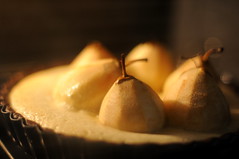
Chocolate-Crust French Pear Tart as Object
The non-objectivity of the world as disclosed by the photographic lens?
...the object is never anything more than an imaginary line. The world is an object that is both imminent and ungraspable. How far is the world? How does one obtain a clearer focus point? Is photography a mirror which briefly captures this imaginary line of the world? Or is it man who, blinded by the enlarged reflection of his own consciousness, falsifies visual perspectives and blurs the accuracy of the world?" (Jean Baudrillard, Photography, Or The Writing Of Light)
While crit theorists were debating the reality of the knots that entangled them, social gospelisers were cracking the whip at coke-bottle-eyed evangelicals: true Christians must be more practical. Less of your talks and studies and more of our going out into the world and doing things, please.

But James assumes that our starting point is the open Bible on our lap. For God brought us forth through the word of truth (James 1:18) and it is the word, implanted, that is able to save our souls (James 1:21). Elsewhere, we are injuncted to give an intent ear to the word of God as first priority. Martha might be the patron saint of the century but it was Mary who received the commendation.

The great reluctance to crack the spine of a black leather-bound might be attributed to lack of belief in the Bible as the word of God or the greater doubt that God does speak at all. But regardless of reason, the fact is that we fail to edify in our speech and actions because we haven't listened and our minds and hearts remain uninformed about God's laws and intention for his children (2 Timothy 3:15-17).

It is from this foundation of God's word that James warns that we mustn't be hearers only of the word but doers as well (James 1:22). James isn't talking about hypocrites here, the white-washed tombs the plebs were only too happy to hear included in Jesus' exposé. The subject of the letter were real Christians - they had the implanted word, yet they were encouraged to receive it with meekness (James 1:21).

If we hear but do not do, we are only deceiving ourselves. Long-in-the-teeth Christians who have learnt to read the Bible properly and get the main point from a chapter in a book of the Bible, who work hard at the talks they are to give, don't need someone to ask them "Where did you get what you have just said from this passage?". But they must not mistake competent comprehension for suitable obedience. Similarly, those who thoroughly enjoy a faithful talk or get great truths from our daily QT but not to go and do anything about it must not think that we are in any way blessed if we do not act on what we have learnt (cf James 1:25). We would be like the supermarket shopper who pays for his groceries and then walks off without them because his silly mind thinks payment = acquisition of goods. (Or perhaps this is not a common experience.)

James, who never had to face a supermarket checkout, likens this to the absurdity of staring intently at the landscape and features of our face in the mirror, turning away, and at once forgetting what we have seen. It is a silly situation that FAILs more than many of the entries on FAIL blog: "Hey," a shopkeeper might say to the man entering his shop after having spent a good hour using the reflective solar film of his shop window as a mirror,"nice nose. We don't get alot of beaks around here." "I've got a beak? Oh, how unusual! I never knew!" Yet, it is the common Christian experience that we do forget, and in vast quantities. So we remember so-and-so as a good speaker, or that there was a good talk last month, a good study last week, a good camp last holiday, and hey, we have a neat file of notes to prove it. But does that mean we really remember what we learnt and completely internalised it that our minds and hearts have been changed by it?

And again in James 1:26-27, James does not warn the hypocrites, the proverbial Sunday Christians, the men (goes the old sermon chestnut) who go to church regularly every week and bible studies and think they are thus saved; James is warning those whom he acknowledges as his beloved brothers (James 1: 16, 19) - the people who have known the new birth.

To these he throws down a challenge: does your religion mean that you master your tongue (James 1:26); is it displayed in your self-control? Do you use your immense "people skills" and way with words to judge and gossip, plot and plan? What do you say in council meetings, deacon sessions? How do you use your opportunities on the pulpit and when teaching small groups? What do you talk about during fellowship meals and gatherings? If we have really heard the word of God, letting slander, gossip and unedifying talk emerge from our lips is absurd. It would be difficult for the objective observer to conclude that we'd listened to God in the first place!

The doing isn't really about social work - the outwardly tangible things people can put together for a biography that will sell at mission conventions and be serialised in Readers' Digest. On one hand, it is about self-control. In addition to internal control, it is about how our religion is demonstrated in our relationships with other people, particularly those who are in need of help (James 1:27a). The Greek word translated as "visit", says Dick Lucas, also appears in Matthew 25 and Luke 7:16. It is used of God visiting his people and making things happen for the benefit of these people. It would be incomprehensible to claim to be well-taught but uninterested in burdensome, energy-sapping, needy IMH-regulars (though of course we'd be amenable to pooling together to get little arms-length "encouragement gifts" for them).

And what of our relationship with God? The reference to "the world" is by default shorthand for our relationship with God, for loving the world means turning our backs to God (cf 1 John 2:15). The world is society organised without reference to God or his son. Previously we loved the world, then God worked on our hearts and so we turned our backs to the world and lived for him but the world is always enticing us to creep back. So Christians have tried to institute by-laws to prevent contamination by the world: no theatre, no dancing, no drinking or smoking. But such legalism and pharsaism was too naive. The current swing towards the other extreme of total liberty, however, tends to lack control. Perhaps the better test is to ask whether this or that draws our hearts from heaven and fastens them to earth; whether it hinders us from setting our hearts on things above and in investing in things above. Like protecting state secrets from covert intelligence gathering, usually of the attractive young female genre, we are to keep ourselves and our relationship with God unspotted from what may seem to be unbelievably fetching temptations. For what fellowship has darkness with light asks Paul in 2 Corinthians 6:14-18.

The proof's in the pudding; the blessing's in the hearing and then the doing.


Chocolate-Crust French Pear Tart Baking in the Oven


Dick Lucas, James
Neil Gaiman and Dave McKean, MirrorMask
Dorie Greenspan, French Pear Tart with some chocolate in the tart dough and great inertia vis-a-vis working with pears.

James

Labels: , ,

Tuesday, April 24, 2007

Skiing and Photography

Friends in temperate climes have been passing round photos of their snowy holidays.

In winter (and early spring), Lord Alfred Rhyme-alot Tennyson might have noted had he not been such a whinger, a young man's fancy lightly turns to thoughts of downhill skiing, the crackling crunch of snow on the slopes and the smell of pine and cowpat. Especially if a stash of old photo albums has recently been unearthed:
Adelboden, Switzerland
Here I crashed into a cushiony lass with flaming ginger hair, who laughed and said it wasn't the way to meet good Irish girls.

Ruka, Finland
Cross-countrying with the sort of friends who would, if you'd fallen on your butt, rush to take a photo of you in unglam positions before deigning to render any help.

Turku, Finland
Apparently good for the circulation: first, sweat it out in a mega-sauna, then when you can't bear it any longer, rush down the stone stairs, slippery with ice, and plunge into the lake, itself barely prevented from freezing over by the bubbling pipes below. Repeat until all you can do is stumble home and sleep 'til morning.

Ski Jumping and the Slow Boat to Sweden
Ski-jumping and the slow boat to Sweden.


But in Singapore, however, it is the season for joyous unions again. Last wedding season, photographer duties spawned a small industry with offers of S$1,000 a gig "or whatever else you want to quote". A few gigs would have paid for a nice DSLR, easy. (I'm looking at you, D200 with a 85mm Nikkor lens.)

(Yes, the doubtful taste of some wedding couples indeed. More evidence that love truly foists upon its unsuspecting victims a horrible blindness.)

Unfortunately, being in the midst of an existential crisis of photographic dimensions, I was unable to take advantage of any ongoing poorsightedness.

Why take photographs?

The image reproductive character of photography makes it obvious that a primary function of photography is documentative: this is how I look, this is how he/she looks, this is how the place looked, this happened and this is how it looked etc.

But photographs rarely remain any more objectively documentative than paintings. Consciously or unconsciously, photographs are the photographer's interpretation of reality. By the framing of the photograph, by the use of light, angles and depth of field, by choosing a shutter speed, the photographer betrays his opinion of the subject. Even a photo of one person can be narrative; think: portraitists like Annie Leibovitz or Steve McCurry.

Susan Sontag, not a photographer herself, acerbically opined that the camera is a way of dealing with the strangeness of reality: a tourist whips out his device in a foreign land so that he will remain safe behind its lens, not overwhelmed by the foreign-ness. Ultimately, she thought, a photographer would become an addict, getting his fix from the segregation and partition of reality within his frame. Elsewhere, she also thought of the camera as a tool of power, where the subject is naked and the photographer is protected:
there is something predatory in the act of taking a picture. To photograph people is to violate them, by seeing them as they never see themselves, by having knowledge of them they can never have; it turns people into objects that can be symbolically possessed. (On Photography)
It is possible, however, that visual image-as-imposition-of-subjective-narrative is not the sole prerogative of the photographer but is also a construct of the viewer who takes a stillshot of reality and deduces, explains and inserts into it his own value system and worldview. And a photograph is vague enough to lend itself to being co-opted to evidence vastly disparate viewpoints.

Personally, I have no more philosophy of photography than I have technique. The only thing that precedes the depression of the shutter release button is the inner bimbo squealing,"Ooo, that's pretty!"

(Of course, the issues of prettiness, beauty and aesthetics themselves constitute a huge and different kettle of fish.)

But there is a certain sense of sadness/wistfulness that accompanies the clicking of the shutter. Perhaps the reason why we take photographs is to grasp, however desperately, a frozen slice of the Heraclitic passing of time: the smile of a baby, the best chum in school, the highlight of a dorm party, the start of a life together... Perhaps photos are fundamentally an acknowledgement of the inevitability of change and ultimately, our mortality and our inability to truly control our lives and eventually, our deaths. Momento mori - the perfect name for a future photo studio.

Anyhows, "serious" photography on hold till this gets a little more sorted!

*In addition to Sontag, Vilém Flusser's also a fairly interesting read.

Labels: ,