Wednesday, April 02, 2008

Tending the Garden, HortPark, Kha Restaurant and Thanksgiving

Cherry Tomatoes on Vine
The happiest days of my childhood were spent in the house garden. Being a Singaporean garden not given to pretension, not for her the niceties of harmony, patterning, fractals, visual jokes, anticipation of colour, and historic styles of classic garden design theory. The choice of vegetation probably hinged on the question: "Can eat anot?" In a back-corner, mangoes, deep yellow and fat and sweet, hung down heavy and luscious. In another, rambutans were red and abundant. We collected them by the basket-full and there was always plenty for neighbours (and mynas). Less popular with the humans but no less bountiful were the chikus and papayas.

In the front garden, when the frangipani flowers were out, the air was sweet and soft. There were rows of ixora bushes wonderful to hide in and suck at nectar-filled flowers while waiting to be found. And there were 2 great trees: a giant pine grand and stately that could be seen for miles around and an equally towering bottlebrush tree which snowed red feathery brushes on the grass below.

Mostly, I remember dappled sunshine, butterflies fluttering about pollinating, sparrows hopping around in the grass, woodpeckers pecking intently at the rambutan tree (an early prognosis of a wormy end for her) and sunbirds building hanging nests in the bougainvillea. Sometimes caterpillars would drop on our heads and we'd put them in old jam jars away from predatory birds and watch weave cocoons around themselves and weeks later, emerge as butterflies.

Our garden was a haven for stray animals. Running about, we'd startle a cat or two napping in the bushes. Sometimes, there were dirty once-white rabbits without waistcoats looking for wonderland. Other times, chicken eggs nestled in shoes that we'd forgotten to put in the cupboard.

And there were snakes of course, whose existence no adult would acknowledge until, to prove the non-existence of an alleged snake, they'd prod a suspect shadow which never failed to slither away reluctantly.

The years in England, with her rabid flower shows, her thick Sunday newspaper supplements helmed by gardening experts arguing over gardening techniques and heirloom vegetable species, her cottage gardens overflowing with huge roses, her petitions for the preservation of historic vegetables, her thoughtful essays on the gardens of Cecil Beaton, Roy Strong and Vita Sackville-West, were a marvellous joy. In our ramshackle house off campus, I had the luxury of a blue door in my room that opened, like a portal in a fairytale, to the little garden outside. In summer, we sat and read on the grass in the sunshine amongst the butterflies and flowers. In winter, I hung out seed-feeders on naked tree branches for needy birds and bushy-tailed squirrels.

Back in Singapore, somehow, over the years, the family acquired and never got round to discharging the services of a Pol Pot gardener with a perchant for mowing over anything on the ground that hadn't attained tree or shrubbery status, the most recent victim being a curry plant. Those Knights of Ni sure knew a thing or two.

In the last year, there have been attempts to cultivate a culinary plot in an empty patch. Not Francophile potager, not renaissance herb garden, but a fairly random mix of useful plants. The aloe vera, lime and basil still live but the rest of the seedlings which hadn't had gone under the Pol Pot blade have perished either in the extremely waterlogged soil from the past weeks of incessant showers or in the the extreme heat that followed.

So it was with some excitement that we wandered over to HortPark, lured by the promise of a one-stop horticultural hub. We opened the car door and were immediately beset by a cloud of hungry mozzies and the stench of fertilizer. The whole garden smelt of fertilizer. Big bags of it lined the footpath. And the footpath wound past balding grass patches and what looked like cheesy leftovers from GardenTech 2007 that shouldn't even think of getting anywhere near the Chelsea Flower Show.
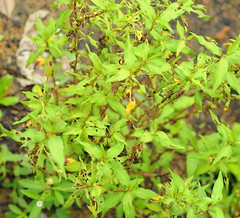
HortPark - Herb and Spice Garden
The pests had gotten to the herb and spice garden first so there wasn't much to see there. A little distance away, children ran screaming round the little playground, chased by a security guard bizarrely yelling,"No running in the garden!"

HortPark - Flowering plants in greenhouse
The good stuff, the riot of colours, was safely encased behind glasswalls at the greenhouses at the end of the park.

HortPark - Kha
(Dinner at the modern thai cuisine restaurant, Kha, was great. The unique juice mixes (pomegranate and jambu) recommended by their inventor were refreshing. And after all that looking around in Bangkok, we finally got a tom yam soup with body and just the right balance of spicy and sour in Singapore. The "medium hot" red duck (chicken?) curry grilled with pumpkin was smokily tender. And hooray good sticky rice and mango with pandan coconut sauce and black sesame seeds! Later, all the air-kissing was explained by the restaurant being the progeny of Yenn Wong's JIA Boutique Hotels group. Wonderful menu by David Hamilton, head chef - Kunchit Srimuang.)

But back to brown-thumbing. We have been trying to grow cherry tomatoes. Since HortPark wasn't quite as advertised, I have started eating my way through the supermarket offerings to find suitable sires. Why bother, asked the colleague. I suppose there is an indescribable satisfaction in cooking and eating the produce of one's garden; to seed, grow and harvest; to smell and touch the food at all stages. Nigel Slater's leading the celebrity chef pack with a soon-to-air series on recipes featuring food from his rather bountiful garden. Perhaps when Jamie Oliver and Nigella Lawson (however unlikely) hop on, community gardens might take off in Singapore and no one will ask "why bother?" because the answer will be glaringly obvious.
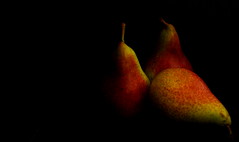
Sugar Pears
In fresh produce sections everywhere, there were mounds of blushing abate fetel pears. Breathing in their sweet ripeness, it was difficult not to admire their inherent medieval beauty. Pear tree mortality in Singapore, however, would be high even sans Pol Pot gardener.

So far removed from the food cycle are we urbanites that we forget that the growing of even basic food is a miracle, a repeated phenomenon of success against all odds. From the sprouting of seeds to their strong and healthy growth to the need for the right proportion of water, soil type, nutrients and sunshine, to protecting against weeds and pests, to the regulating of temperature...there are few things that more obviously and consistently spotlight our lack of control of our very existence. It is no wonder that the people in the agriculturally-intensive times before pesticides, greenhouses, hydroponics and other farming technology, were acutely superstitious. They faced, on a daily basis, the reality that they could not ascertain their supply of nourishment, and so neither too, their continued survival.

And even now in the age of advanced science, the missions carried out in Biosphere 2 (the reports read like episodes of Survivor) and The Eden Project continue demonstrate the delicate complexity of the systems that support agriculture and animal husbandry and their extreme vulnerability to unplanned events, systems that we have taken for granted and have so far failed to replicate.

Through the years, I have held off saying grace before meals, attempting to avoid the religious conceit that so often accompanies rituals. Yet, thanksgiving is only appropriate when we consider how the food before us arrived on the plate.

If we get what we deserve, if the meat, vegetable, starch and sweets are only a result of our hard work and superior brainpower, then there would be no need for thanksgiving because we would have received the due payment for our labours.

But we know we can't claim the credit for it. There is a Creator who created the world and everything in it. Genesis 1 waxes lyrical about his thoughtful moulding of this awesome place we live in. And the Creator of the world also sustains it: he causes the sun to shine and the rain to fall and the plants to grow, he provides food for the animals and gives man both plants (Genesis 1:29) and animals for food (Genesis 9:3). How can we neglect to thank him for all this?

It would be terribly unwise to care more about our diets than about the source of our food, to adhere to Atkins, South Beach, gluten-free or other dietery regimes without a thought about the person who gives us life and health.

What Would Jesus Do? Thanksgiving was a huge part of what he did while he was on earth, yet we dare to consider this a mundanity unworthy of our attention. What is the will of God for me? we ask, but ignore the stated will of God for us to give thanks not just for food but for everything in all circumstances (1 Thessalonians 5:18).
You say grace before meals. All right. But I say grace before the concert and the opera, and grace before the play and pantomime, and grace before I open a book, and grace before sketching, painting, and swimming, fencing, boxing, walking, playing, dancing, and grace before I dip the pen in ink. (G.K. Chesterton, who might have had a point there)

HortPark
33 Hyderabad Road, off Alexandra Road
6.00 am to 10.00 pm

Kha
HortPark
33 Hyderbad Road


Labels: ,

Tuesday, March 11, 2008

The Light At The End Of The Tunnel Not Being The Headlight Of An Oncoming Train and Bothering About the Resurrection

Then they lay basking in the sun with the delight of those that have been wafted suddenly from bitter winter to a friendly clime, or of people that, after being long ill and bedridden, wake one day to find that they are unexpectedly well and the day is again full of promise. (Fellowship of the Rings, J. R. R. Tolkien)
A wet week of basking in the Singapore sun. For thanksgiving and archival purposes:

Goodbye BooksActually at Telok Ayer Street
Friday: saying goodbye to BooksActually's up-the-rabbithole-at-the-whitehorsey treehouse on 125A Telok Ayer Street for the frontage of Ann Siang Hill. Kenny and Karen, still love the Birds & Co stuff (thanks strangeknight). Glad you liked the punch. We hope you draw regular salaries soon too!

Sunday Lunch
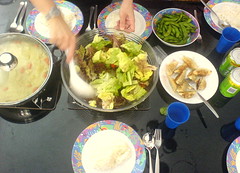
Sunday: loads of catching up with people after service, then a good chat in the void deck under a block of HDB flats about differing interpretations of Romans 7, then a lazy afternoon of lunch, fellowship, sharing of burdens and being reminded from 1 Corinthians 15 of the reality and importance of Jesus' resurrection for the Christian faith;

Greedy Golden Retriever
Tuesday: being encouraged about the God with whom we can now have a direct relationship and whom we know hears our prayers because of the blood of his Son, at the home of a particularly greedy golden retriever. Every cracking open of a bag immediately precipitated the prick of furry ears, a streak of golden-yellow, a wet-nosed nuzzle and hot hopeful doggy breath by your side;

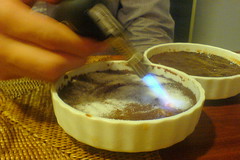
Lightsabre in peace times - used on chocolate mousse
Wednesday: dinner with old mates interrupted by an sms for birthday drinks on Monday, then a call about unreasonable bosses during which the kid, for my entertainment, attempted to prance up and down in shoes 3,000 times too large for him, then a work telecon - the kid toddled up smiling invitingly and poo-poo-ed in his pampers pants, detonating a stinkbomb so powerful that the counterparty in Vietnam gagged. After the kid was banished upstairs for a bath still grinning and holding his nose to the self-inflicted stench, time for Spreyside and Islay whiskeys (a Laphroaig over a flowery Speyburn any night), plans for the future, the challenges of upfront ministries in church services, conspiracy theories about the escape of Mas Selamat Kastari and how sometimes sorry isn't sorry, disparate World War II dreams, Singapore's secret weapon - militant mothers, sinfulness and life as the body of Christ, and the taste of heaven on earth in authentic Christian communities.

Later, in the midnight drizzle whilst leaning against a car, continued discussion about the authenticity of Christian communities, Book of Acts communities, the necessity of prayer and setting aside time for prayer, the probably non-physical acts of loving God intent on drawing back his recalcitrant people to right relationship with him. Back home, an early morning chat with a wayward actor in New York, who, having previously spoken of the utter loneliness of looking out at a neighbouring apartment full of people, framed by their sitting room windows, eating their TV dinners alone, of the difficulties of Green Cards, of not making rent every month, of caging money at church on Sundays, was finally deciding to head back where steady employment might actually materialise;

Appled Cored and Sliced
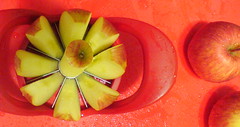
Thursday: an ad hoc prayer group, the sharing of food and lives, and the resident toddler, test-driving his 5 new teeth, gnawed on a yellow doorstop, then the plastic pot of a plastic plant, then a rattle, then more successfully, the wrapping paper off old Christmas presents before his mother grabbed him, put her finger in his mouth and fished the piece out;

Soil & "Pimp" Sessions, Singapore Mosaic Festival
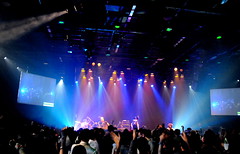
Friday: free tickets to Soil & "Pimp" Sessions at the Singapore Mosaic Festival where the death jazz was loud, frantic, insistent. Earplugs were handed out at the door. Inside the club-space, jumping about and sweating, afros all round, an agitator, a megaphone, strobe lights, a complimentary round of drinks and hands in the air.
Thank you Heineken for free tickets to Soil & "Pimp" Sessions
(Thank you Heineken Music.) Then trying to wring out adjectives to describe the last 75 minutes of staged, very polite Japanese madness;

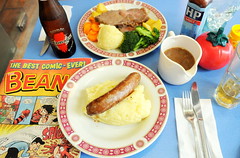
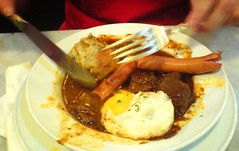
Sunday Roast and Bangers and Mash at Monster Mash
rainy Sunday: stodgy half-decent comfort food at Monster Mash Café where I discovered that few friends (infact, none) shared my nostalgic love for The Beano and childhood Desperate Dan obsession with eating piles of steaming hot creamy mash artfully studded with sizzling bangers about to burst out of their skins. (This dream was finally fulfilled at a greasy spoon known greasily (and leatherly) as S&M Cafe along Portobello Road, London. However, having been ruined by the pouncey Sainsbury's Magazine into making buttermilk garlic mash and pouring rustled-up caramelised onion and red wine reduction gravy over venison and cranberry sausages, I did not quite cry tears of unbridled happiness at this consummation.) The Sunday roast was pretty good though, but missed those little Yorkshire pudding things. And since Old Blighty is all about variations on a theme, what might coupling yorkshire pudding with bangers produce? Toad in a hole! Forward the stodge brigade! Charge for the guns! he said.

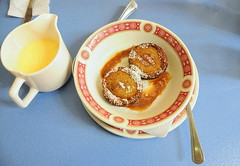
Steamed Pudding at Monster Mash
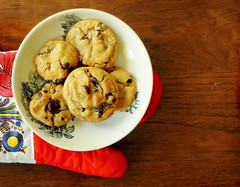
Steamed pudding drizzled with caramel sauce and a jug of custard standing by. Later, a good quiet afternoon of reading over a cuppa tea, after which I felt rested enough to poison the household with chocolate chip cookies:
Chocolate Chip Cookies

It would be difficult to truly acknowledge and revel in the innate goodness of friendship and mateship, of music and dancing, of drinking and eating, if they were all but trivial niceties, passing distractions to kill time while we wait for death.

That would be like the story told of a town that was known particularly for the jollity of its condemned criminals. These men would laugh and joke all the way to the gallows. This strange phenomenon drew many curious visitors from out of town and was very good for trade. But a sinister reason lay behind this. Every condemned prisoner would be visited by the town mayor and the mayor would tell him that actually, the gallows weren't going to be the end of them. Oh no, once the trapdoor opened beneath them, they would be caught by people stationed below, taken through an underground passage to a place out of town where a coach and four horses waited to take them to a place of safety. Now, the condition to all this that the prisoner must act jolly on his way to the gallows. Of course, the gallows were the end for these poor chaps. There wasn't anyone to catch them as they fell, there was no underground passage and there certainly wasn't a coach and four horses waiting for them anywhere.

Some people think that the Christian faith is like this, an elaborate hoax, a sort of Elisabeth Kübler-Ross acceptance of death covered liberally with Martha Stewart marzipan in Easter colours; that Christians fool themselves into thinking that there is a better place after this life, that there is a God who cares enough about the world to pronounce judgement on evil and to save those who trust in him from judgement, that there is meaning to this life and the sensual pleasures offered by this world.

Paul was well aware of the possibility of delusion. Christians say that death is not the end. But what if it was?
...if there is no resurrection of the dead, then not even Christ has been raised. And if Christ has not been raised, then our preaching is in vain and your faith is in vain. We are even found to be misrepresenting God, because we testified about God that he raised Christ, whom he did not raise if it is true that the dead are not raised. For if the dead are not raised, not even Christ has been raised. And if Christ has not been raised, your faith is futile and you are still in your sins. Then those also who have fallen asleep in Christ have perished. If in Christ we have hope in this life only, we are of all people most to be pitied. (1 Corinthians 15:13-19)
But this little thought experiment in futility is moot, because Christ was in fact raised from the dead (15:20). Jesus did really die (15:3), he was buried (15:4) and was raised again on the third day (15:4). There were many eyewitnesses of this: Simon Peter (15:5; Luke 24:34), the 12 disciples (15:5; Mark 16:14; Luke 24:36; John 20:19, 26; Acts 10:41), and, if one found numbers convincing, over 500 people at one time (15:6) - some of whom were still alive and could verify the event, and then to James and the apostles (15:7; Luke 24:50; Acts 1:3, 4), and then also to Paul himself (15:8). (William Lane Craig has a quick walk through the evidence for resurrection here.)

Jesus' death wasn't an accident. There wasn't a flurry in heaven when he died on the cross. It had been planned from eternity and had been written about in various parts of the Scriptures (15:3-4) hundreds of years before he was incarnated on earth.

Jesus' death was purposeful. God intended that Jesus should die in place of all sinners (that is, all of us) so that those who trust in him will no longer face eternal death.
...Christ has been raised from the dead, the firstfruits of those who have fallen asleep. For as by a man came death, by a man has come also the resurrection of the dead. For as in Adam all die, so also in Christ shall all be made alive. But each in his own order: Christ the firstfruits, then at his coming those who belong to Christ. Then comes the end, when he delivers the kingdom to God the Father after destroying every rule and every authority and power. For he must reign until he has put all his enemies under his feet. The last enemy to be destroyed is death. (1 Corinthians 15:20-26)
Which, Potterheads, is a far more glorious reality than Harry finally understanding the words on his parents' grave before deciding to face Voldemort in that penultimate The Deathly Hallows showdown.

BooksActually
5 Ann Siang Road from 17 March 2008

Monster Mash
26 Lorong Mambong
Holland Village
Singapore 277685

Labels: , , , ,

Wednesday, December 26, 2007

Home For Christmas and Amazingly, A Round-up for 2007

Christmas + Cookies

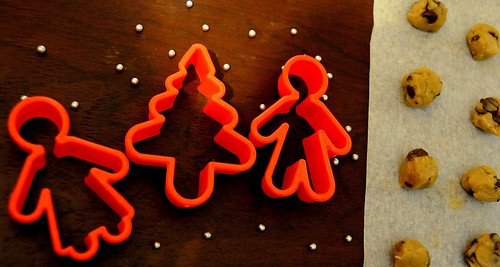
Back home in Singapore for Christmas. As promised. Who else could have been entrusted with blasting the entire 141 minutes of Masaaki Suzuki's take on Handel's Messiah while laying down balls of cookie dough in infringement of the borders of their neighbours' personal space?

Living, as we all do in this life, in the present-continuous, I subscribe neither to the ritual of annual round-ups, nor, for that matter, the illogicality of new year resolutions, the baseless hope of Philip Larkin's Trees.

Still.

A polaroid of 2007 for the future self (with the usual caveats that accompany such misrepresentative snapshots).

A bit of travelling: snorkelling and diving in Tioman, two work trips to Ho Chi Minh/Saigon, surfing in Bali, mall-ing it in Dubai, dune-bashing and sandboarding in Oman, two work trips to Qatar, wandering about in total amazement in Tokyo. My frequent flyer miles pale in comparison to my colleagues' but are sufficiently foul that preliminaries in discussions with friends about meeting-up inevitably include the question "when are you flying off again?". Even less fortunately, travelling does nothing to douse the wanderlust, it just inflames it so that am currently fairly determined to do a Singapore-London road trip. With the wandering about came a fascination with the diversity of cities and theories about urban environments and urbanity.

Worldview interest of the year: crit theory. Post-modernism, post-post-modernism, post-structuralism, post-existentialism. Michel Houellebecq, Iris Murdoch, Mary Midgley, Jean Baudrillard, Roland Barthes, Slavoj Žižek. This trend is forecast to continue into the new year.

Food interest of the year: cupcakes. An interest in the variety of cake and cream combinations to be had and cream top as blank-canvas/art-space. There is no foreseeable future for this food interest.

Game of the year: Guitar Hero! I IZ RAWKSTARRRR KAME 2 RAWK UR WRLDZ! \m/ RAWR!!! *smashes guitar* uh-oh.

Work: work has been fairly decent. The boss has told many people how pleased he is with my deals and "keen mind". (Exchange rate between praise and bonus not available.) Have also gotten fairly major 'uns which have been intellectually interesting though time and patience-consuming.

Weddings, wedding photography, babies: weddings continued at a steady pace in 2007. I still refused to attend photography classes so as not to have personal idea of aesthetics (which according to current thought ought to be subjective so as not to become Consumerist) squished under the thumb of photography nazis.

I managed, with the mid-range cameras, to pin colours down almost where I wanted them. The Nikon D100 was an eye-opener. The D200 was a bit of a WB let-down. But the D300 was telling me that we could possibly make beautiful music together...if I stopped dropping it on its head. Started experimenting with angles. The new Nikkor VR 18 - 200mm lens promised to open up vistas previously denied by the prime 85mm f1.4 and 50mm f1.4. Oh, but to have a 18 -200mm f1.4. Catch up, technology, catch up!

(Re: people who complained of being made to look ugly in photos (and they were never the brides). The camera don't lie, honey.)

Became vastly more tolerant of the by-products of weddings: babies. And also of the by-products of babies: baby saliva on clothes and the smell of baby poo (totally under-rated on the stench-o-meter).

God and ministry: the most encompassing for last. The last few years have been a horrible struggle, a struggle to keep trusting in God's character and God's promises; a struggle not to let go.

I hold on to God not because of sentimentality since I eschew all things sentimental, nor for the comfort of habit because malignant wanderlust ensures a great adversion to repetition for its own sake, but because the truth of the matter was investigated a long time ago and the evidence[1] pointed to the fair certainty of the goodness and wisdom of God as Creator and Sustainer and Judge and his words as a good thing to hold on to.

Therefore the struggle was not one with the conviction of truth but rather, with over-realised eschatology (not health-and-wealth over-realisation but with wanting justice now, wanting every evil and hidden thing to be brought to light now) and with that biblical both-and of human works and divine sovereignty.

[1] "Quid est veritas?" indeed. I suppose one day I should write down the beyond-reasonable-doubt-edness of the evidence for the truth of biblical Christianity, the external evidence as well as how it is internally consistent and a comparison with other worldview claims. Probably can even dispense with ceteris paribus-type qualifications which are so, duh, cop-out when talking about ultimates.

PS. I suppose also that if God is Creator and Sustainer, then none of this is ultimately my work or effort but his. And this is possibly exacerbated in my instance since am supremely (and, to my boss and family, frustratingly) unambitious, seeing no satisfaction and meaning in the garden-variety ambitions of the world. And if God is Judge then, I think he can be trusted to know when patience is required to give people (including myself) the opportunity to repent.

Labels: ,

Saturday, December 01, 2007

Heart, Liver, Kidneys and the Christian Worldview

Bak kut teh

Nothing like a bit of prolonged travelling to realise what the heart, liver and kidneys, to use old Hebrew metaphors, truly treasure. It is strange to discover, day after day, that which remains constant in foreign cultures and different circumstances; the consistency of one's beliefs, one's worldview, one's lifestyle, one's passions.

Everybody has a set of beliefs. Beliefs not as the gullible acceptance of incredible things but basic ideas or presuppositions we have about the nature of reality.

Everyone has a worldview or a framework for perceiving reality. We have conceptual frameworks (the abstract concepts through which we "frame" and organise all our specific concepts), ideologies (sets of ideas about the nature of society and our role in it), lifestyles (practical sets of values and ways of looking at life). Worldviews are formed when our foundational beliefs or presuppositions combine with our inferred beliefs to form a network of beliefs that help us think about or act in the world. They explain life and give it meaning.

Worldviews affect things. They affect the way that we think, the way that we act, the way we make ethical decisions, the way that we relate, the way that we live and the way that we die...how much we eat, what we eat, how we spend money on...

Worldviews have particular components. They usually consist of beliefs concerning God and his/her existence and character, the nature of human beings, morality, ultimate reality (what is really real), death, and meaning to life.

Naturally, having a worldview limits the views that can be consistently held. No argument whose conclusion is obviously inconsistent with one's worldview can be rationally convincing unless the worldview itself is adjusted.

Somehow It comes as no surprise that with the Christian worldview, no editing is needed. It is as constant as the Faithful One, the Only God, whom Christianity reveals.

The Christian Worldview
  • The world is not a mere cosmic accident. God created world with specific beginning and end in mind. The world is tied up with God's purposes.
  • Human beings, too, are not cosmic accidents. They are created by God as part of his purpose for the world. That purpose is intricately tied up with human beings and involves them sharing in relationship with their creator as both dependent creatures and willing friends.
  • God is the loving ruler of the world. He is independent from his creation and committed to it. His nature is to love his creation and to rule it in grace in justice. Our experience of life is that we can't live rightly with God, without other people and with the environment God gave us to live in other than the way God intended for us to live.
  • Instead of acting responsibly as dependent creatures and willing friends, we behave as independent rulers and judges, passively ignoring him or actively rebelling against him. This desire for, and practice of, independence is deep seated and incurable in us.
  • God will not let his purpose go. He is so committed to it that he sent his son Jesus into the world as a human being.
  • Jesus did what no other human being had done. He lived in dependence and friendship with God. He demonstrated this in his being willing to obey his Father to the point of death on behalf of all humans.
  • He took the punishment that was due to them for their independence and rebellion. He acted as God had always acted – with our best interests in mind. As a result of God's action in Jesus, reconciliation is possible. If we accept what Jesus has done on our behalf, God promises to treat us as though the breach in relationship had never happened. He promises to give us new life and new strength to live dependently through the gift of the Holy Spirit.
  • This life will continue past death. On the other hand, if we continue to reject God's purpose in Christ, God promises that he will judge us for our rebellion and that we will forever live out of relationship with him, the source of all goodness, justice and love.
  • Purpose and meaning for life is now found in two things: (1) living in close relationship with God ourselves; and (2) telling others of what God has done in Christ in order that they too might live as they were created to live.
  • As God began the world and as he sent Jesus into the world to redeem it, so God will end the world. At that end, God will balance the books, establish justice and bring in the possibility of a new world where human beings might live in untainted relationship with him, with each other, and with the environment he places them in.
Andrew Reid, Apologetics

Ah Huat Bak Kut Teh
7 Keppel Road
#01-05/07
PSA Tanjong Pagar Complex

Labels: , ,

Saturday, June 02, 2007

Thanksgiving For Being Saved While Looking The Other Way
Aurum Mosaic
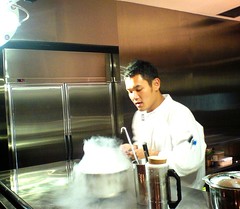
A mere post cannot encompass the extent of the mad birthday celebrations (which were all actually quite swell despite it being well-known that I am adverse to such things. But please do pray for the evangelistic do coming up next Sat!): a fortnight of fêtes and more to come, interrupted only by all this leaving (and arriving) on jetplanes. Days of festivities. Nights of revelry. Cheekiness. Plenty of laughs and honest talk. Stupendous food and drink. Great company. Maaan. Random things from today alone: pressies in the morning, including a flat tyre from my car (nice); lol ugly birthday photos courtesy of lol ugly models; pottering up to a pie just out of the oven and daftly wondering aloud why it had my firstname initial on it; a kid whose limited height and vocabulary transformed the traditional greeting to a cute cuddle about the knees mumbling "Happy! Happy!"; molecular gastronomy at Aurum, which, despite bad press, was fantastic - food prep hacking and then eating the results. (Am now in the market for centrifuges and a giant canister of liquid nitrogen for the kitchen.)
Liquid Nitrogen Rules!

3am each morning, settling down for the long drive home, tired but most chuffed.

Who am I on quiet expressways that turn off to wide roads and backlanes and forests?
Who am I in silent wide spaces that unfurl into infinite horizons?
Who am I beside empty passenger seats rapidly forgetting their warmth?
Who am I when there is no one around? But God.
Who am I that the Lord of all the earth would care to know me?

Retro hits on the radio: I am 13. I am supposed to be studying for exams - for my future. But I am wondering about my future. It is shrouded. It is barely glimpsed behind a misty old windscreen caked with bug-splatter. So I write a letter to my future self in awkward newborn cursive: Dear me, who are you? Do you still remember me? Do you hold to everything that is noble and good and true? Will I like you? Yours sincerely, me.

Dear me, what adventure lies ahead: mountains to climb, oceans to swim in, rocks to scale, snowy peaks to slam down, people to empathise with and love whom you never thought you'd even get along with, barns to dance in, cathedrals to sing in, horses to be trampled by, eyebrows to be singed by pyrotechnic experiments, hands to be singed by baking experiments, smelling close ones dying, watching babies grow up, lying on the field in horrifying numbness after bad rugby tackles, imbibing the audience-energy of stage work, falling into darkness and clambering out, tasting the mellowness of a lost Strad under the chin, new possibilities and vistas, sweet/sour/spici/salti/bitter-ness...

And in the midst of all this, Someone will tap you (very hard) on the shoulder and point out politely that you've been falling down a deep dark void all this while and would you please like to grasp hold of a sturdy rope to keep from falling?
Save Now
While you are not looking, Someone will come and guide you to all that is noble and good and true. And in that light, you will realise that you are truly evil. And also that none of this salvation is born of your own effort or qualification.
Saved
Will you like me? I don't know. But, heads up!*snaps fingers* (hehheh, yeah, we learnt to do that) Far grander, far universe-encompassing stuff ahead!

Love, me.
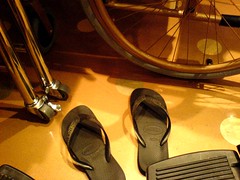
Slippers in Aurum
PS: Obviously, we haven't outgrown cheesiness, as this writing-to-ourselves thing evidences. Alas.
PPS: No worries. Slippers work even with "fine dining".
PPPS: Chinese tuition won't do you any good. Take the money and invest in Microsoft.

Labels: ,

Saturday, October 28, 2006

Wiener Kaffeehaus and Thanksgiving for the Physical
"There shall be," it was declared, in a firm and serious tone,"no more socials for the week."

But we know what happens to the best laid plans of mice and men.

And we know what happens to the best laid plans of mice and men especially when what is on offer is Austrian fare.

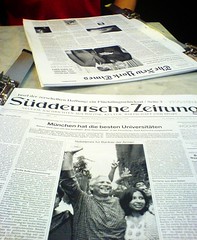
Newspapers at Wiener KaffeehausSo at Wiener Kaffeehaus on Neil Road, the air was thick with the sweetness of coffee beans roasted and ground and brewed into heady liquor. The dark wood panelling, round marble-top tables, Michael Thonet-bentwood-type chairs and mirror-lined walls exuded the promise of a real Viennese kaffeehaus. On the newspaper rack near the door sat copies of the New York Times and the Süddeutsche Zeitung for a read while waiting for friends and food. Over on the other side of the room, there was a golden hint of Gustav Klimt's man in a geometric print cloak snogging a lady. "Eeee," said the boy at the next table,"the man kiss the woman." Later, the door swung open and a young blonde and an old brunette blew in, discussing ex-boyfriends, followed closely by the distinctive scent, topnote-wise, of fresh jasmine flowers and bottomnote-wise, of ang mohs who'd walked some distance in the humid Singapore night.
Fiaker Gulasch at Wiener Kaffeehaus
Then, before it could be explained why, until he won the Nobel Prize for Literature, only a select few had ever heard of Orhan Pamuk, there appeared on the table fiaker gulasch with frankfurters and fried egg and knodel dumplings and also roasted pork loin and sauerkraut and then a good apfelstrudel and a slice of sachertorte lined with apricot jam and also an Einspaenner (because we had a horse-cab-driver theme going on) and a glass of palate-cleansing water on a small silver tray.
Einspaenner at Wiener Kaffeehaus
(And because sometimes, brains take a hike after a decent dinner, there was the following conversation:
"Hmmm...Viennese," she said,"Viennese is Austrian?"
"Yes."
"Austrian is Communist?"
"No."
"Austrian is 'The Sound of Music'?"
"Yes."
"So Austria was where they were at the beginning of the film or at the end, when they were running over the hills?"

Whereupon there was a confession that, infact, nothing much was known about the beginning or the end of "The Sound of Music", or, for that matter, anything in between.

"But you must watch it! How could you not have watched it?"
"I was traumatised," I said,"as a kid, when I happened upon that kissing scene in the garden."
"You mean between Julie Andrews and whatshisface?"
"Yes, because she was a slut."
"No way. She was nun!"
"Worse then: she was a flirt!", the said nun having first of all, broken her vow of chastity, and secondly, stolen Captain von Trapp from his betrothed. Ah, the righteous indignation of snotty eight-year-olds.)

And we love Wiener Kaffeehaus because nowhere among the packets of roasted coffee and shelves of shining coffeemakers, nowhere, was there even a peek of paraphernalia commemorating Wolfgang Amadeus Mozart's 250th birthday: Mozart, that is, currently of the malted chocolate milk fame, formerly of the Mozartkugel chocolate fame, and slightly more removedly of the Peter Schaffer "Amadeus" fame. (There were, however, T-shirts printed with the opening bars of "Eine Kleine Nachtmusik".)(But, like, hello, let's get over Wolfgangus already. What about Joseph Haydn and Franz Schubert and Erwin Schrödinger and Ludwig Wittgenstein? Why not diversify into Schubert sherbets and Schrödinger cats?)

But speaking of Nachtmusik, Wiener Kaffeehaus wasn't that sort of Nacht-Café where buxom prostitutes are groped by leery men. Down the nearby Keong Saik Road, however, nestled among a Whatever and the boutique "Hotel 1929" and "The Royal Peacock", there were old shophouses with their numbers clearly lit for nacht business and ladies of the nacht looking sheepish in the lobby of the "cosy" Hotel 81.
Keong Saik
When we'd sauntered to the other end of Keong Saik Road, I said, "Let us go," ill-advisedly waving in the general direction of Pearl Centre where the well-stocked Visma and also the dodgy Yangtze Cinema were located,"to the CD shop."
Yangtze Cinema
There was an awkward silence and some shuffling about.
"By CD," I hastily clarified,"I meant CD, like Charlie Delta. Not seedy, like lonely old men with umbrellas."

Visma Video & Trading Pte Ltd
100 Eu Tong Sen Street
#01- 21 Pearl's Centre
Singapore 059812
(+65) 62249592
*************

Catholic upbringings leave one sensitive to the danger of false piety and meaningless ritual, so it was a conscious decision not to make a practice of saying grace before meals.

However, over Hari Raya, I've been reminded (even though it ought, really, to be patently obvious) that there is much to give thanks to God for that need not be merely ritualistic. We tend to think that the God preached by Christians is a stern austere wetblanket, purely concerned with a spiritual higherplane. But the God of the Bible is nothing like that at all: for it was he who created the universe physical; he created dry land and gathered together the seas, he created lush vegetation and trees laden with fruit, he made the waters team with fish and creatures of every kind and filled the air with birds of many colours and songs, he brought into existence all animals on earth, and he also made man - physical. And he looked upon his material creation and saw that it was good (Genesis 1).

So there is nothing inherently evil about the physical and we are neither to despise our bodies, nor its pleasures, nor any created thing like food or textiles. For everything created by God is good, and nothing is to be rejected if it is received with thanksgiving (1 Timothy 4:4). And indeed the new creation, the new heavens and earth and the new bodies that we look forward to will be physical, as the bodily resurrection of Jesus was physical (1 Corinthians 15).
Yes, we should hate sin and we should not use our bodies and their pleasures in sinful ways - for greed or gossip or against God's creational design etc; we should exercise control over our bodies and master our desires. And we are rightly sad when there is physical sickness and infirmity because these things are some of the consequences of our sinfulness and the Fall.

But there is also much to give thanks to God for: hearts and lungs and brains that function to give us breath, general mobility, eyes that can appreciate the modern European Art Deco interior of a café, the sun and the rain that bring forth the plants that feed the animals, hands that prepare wonderful food, palates that taste and enjoy the fruits of the land, ears that take pleasure in music, joy in friendship, synapse-to-synapse connections, language, fingers that type this out...

The thanksgiving list is endless. And the nice thing is that, because Jesus has bridged the separation between God and man, we can thank he who gave us all these good gifts directly and without the need for an intermediary.
Labels: ,

Wednesday, May 31, 2006

Thanksgiving for Christian Friends and the Early Church in Acts

It has been an unimaginably busy few weeks. Unimaginably busy.

Though I am truly grateful for friends with whom there can be night-long discussions (without any hint of embarrassment) about the advantages of Pollini's Horowitz-like 4'50" for one of Chopin's Etudes to Ashkenazy's 5'46", I thank God even more for Christian friends who keep one somewhat fed and watered physically (who insist on swinging by at ungodly hours and days to drop off "something special" or force me to have dinner) and also spiritually, encouraging perseverance in Christ and in prayer.
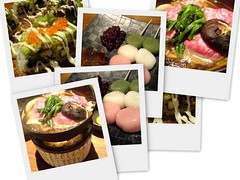
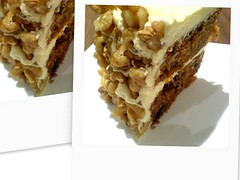
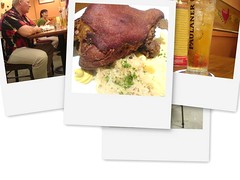
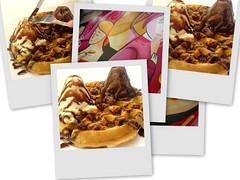
Fish Head Curry Collage
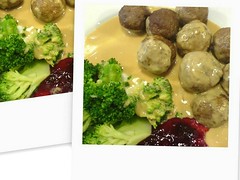
Hot Dog CollageSwedish Meatballs Collage
Sun and Moon CollageCarrot Cake Collage
Pork Knuckle CollageWaffles Collage
Mango Crumble Collage
And we're off to Malacca this weekend for the ARPC church camp and after there're seminars and loads of Bible studies! Excellent. Will update here when there's a bit of breathing space! :-)

*************

Swotting overnight over the church camp Acts studies, realised that Luke's term for this friendship is koinonia; fellowship.

In Acts 2:42-47, Luke gives us an enthusiastic description of the early church:
They devoted themselves to the apostles' teaching and to the fellowship, to the breaking of bread and to prayer. Everyone was filled with awe, and many wonders and miraculous signs were done by the apostles. All the believers were together and had everything in common. Selling their possessions and goods, they gave to anyone as he had need. Every day they continued to meet together in the temple courts. They broke bread in their homes and ate together with glad and sincere hearts, praising God and enjoying the favor of all the people. And the Lord added to their number daily those who were being saved.
and again in Acts 4:32-37:
All the believers were one in heart and mind. No one claimed that any of his possessions was his own, but they shared everything they had. With great power the apostles continued to testify to the resurrection of the Lord Jesus, and much grace was upon them all. There were no needy persons among them. For from time to time those who owned lands or houses sold them, brought the money from the sales and put it at the apostles' feet, and it was distributed to anyone as he had need.

Joseph, a Levite from Cyprus, whom the apostles called Barnabas (which means Son of Encouragement), sold a field he owned and brought the money and put it at the apostles' feet.
Some modern thinking encourages us to believe that we are individualists with no need of anyone else. But the gamut of soppy weepy love songs over the generations attest that we all hunger for meaningful relationships and communities of some sort. This isn't surprising considering that God designed us that way: to live not as individuals but as a community of his people.

So when we are saved, we are not just saved as individuals per se, but we are saved into a community, we are brought into a family, we become a part of the body of Christ, the covenant people of God. Says Peter:
...you are a chosen race, a royal priesthood, a holy nation, God's own people, in order that you may proclaim the mighty acts of him who called you out of darkness into his marvelous light. Once you were not a people, but now you are God's people; once you had not received mercy, but now you have received mercy. (1 Peter 2:9-10)
Augustine's pithy phrase for this was "Salus extra ecclesiam non est (Outside the church, there is no salvation)". Unfortunately, Catholic Church in the Middle Ages interpreted this as "Outside the Catholic Church, there is no salvation". What poor old Auggie apparently meant (or so his apologists tell us) was that we cannot be Christian without being automatically welded into an intimate new group of people, a new family with new brothers and sisters.

The ἐκκλησία, the church, is a unified body that depends not on gathering in some architectural wonder/monstrosity, but in members in their several places united to the One Head - Christ, forming one organic living whole (1 Corinthians 12), making up the whole bride of Christ (Ephesians 5:25-32).

The early church was not a lukewarm meeting to which one dragged oneself out of plodding obligation and because the moving pictures and the home telly hadn't been invented.

The early church was passionate about God and about each other. They couldn't wait to spend all their time together, learning about God and sharing their meals. So in love were they with each other that they renounced not their possessions but their possessiveness over their possessions (surely the harder thing!). There was no narcissistic drive for self-fulfilment. Instead, brimming in love, they cared for each other's needs so that there were no one needy in among them.

Fellowship was not about the warm fuzzies. It was doing things for each other and caring for each other under God, guided by his word.

And evangelism was not another campaign (ie. Save People, like you would Save Water, Save Electricity, Save the Dolphins, Save Martha...) but it was the enthusiasm for God and the gospel bubbling out of the life of the believer, so happy and joyful he was that he could not but share the good news with every one he met.

This was the early church. And God added to their number daily those who were being saved.

Labels: ,

Sunday, July 10, 2005

Psalms, Praise and Worship

Between

pretty decent pepper crab and

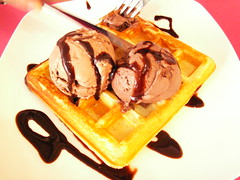
pretty decent waffles,
was stopped in tracks by a very decent doppelgänger in Sin Ming
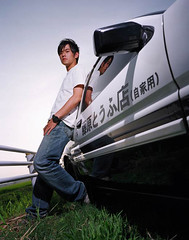
of the souped up Toyota AE86 Trueno driven by Jay Chou in Initial D


Didn't wait to see the driver of the doppelgänger. Too shored up in our current reading of Psalms.

Everyone likes the Book of Psalms. It's poetic, it's lyrical, it's beautiful. But pay attention to the words and not everyone can in all honesty praise God with those words.

The word "praise" itself is often used to mean "sing a song to God". "First we'll have a time of praise and worship before Pastor XXX comes up to give us the sermon", say many songleaders (or "worship leaders" as they are misleadingly termed). Many think that "praise and worship" releases the presence of God into a Christian meeting, so they can "have a personal experience of God's presence" (eg. the "liver shivers" or "warm fuzzies"). Some Christians use "praise and worship" as an attempted means of getting God to act. However, this was not how it was meant to be...

It is in fact, no better than the prophets of Baal in 1 Kings 18. Contrast this with Elijah's behaviour, which is almost "anti-worship". Elijah "tries to create an atmosphere which is non-conducive to divine intervention (for example, pouring water over the sacrifice)" and then uses only "a short prayer of dependence" which is based on Yahweh's prior faithfulness, rather than being "an attempt to rouse God to act".
This contrast between Israel's worship and that of her neighbours can be simply stated in an antithesis: for Israel, worship was the response to God's action, not the means of rousing it...

The view that our "praise and worship" rouses God to act in some way is attractive because it gives us a part to play in the divine activity. It makes us feel as though we are able to create the atmosphere which is conducive to God's blessing - that my singing, praying and praising somehow invites God's presence. Attractive as it might be to some, I hope it is obvious that this way of thinking cuts right across the gospel of sheer grace. (John Dickson, "Worship and the Digeridoo")
What then is "praise"? And how does one do "praise"?

Tony Payne writes in Confessions of a Teenage Praise Junkie,
The Hebrew title for the Psalms ("tehillim") means simply "praises", and certainly we cannot read many psalms without coming across the familiar call to praise ("Praise the LORD") or some other expression of praise ("I will praise you, O LORD").

In their original context, the Psalms were probably something like Israel's hymnbook. Many, if not all, of them were accompanied by music, and it seems likely that the temple was the usual place where they were sung.

But if it is clear that music was often involved in Israel's praise, it is just as clear that it was the accompaniment to praise, not the praise itself. Singing was often the mode of expression, and musical instruments were the accompaniment ("I will praise you with the lyre and harp"), but what was it that was being expressed and accompanied? When the call rang out to "Praise the LORD", what did Israelite in the congregation expect to happen next? What was the "praise"?

...as is so often the case with biblical words and ideas, the Hebrew word translated "praise" describes a much more ordinary and mundane activity. Suppose we see a friend doing something excellent, or notice a fine quality or attribute in his character. "Praise" happens when, having observed this excellence, we tell others about it. We might stand our friend up in front of his peers and tell them all, right in front of him, just what he has done, and how excellent it is. We praise him. We describe how noble is his character or how extraordinary his achievements.

Praise is this proclamation of how good someone is. It is advertising. In the Psalms, it is advertising about God. It consists of telling forth as loudly and widely as possible, the excellences of the God of Israel, that everyone might honour him.

Thus, when there is an exhortation to praise God in the Psalms, it is invariably followed by the praise itself--the declaration of his mighty character and deeds for the individual or the nation. Psalm 96 is a classic example:
Sing to the LORD a new song; sing to the LORD, all the earth. Sing to the LORD, praise his name; proclaim his salvation day after day. Declare his glory among the nations, his marvellous deeds among all peoples. For great is the LORD and most worthy of praise; he is to be feared above all gods. For all the gods of the nations are idols, but the LORD made the heavens. Splendour and majesty are before him; strength and glory are in his sanctuary. (Psalm 96:1-6)
This public proclamation of God's greatness in the Psalms covers the full range of God's character and achievements. He is acclaimed for being the all-powerful Creator and sustainer of all things (Psalms 74; 104), the Judge of the Earth (Ps 33:6-9,13-15; 11), who rules with righteousness (Psalm 9:8) and acts with an unfailing steadfast love (Psalm 136). The Psalms ring with the wonder that this mighty, righteous, good God has entered into covenant with Israel, that he has stooped from his heights to love them in their depths. He is Israel's Redeemer, both corporately (Psalms 105; 136; 89) and individually (Psalms 22; 30; 32).

Praise, then, is essentially advertising, as odious as that comparison might seem. In fact, to tease the comparison out further, it is like advertising in three ways.

Praise and music
Like advertising, praise can be accompanied by music, although music is not the essence of it. Music is to praise as the jingle is to advertising. It can make it effective, memorable, even grand, but unless the product is actually described and promoted, the music is of little use.

In the case of praising God, it is of course most appropriate to make a noise about it--as in Psalm 150 where a veritable orchestra is assembled to accompany the praise. It is appropriate not only because of the joy and celebration that naturally well up in God's people as they recall all God's mercies, but also because it makes the advertising more effective. The music is not for God's benefit, as if he likes a nice tune, or like Baal needs waking up by loud noise. It is more for those who hear, so that in the context of the temple gathering the proclamation of God’s greatness can have a grand effect.

Perhaps a modern psalmist would write: "Praise our God with a powerful PA system, and with the loudspeaker turned up to 11."

Different forms
Like advertising, praise can take different forms. Very often in the Psalms, it is in the third person--that is, it is spoken or sung about God, being addressed to those listening rather than to God himself. This takes place in God's presence, undoubtedly, but it is addressed to those who are listening:
From the rising of the sun to the place where it sets, the name of the LORD is to be praised. The LORD is exalted over all the nations, his glory above the heavens. Who is like the LORD our God, the One who sits enthroned on high, who stoops down to look on the heavens and the earth? He raises the poor from the dust and lifts the needy from the ash heap; he seats them with princes, with the princes of their people. He settles the barren woman in her home as a happy mother of children. Praise the LORD. (Ps 113:3-9).
Sometimes it is in the form of a personal testimony:
I waited patiently for the LORD; he turned to me and heard my cry. He lifted me out of the slimy pit, out of the mud and mire; he set my feet on a rock and gave me a firm place to stand. He put a new song in my mouth, a hymn of praise to our God. Many will see and fear and put their trust in the LORD. (Psalm 40:1-3).
And sometimes it is addressed directly to God himself:
I will praise you, O LORD, with all my heart; before the "gods" I will sing your praise. I will bow down towards your holy temple and will praise your name for your love and your faithfulness, for you have exalted above all things your name and your word. When I called, you answered me; you made me bold and stout-hearted. May all the kings of the earth praise you, O LORD, when they hear the words of your mouth. (Psalm 138:1-4)
However, even when praise is addressed to God, it has the character of proclamation. The psalmist speaks or sings to God about all the things God is and has done, but he is doing so in front of others. God is "praised" when others hear of the marvellous things he has done. Which brings us to the third respect in which praise is like advertising.

Praise is public
Just as one can't conduct an advertising campaign in private, so one can't "praise" in private. The basic nature of praise is the public proclamation, acknowledgment and acclamation of God. Notice how the psalmist expresses this in Psalm 40:
I proclaim righteousness in the great assembly; I do not seal my lips, as you know, O LORD. I do not hide your righteousness in my heart; I speak of your faithfulness and salvation. I do not conceal your love and your truth from the great assembly. (Psalm 40:9-10)
It is as if the act of rescue or deliverance is not for the psalmist alone. It is given to him that he might proclaim it to the whole community. To conceal it, to keep it to himself, is unthinkable. He must testify in the great assembly (cf. Psalm 35:18).

This, of course, is not to say that in our private prayers we do not give thanks to God for who he is and what he has done. We express our adoration for his glorious character and works. Yet, if we are going to use biblical words we should use them in a biblical way. This personal, private thanksgiving is not "praise" in the biblical sense. Praise always has the character of public proclamation.
Advertising and us
In the New Testament, praise has the same basic shape as in the Old Testament. As Hebrews 13:15 puts it:
Through Jesus, therefore, let us continually offer to God a sacrifice of praise--the fruit of lips that confess his name.
Or as Peter expresses it:
But you are a chosen people, a royal priesthood, a holy nation, a people belonging to God, that you may declare the praises of him who called you out of darkness into his wonderful light. Once you were not a people, but now you are the people of God; once you had not received mercy, but now you have received mercy. (1 Peter 2:9-10)
Praise is a confession, a testimony, a declaration of what God has done. Of course, for us, upon whom the end of the ages has come, praise is no longer focused on the physical temple in Jerusalem and its worship. Through Jesus, we are all temples of the Holy Spirit, and so praise takes place not in the cultic context of a temple gathering, but whenever and wherever we "confess his name". When we declare his greatness to others, telling of how he has shown us mercy and called us to be his own people, then we are praising God.

In the New Testament, then, praise is somewhat similar to evangelism. It is the advertisement of God's mighty saving deeds. Because of what God has done for us, we testify. It is not something that we only do in church, any more than we only proclaim the gospel when we gather together. It is not something that is only ever set to music.

This democratisation or expansion of praise in the New Testament mirrors the way so many Old Testament categories are transformed in Christ--"temple", "worship", "priest", "sacrifice", and so on. In fact, many of the errors and problems we face in church life stem from a failure to recognise this transformation.

In the case of praise, many churches fail to free themselves from an Old Testament/temple way of thinking about how praise should happen. Praise is seen as a cultic, religious activity or experience, set to music, to be conducted in church. Just as God was seen to be specially present in the Old Testament temple, so his special presence is manifest when songs of praise are sung, and a particular atmosphere is created.

But in Christ, the Father comes and makes his home within each of us through his Spirit. He is constantly present. Our spiritual worship is the sacrifice of our whole lives to him (Romans 12:1-2), and our praise, similarly, is the lifelong and lifewide confession before the world of what he has done for us.

It must also be said that many churches today fail to recognise the basic nature of praise, in the Psalms and in the New Testament. Praise is not making beautiful music for God. It is not a personal, mystical encounter with God. Nor do we praise God by saying,"We praise you God, thank you Jesus, Hallelujah".

Praise is advertising. It is remembering and declaring who God is and what he has done. It takes place in his hearing, but it is done by telling others. It is boasting about God, speaking well of him, broadcasting his virtues and excellences. It springs from salvation, from what he has done for us. Praise is the testimony of the redeemed.

Labels: ,